1
Diplomarbeit
Simulation der
Innenohrschwerhörigkeit
I
Zusammenfassung
Dieser Bericht gibt eine Übersicht über die Diplomarbeit "Simulation der Innenohrschwerhörigkeit". Ziel
dieser Diplomarbeit war es, eine realistische Simulation der Innenohrschwerhörigkeit in Echtzeit (d.h.
ohne merkliche Zeitverzögerung) aufzubauen und zu testen. Der Leser erhält eine Einführung in die
Funktionsweise und die Bedienung dieses Simulators.
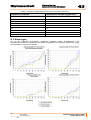
Zwei typische Hörschädigungen des Innenohres wurden berücksichtigt, einerseits eine
frequenzabhängige Dämpfung, andererseits das sogenannte "Recruitment", eine lautstärke- und
frequenzabhängige Dämpfung. Der Simulationsalgorithmus konnte aus einer vorangehenden
Semesterarbeit übernommen werden.
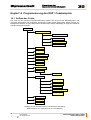
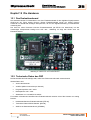
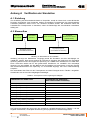
Damit das System in Echtzeit läuft, wurde ein digitaler Signalprozessor (DSP) mit einer für
Audiosignale geeigneten Hardwareumgebung eingesetzt. Hauptaufgabe der Diplomarbeit war nun die
Programmierung des DSP in der zugehörigen Assemblersprache. Zusätzlich wurde ein
Kommunikationsprotokoll für eine serielle Kommunikation (RS-232) mit einem Personalcomputer (PC)
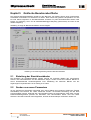
entworfen. Mit Hilfe einer grafischen Benutzeroberfläche kann der Benutzer am PC den simulierten
Hörschaden vorgeben. Die Simulation ist wegen der eingeschränkten der Rechenleistung des DSP
nur in Mono ausgeführt.
Das Eingangssignal des Simulators ist ein Line-Signal mit einem maximalen Pegel von 0.707VRMS,
(entsprechend einer Spitze-Spitze-Spannung von 2V). Am Ausgang liefert der Simulator ebenfalls ein
Line-Signal mit dem gleichen Pegel. Die Samplingrate beträgt 44.1kHz. Mit einem Kopfhörerverstärker
und einem Kopfhörer kann der simulierte Hörschaden nachempfunden werden. Anhand zweier
Testläufe mit normalhörenden Personen konnte die korrekte Funktion des Simulators nachgewiesen
werden.
Abstract
This report gives an overview to the diploma work "Simulation of the cochlear hearing loss". The goal
of this diploma work was to implement and test a realistic simulation of the cochlear hearing loss in
real-time. The reader of this report gets an introduction to the priciples of this simulation, namely a
frequency dependent damping and the so-called recruitment, a frequency- and loudness dependent
damping. The simulation algorithm could be taken from a preceding term work.
For that the system runs in real time, a digital signal processor (DSP) with a hardware environment
suitable for audio signals was used. The main task of the diploma work was then the programming of
the DSP in the appropriate assembler language. Additionally, a communication protocol for serial
communication (RS-232) with a personal computer (PC) was set up. By means of a graphical user
interface, the user can specify a specific hearing loss, that then will be simulated. Because of the
limited speed of the processor, the simulation is only realised in mono.
The input signal of the simulator is a line-level signal with a maximum amplitude of 0.707VRMS
(corresponding to a peak-peak voltage of 2V). At the output, the simulator provides likewise a linelevel signal with the same maximum amplitude. The sampling rate is 44.1kHz. With a headphone
amplifier and headphone one can listen to the simulated hearing loss.
On the basis of two test runs with normalhearing persons the correct function of the simulator could be
proven.
Burgdorf, im Januar 2002
M. Suter
HTA Burgdorf
Abt. Elektrotechnik
Wintersemester 2001 / 2002
Autor: Marcel Suter