1
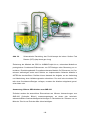
Updates of the washdown-models. Three models are provided in COCOSYS: 1) for non-soluble (AULA) aerosols, 2) for soluble aerosols and 3) for iodine (film model). These models will be merged in the frame of the follow-up development project to gain a closed description of the complex washdown processes within COCOSYS Modelling of the decomposition of CsI under radioactive exposure, during which volatile iodine is being released The restructuring work of the fission product and aerosol behaviour module AFP in COCOSYS for consistent balances of amounts of substances has been conducted up to the achievement of important milestones (implementation of the concept elaborated in project RS1185 in form of detailed models for volume condensation, aerosol deposition, transport by washdown and drainage, etc.). However, some remaining work has to be finished in the frame of the follow-up development project, as regards e. g. the iodine chemistry, nuclide behaviour, and pool scrubbing submodels. Coupled analyses with ATHLET-CD and COCOSYS for the simulation of the integral behaviour in cooling circuit and containment are of increasing relevance. An open point in the coupled application of the two codes is related to the failure of the RPV and the release of melt into the reactor cavity. The strategy of the coupling between COCOSYS and ATHLET-CD in case of RPV failure has been reconciled amongst the two development teams in GRS, and first actions for a technical implementation have been initiated on both sides. This item is also subject for continuation in the follow-up development project. GRS’s work on ASTEC, developed together with IRSN, has been focussed on containment phenomena and singular extensions with relation to BWR in the modules CPA (thermal hydraulics in the containment), MEDICIS (molten core/concrete interactions, MCCI), and on the coupling between CESAR (primary circuit) and CPA. The DCH model which was provided in ASTEC in the frame of RS1185 has been extended with calculations of chemical reactions and heat transfers between airborne melt droplets and atmosphere and has been validated by post-test calculations of DCH experiments performed in the DISCO-facility at KIT. Furthermore, the models and correlations for passive autocatalytic recombiners (PAR) of the types “AREVA” and “AECL” available in COCOSYS have been ported to ASTEC/CPA, and a user’s guide has been provided. VI