1
DESIGN GUIDELINES CONTINUED
There are two components to figuring out
what detail size you can achieve on the
X- and Y axes. First is positioning accuracy.
Positioning accuracy tells us how precisely
the extruder can find the spot it is looking for
on a plane. X and Y positioning accuracy on
your Replicator 2X is about .01 mm.
That’s a number you should consider when
modeling shallow surface detail, but for small
stand-alone or protruding features, you will
have to go larger than that. The limiting factor
here is the layer width. The layer width is the
same as the diameter of the extruder nozzle:
.4 mm. Because a single line of extrusion is
never narrower than .4 mm, no printed feature
can be narrower than .4 mm.
However, most slicing engines still can’t handle
features that small because they can’t print
a line alone: each layer perimeter must be a
closed loop. That means that the smallest
feature you can actually print is .8 mm -- the
width of two extruded lines side by side. The
MakerBot Slicer’s spur settings work to correct
this by allowing shapes that are not closed
loops, but these features are experimental.
106
ORIENTATION
Many of the problems you might run into
while trying to print difficult models can be
prevented by changing the orientation of
the model on the build plate.
MINIMIZE SUPPORT MATERIAL
You can build an object of any shape using
tearaway support structures, but supports
can be difficult to remove and use up
plastic. Make sure your object has a flat side
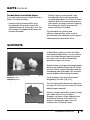
to rest on. Orient your object to minimize
overhangs and bridges. For example,
printed right-side-up, these tables would
have unprintable bridges and unprintable
overhangs, but upside-down they print
easily. [http://www.thingiverse.com/
thing:18982]
MAXIMIZE OBJECT STRENGTH
Another thing to consider is the “grain” of the
printed object. A thin cylinder printed upright
will be composed of a series of circles placed
on top of one another. If you try to break it
in half, it will have as many natural breaking
points as it has layers, and will snap easily. If,
on the other hand, it is printed on its side, the
layers will run up along the cylinder, and every
layer will have to bend in order for the cylinder
to break. Keep this in mind when designing
objects, especially functional ones. A spool
holder is a good example of an object that
should be printed on its side for strength.