1
should not be placed in a built-in installation such as a book case or rack unless proper ventilation is provided or the
manufacturer’s instructions have been adhered to.
11. POWER SOURCE- This product should be operated from the type of power source indicated on the marking label. If you
are not sure of the type of power supply to your home, consult your product dealer or local power company. For product
intended to operate from batter power, or other sources, refer to operating instruction.
12. GROUND and POLARIZATION- This product may be equipped with a polarized alternating current line plug (a plug
having one blade wider than the other) This plug will fit into the power outlet only one way. This is a safety feature. If you
are unable to insert the plug fully into the outlet, try reversing the plug. If the plug should still fail to fit, contact your
electrician to replace your obsolete outlet. Do not defeat the safety purpose of the polarized plug.
ALTERNATIVE WARNINGS- This product is equipped with a three-wire ground-type plug, a plug having a third
(grounding) pin. This plug will only fit into a grounding-type power outlet. This is a safety feature. If you are unable to insert
the plug into the outlet, contact your electrician to replace your obsolete outlet. Do not defeat the safety purpose of the
grounding-type plug.
13. POWER-CORD PROTECTION- Power supply cords should be routed so that they are not likely to be walked on or pinched
by items placed upon or against them, paying particular attention to cords at plugs, convenience receptacles, and point
where they exist from the product.
14. PROTECTIVE ATTACHEMENTS PLUG- The product is equipped with an attachment plug having overload protection. This
is a safety feature. See instruction Manual for replacement or resetting of protective device. If replacement of the plug is
required, be sure the service technician has used a replacement plug specified by the manufacturer that has the same
overload protection as the original plug.
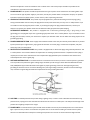
15. OUTDOOR ANTENNE PLUG- If an outside antenna is connected to the receiver, be sure the antenna system is grounded
so as to provide some protection against voltage surges and built-up static charges. Article 810 of the National Electrical
Code, ANSI/NFPA 70, provides information with regards to proper grounding of the mast and supporting structure,
grounding of the lead-in wire to an antenna-discharge unit, size of grounding conductors, location of antenna-discharge
unit, connection to grounding electrodes and requirements for the grounding electrodes.
16. LIGHTING- For added protection this product during a lighting storm, or when it is left unattended and unused for long
periods of time, unplug it from the wall outlet and disconnect the antenna or cable system. This will prevent damage to the
product due to lighting and power-line surges.
17. POWER LINES- An outside antenna system should not be located in the vicinity of overhead power lines or other electric
light or power circuits, or where it can fall into such power lines or circuits. When installing an outside antenna system,
extreme care should be taken to keep from touching such power lines or circuits as contact with them might be fatal.