1
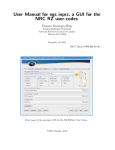
Epp User Manual
3
1 Introduction
1.1 Overview
Epp is a user code for the Monte Carlo simulation package EGSnrc (1) and can be used to simulate dose
deposition in a voxelized volume and to generate images from an object illuminated by an x-ray source.
The imaging part of the software is designed for analyzing the amount and distribution of Compton and
Rayleigh scattering arising in the imaging process, but can be extended and/or modified to suit other
applications as well.
Epp is written entirely in C++, and based on the EGSnrc C++ class library (3) which provides a wealth of
primitive geometries that can be used to construct a complex simulation geometry. The EGSnrc C++
class library also implements various particle sources and provides a C++ interface to the EGSnrc Monte
Carlo simulation written in MORTRAN.
The actual simulation of the particles propagating through and interacting with matter is done by the
EGSnrc code system. The EGSnrc C++ class library implements the geometry and particle source that the
user has setup and also provides additional functionality for running the simulation in parallel with multiple processes and combining the results of a parallel run. Epp keeps track of the number of scatter
events that a particle undergoes during the simulation and also the dose deposited in each voxel of the
volume in which the user wants the dose to be recorded. In addition to that, Epp also propagates every
photon that leaves the simulation geometry to a virtual detector specified by the user and records the
total number of photons and/or total energy deposited in each pixel. This data can be written to binary
output files and images visualizing the data can also be generated.
For analyzing the amount and distribution of Compton and Rayleigh scatter, the photons are assigned to
one of the following categories for which separate output files can be created; see section 6.3 for more
information:
•
•
•
•
Primary: photons that have not been scattered
Compton: photons that have been Compton scattered exactly once
Rayleigh: photons that have been Rayleigh scattered exactly once
Multiple: photons that have been scattered more than once
The current implementation of Epp does not keep track of other interactions such as pair production or
photoelectric effects, but Epp could be extended to account for these interactions as well. Epp could
also be modified to track other particles.
© 2011 CancerCare Manitoba
July 9, 2011