1
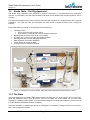
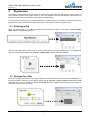
Shake Table Rig Laboratory User Guide Version 2.0 1.2 Shake Table - The Rig Apparatus The Shake Table Laboratory was designed to model the behaviour of a building during an earthquake scenario. It is hosted by UTS and helps students break down and understand the complex dynamics of such a system. Five rigs were developed as two-storey structures that emulate vibrations in a single direction with 2 degrees of freedom. Two extra rigs were also developed with three-stories to model movement with 3 degrees of freedom. Each Shake Table rig consists of the following main components: A building model; Where each level has a known mass. Connected by a material with a known stiffness coefficient. Displacement sensors for each level of the building. The base plus a motor to provide appropriate excitation. Damping coils with a known damping coefficient. Data acquisition and control hardware. A web camera for visual feedback. A control interface written in LabVIEW. Level 2 Displacement Sensors Eddy Current Coil Dampers Electric Motor Level 1 LVDT Level 0 Guide Rail Scotch Yoke Mechanism Figure 1: 2 Degrees of Freedom Shake Table with base displacement measurement (LVDT). 1.2.1 The Base The model itself sits on the Shake Table platform where the base level (i.e. level 0) glides along a low-friction guide rail. Rotational motion from an electric motor is converted into linear motion via a „scotch yoke‟ mechanism, providing base excitation at a user-specified frequency. Changing this frequency allows the user to model different earthquake vibration conditions. The base amplitude of displacement during an earthquake is modelled by setting the stroke on the motor, which can be adjusted manually. Labshare © 2011 Page 3