1
Parallel Programming with Intel® Fortran
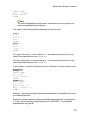
Note
Interchanging is not always possible because of dependencies, which can
lead to different results.
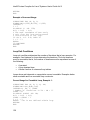
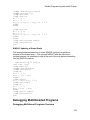
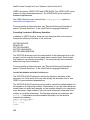
Example of Matrix Multiplication with Stride-1:
DO J=1,N
DO K=1,N
DO I=1,N
C(I,J) = C(I,J) + A(I,K)*B(K,J)
ENDDO
ENDDO
ENDDO
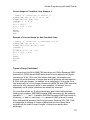
For additional information, see publications on Compiler Optimizations.
Auto-parallelization
Auto-parallelization Overview
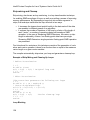
The auto-parallelization feature of the Intel® Fortran Compiler automatically
translates serial portions of the input program into equivalent multithreaded code.
The auto-parallelizer analyzes the dataflow of the program’s loops and generates
multithreaded code for those loops which can be safely and efficiently executed
in parallel. This enables the potential exploitation of the parallel architecture
found in symmetric multiprocessor (SMP) systems.
Automatic parallelization relieves the user from:
•
•
•
Having to deal with the details of finding loops that are good worksharing
candidates
Performing the dataflow analysis to verify correct parallel execution
Partitioning the data for threaded code generation as is needed in
programming with OpenMP* directives.
The parallel run-time support provides the same run-time features as found in
OpenMP, such as handling the details of loop iteration modification, thread
scheduling, and synchronization.
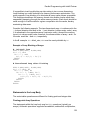
While OpenMP directives enable serial applications to transform into parallel
applications quickly, the programmer must explicitly identify specific portions of
the application code that contain parallelism and add the appropriate compiler
directives. Auto-parallelization triggered by the -parallel option automatically
identifies those loop structures, which contain parallelism. During compilation, the
compiler automatically attempts to decompose the code sequences into separate
threads for parallel processing. No other effort by the programmer is needed.
143