1
Appendix C. Random Library Appendix
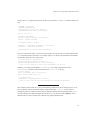
ii. The lagged-Fibonacci generators (ACG, SWBi, PSWB) all fail the Diehard ‘Birthday Spacings
Test’, and are therefore only conditionally recommended for use.
iii. The other 32-bit generators pass all tests, and I therefore have no reason not to recommend them
all for use.
iv. The 31-bit generators all fail certain tests because one bit has a constant value. Beyond that they
all seem to be ok.
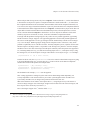
b. We want a generator to have a long enough period for our purpose, and in general the longer the
period the better. (However, note that to generate 2 64 random numbers from a fast generator like
MT19937 would take 2.1 million years on a 486/66, so in practice any generator with a period close
to 260 or larger will be acceptable.) The PMMLCG generators, although they are of acceptable
quality otherwise, have a period less than 2 31 which we can exhaust in under 3 hours. So use those
only for quick ‘toy’ applications.
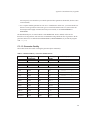
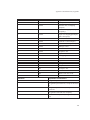
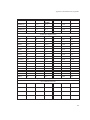
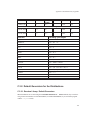
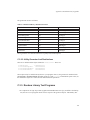
c. We want a generator to execute efficiently, the faster the better. The Generators data table indicates
the execution times for the generators as implemented.
d. We want a generator to take as little resources (memory) as possible. The Generators data table
indicates the size of each generator’s state in bits.
e. Other things being equal, we want our generator to have a single full period rather than a number of
shorter periods, since we may not know whether a particular starting seed will put us into a long or a
short subcycle. This disqualifies SWB, and possibly the new MWC and RWC generators (Marsaglia
does not say how many periods these generators have, but only gives the period length.)
C.3.1.2. Strategy For Using Random Generators
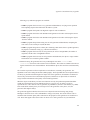
There are 3 possible strategies for using random generators:
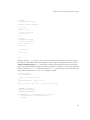
a. Use one single generator for your whole simulation, and have all ‘users’ of randomness
(distributions and other objects) call this single generator in an interleaved fashion. For this purpose,
generators such as MT19937, TT800, TT775, TT443 (and possibly PSWB and SWB) seem
particularly well suited since they have immense periods. The code in random/random.m shows how
to connect several distribution objects to a single random generator. The generator randomGenerator
supplied there is of class MT19937.
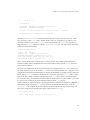
b. Use a single generator of long period, but divide this long period up into a number of
non-overlapping (hence statistically independent) segments, and let each ‘user’ of randomness draw
their random numbers from separate segments. Doing this requires that we be able to quickly access
these separate segments. The ‘split’ generators C2LCGX and C4LCGX implement such a scheme.
157