1
Problem
Probable Cause
Remedy/Comments
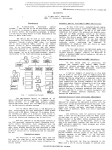
Problem No. 12: Baseline Drift
Normal
794-0748
Problem
794-0764
1. Column temperature fluctuation. (Even
small changes cause cyclic baseline
rise and fall. Most often affects
refractive index and conductivity
detectors, UV detectors at high
sensitivity or in indirect photometric
mode.)
2. Nonhomogeneous mobile phase. (Drift
usually to higher absorbance, rather
than cyclic pattern from temperature
fluctuation.)
3. Contaminant or air buildup in detector
cell.
4. Plugged outlet line after detector.
(High pressure cracks cell window,
producing noisy baseline.)
5. Mobile phase mixing problem or
change in flow rate.
6. Slow column equilibration, especially
when changing mobile phase.
7. Mobile phase contaminated, deteriorated, or not prepared from high
quality chemicals.
8. Strongly retained materials in sample
(high k’) can elute as very broad
peaks and appear to be a rising
baseline. (Gradient analyses can
aggravate problem.)
9. Detector (UV) not set at absorbance
maximum but at slope of curve.
1. Control column and mobile phase
temperature, use heat exchanger
before detector.
2. Use HPLC grade solvents, high
purity salts, and additives. Degas
mobile phase before use, sparge
with helium during use.
3. Flush cell with methanol or other
strong solvent. If necessary, clean
cell with 1N HNO3 (never with HCl
and never use nitric acid with
PEEK tubing or fittings.)
4. Unplug or replace line. Refer to
detector manual to replace window.
5. Correct composition/flow rate. To
avoid problem, routinely monitor
composition and flow rate.
6. Flush column with intermediate
strength solvent, run 10-20 column
volumes of new mobile phase
through column before analysis.
7. Check make-up of mobile phase
(page 2).
8. Use guard column. If necessary,
flush column with strong solvent
between injections or periodically
during analysis.
9. Change wavelength to UV absorbance maximum.
Problem No. 13: Baseline Noise (regular)
1. Air in mobile phase, detector cell, or
pump.
Normal
2. Pump pulsations.
794-0748
4. Temperature effect (column at high
temperature, detector unheated).
5. Other electronic equipment on same
line.
Problem
794-0765
10
3. Incomplete mobile phase mixing.
6. Leak.
1. Degas mobile phase. Flush system to
remove air from detector cell or
pump.
2. Incorporate pulse damper into
system.
3. Mix mobile phase by hand or use
less viscous solvent.
4. Reduce differential or add heat
exchanger.
5. Isolate LC, detector, recorder to
determine if source of problem is
external. Correct as necessary.
6. Check system for loose fittings.
Check pump for leaks, salt buildup,
unusual noises. Change pump seals
if necessary.