1
Declaring Subprograms
You must place all subprogram declarations at the end of the declare section,
following all variable, constant, type, and exception declarations for the block.
The syntax is as follows:
PROCEDURE procedure_name (param_name datatype, param_name datatype...)
IS
{local declarations}
BEGIN {executable code}
EXCEPTION
END;
Note: For subprograms, the keyword DECLARE is omitted before the local
declarations. Place local declarations before the keyword BEGIN, as shown.
The names you give the parameters in the declaration are the names that the
procedure itself uses to refer to them. These are called the formal parameters.
When the procedure is invoked, different variables or constants may be used to
pass values to or from the formal parameters; these are called the actual
parameters.
When calling the procedure, you can use each parameter for input of a value to
the procedure, output of a value from it, or both. These correspond to the three
parameter modes: IN, OUT, and IN/OUT. For more information, see “Parameter
Modes” in the PL/SQL User’s Guide and Reference.
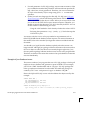
When you call the procedure, you can match the actual to the formal parameters
either implicitly, by passing them in the same order they are given in the
declaration, or explicitly, by naming the formal followed by the actual parameter
as shown:
transmit(destination => address);
This invokes a procedure called transmit, assigning the value of address as the
actual parameter for the formal parameter destination. This implies that the
parameter destination is used within the transmit procedure and that the
parameter address is used outside of it. Usually, it is good programming practice
to use different names for matching formal and actual parameters. For more
information on this, see “Positional and Named Notation” in the PL/SQL User’s
Guide and Reference.
Functions are the same, except for the addition of a return value, specified as
follows:
FUNCTION function_name (param_name, param_name datatype...)
RETURN datatype IS
{local declarations}
BEGIN {executable code}
EXCEPTION {local exception handlers}
END;
B-20
Oracle WebServer 2.0 User’s Guide