1
Modus 3 RF Network Emulator - Quick Start Guide
Introduction
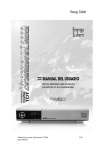
Modus 3 is a transport stream player,
COFDM modulator and RF up converter in
one integrated system. It is designed to
emulate the signals from terrestrial and
mobile TV transmission network and
currently support DAB derived systems like
T-DMB and DVB-T derived systems like
DVB-H.
Modus 3 has a highly configurable software
defined radio architecture and can act as a
I/Q RF signal generator for emulation of
DAB/T-DMB systems or as a channel modulator for DVB-T and DVB-H.
Modus 3 can store I/Q files and transport stream files on either a removable Compact Flash
card or an optional internal hard disk drive.
RF output can be in the range 100MHz to 2.2GHz in a continuous range with levels between
0dBm and -110 dBm in 0.5dB steps, set using the internal electronic attenuator.
All channel settings are stored in a XML meta data file which resides with the I/Q and
Transport Stream files on either of the two storage media.
Modus 3 has a USB interfaces, which provides mass storage class connectivity. The unit
also has differential I/Q RF outputs which can be used to drive a external I/Q Vector Signal
Generator like the Agilent ESG-C to provide a reference quality RF output with 0.1db
resolution and very low phase noise. Modus 3 support hierarchical ASI inputs and outputs,
together with SPI inputs and outputs.
For support issues not covered in this manual please email or phone CellMetric. The
dedicated support email is [email protected]
DVB Composer
CellMetric’s DVB Composer application is an optional software package designed to work
with the Modus 3. Composer emulates on PC a complete TV head end to either the DVB-T
or DVB-H standard, generating test streams and patterns for transmission. Functionality
includes Multiplexing, SI Insertion, time slicing, MPE FEC, and IP encapsulation.
DVB - H , DAB & DAB+ Test streams
CellMetric can provide a library of DVB-H, DAB and DAB+ standard test streams for the
Modus 3.
1