1
SuSE Linux
U SER G UIDE
3. edition 2003
Copyright ©
This publication is intellectual property of SuSE Linux AG.
Its contents can be duplicated, either in part or in whole, provided that a copyright label
is visibly located on each copy.
All information found in this book has been compiled with utmost attention to detail.
However, this does not guarantee complete accuracy. Neither SuSE Linux AG, the authors, nor the translators shall be held liable for possible errors or the consequences
thereof.
Many of the software and hardware descriptions cited in this book are registered trademarks. All trade names are subject to copyright restrictions and may be registered trade
marks. SuSE Linux AG essentially adheres to the manufacturer’s spelling. Names of
products and trademarks appearing in this book (with or without specific notation) are
likewise subject to trademark and trade protection laws and may thus fall under copyright restrictions.
Please direct suggestions and comments to [email protected]
Authors:
Jörg Bartsch, Gernot Hillier, Marcel Hilzinger, Johannes Meixner,
Matthias Nagorny, Siegfried Olschner, Marcus Schäfer, Arvin Schnell,
Adrian Schröter
Translators: Tino Tanner, Rebecca Walter
Editors:
Jörg Arndt, Antje Faber, Berthold Gunreben, Roland Haidl,
Jana Jaeger, Edith Parzefall, Peter Reinhart, Inés Pozo, Thomas Rölz,
Thomas Schraitle
Layout:
Manuela Piotrowski, Thomas Schraitle
Setting:
LATEX, DocBook-XML
This book has been printed on 100 % chlorine-free bleached paper.
Contents
I
0.1
Changes in the User Guide . . . . . . . . . . . . . . . . . . . . . .
1
0.2
Acknowledgements . . . . . . . . . . . . . . . . . . . . . . . . . .
3
Installation
5
1 Quick Installation
7
1.1
Step One: The Start Screen . . . . . . . . . . . . . . . . . . . . . . .
8
1.2
Step Two: Accept Suggestions . . . . . . . . . . . . . . . . . . . . .
8
1.3
Step Three: Installation . . . . . . . . . . . . . . . . . . . . . . . . .
9
1.4
Configuration . . . . . . . . . . . . . . . . . . . . . . . . . . . . . .
9
2 User-Defined Installation
2.1
13
Starting Your System from the CD-ROM . . . . . . . . . . . . . . .
14
2.1.1
Possible Problems When Starting from the CD/DVD . . . .
14
2.2
The Boot Screen . . . . . . . . . . . . . . . . . . . . . . . . . . . . .
15
2.3
Language Selection . . . . . . . . . . . . . . . . . . . . . . . . . . .
17
2.4
Installation Mode . . . . . . . . . . . . . . . . . . . . . . . . . . . .
17
2.5
Installation Suggestion . . . . . . . . . . . . . . . . . . . . . . . . .
18
2.5.1
Installation Mode . . . . . . . . . . . . . . . . . . . . . . . .
18
2.5.2
Keyboard Layout . . . . . . . . . . . . . . . . . . . . . . . .
18
2.5.3
Mouse . . . . . . . . . . . . . . . . . . . . . . . . . . . . . .
19
2.5.4
Partitioning . . . . . . . . . . . . . . . . . . . . . . . . . . .
19
2.5.5
Expert Partitioning with YaST . . . . . . . . . . . . . . . . .
24
2.5.6
Software . . . . . . . . . . . . . . . . . . . . . . . . . . . . .
30
2.5.7
Boot Configuration (Boot Loader Installation) . . . . . . . .
33
2.5.8
Time Zone
. . . . . . . . . . . . . . . . . . . . . . . . . . .
33
2.5.9
Language . . . . . . . . . . . . . . . . . . . . . . . . . . . .
33
2.5.10 Launching the Installation . . . . . . . . . . . . . . . . . . .
34
Finishing the Installation . . . . . . . . . . . . . . . . . . . . . . . .
34
2.6.1
root Password . . . . . . . . . . . . . . . . . . . . . . . . .
35
2.6.2
Network Configuration . . . . . . . . . . . . . . . . . . . .
35
2.6.3
Testing the Internet Connection . . . . . . . . . . . . . . . .
35
2.6.4
Loading Software Updates . . . . . . . . . . . . . . . . . .
36
2.6.5
User Authentication . . . . . . . . . . . . . . . . . . . . . .
37
2.6.6
Configuring the Host as a NIS Client . . . . . . . . . . . . .
38
2.6.7
Creating Local User Accounts . . . . . . . . . . . . . . . . .
39
2.6.8
Reading the Release Notes . . . . . . . . . . . . . . . . . . .
40
2.7
Hardware Configuration . . . . . . . . . . . . . . . . . . . . . . . .
41
2.8
Graphical Login . . . . . . . . . . . . . . . . . . . . . . . . . . . .
42
2.6
II Configuration
45
3 YaST — Configuration
47
3.1
Starting YaST . . . . . . . . . . . . . . . . . . . . . . . . . . . . . .
48
3.2
The YaST Control Center . . . . . . . . . . . . . . . . . . . . . . . .
48
3.3
Software . . . . . . . . . . . . . . . . . . . . . . . . . . . . . . . . .
49
3.3.1
Change Installation Source . . . . . . . . . . . . . . . . . .
49
3.3.2
YaST Online Update . . . . . . . . . . . . . . . . . . . . . .
50
3.3.3
Patch CD Update . . . . . . . . . . . . . . . . . . . . . . . .
51
3.3.4
Installing and Removing Software . . . . . . . . . . . . . .
51
3.3.5
System Update . . . . . . . . . . . . . . . . . . . . . . . . .
59
Hardware . . . . . . . . . . . . . . . . . . . . . . . . . . . . . . . .
62
3.4.1
CD-ROM Drives . . . . . . . . . . . . . . . . . . . . . . . .
63
3.4.2
Printer . . . . . . . . . . . . . . . . . . . . . . . . . . . . . .
63
3.4.3
Hard Disk Controller . . . . . . . . . . . . . . . . . . . . . .
72
3.4
iv
Contents
3.5
3.6
3.7
3.8
3.4.4
Graphics Card and Monitor (SaX2) . . . . . . . . . . . . . .
72
3.4.5
Hardware Information . . . . . . . . . . . . . . . . . . . . .
81
3.4.6
IDE DMA Mode . . . . . . . . . . . . . . . . . . . . . . . .
82
3.4.7
Joystick . . . . . . . . . . . . . . . . . . . . . . . . . . . . .
83
3.4.8
Select Mouse Model . . . . . . . . . . . . . . . . . . . . . .
83
3.4.9
Scanner . . . . . . . . . . . . . . . . . . . . . . . . . . . . .
83
3.4.10 Sound . . . . . . . . . . . . . . . . . . . . . . . . . . . . . .
85
3.4.11 TV and Radio Cards . . . . . . . . . . . . . . . . . . . . . .
87
Network Devices . . . . . . . . . . . . . . . . . . . . . . . . . . . .
87
3.5.1
Basic Information about Internet Access . . . . . . . . . . .
87
3.5.2
Information about the Internet Dial-Up . . . . . . . . . . .
89
3.5.3
Network Card . . . . . . . . . . . . . . . . . . . . . . . . .
89
3.5.4
Modem . . . . . . . . . . . . . . . . . . . . . . . . . . . . .
91
3.5.5
DSL . . . . . . . . . . . . . . . . . . . . . . . . . . . . . . .
93
3.5.6
ISDN . . . . . . . . . . . . . . . . . . . . . . . . . . . . . .
95
Network Services . . . . . . . . . . . . . . . . . . . . . . . . . . . .
99
3.6.1
Host Name and DNS . . . . . . . . . . . . . . . . . . . . . .
99
3.6.2
NFS Client and NFS Server . . . . . . . . . . . . . . . . . .
99
3.6.3
Configuration of a Samba Server . . . . . . . . . . . . . . . 100
3.6.4
Configuration of Samba Clients . . . . . . . . . . . . . . . . 101
3.6.5
NTP Client . . . . . . . . . . . . . . . . . . . . . . . . . . . 101
3.6.6
Routing . . . . . . . . . . . . . . . . . . . . . . . . . . . . . 101
3.6.7
Mail Transfer Agent . . . . . . . . . . . . . . . . . . . . . . 101
3.6.8
Network Services (inetd)
. . . . . . . . . . . . . . . . . . . 102
Security and Users . . . . . . . . . . . . . . . . . . . . . . . . . . . 103
3.7.1
User Administration . . . . . . . . . . . . . . . . . . . . . . 103
3.7.2
Group Administration . . . . . . . . . . . . . . . . . . . . . 103
3.7.3
Security Settings . . . . . . . . . . . . . . . . . . . . . . . . 104
3.7.4
Firewall . . . . . . . . . . . . . . . . . . . . . . . . . . . . . 107
System . . . . . . . . . . . . . . . . . . . . . . . . . . . . . . . . . . 108
3.8.1
Backup Copy of the System Areas . . . . . . . . . . . . . . 108
3.8.2
Restoring the System . . . . . . . . . . . . . . . . . . . . . . 109
SuSE Linux – User Guide
v
3.8.3
Creating a Boot, Rescue, or Module Disk . . . . . . . . . . . 110
3.8.4
Boot Loader Configuration with YaST
3.8.5
LVM . . . . . . . . . . . . . . . . . . . . . . . . . . . . . . . 116
3.8.6
Partitioning . . . . . . . . . . . . . . . . . . . . . . . . . . . 116
3.8.7
Profile Manager (SCPM) . . . . . . . . . . . . . . . . . . . . 116
3.8.8
Runlevel Editor . . . . . . . . . . . . . . . . . . . . . . . . . 116
3.8.9
Sysconfig Editor . . . . . . . . . . . . . . . . . . . . . . . . 117
. . . . . . . . . . . . 112
3.8.10 Time Zone Selection . . . . . . . . . . . . . . . . . . . . . . 118
3.8.11 Language Selection . . . . . . . . . . . . . . . . . . . . . . . 118
3.8.12 Keyboard Layout Selection . . . . . . . . . . . . . . . . . . 118
3.9
Miscellaneous . . . . . . . . . . . . . . . . . . . . . . . . . . . . . . 118
3.9.1
Submitting a Support Request . . . . . . . . . . . . . . . . . 118
3.9.2
Boot Log
3.9.3
System Log . . . . . . . . . . . . . . . . . . . . . . . . . . . 120
3.9.4
Loading a Vendor’s Driver CD . . . . . . . . . . . . . . . . 120
. . . . . . . . . . . . . . . . . . . . . . . . . . . . 119
3.10 YaST2 in Text Mode (ncurses) . . . . . . . . . . . . . . . . . . . . . 120
3.10.1 Controls . . . . . . . . . . . . . . . . . . . . . . . . . . . . . 120
3.10.2 Restriction of Key Combinations . . . . . . . . . . . . . . . 121
3.10.3 Module Operation . . . . . . . . . . . . . . . . . . . . . . . 122
3.10.4 Starting Individual Modules
. . . . . . . . . . . . . . . . . 122
4 The KDE Desktop
4.1
4.2
Desktop Components . . . . . . . . . . . . . . . . . . . . . . . . . 126
4.1.1
The Desktop Menus . . . . . . . . . . . . . . . . . . . . . . 126
4.1.2
The Trash Bin . . . . . . . . . . . . . . . . . . . . . . . . . . 127
4.1.3
CD-ROM, DVD-ROM, and Floppy Disks
4.1.4
The Printer Icon . . . . . . . . . . . . . . . . . . . . . . . . 128
4.1.5
The Panel . . . . . . . . . . . . . . . . . . . . . . . . . . . . 131
4.1.6
The Main Menu
4.1.7
The Windows . . . . . . . . . . . . . . . . . . . . . . . . . . 133
. . . . . . . . . . 128
. . . . . . . . . . . . . . . . . . . . . . . . 131
Settings . . . . . . . . . . . . . . . . . . . . . . . . . . . . . . . . . 133
4.2.1
vi
125
Contents
Peripherals . . . . . . . . . . . . . . . . . . . . . . . . . . . 133
4.3
4.4
4.2.2
Desktop . . . . . . . . . . . . . . . . . . . . . . . . . . . . . 136
4.2.3
Sound & Multimedia . . . . . . . . . . . . . . . . . . . . . . 136
4.2.4
Appearance & Themes . . . . . . . . . . . . . . . . . . . . . 137
4.2.5
Regional & Accessibility . . . . . . . . . . . . . . . . . . . . 139
Konqueror as a File Manager . . . . . . . . . . . . . . . . . . . . . 142
4.3.1
The Konqueror Menu . . . . . . . . . . . . . . . . . . . . . 142
4.3.2
The Toolbar . . . . . . . . . . . . . . . . . . . . . . . . . . . 144
4.3.3
The Location Bar . . . . . . . . . . . . . . . . . . . . . . . . 144
4.3.4
The Main Window . . . . . . . . . . . . . . . . . . . . . . . 144
4.3.5
Creating an Image Gallery . . . . . . . . . . . . . . . . . . . 145
Important Utilities . . . . . . . . . . . . . . . . . . . . . . . . . . . 145
4.4.1
KInternet – the Door to the WWW . . . . . . . . . . . . . . 145
4.4.2
The Download Manager KGet . . . . . . . . . . . . . . . . 147
4.4.3
SuSEWatcher . . . . . . . . . . . . . . . . . . . . . . . . . . 147
4.4.4
The Clipboard Klipper . . . . . . . . . . . . . . . . . . . . . 148
4.4.5
Monitoring Print Jobs . . . . . . . . . . . . . . . . . . . . . 149
4.4.6
Formatting Floppy Disks with KFloppy
4.4.7
Ark: Displaying, Decompressing, and Creating Archives . . 152
4.4.8
Desktop Sharing . . . . . . . . . . . . . . . . . . . . . . . . 153
4.4.9
KSnapshot: Taking Screenshots . . . . . . . . . . . . . . . . 154
. . . . . . . . . . . 151
5 The GNOME Desktop
5.1
5.2
The Desktop
157
. . . . . . . . . . . . . . . . . . . . . . . . . . . . . . 158
5.1.1
The Icons . . . . . . . . . . . . . . . . . . . . . . . . . . . . 158
5.1.2
The Desktop Menu . . . . . . . . . . . . . . . . . . . . . . . 158
5.1.3
The Panel . . . . . . . . . . . . . . . . . . . . . . . . . . . . 159
5.1.4
The Main Menu
5.1.5
Handling Floppy Disks, CDs, or DVDs . . . . . . . . . . . . 159
. . . . . . . . . . . . . . . . . . . . . . . . 159
Settings . . . . . . . . . . . . . . . . . . . . . . . . . . . . . . . . . 160
5.2.1
Keyboard . . . . . . . . . . . . . . . . . . . . . . . . . . . . 160
5.2.2
Mouse Configuration . . . . . . . . . . . . . . . . . . . . . 161
5.2.3
Menus and Toolbars . . . . . . . . . . . . . . . . . . . . . . 161
SuSE Linux – User Guide
vii
5.2.4
Screensaver . . . . . . . . . . . . . . . . . . . . . . . . . . . 161
5.2.5
Windows . . . . . . . . . . . . . . . . . . . . . . . . . . . . 162
5.2.6
Background . . . . . . . . . . . . . . . . . . . . . . . . . . . 162
5.2.7
Font . . . . . . . . . . . . . . . . . . . . . . . . . . . . . . . 163
5.2.8
Theme . . . . . . . . . . . . . . . . . . . . . . . . . . . . . . 163
5.2.9
Accessibility . . . . . . . . . . . . . . . . . . . . . . . . . . 163
5.2.10 Keyboard Shortcuts . . . . . . . . . . . . . . . . . . . . . . 164
5.2.11 Sound (system alerts) . . . . . . . . . . . . . . . . . . . . . 165
5.3
5.4
III
5.3.1
Navigating in Nautilus . . . . . . . . . . . . . . . . . . . . . 165
5.3.2
File Management . . . . . . . . . . . . . . . . . . . . . . . . 166
5.3.3
Configuring Nautilus . . . . . . . . . . . . . . . . . . . . . . 167
Important Utilities . . . . . . . . . . . . . . . . . . . . . . . . . . . 167
5.4.1
Dictionary . . . . . . . . . . . . . . . . . . . . . . . . . . . . 167
5.4.2
Managing Archives with File Roller . . . . . . . . . . . . . . 168
Office Applications
171
6 The OpenOffice.org Office Suite
173
6.1
The Quickstarter . . . . . . . . . . . . . . . . . . . . . . . . . . . . 174
6.2
Overview of the Application Modules . . . . . . . . . . . . . . . . 174
6.3
Getting Help . . . . . . . . . . . . . . . . . . . . . . . . . . . . . . 175
6.4
Converting Microsoft Office Documents . . . . . . . . . . . . . . . 175
6.5
Changing the Global Settings . . . . . . . . . . . . . . . . . . . . . 176
6.6
Word Processing with OpenOffice.org Writer . . . . . . . . . . . . 178
6.7
viii
File Management with Nautilus . . . . . . . . . . . . . . . . . . . . 165
6.6.1
Creating Texts with the AutoPilot . . . . . . . . . . . . . . . 178
6.6.2
Creating Texts without the AutoPilot . . . . . . . . . . . . . 178
6.6.3
Selecting Text . . . . . . . . . . . . . . . . . . . . . . . . . . 179
6.6.4
Working with the Stylist . . . . . . . . . . . . . . . . . . . . 179
6.6.5
Inserting a Table . . . . . . . . . . . . . . . . . . . . . . . . 181
6.6.6
Inserting Graphics . . . . . . . . . . . . . . . . . . . . . . . 182
Spreadsheets with OpenOffice.org Calc
Contents
. . . . . . . . . . . . . . . 182
6.7.1
Changing Cell Attributes . . . . . . . . . . . . . . . . . . . 183
6.7.2
A Practical Example: Monthly Expenses . . . . . . . . . . . 184
6.7.3
Creating Charts . . . . . . . . . . . . . . . . . . . . . . . . . 185
6.7.4
Importing Spreadsheet Tables . . . . . . . . . . . . . . . . . 185
6.8
Creating Graphics Using OpenOffice.org Draw . . . . . . . . . . . 187
6.9
Creating Presentations with OpenOffice.org Impress . . . . . . . . 187
6.9.1
Creating Presentations with the AutoPilot . . . . . . . . . . 187
6.9.2
Adding a Slide . . . . . . . . . . . . . . . . . . . . . . . . . 188
7 The KWrite Text Editor
189
7.1
General Features . . . . . . . . . . . . . . . . . . . . . . . . . . . . 190
7.2
The File Menu
7.3
The Edit Menu . . . . . . . . . . . . . . . . . . . . . . . . . . . . . 191
7.4
The View Menu . . . . . . . . . . . . . . . . . . . . . . . . . . . . . 193
7.5
The Bookmarks Menu . . . . . . . . . . . . . . . . . . . . . . . . . 193
7.6
The Tools Menu . . . . . . . . . . . . . . . . . . . . . . . . . . . . . 193
7.7
The Settings Menu . . . . . . . . . . . . . . . . . . . . . . . . . . . 194
7.8
The Help Menu . . . . . . . . . . . . . . . . . . . . . . . . . . . . . 194
7.9
Kate . . . . . . . . . . . . . . . . . . . . . . . . . . . . . . . . . . . 194
. . . . . . . . . . . . . . . . . . . . . . . . . . . . . 191
8 Sychronizing a Handheld Computer with KPilot
195
8.1
KPilot Basics . . . . . . . . . . . . . . . . . . . . . . . . . . . . . . . 196
8.2
Conduits Used by KPilot . . . . . . . . . . . . . . . . . . . . . . . . 196
8.3
8.2.1
Configuring the Handheld Connection . . . . . . . . . . . . 197
8.2.2
Configuring the KAddressBook Conduit . . . . . . . . . . . 199
8.2.3
Managing To-Do Items and Events . . . . . . . . . . . . . . 199
Working with KPilot . . . . . . . . . . . . . . . . . . . . . . . . . . 200
8.3.1
Backing up Data from the Handheld . . . . . . . . . . . . . 200
8.3.2
Installing Programs on the Handheld
. . . . . . . . . . . . 200
SuSE Linux – User Guide
ix
9 Scheduling with KOrganizer
203
9.1
Starting KOrganizer . . . . . . . . . . . . . . . . . . . . . . . . . . 204
9.2
Configuring KOrganizer . . . . . . . . . . . . . . . . . . . . . . . . 204
9.3
Toolbars . . . . . . . . . . . . . . . . . . . . . . . . . . . . . . . . . 205
9.4
Using the Calendar . . . . . . . . . . . . . . . . . . . . . . . . . . . 206
9.4.1
Events . . . . . . . . . . . . . . . . . . . . . . . . . . . . . . 207
9.4.2
Attendees . . . . . . . . . . . . . . . . . . . . . . . . . . . . 208
9.4.3
To-Do Items . . . . . . . . . . . . . . . . . . . . . . . . . . . 208
9.4.4
Categories . . . . . . . . . . . . . . . . . . . . . . . . . . . . 209
9.5
Printing . . . . . . . . . . . . . . . . . . . . . . . . . . . . . . . . . 209
9.6
Address Book . . . . . . . . . . . . . . . . . . . . . . . . . . . . . . 209
9.7
Help . . . . . . . . . . . . . . . . . . . . . . . . . . . . . . . . . . . 210
10 Address Management with KAddressBook
211
10.1 Overview of KAddressBook . . . . . . . . . . . . . . . . . . . . . . 212
10.2 Creating a New Contact . . . . . . . . . . . . . . . . . . . . . . . . 212
10.3 Creating Address Lists . . . . . . . . . . . . . . . . . . . . . . . . . 213
10.4 Searching Address Data . . . . . . . . . . . . . . . . . . . . . . . . 213
IV
Internet
217
11 The Web Browser Konqueror
219
11.1 Opening Web Pages . . . . . . . . . . . . . . . . . . . . . . . . . . 220
11.2 Saving Web Pages and Graphics
. . . . . . . . . . . . . . . . . . . 220
11.3 Enhanced Web Browsing (Internet Keywords) . . . . . . . . . . . . 221
11.4 Bookmarks . . . . . . . . . . . . . . . . . . . . . . . . . . . . . . . 221
11.5 Java and JavaScript . . . . . . . . . . . . . . . . . . . . . . . . . . . 222
12 The Web Browser Galeon
223
12.1 Optimized for the Web . . . . . . . . . . . . . . . . . . . . . . . . . 224
12.2 Efficient Surfing with Tabs . . . . . . . . . . . . . . . . . . . . . . . 225
12.3 Smart Bookmarks . . . . . . . . . . . . . . . . . . . . . . . . . . . . 225
12.4 Settings and Controls
. . . . . . . . . . . . . . . . . . . . . . . . . 225
12.5 For More Information . . . . . . . . . . . . . . . . . . . . . . . . . 225
x
Contents
13 The Mozilla Web Browser
227
13.1 The Initial Browser Window . . . . . . . . . . . . . . . . . . . . . . 228
13.1.1 The Menu Bar . . . . . . . . . . . . . . . . . . . . . . . . . . 228
13.1.2 The Navigation Toolbar . . . . . . . . . . . . . . . . . . . . 230
13.1.3 The Personal Toolbar . . . . . . . . . . . . . . . . . . . . . . 230
13.1.4 Sidebar . . . . . . . . . . . . . . . . . . . . . . . . . . . . . 231
13.2 Working with Tabs . . . . . . . . . . . . . . . . . . . . . . . . . . . 231
13.3 Preferences . . . . . . . . . . . . . . . . . . . . . . . . . . . . . . . 231
14 Encryption with KGpg
235
14.1 Key Management . . . . . . . . . . . . . . . . . . . . . . . . . . . . 236
14.1.1 Generating a New Key Pair . . . . . . . . . . . . . . . . . . 236
14.1.2 Exporting the Public Key . . . . . . . . . . . . . . . . . . . 237
14.1.3 Importing Keys . . . . . . . . . . . . . . . . . . . . . . . . . 238
14.1.4 Signing Keys . . . . . . . . . . . . . . . . . . . . . . . . . . 238
14.2 The Key Server Dialog . . . . . . . . . . . . . . . . . . . . . . . . . 239
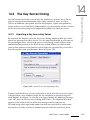
14.2.1 Importing a Key from a Key Server . . . . . . . . . . . . . . 239
14.2.2 Exporting Your Keys to a Key Server . . . . . . . . . . . . . 241
14.3 The Applet . . . . . . . . . . . . . . . . . . . . . . . . . . . . . . . 241
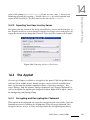
14.3.1 Encrypting and Decrypting the Clipboard . . . . . . . . . . 241
14.3.2 Encrypting and Decrypting by Dragging and Dropping . . 242
14.3.3 The KGpg Editor . . . . . . . . . . . . . . . . . . . . . . . . 242
14.4 For More Information . . . . . . . . . . . . . . . . . . . . . . . . . 243
15 KMail — The KDE Mail Application
245
15.1 Mail Formats . . . . . . . . . . . . . . . . . . . . . . . . . . . . . . 246
15.2 Access Types . . . . . . . . . . . . . . . . . . . . . . . . . . . . . . 246
15.3 Configuring KMail . . . . . . . . . . . . . . . . . . . . . . . . . . . 246
15.3.1 Defining Your User Identity . . . . . . . . . . . . . . . . . . 247
15.3.2 Setting up Network Connections . . . . . . . . . . . . . . . 247
15.3.3 Configuring the Appearance of KMail . . . . . . . . . . . . 248
15.4 Using KMail . . . . . . . . . . . . . . . . . . . . . . . . . . . . . . . 248
15.5 Creating a New Message . . . . . . . . . . . . . . . . . . . . . . . . 250
SuSE Linux – User Guide
xi
15.6 Message Folders . . . . . . . . . . . . . . . . . . . . . . . . . . . . 251
15.7 The Address Book . . . . . . . . . . . . . . . . . . . . . . . . . . . 253
15.8 Filters . . . . . . . . . . . . . . . . . . . . . . . . . . . . . . . . . . 253
15.8.1 Filter Rules . . . . . . . . . . . . . . . . . . . . . . . . . . . 253
15.8.2 Examples of Filters . . . . . . . . . . . . . . . . . . . . . . . 253
15.9 Mail Encryption with PGP or GnuPG . . . . . . . . . . . . . . . . . 254
15.9.1 Signing Messages
. . . . . . . . . . . . . . . . . . . . . . . 255
15.9.2 Checking the Signature of a Received Message . . . . . . . 255
15.9.3 Sending Public Keys . . . . . . . . . . . . . . . . . . . . . . 256
15.9.4 Decoding Encrypted Messages . . . . . . . . . . . . . . . . 256
15.9.5 Encrypting Your Own Messages . . . . . . . . . . . . . . . 256
15.10For More Information . . . . . . . . . . . . . . . . . . . . . . . . . 256
16 Evolution: An E-Mail and Calendar Program
257
16.1 Starting Evolution . . . . . . . . . . . . . . . . . . . . . . . . . . . . 258
16.2 Importing E-Mail from Other Mail Programs . . . . . . . . . . . . 258
16.3 Overview of Evolution . . . . . . . . . . . . . . . . . . . . . . . . . 259
16.3.1 Summary . . . . . . . . . . . . . . . . . . . . . . . . . . . . 259
16.3.2 Inbox . . . . . . . . . . . . . . . . . . . . . . . . . . . . . . 260
16.3.3 Calendar . . . . . . . . . . . . . . . . . . . . . . . . . . . . 260
16.3.4 Tasks
. . . . . . . . . . . . . . . . . . . . . . . . . . . . . . 260
16.3.5 Contacts . . . . . . . . . . . . . . . . . . . . . . . . . . . . . 260
16.4 E-Mail . . . . . . . . . . . . . . . . . . . . . . . . . . . . . . . . . . 260
16.4.1 Configuring Accounts . . . . . . . . . . . . . . . . . . . . . 261
16.4.2 Mail Preferences . . . . . . . . . . . . . . . . . . . . . . . . 261
16.4.3 Creating Messages . . . . . . . . . . . . . . . . . . . . . . . 261
16.4.4 Encrypted E-Mail and Signatures . . . . . . . . . . . . . . . 261
16.4.5 Folders . . . . . . . . . . . . . . . . . . . . . . . . . . . . . 262
16.4.6 Filters . . . . . . . . . . . . . . . . . . . . . . . . . . . . . . 263
16.4.7 Virtual Folders . . . . . . . . . . . . . . . . . . . . . . . . . 264
16.5 Calendar . . . . . . . . . . . . . . . . . . . . . . . . . . . . . . . . 265
16.5.1 Adding Appointments . . . . . . . . . . . . . . . . . . . . . 265
xii
Contents
16.5.2 Scheduling a Meeting . . . . . . . . . . . . . . . . . . . . . 265
16.5.3 Adding Tasks . . . . . . . . . . . . . . . . . . . . . . . . . . 265
16.6 Contacts . . . . . . . . . . . . . . . . . . . . . . . . . . . . . . . . . 266
16.6.1 Adding Contacts . . . . . . . . . . . . . . . . . . . . . . . . 266
16.6.2 Making a List . . . . . . . . . . . . . . . . . . . . . . . . . . 266
16.6.3 Sharing Contacts . . . . . . . . . . . . . . . . . . . . . . . . 266
16.7 Public Address Books in Evolution . . . . . . . . . . . . . . . . . . 266
16.8 For More Information . . . . . . . . . . . . . . . . . . . . . . . . . 267
17 ISDN Telecommunication
269
17.1 CapiSuite Basics . . . . . . . . . . . . . . . . . . . . . . . . . . . . 270
17.2 Configuration . . . . . . . . . . . . . . . . . . . . . . . . . . . . . . 270
17.2.1 Configuring Fax Services . . . . . . . . . . . . . . . . . . . 271
17.2.2 Configuring the Answering Machine . . . . . . . . . . . . . 273
17.3 Usage . . . . . . . . . . . . . . . . . . . . . . . . . . . . . . . . . . 276
17.3.1 General Notes about Reception . . . . . . . . . . . . . . . . 276
17.3.2 Fax Operation
. . . . . . . . . . . . . . . . . . . . . . . . . 277
17.3.3 Operation of the Answering Machine . . . . . . . . . . . . 279
V Multimedia
281
18 Sound in Linux
283
18.1 Basic ALSA PCM Types . . . . . . . . . . . . . . . . . . . . . . . . 284
18.2 Mixers . . . . . . . . . . . . . . . . . . . . . . . . . . . . . . . . . . 284
18.2.1 gamix . . . . . . . . . . . . . . . . . . . . . . . . . . . . . . 284
18.2.2 qamix . . . . . . . . . . . . . . . . . . . . . . . . . . . . . . 285
18.2.3 KMix . . . . . . . . . . . . . . . . . . . . . . . . . . . . . . 286
18.2.4 The GNOME Mixer Applet . . . . . . . . . . . . . . . . . . 286
18.2.5 alsamixer . . . . . . . . . . . . . . . . . . . . . . . . . . . . 286
18.2.6 Mixer Parameters of Soundblaster Live! and Audigy . . . . 287
18.2.7 The Mixer for the Sound Chip Envy24 . . . . . . . . . . . . 287
18.2.8 Configuration of the S/PDIF Channels . . . . . . . . . . . . 288
SuSE Linux – User Guide
xiii
18.3 Players
. . . . . . . . . . . . . . . . . . . . . . . . . . . . . . . . . 289
18.3.1 XMMS — An MP3, WAV, OGG, and Stream Player . . . . . 289
18.3.2 kscd — Audio CD Player . . . . . . . . . . . . . . . . . . . 290
18.3.3 The Audio CD Player WorkMan . . . . . . . . . . . . . . . 290
18.3.4 GNOME CD Player Applet . . . . . . . . . . . . . . . . . . 290
18.4 Buffering and Latencies . . . . . . . . . . . . . . . . . . . . . . . . 291
18.5 The JACK Audio Connection Kit . . . . . . . . . . . . . . . . . . . 293
18.6 Hard Disk Recording with Audacity . . . . . . . . . . . . . . . . . 294
18.6.1 Recording WAV Files and Importing Files . . . . . . . . . . 294
18.6.2 Editing Audio Files . . . . . . . . . . . . . . . . . . . . . . . 294
18.6.3 Saving and Exporting . . . . . . . . . . . . . . . . . . . . . 296
18.7 Direct Recording and Playback of WAV Files
. . . . . . . . . . . . 297
18.8 Compressing Audio Data . . . . . . . . . . . . . . . . . . . . . . . 297
18.9 ALSA and MIDI . . . . . . . . . . . . . . . . . . . . . . . . . . . . 298
18.9.1 Loading Sound Fonts: SB Live! and AWE . . . . . . . . . . 299
18.9.2 vkeybd — Virtual MIDI Keyboard . . . . . . . . . . . . . . 299
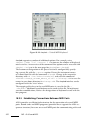
18.9.3 Establishing Connections Between MIDI Ports . . . . . . . 300
18.9.4 kmid — The KDE MIDI Player . . . . . . . . . . . . . . . . 302
18.10MIDI Playback without a WaveTable Card . . . . . . . . . . . . . . 303
18.10.1 The Sound Font Synthesizer fluidsynth . . . . . . . . . . . . 304
18.10.2 Configuration of timidity++ . . . . . . . . . . . . . . . . . . 304
18.10.3 Starting timidity++ with the Graphical Interface . . . . . . . 305
18.10.4 The ALSA Server Mode of timidity++ . . . . . . . . . . . . . 305
18.11 AlsaModularSynth — Synthesizer and Effect Processor . . . . . . . 305
18.11.1 Randomly Playing Patches . . . . . . . . . . . . . . . . . . 306
18.11.2 AlsaModularSynth as an Effect Processor
. . . . . . . . . . 306
18.11.3 Synthesizer Patches . . . . . . . . . . . . . . . . . . . . . . 307
18.11.4 Keeping Track with the Control Center . . . . . . . . . . . . 308
18.11.5 The MIDI Out Module . . . . . . . . . . . . . . . . . . . . . 309
18.11.6 Writing WAV Files with the WAV Out Module . . . . . . . . 309
18.12 NoteEdit and MIDI Sequencers . . . . . . . . . . . . . . . . . . . . 309
xiv
Contents
19 TV, Video, Radio, and Webcam
311
19.1 Watching TV with motv . . . . . . . . . . . . . . . . . . . . . . . . 312
19.1.1 Video Source and Network Search . . . . . . . . . . . . . . 312
19.1.2 From Silent Film to Sound Film . . . . . . . . . . . . . . . . 313
19.1.3 Screen Proportions and Full-Screen Mode . . . . . . . . . . 313
19.1.4 The Launcher Menu . . . . . . . . . . . . . . . . . . . . . . 313
19.2 Video Text with alevt . . . . . . . . . . . . . . . . . . . . . . . . . . 314
19.3 Webcams and motv . . . . . . . . . . . . . . . . . . . . . . . . . . . 314
19.4 nxtvepg — The TV Magazine for Your PC . . . . . . . . . . . . . . 315
19.4.1 Importing the EPG Database . . . . . . . . . . . . . . . . . 315
19.4.2 Sorting the Programs . . . . . . . . . . . . . . . . . . . . . . 316
20 K3b — The KDE Burning Application
317
20.1 Creating a Data CD . . . . . . . . . . . . . . . . . . . . . . . . . . . 318
20.2 Burning CDs . . . . . . . . . . . . . . . . . . . . . . . . . . . . . . 318
20.3 Creating an Audio CD . . . . . . . . . . . . . . . . . . . . . . . . . 319
20.4 Copying a CD . . . . . . . . . . . . . . . . . . . . . . . . . . . . . . 320
20.5 Writing ISO Images . . . . . . . . . . . . . . . . . . . . . . . . . . . 320
20.6 For More Information . . . . . . . . . . . . . . . . . . . . . . . . . 321
21 Digital Cameras and Linux
323
21.1 Connecting to the Camera . . . . . . . . . . . . . . . . . . . . . . . 324
21.2 Installating the Programs . . . . . . . . . . . . . . . . . . . . . . . 324
21.3 Using Konqueror . . . . . . . . . . . . . . . . . . . . . . . . . . . . 324
21.4 Using gtKam . . . . . . . . . . . . . . . . . . . . . . . . . . . . . . 325
21.5 Using Digikam . . . . . . . . . . . . . . . . . . . . . . . . . . . . . 327
21.6 For More Information . . . . . . . . . . . . . . . . . . . . . . . . . 327
22 Kooka — A Scanning Application
329
22.1 The Kooka Window . . . . . . . . . . . . . . . . . . . . . . . . . . 330
22.2 The Preview . . . . . . . . . . . . . . . . . . . . . . . . . . . . . . . 330
22.3 The Final Scan . . . . . . . . . . . . . . . . . . . . . . . . . . . . . 330
22.4 The Menus . . . . . . . . . . . . . . . . . . . . . . . . . . . . . . . 331
22.5 The Gallery . . . . . . . . . . . . . . . . . . . . . . . . . . . . . . . 333
22.6 Optical Character Recognition . . . . . . . . . . . . . . . . . . . . . 334
SuSE Linux – User Guide
xv
23 Graphics with The GIMP
335
23.1 Image Processing and Graphics Formats . . . . . . . . . . . . . . . 337
23.1.1 Pixel Images . . . . . . . . . . . . . . . . . . . . . . . . . . 337
23.1.2 Vector Graphics . . . . . . . . . . . . . . . . . . . . . . . . . 338
23.2 Using The GIMP . . . . . . . . . . . . . . . . . . . . . . . . . . . . 338
23.2.1 Starting The GIMP . . . . . . . . . . . . . . . . . . . . . . . 338
23.2.2 The Toolbox . . . . . . . . . . . . . . . . . . . . . . . . . . . 339
23.2.3 The Menu Bar . . . . . . . . . . . . . . . . . . . . . . . . . . 339
23.2.4 The Tool Icons . . . . . . . . . . . . . . . . . . . . . . . . . 339
23.2.5 The Selection Tools . . . . . . . . . . . . . . . . . . . . . . . 340
23.2.6 Transformation Tools . . . . . . . . . . . . . . . . . . . . . . 340
23.2.7 Paint Tools . . . . . . . . . . . . . . . . . . . . . . . . . . . 342
23.2.8 Color, Brush, Pattern, and Gradient Selection . . . . . . . . 344
23.3 Working with The GIMP . . . . . . . . . . . . . . . . . . . . . . . . 345
23.3.1 Opening Images . . . . . . . . . . . . . . . . . . . . . . . . 345
23.3.2 Creating a New Image . . . . . . . . . . . . . . . . . . . . . 346
23.3.3 Saving Images . . . . . . . . . . . . . . . . . . . . . . . . . 346
23.3.4 Configuring The GIMP
. . . . . . . . . . . . . . . . . . . . 347
23.3.5 Layers . . . . . . . . . . . . . . . . . . . . . . . . . . . . . . 347
23.3.6 Image Modes . . . . . . . . . . . . . . . . . . . . . . . . . . 348
23.4 Introduction to Image Manipulation . . . . . . . . . . . . . . . . . 349
23.4.1 Special Effects
. . . . . . . . . . . . . . . . . . . . . . . . . 349
23.4.2 Inserting Text . . . . . . . . . . . . . . . . . . . . . . . . . . 349
23.4.3 Retouching Images . . . . . . . . . . . . . . . . . . . . . . . 349
23.5 For More Information . . . . . . . . . . . . . . . . . . . . . . . . . 350
VI
Excursions
24 Working with the Shell
351
353
24.1 Introduction . . . . . . . . . . . . . . . . . . . . . . . . . . . . . . . 354
24.2 Introduction to Bash . . . . . . . . . . . . . . . . . . . . . . . . . . 354
24.2.1 Commands . . . . . . . . . . . . . . . . . . . . . . . . . . . 354
xvi
Contents
24.2.2 Files and Directories . . . . . . . . . . . . . . . . . . . . . . 354
24.2.3 Bash Functions . . . . . . . . . . . . . . . . . . . . . . . . . 356
24.2.4 Specifying Paths . . . . . . . . . . . . . . . . . . . . . . . . 358
24.2.5 Wild Cards . . . . . . . . . . . . . . . . . . . . . . . . . . . 358
24.2.6 More or Less . . . . . . . . . . . . . . . . . . . . . . . . . . 359
24.2.7 Pipes
. . . . . . . . . . . . . . . . . . . . . . . . . . . . . . 359
24.2.8 Archives and Data Compression . . . . . . . . . . . . . . . 360
24.2.9 mtools . . . . . . . . . . . . . . . . . . . . . . . . . . . . . . 361
24.2.10 Cleaning Up . . . . . . . . . . . . . . . . . . . . . . . . . . 362
24.3 Users and Access Permissions . . . . . . . . . . . . . . . . . . . . . 362
24.3.1 File System Permissions . . . . . . . . . . . . . . . . . . . . 362
24.3.2 Modifying File Permissions . . . . . . . . . . . . . . . . . . 364
24.3.3 The setuid Bit . . . . . . . . . . . . . . . . . . . . . . . . . . 365
24.3.4 The setgid Bit . . . . . . . . . . . . . . . . . . . . . . . . . . 366
24.3.5 The Sticky Bit . . . . . . . . . . . . . . . . . . . . . . . . . . 366
24.3.6 Access Control Lists . . . . . . . . . . . . . . . . . . . . . . 367
24.4 Important Linux Commands . . . . . . . . . . . . . . . . . . . . . 368
24.4.1 File Commands . . . . . . . . . . . . . . . . . . . . . . . . . 368
24.4.2 System Commands . . . . . . . . . . . . . . . . . . . . . . . 373
24.5 The vi Editor . . . . . . . . . . . . . . . . . . . . . . . . . . . . . . 375
25 Ergonomics in the Workplace
379
25.1 The Working Environment . . . . . . . . . . . . . . . . . . . . . . . 380
25.1.1 The Right Desk . . . . . . . . . . . . . . . . . . . . . . . . . 380
25.1.2 Sitting Correctly on the Right Working Chair . . . . . . . . 381
25.1.3 Good Lighting for Productive Work . . . . . . . . . . . . . 382
25.1.4 Optimum Climate . . . . . . . . . . . . . . . . . . . . . . . 383
25.1.5 Too Much Noise Causes Stress . . . . . . . . . . . . . . . . 384
25.2 Office Equipment . . . . . . . . . . . . . . . . . . . . . . . . . . . . 385
25.2.1 Buying a Screen
. . . . . . . . . . . . . . . . . . . . . . . . 385
25.2.2 Screen Location . . . . . . . . . . . . . . . . . . . . . . . . . 386
25.2.3 The Keyboard and the Wrists . . . . . . . . . . . . . . . . . 387
25.2.4 Liberating the Mouse . . . . . . . . . . . . . . . . . . . . . 388
25.3 Links and Literature . . . . . . . . . . . . . . . . . . . . . . . . . . 389
SuSE Linux – User Guide
xvii
A Help and Documentation
391
A.1 Using the SuSE Help Center . . . . . . . . . . . . . . . . . . . . . . 391
A.2 Contents of the SuSE Help Center . . . . . . . . . . . . . . . . . . . 392
A.3 The Search Function of the SuSE Help Center . . . . . . . . . . . . 393
xviii
B SuSE Linux FAQ
395
C Glossary
401
Contents
Welcome
Congratulations for selecting SuSE Linux! A few clicks are all that is needed to
prepare the installation, which takes about fifteen to twenty minutes. After configuring the users and their passwords and selecting the screen resolution, your
SuSE Linux system is ready for use. If you are familiar with earlier versions of
SuSE Linux, you will notice how much the configuration with the system assistant YaST has been expanded and simplified.
The simple quick installation is explained first. If you have special wishes in
connection with the programs to install, the partitioning of your hard disk, or
other features, read the chapter about the custom installation. YaST additionallyfacilitates the configuration and administration of your hardware, Internet
access, and system — without any irritating reboots!
Get to know the graphical desktop environments KDE and GNOME and learn
how to adapt them to your personal preferences. The following sections introduce some very useful and interesting programs from the large range of
available applications, including office programs such as OpenOffice.org, web
browsers, file managers, scanning tools, and image editing tools.
Additionally find information on the SuSE help system and the available information sources containing further documentation. Also included are a list of frequently asked questions about SuSE Linux and a glossary of the most important
terms from the world of computers and Linux.
0.1
Changes in the User Guide
The documentation of the previous version (SuSE Linux 8.2) has been modified
as follows:
The instructions for the installation and configuration with YaST have
been updated.
Due to new features, the following chapters have undergone substantial
editing:
. The KDE desktop: everything about KDE.
. The GNOME desktop: everything about GNOME.
. OpenOffice.org, the complete office suite for Linux.
. A new version of the comfortable scanning application Kooka is
now available.
. K3b for burning CDs and DVDs also contains some new features,
which are covered in the documentation.
. Installation and configuration of telecommunications services (see
Chapter ISDN Telecommunication on page 269 ).
. The chapter about digital cameras and Linux now describes the application digikam.
The following chapters are new in this edition:
. A chapter about encryption in SuSE Linux explains how KGpg
works and how you can use it for managing your keys.
. kaddressbook is a comfortable application for managing your addresses.
. The chapter about korganizer shows how to manage appointments
and tasks.
. Instructions for synchronizing your PalmPilot with your Linux system using kpilot.
. Mozilla has been included in the list of documented web browsers.
Typographical Conventions
The following typographical conventions are used in this book:
/etc/passwd: files or directories
hplaceholderi: replace the character string hplaceholderi (including the angle
brackets) with the actual value
PATH: an environment variable
ls: commands
2
0.1. Changes in the User Guide
user: users
: a key to press
Alt ‘File’: menu items, buttons
0.2
Acknowledgements
With a lot of personal commitment, the Linux developers continue to promote
the development of Linux.We would like to express our sincere gratitude for
their efforts. Without them, this distribution would not exist.Additional thanks
go to Frank Zappa and Pawar.
Special thanks, of course, to Linus Torvalds.
Have a lot of fun!
Your SuSE Team
SuSE Linux – User Guide
3
Part I
Installation
1
Quick Installation
Quick Installation
In the best case, a few clicks are sufficient to install SuSE Linux on your computer. If no Linux system was installed on your computer previously, your hard
disk is automatically partitioned, an installed Windows system (95, 98, or ME) is
resized, a software selection is installed, and your hardware is configured automatically. If you do not like the suggestions of the system assistant YaST (Yet another Setup Tool) or have special requirements for your system, change the individual installation suggestions manually as described in Chapter User-Defined
Installation on page 13 .
1.1
1.2
1.3
1.4
Step One: The Start Screen . .
Step Two: Accept Suggestions
Step Three: Installation . . . .
Configuration . . . . . . . . .
.
.
.
.
.
.
.
.
.
.
.
.
.
.
.
.
.
.
.
.
.
.
.
.
.
.
.
.
.
.
.
.
.
.
.
.
.
.
.
.
.
.
.
.
.
.
.
.
.
.
.
.
.
.
.
.
8
8
9
9
1.1 Step One: The Start Screen
Turn on your computer and all connected hardware components and immediately insert CD 1 or the DVD in the respective drive. In the start screen, select
an installation mode or boot an installed operating system. Following the successful installation, the CD only needs to be inserted in the drive occasionally to
install additional software. As the CD can be forgotten in the drive, the option
to boot the installed system is preselected. For installation, use the arrow keys to
select ‘Installation’.
Note
If your computer does not boot from CD 1 or the DVD, read Section The
Boot Screen on page 15 .
Note
1.2 Step Two: Accept Suggestions
After the system is booted from CD or DVD, the SuSE system assistant YaST will
be started. First, select the language for your system. The language setting is
automatically adopted for the keyboard layout. Then YaST checks your system.
If you already installed a SuSE Linux version on your computer, the next dialog
asks whether to install SuSE Linux from scratch or perform an update of your
previous system.
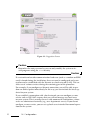
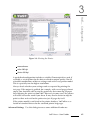
If Linux was not installed on your computer previously or if you select ‘New installation’, YaST checks all your hardware and list the result in the “suggestion
dialog”, shown in Figure 1.1 on page 10. This dialog also displays the partitioning suggestion (possibly Windows will be resized) and the selected installation
type. If installing Linux for the first time, you should accept these suggestions,
which are usually suitable.
The following messages and suggestions are displayed after the system check:
Mode ‘New installation’ is the default value here.
Keyboard The keyboard layout defaults to the selected language. This can easily be changed.
Mouse The detected mouse type is listed here.
Partitioning Suggests a suitable partitioning. If Windows 9x or ME (FAT32 file
system) exists on the hard disk, the resizing rate is indicated.
8
1.1. Step One: The Start Screen
1
Software A default system with office applications is preset.
Time Zone Depending on the selected language settings, the time zone of the
respective country is selected. Check this setting as many languages are
used in several countries.
Language Shows the language setting.
Modify the YaST suggestions at any time by clicking the respective heading. The
dialogs displayed enable detailed settings. The exact procedure is described in
User-Defined Installation on page 13 .After the changes, you are returned to the
overview and can proceed with the installation using the modified values by
clicking ‘Accept’.
Quick Installation
Booting Determines where SuSE Linux installs the boot manager. The Master
Boot Record (MBR) of the first hard disk is the default setting.
Caution
If the hardware was detected correctly, you do not need to change anything. Do not change the boot loader, partitioning, or hardware settings
unless you know what you are doing.
Caution
1.3
Step Three: Installation
Start the installation with the current settings by clicking ‘Yes’ in the green window displayed by YaST. Depending on the performance of your computer, the
complete installation of your system with about 350 program packages takes
approximately fifteen minutes.
1.4
Configuration
Following the installation, specify some important settings before starting using
SuSE Linux. Detailed instructions are available in Finishing the Installation on
page 34 . First, set a password for the system administrator (user ☞root).This
special user is always configured by YaST and is needed for system maintenance
tasks.
SuSE Linux – User Guide
9
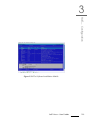
Figure 1.1: Suggestion Screen
Caution
Remember the root password as you can only modify the system or install programs using the root identity.
Caution
If a network card or other communication hardware (such as a modem or ISDN
card) is found during the installation, these can now be configured and a connection can be established with the Internet or a local network (LAN). This enables use of various services during the remaining part of the procedure.
For example, if you configure an Internet connection, you will be able to perform an online update immediately. In this way, you can include the latest updates for your system.
If you establish a connection with a local network, you can configure a name
service such as NIS. YaST assumes that you will not manage any local users
on your system. This is usually the case with commercial workstations, whose
users are administered centrally (e.g., on a department server). If you do not
configure a name service, you can set up local users intended for normal operations on the system.
10
1.4. Configuration
Have a lot of fun with SuSE Linux!
SuSE Linux – User Guide
1
Quick Installation
An additional overview displays the detected screen, graphics card, and other
hardware components (printer, sound card, etc.). If necessary, change settings, such as the suggested screen resolution or the color depth. Refer to Section Hardware Configuration on page 41 . Some of the dialogs for the configuration of the additional hardware are able to search for connected devices. However, these settings do not need to be specified at this stage. You can also skip
this step and do it later. After the completion of this last step, your newly installed system is booted and you can start using it.
11
2
The previous chapter covered the quick installation procedure. This chapter
provides detailed information about the settings you can modify by starting
the relevant module from the suggestion window. This gives complete control
over the installation.
2.1
2.2
2.3
2.4
2.5
2.6
2.7
2.8
Starting Your System from the CD-ROM
The Boot Screen . . . . . . . . . . . . . .
Language Selection . . . . . . . . . . . .
Installation Mode . . . . . . . . . . . . .
Installation Suggestion . . . . . . . . . .
Finishing the Installation . . . . . . . . .
Hardware Configuration . . . . . . . . .
Graphical Login . . . . . . . . . . . . .
.
.
.
.
.
.
.
.
.
.
.
.
.
.
.
.
.
.
.
.
.
.
.
.
.
.
.
.
.
.
.
.
.
.
.
.
.
.
.
.
.
.
.
.
.
.
.
.
.
.
.
.
.
.
.
.
.
.
.
.
.
.
.
.
14
15
17
17
18
34
41
42
User-Defined Installation
User-Defined Installation
2.1 Starting Your System from the CD-ROM
Insert the first SuSE Linux CD or the DVD into the drive. Then reboot the computer to start the installation program from the medium in the drive.
2.1.1
Possible Problems When Starting from the CD/DVD
If you experience problems booting from CD 1, one of the following items is
probably the cause. Resolve the problem as described.
The CD-ROM drive is not able to read the boot image on the first CD.
In this case, use CD 2 to boot the system. CD 2 contains a conventional
2.88 MB boot image, which can be read even by older drives.
The boot sequence in the BIOS (Basic Input Output System) is incorrect.
The BIOS is a software for activating the basic functions of a computer.
Motherboard vendors provide a BIOS that is adapted to the hardware.
Information about changing the BIOS settings is provided in the documentation of your motherboard and in the following paragraphs.
Normally, the BIOS setup can only be accessed at a specific time — when
the machine is booting. During this initialization phase, the machine performs a number of diagnostic hardware tests. One of them is a memory
check, recognizable from the memory counter. When the counter appears,
look for a line, usually below the counter or somewhere at the bottom,
mentioning the key to press to access the BIOS setup. Usually the key to
press is Del ,
F1 , or Esc . Press this key until the BIOS setup screen appears.
To change the boot sequence in an AWARD BIOS, look for the ‘BIOS FEATURES SETUP’ entry. Other manufacturers may have a different name
for this, such as ‘ADVANCED CMOS SETUP’. When you have found the
entry, select it and confirm with ↵ .
In the screen that opens, look for a subentry called ‘BOOT SEQUENCE’.
The boot sequence is often set to something like C,A or A,C. In the former
case, the machine first searches the hard disk (C) then the floppy drive
(A) to find a bootable medium. Change the settings by pressing Page ↑ or
Page
until
the
sequence
is
A,CDROM,C.
↓
Esc . To save the changes, select
Leave the BIOS setup screen by pressing ‘SAVE & EXIT SETUP’ or press F10 . To confirm that your settings should
be saved, press Y
.
14
2.1. Starting Your System from the CD-ROM
Your CD-ROM drive may not be supported because it is an older model.
2.2
The Boot Screen
2
User-Defined Installation
If you have a SCSI CD-ROM drive, you need to change the setup of the
SCSI BIOS. In the case of an Adaptec host adapter, for instance, open the
setup by pressing Ctrl +
A
. After that, select ‘Disk Utilities’, which displays the connected hardware components. Make a note of the SCSI ID
Esc then open ‘Configure
for your CD-ROM drive. Exit the menu with Adapter Settings’. Under ‘Additional Options’, select ‘Boot Device Op tions’ and press ↵ . Enter the ID of the CD-ROM drive and press ↵ again. Then press Esc twice to return to the start screen of the SCSI BIOS.
Exit this screen and confirm with ‘Yes’ to ☞boot again.
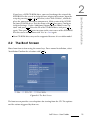
Move from item to item using the arrow keys. For a normal installation, select
‘Installation’Confirm the selection with Enter .
Figure 2.1: The Boot Screen
The boot screen provides several options for starting from the CD. The options
and the actions triggered by them are:
SuSE Linux – User Guide
15
Boot from Harddisk: Boots the system installed on the hard disk (the system normally booted when the machine is started). This option is preselected.
Installation: The “normal” installation mode. All modern hardware functions are enabled.
Installation - ACPI Disabled: If the normal installation fails, this may
be due to lacking ACPI (Advanced Configuration and Power Interface)
support of the system hardware. In this case, use this option to perform
the installation without ACPI support.
Installation — Safe Settings: The DMA mode (for CD-ROM drives) and
any critical power management functions are disabled. Experts can also
use the command line to enter or change kernel parameters.
Manual Installation: If the automatic loading of drivers causes problems
with the installation, you can perform the installation “manually”. In a
manual installation, drivers are not loaded automatically. However, this
will not work if you use a USB keyboard on your machine.
Rescue System: If you are unable to boot into your installed Linux system
for some reason, you can boot the computer from the DVD or CD1 and
select this item. This option starts a “rescue system” — a minimal Linux
system without any graphical user interface, which can be used by experts
to access disk partitions for troubleshooting.
Memory Test: This tests your system RAM by means of repeated read
and write cycles. This is done in an endless loop, as memory corruption
often shows up very sporadically, so many read and write cycles might be
necessary to detect it. If you suspect that your RAM might be defective,
start this test and let it run for several hours. If no errors are detected after
a longer time period, you can assume that the memory is intact. Terminate
the test by rebooting.
A few seconds after starting the installation, SuSE Linux loads a minimal ☞
Linux system, which takes control and performs the installation. A number of
messages and copyright notices are displayed then, at the end of the loading
process, the YaST installation program is started. After a few more seconds, the
screen should display the graphical interface that will guide you through the
installation.
The YaST screens have a common format. All buttons, entry fields, and lists can
be accessed with the mouse. If your mouse pointer does not move, the mouse
has not been correctly detected. In this case, use the keyboard for navigation.
16
2.2. The Boot Screen
2.3
2
Language Selection
User-Defined Installation
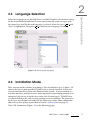
Select the language to use for SuSE Linux and YaST. English is the default setting
for the international distribution. If your mouse does not work, navigate with
the arrow keys until the desired language is selected. After this, press Tab until
to confirm your language selection.
‘Next’ is highlighted. Then press ↵ Figure 2.2: Selecting the Language
2.4
Installation Mode
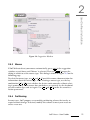
Here you can decide whether to perform a ‘New Installation’ or an ‘Update’. Of
course, the latter is only possible if SuSE Linux is already installed. In this case,
you can also boot this system with ‘Boot installed system’. If your installed system does not start, perhaps because some important system configurations were
corrupted, you can try to repair the system with ‘System repair’. If SuSE Linux
was not installed so far, you can only perform a new installation. The procedure
for the new installation is described in the following section. More information
about the system update is provided in Section System Update on page 59 .
Click ‘OK’ to continue (Figure 2.3 on the following page).
SuSE Linux – User Guide
17
Figure 2.3: Selecting the Installation Mode
2.5 Installation Suggestion
After hardware detection, the suggestion window, shown in Figure 2.4 on the
next page, displays some information about the hardware recognized and proposes a number of installation and partitioning options. When selecting any of
these items and configuring them in the corresponding dialogs, you are always
returned to the suggestion window, which is updated accordingly. The individual settings are discussed in the following sections.
2.5.1 Installation Mode
This offers the opportunity to change the installation type selected previously.
If you already have a Linux system installed on your machine, you can use this
to boot into that system. This is useful if the system is damaged for some reason
and cannot be booted from the hard disk.
2.5.2 Keyboard Layout
Select the keyboard layout. By default, the layout corresponds to the selected
language. After changing the layout, test Y, Z, and special characters to make
sure the selection is correct. When finished, select ‘Next’ to return to the suggestion window.
18
2.5. Installation Suggestion
2
User-Defined Installation
Figure 2.4: Suggestion Window
2.5.3 Mouse
If YaST did not detect your mouse automatically, press Tab in the suggestion
window several times until ‘Mouse’ is selected. Then use Space to open the
dialog in which to set the mouse type. This dialog is shown in Figure 2.5 on the
following page.
To select the mouse type, use and . Consult the mouse documentation for
↑
↓
information about the mouse type. After selecting a mouse type, use the key
combination Alt +
T
to test whether the device works correctly without selecting it permanently. If the mouse does not behave as expected, use the keyboard
to select another type and test again. Use Tab and ↵ to make the current selection permanent.
2.5.4 Partitioning
In most cases, YaST proposes a reasonable partitioning scheme that can be accepted without change. If desired, modify this scheme to meet your needs or
create a new one.
SuSE Linux – User Guide
19
Figure 2.5: Selecting the Mouse Type
Partition Types
Every hard disk has a partition table with space for four entries. Each entry in
the partition table can be a primary partition or an extended partition. Only one
extended partition entry is allowed, however.
Primary partitions consist of a continuous range of cylinders (physical disk areas) assigned to a particular operating system. Using primary partitions, you
could not set up more than four partitions per hard disk. More do not fit in the
partition table.
This is why extended partitions are used. Extended partitions are also continuous ranges of disk cylinders, but an extended partition may itself be subdivided
into logical partitions. Logical partitions do not require entries in the partition
table. In other words, an extended partition is a container for logical partitions.
If you need more than four partitions, create an extended partition. This extended partition should span the entire remaining free cylinder range. Then
create multiple logical partitions within the extended partition. The maximum
number of logical partitions is fifteen on SCSI disks and 63 on (E)IDE disks.
It does not matter which type of partitions are used for Linux. Primary and logical partitions both work fine.
20
2.5. Installation Suggestion
2
Required Disk Space
Minimal system: 180 MB
No graphical interface (X Window System) is installed, which means only
console applications can be used. Also, only a very basic selection of software is installed.
Minimal system with graphical interface: 500 MB
This includes X and some applications.
Graphical system with modern applications: between 1 GB and 2 GB
User-Defined Installation
The amount of hard disk space needed depends on the intended use of the system. Available space limits what applications can be installed. The following
hints give some guidelines for space requirements:
This includes recent versions of graphical desktops, namely KDE and
GNOME, and bigger application packages, such as OpenOffice.org and
Netscape or Mozilla.
For downloading lots of movies and music with Linux: 2 GB
Both items: 3 GB
Burning CDs and the items listed above: 4 GB
These guidelines can help develop a partitioning scheme for your system:
Under 500 MB:
A swap partition and a root partition (/).
Between 500 MB and 4 GB:
A small boot partition located within the first cylinders of the hard disk
(/boot, at least 8 MB or 1 cylinder) to hold the kernel and the boot loader.
Also create a swap partition of approximately 256 MB then use the rest for
the root partition (/).
For more than 4 GB:
Boot (/boot), swap, root (250 MB), home directories (/home) with about
200 MB for each user, and the rest for programs and data (/usr). You may
also reserve an extra partition each for /opt and /var.
SuSE Linux – User Guide
21
Some commercial programs install their data in /opt. If necessary, create a
separate partition for /opt or make the root partition large enough. KDE and
GNOME are also installed in /opt.
Tip
Things should be fine if your partitioning setup is similar to that proposed by YaST. This is usually a small partition for /boot at the beginning of the hard disk (about 10 MB, or 1 cylinder on a large hard disk), a
swap partition (between 128 and 256 MB), and the rest for /.
Tip
Partitioning with YaST
When you select the partitioning item in the suggestion window for the first
time, YaST displays a dialog listing the partition settings as currently proposed.
Accept these current settings without change or change them before continuing.Alternatively, discard all the settings and start over from scratch.
Figure 2.6: Editing the Partitioning Setup
Nothing in the partitioning setup is changed if you select ‘Accept Suggested
Partitioning Setup’. If you select ‘Change Suggested Partitioning Setup’, the ‘Expert Partitioner’ opens. It allows you to tweak the partition setup in every de-
22
2.5. Installation Suggestion
If you select ‘Create custom partitioning setup’, a dialog, like that in Figure 2.7,
opens in which to select a hard disk from those on your system. SuSE Linux will
be installed on the disk selected in this dialog.
2
User-Defined Installation
tail. This dialog is explained in Section Expert Partitioning with YaST on the next
page . The original setup as proposed by YaST is offered there as a starting point.
Figure 2.7: Selecting the Hard Disk
The next step is to determine whether the entire disk should be used (‘Use entire
hard disk’) or whether to use any existing partitions, if available, for the installation. If a Windows operating system was found on the disk or if there is some
other FAT file system, select whether to delete or resize the partition. Before doing so, read Section Resizing a Windows Partition on page 26 . If desired, go to the
‘Expert Partitioner’ dialog to create a custom partition setup at this point (see
Section Expert Partitioning with YaST on the following page ).
Caution
If you choose ‘Use entire hard disk’, all data on that disk will be lost.
Caution
YaST checks during the installation whether the disk space is sufficient for the
software selection made. If not, YaST automatically removes parts from the software selection as needed. The suggestion window then includes a notice to in-
SuSE Linux – User Guide
23
form you about this. As long as there is sufficient disk space available, YaST simply accepts your settings and partitions the hard disk accordingly.
2.5.5
Expert Partitioning with YaST
With the expert dialog, shown in Figure 2.8, the partitioning of your hard disk
can be modified manually. Partitions can be added, deleted, or edited.
Figure 2.8: The YaST Partitioner in Expert Mode
All existing or suggested partitions on all connected hard disks are displayed
in the list of the expert dialog. Entire hard disks are listed as devices without
numbers, such as /dev/hda or /dev/sda. Partitions are listed as parts of
these devices, such as /dev/hda1 or /dev/sda1. The size, type, file system,
and mount point of the hard disks and their partitions are also displayed. The
mount point describes where the partition is mounted in the Linux file system
tree.
Any free hard disk space is also listed and automatically selected. To allocate additional storage space to ☞Linux, free the needed space starting from the bottom
toward the top of the list (starting from the last ☞partition of a hard disk toward
the first). For example, if you have three partitions, you cannot use the second
exclusively for Linux and retain the third and first for other operating systems.
24
2.5. Installation Suggestion
2
Creating a Partition
2. Select the file system to use to format the partition and a mount point, if
necessary. YaST suggests a mount point for each partition created. Details
of the parameters are provided in the next section.
3. Select ‘OK’ to apply your changes.
User-Defined Installation
1. Select ‘New’. If several hard disks are connected, a selection dialog appears in which to select a hard disk for the new partition. Then, specify
the partition type (primary or extended). Create up to four primary partitions or up to three primary partitions and one extended partition. Within
the extended partition, you can create several logical partitions (see Section Partition Types on page 20 ).
The new partition is then listed in the partition table. If you click ‘Next’, the current values are adopted and you are returned to the suggestion screen.
Partitioning Parameters
If you create a new partition or modify an existing partition, various parameters
can be set in the partitioning tool. For new partitions, suitable parameters are
set by YaST and usually do not require any modification. To perform manual
settings, proceed as follows:
1. Select the partition.
2. ‘Edit’ the partition and set the parameters:
File System ID
Even if you do not want to format the partition at this stage, specify one of the following file system IDs to ensure that the partition is
registered correctly: ‘Linux’, ‘Linux swap’, ‘Linux LVM’, or ‘Linux
RAID’. Refer to the Administration Guide for details on LVM and
RAID.
File System
To format the partition immediately within the scope of the installation, specify one of the following file systems for the partition:
‘Swap’, ‘Ext2’, ‘Ext3’, ‘ReiserFS’, or ‘JFS’.
Swap is a special format that makes the partition usable as virtual
memory. Every system should have at least one swap partition of
at least 128 MB (see page on the next page). ReiserFS is the default
for Linux partitions. ReiserFS as well as JFS and Ext3 are journaling
SuSE Linux – User Guide
25
file systems. These file systems are able to restore your system very
quickly after a system crash, as write processes are logged during
the operation. Furthermore, ReiserFS is very fast in handling lots
of small files. Ext2 is not a journaling file system. It is “rock solid”
and good for smaller partitions, as it does not require too much disk
space for management.
File System Options
Here, specify various parameters for the selected file system. Depending on the file system used, various options are offered. Only
make changes if you are absolutely sure what you are doing.
Encrypt File System
If you activate the encryption, all data is written to the hard disk in
encrypted form. This increases the security of sensitive data, but reduces the system speed, as the encryption takes some time.
fstab Options
Here you can specify various parameters for the administration file
of the file systems (/etc/fstab). Experienced users have the possibility to modify a number of options. Refer to the respective chapter
in the Administration Guide before changing anything.
Mount Point
This specifies the directory at which the partition should be mounted
in the file system tree. Various YaST suggestions can be expanded at
the respective entry field. If you accept these suggestions, the default
file system structure is implemented. However, you can also specify
any other names.
3. Select ‘Next’ to activate the partition.
Note
If you partition manually, create a swap partition. The swap partition is
used to free the main memory from data that is not used at the present
moment. This keeps the main memory free for the most frequently-used
important data.
Note
Resizing a Windows Partition
If a hard disk containing a Windows FAT or NTFS partition was selected as installation target, YaST will offer to delete or shrink this partition. In this way, you
26
2.5. Installation Suggestion
If YaST sees that there is not enough space on the selected hard disk, but that
space could be made available by deleting or shrinking a Windows partion, it
will present a dialog in which you can choose one of these two options.
2
User-Defined Installation
can install SuSE Linux even if there is currently not enough space on the hard
disk. This functionality is especially useful if the selected hard disk merely contains one Windows ☞partition that covers the entire hard disk, which is often the
case with preinstalled computers.
Figure 2.9: Possible Options for Windows Partitions
If you select ‘Delete Windows completely’, the Windows partition will be
marked for deletion, and the freed space will be used for the installation of SuSE
Linux.
Caution
If you delete Windows, all data will be lost beyond recovery as soon as
the formatting starts.
Caution
To shrink the Windows partition, interrupt the installation and boot Windows
in order to prepare the partition from there. Although this step is not strictly
required for FAT partitions, it speeds up the resizing process and also makes it
safer. These steps are vital for NTFS partitions.
FAT file system In Windows, first run scandisk to make sure the FAT partition
is free of lost file fragments and crosslinks. After that, run defrag to move
SuSE Linux – User Guide
27
files to the beginning of the partition. This will accelerate the resizing procedure in Linux.
Note
If you have optimized virtual memory settings for Windows in
such a way that a contiguous swap file is used with the same initial
(minimum) and maximum size limit, consider another step. With
these Windows settings, the resizing might have the effect that the
swap file is split into many small parts scattered all over the FAT
partition. Also, the entire swap file would need to be moved during
the resizing, which makes the process rather slow. It is therefore
useful to unset these Windows optimizations for the time being and
reenable them after the resizing has been completed.
Note
NTFS file system In Windows, run scandisk and defrag in order to move the
files to the beginning of the hard disk. In contrast to the FAT file system,
this must be done in NTFS in order to enable resizing.
Note
If you operate your system with a permanent swap file on an NTFS
file system, this file may be located at the end of the hard disk and
remain there despite defrag. Therefore, it may be impossible to
shrink the partition sufficiently. In this case, temporarily deactivate
the swap file (the virtual memory in Windows). After the partition
has been resized, you can configure as much virtual memory as you
need..
Note
After these preparation, return to the Linux partitioning setup and select ‘Shrink
Windows Partition’. After a quick check of the partition, YaST will open a dialog
with a suggestion for resizing the Windows partition.
The first bar graph shows how much disk space is currently occupied by Windows and how much space is still available. The second bar graph shows how
the space would be distributed after the resizing, according to YaST’s current
proposal (Figure 2.10 on the facing page). Accept the proposed settings or use
the slider to change the partition sizing (within certain limits).
If you leave this dialog by selecting ‘Next’, the settings will be stored and you
will be taken back to the previous dialog. The actual resizing will take place
later, before the hard disk is formatted.
28
2.5. Installation Suggestion
2
User-Defined Installation
Figure 2.10: Resizing the Windows Partition
Note
By default, the Windows versions NT, 2000, and XP use the NTFS file system. Unlike FAT file systems, NTFS file systems can (currently) only be
read from Linux. Therefore, you can read your Windows files from Linux,
but you cannot edit them. If you want write access to your Windows data
and do not need the NTFS file system, you can install Windows anew
on a FAT32 file system. In this case, you will have full access to your
Windows data from SuSE Linux.
Note
More Partitioning Tips
If the partitioning is performed by YaST and other partitions are detected in the
system, these partitions are also entered in the file /etc/fstab to enable easy
access to this data. This file contains all partitions in the system with their properties (parameters), such as the file system, mount point, and user permissions.
/dev/sda1
/dev/sda8
/data1
/data2
auto
auto
noauto,user 0 0
noauto,user 0 0
File 1: /etc/fstab: Partition Data
SuSE Linux – User Guide
29
The partitions, regardless of whether they are Linux or FAT partitions, are specified with the options noauto and user. This allows any user to mount or unmount these partitions as needed. For security reasons, YaST does not automatically enter the exec option here, which is needed for executing programs from
the respective location. However, to run programs from there, you can enter this
option manually. This measure is necessary if you encounter system messages
such as "bad interpreter" or "Permission denied".
Detailed background information and tips for partitioning are provided in the
Administration Guide in Special Installation Procedures, Partitioning for Experts.
2.5.6
Software
SuSE Linux contains a number of software packages for various application purposes. As it would be burdensome to select the needed packages one by one,
SuSE Linux offers three system types with various installation scopes. Depending on the available disk space, YaST selects one of these basic systems and displays it in the suggestion screen.
Minimum System (only recommended for special purposes)
This installs the operating system with various services without the
graphical user interface. The machine can only be operated by way of the
ASCII consoles. This system type is especially suitable for server applications requiring little direct user interaction.
Minimum Graphical System (without KDE)
If you do not want the KDE desktop or if the disk space is insufficient, install this system type. The installed system includes an elementary graphical user interface with terminal windows, but no real desktop with the
usual functionality. You can use all programs that have their own graphical user interfaces (such as Netscape). No office programs are installed.
Default System (with KDE and office package)
This is the largest of all offered basic systems. It contains the KDE desktop
together with most of the KDE programs and the office programs. This is
the most suitable system type for normal stand-alone machines. If possible, YaST selects this system type.
Click ‘Software Selection’ in the suggestion screen to open a dialog in which to
select one of the basic systems. To start the software installation modules (package manager) and modify the installation scope, click ‘Detailed Selection’ (see
Figure 2.11 on the next page).
30
2.5. Installation Suggestion
2
User-Defined Installation
Figure 2.11: Installing and Removing Software with the YaST Package Manager
Changing the Installation Scope
If you install the default system, there is usually no need to add or remove individual packages. This basic system consists of a software selection that meets
most requirements without any changes. If you have specific needs, modify this
selection with the package manager. It offers various filter criteria for determining a selection from the numerous packages in SuSE Linux.
The filter selection box is located at the top left under the menu bar. At startup, the ‘Selections’ filter is active. This filter groups the program packages by
their application purpose, such as multimedia or office applications. The various
groups of the Selections filter are listed under the filter selection box. The packages included in the selected system type are preselected. Click the respective
check boxes to select or deselect entire selections for installation.
The right part of the window displays a table listing the individual packages
included in the current selection. The leftmost table column shows the current
status of each package. Two status flags are especially relevant for the installation: “Install” (the box in front of the package name is checked) and “Do Not
Install” (the box is empty). To select or deselect individual software packages,
click the status box until the desired status is displayed.
Alternatively, right-click the package line to access a pop-up menu listing various status options. However, the other status settings are not needed for the
installation. They are described in detailed in Section Installing and Removing
Software on page 51.
SuSE Linux – User Guide
31
Other Filters
Click the filter selection box to view the range of possible filters. The selection
according to ‘Package Groups’ can also be used for the installation. This filter
sorts the program packages by subjects in a tree structure to the left. The more
you expand the branches, the more specific the selection of packages is and the
fewer packages that are displayed in the list of associated packages to the right.
Use ‘Search’ to search for a specific package. This is explained in detail in Section Installing and Removing Software on page 51 .
Package Dependencies and Conflicts
Instead of rewriting the same basic functions in each software package, programmers access the functions of other packages. For this reason, many packages require that other packages are installed for the programs to function. In
rare cases, programs interfere with each other, causing conflicts. When selecting
and deselecting software packages in this dialog, alerts about unresolved package dependencies or conflicts may be displayed. If you install SuSE Linux for
the first time or if you do not understand the alerts, read Section Installing and
Removing Software on page 51, which provides detailed information about the
operation of the package manager and a brief summary of the software organization in Linux.
Caution
The software preselected for installation is based on our long-standing
experience and is usually suitable for the needs of most newcomers and
advanced home users. In general, there is no need to change anything
here. However, if you decide to select or deselect any packages, you
should be aware of the consequences. In particular, observe any warnings
and avoid deselecting any packages of the base system.
Caution
Exiting the Software Selection
If you are satisfied with your software selection and there are no more unresolved package dependencies or conflicts, click ‘Accept’ to apply your changes
and exit the program. If this module is started in the installed system, the
changes are applied immediately. During the installation, however, the changes
are recorded internally and applied later when the actual installation starts.
32
2.5. Installation Suggestion
2.5.7
2
Boot Configuration (Boot Loader Installation)
One possibility is to configure the boot mechanism to rely on a special boot
floppy. Although this has the disadvantage of requiring the boot floppy in the
drive for boot, it allows you to leave an existing boot mechanism untouched.
This should not normally be necessary, however, because YaST can configure the
SuSE Linux boot loader to boot existing operating systems as well. Another possibility with the configuration is to change the location of the boot mechanism
on hard disk.
To change the boot configuration proposed by YaST, select ‘Booting’ to open a
dialog in which to change many details of the boot mechanism. For information,
read Section Boot Loader Configuration with YaST on page 112 .
User-Defined Installation
During the installation, YaST proposes a boot configuration for your system.
Normally, you should leave these settings unchanged. However, if you need a
custom setup, modify the proposal for your system.
Note
The boot method should only be changed by experienced computer
users.
Note
2.5.8
Time Zone
In this dialog, shown in Figure 2.12 on the following page, choose between
Local Time and UTC under ‘Hardware clock set to’. The selection depends on
how the hardware (BIOS) clock is set on your machine. If it is set to GMT, which
corresponds to UTC, your system can rely on SuSE Linux to switch from standard time to daylight savings time and vice versa.
2.5.9
Language
The language was already selected at the beginning of the installation (see Section Language Selection on page 17 . If you want to change this setting, you can
do this here. Furthermore, advanced users can use the ‘Details’ button to set the
language for the user root. The drop-down menu offers three options:
ctype The value of the variable LC_CTYPE in the file /etc/sysconfig/
language is adopted for the user root. This sets the localization for
language-specific function calls.
SuSE Linux – User Guide
33
Figure 2.12: Selecting the Time Zone
yes
The user root has the same language settings as the local user.
no
The language settings for the user root are not affected by the language
selection.
Click ‘OK’ to complete the configuration or ‘Discard’ to undo your changes.
2.5.10
Launching the Installation
When satisfied with the installation settings, click ‘Next’ to begin the installation. Confirm with ‘Yes’ in the green dialog that opens. Installation usually takes
between fifteen and thirty minutes, depending on system performance and the
software selected.
2.6 Finishing the Installation
After completing the basic system setup and the installation of all selected software packages, provide a password for the account of the system administrator
(the root user). Then configure your Internet access and network connection,
34
2.6. Finishing the Installation
2.6.1
root Password
☞root is the name of the superuser, the administrator of the system. Unlike regular users, which may or may not have permission to do certain things on the
system, root has unlimited power to do anything: changing the system configuration, installing programs, and setting up new hardware. If users forget their
passwords or have other problems with the system, root can help. The root
account should only be used for system administration, maintenance, and repair. Logging in as root for daily work is rather risky: a single mistake could
lead to many system files being irretrievably lost.
2
User-Defined Installation
if available. With a working Internet connection, it is possible to update the system with security patches and software updates during installation. If desired,
configure a name server for centralized user administration in a local network.
Also configure any hardware devices, such as printers and scanners.
Figure 2.13 on the following page shows the relevant dialog. For verification
purposes, the password for root must be entered twice. Do not forget the root
password. It cannot be retrieved later.
Caution
The user root has all the permissions needed to make changes to the
system. To carry out such tasks, the root password is required. You
cannot carry out any administrative tasks without this password.
Caution
2.6.2
Network Configuration
In this step, configure network devices for a connection to the outside world.
If you have these devices, such as network cards, modems, and ISDN or DSL
hardware, it is a good idea to configure them now. An Internet connection allows YaST to retrieve any available SuSE Linux updates.
Directions for configuring network hardware are available in Section Network
Devices on page 87 , where the necessary steps are described. If preferred, configure your network devices later from the installed system. To do so, select
‘Skip Network Configuration’ then ‘Accept’.
2.6.3 Testing the Internet Connection
If you configured an Internet connection, you can test it right now. For this purpose, YaST establishes a connection to the SuSE server and checks if any product
SuSE Linux – User Guide
35
Figure 2.13: Setting the root Password
updates are available for your version of SuSE Linux. Also, the latest release
notes are downloaded. Any available updates can be installed in the next step.
If you do not want to test the connection at this point, select ‘Skip Test’ then
‘Next’. This also skips downloading product updates and release notes.
2.6.4 Loading Software Updates
If YaST was able to connect to the SuSE servers, select whether to perform a YaST
online update. If there are any patched packages available on the servers, you
can download and install them now to fix known bugs or security issues.
Note
The download of updates might take quite some time, depending on the
bandwidth of the Internet connection and on the size of the update files.
Note
To perform a software update immediately, select ‘Perform Update Now’ and
click ‘OK’. This opens YaST’s online update dialog with a list of the available
patches (if any), which can be selected and loaded. To learn about the process,
36
2.6. Finishing the Installation
2
User-Defined Installation
Figure 2.14: Configuring the Network Devices
read Section YaST Online Update on page 50 . This kind of update can be performed at any time after the installation. If you prefer not to update now, select
‘Skip Update’ then click ‘OK’.
2.6.5 User Authentication
If the network access been configured successfully during the previous steps
of the installation, you now have two different possibilities for managing user
accounts on your system.
Local User Administration Using this method, users are managed locally —
on the installed machine. This is the typical solution for stand-alone workstations.
User Administration with NIS or LDAP
This method is mostly used in organizations to manage workstations on a
department-wide basis. The user administration for the entire department
is carried out on a central host or name server, making the creation of local
accounts unnecessary. In fact, the method could be chosen because local
accounts are undesirable.
SuSE Linux – User Guide
37
Figure 2.15: Testing the Internet Connection
If all requirements are met, YaST opens a dialog in which to select the user administration method. It is shown in Figure 2.16 on the next page. If you do not
have the necessary network connection local user accounts can still be created.
2.6.6 Configuring the Host as a NIS Client
If you have decided to manage user accounts through NIS, configure the host
as a NIS client. A NIS-enabled network requires some expert knowledge. The
details of NIS are explained in the Administration Guide. The following only explains the basic setup of the client side.
In the following dialog, shown in Figure 2.17 on page 40, first select whether
the host has a fixed IP address or gets one via DHCP. DHCP also provides the
NIS domain and the NIS server. For information about DHCP, see DHCP in the
Administration Guide. If a static IP address is used, specify the NIS domain and
the NIS server manually.
To search for NIS servers broadcasting in the network, check the relevant option. You can also specify several NIS domains and set a default domain. For
each domain, you can select ‘Edit’ to specify several server addresses or enable
the broadcast function on a per-domain basis.
38
2.6. Finishing the Installation
2
User-Defined Installation
Figure 2.16: User Authentication
In the expert settings, use ‘Answer to the Local Host Only’ to prevent other network hosts from being able query which server your client is using. If you activate ‘Broken Server’, responses from servers on unprivileged ports are also
accepted.For more information, refer to the man page of ypbind.
2.6.7
Creating Local User Accounts
When user accounts are created locally, any data related to user accounts (name,
login, password, and so on) are stored and managed on this host.
Linux is an operating system that allows several users to work on the same system at the same time. Each user needs a ☞user account to log in to the system. By
having user accounts, the system gains a lot in terms of security. Regular users
cannot change or delete files needed for the system to work properly. Similarly,
the personal data of a given user cannot be modified, viewed, or tampered with
by other users. Each user can set up his own working environment and always
find it unchanged when logging back in.
A user account can be created using the dialog shown in Figure 2.18 on page 41.
After entering the first name and last name, specify the user name (login). If
you cannot think of a suitable user name, click ‘Suggestion’ for the system to
generate one automatically.
SuSE Linux – User Guide
39
Figure 2.17: NIS Client Configuration
Finally, enter a password for the user. Reenter it for confirmation (to ensure that
you did not type something else by mistake). The user name tells the system
who a user is and the password is used to verify this identity.
Caution
Remember both your user name and the password because they are
needed each time you log in to the system.
Caution
To provide effective security, a password should be between five and eight characters long. The maximum length for a password is 128 characters, but if no
special security modules are loaded, only the first eight characters are used to
identify the password.
Linux distinguishes between lowercase and uppercase letters in the password.
Accented characters and umlauts are not allowed. Special characters and the
digits 0–9 may be used.
2.6.8
Reading the Release Notes
After completing the user authentication setup, YaST displays the release notes.
They contain important up-to-date information not available when the manuals
40
2.6. Finishing the Installation
2
User-Defined Installation
Figure 2.18: Entering the User Name and Password
were printed. If you have installed update packages, the most recent version of
the release notes is available.
2.7
Hardware Configuration
Configure the graphics card and, if desired, other hardware devices, such as the
printer and the sound card. Just click a component to start its configuration. For
the most part, YaST then detects and configures the devices automatically.
You may skip any peripheral devices and configure them later. However, you
should configure the graphics card right away. Although the display settings as
autoconfigured by YaST should be generally acceptable, most users have very
strong preferences as far as resolution, color depth, and other graphics features
are concerned. To change these settings, select ‘X Configuration’. The configuration is explained in Section Graphics Card and Monitor (SaX2) on page 72 . When
finished, click ‘Finish Installation’.
After YaST has written the configuration data, you can finish the installation of
the SuSE Linux with ‘Finish’ in the final dialog.
SuSE Linux – User Guide
41
Figure 2.19: Configuring the System Components
2.8 Graphical Login
SuSE Linux is now installed and ready for your first login. On your screen, you
should see the graphical ☞login as shown in Figure 2.20 on the next page. Enter
the user name created during installation then the respective password.
42
2.8. Graphical Login
2
User-Defined Installation
Figure 2.20: The Login Screen
SuSE Linux – User Guide
43
Part II
Configuration
3
YaST — Configuration
YaST — Configuration
YaST, the setup tool used for the installation, is also the configuration tool for
SuSE Linux. This chapter covers the configuration of your system with YaST.
This includes most of the hardware, the graphical user interface, Internet access,
security settings, user administration, installation of software, system updates,
and system information. This chapter also provides instructions for using YaST
in text mode.
3.1
3.2
3.3
3.4
3.5
3.6
3.7
3.8
3.9
3.10
Starting YaST . . . . . . . . .
The YaST Control Center . . .
Software . . . . . . . . . . . .
Hardware . . . . . . . . . . .
Network Devices . . . . . . .
Network Services . . . . . . .
Security and Users . . . . . .
System . . . . . . . . . . . . .
Miscellaneous . . . . . . . . .
YaST2 in Text Mode (ncurses)
.
.
.
.
.
.
.
.
.
.
.
.
.
.
.
.
.
.
.
.
.
.
.
.
.
.
.
.
.
.
.
.
.
.
.
.
.
.
.
.
.
.
.
.
.
.
.
.
.
.
.
.
.
.
.
.
.
.
.
.
.
.
.
.
.
.
.
.
.
.
.
.
.
.
.
.
.
.
.
.
.
.
.
.
.
.
.
.
.
.
.
.
.
.
.
.
.
.
.
.
.
.
.
.
.
.
.
.
.
.
.
.
.
.
.
.
.
.
.
.
.
.
.
.
.
.
.
.
.
.
.
.
.
.
.
.
.
.
.
.
48
48
49
62
87
99
103
108
118
120
3.1 Starting YaST
System configuration with YaST is conducted by means of various YaST modules
serving different purposes, such as the configuration of the keyboard or the selection of the system language. These modules can be accessed in various ways.
An overview of all modules is available in the YaST Control Center, which can
be started from the ‘SuSE’ menu, the SuSE icon at the bottom left of your KDE
panel. Select ‘SuSE’ ➝ ‘System’ ➝ ‘YaST’. The individual modules can also be
accessed from the KDE Control Center.
If you use KDE, you can also start YaST by pressing Alt +
F2 . In the window
.
that opens, enter kdesu /sbin/yast2 and confirm with ↵ As these start methods are usually used by a normal user, YaST opens a small
dialog for entering the root password. root privileges are required for all YaST
modules, as only this user is permitted to modify the Linux system files.
If, for any reason, YaST cannot be started as described above, it can be started
from the command line. In the shell, change to the user root with sux. Enter
the root password and run the command yast2.
Tip
To change the language of YaST, select ‘System’ ➝ ‘Select Language’ in
the YaST Control Center. Choose a language, exit the YaST Control Center,
log out from your computer, then log in and restart YaST.
Tip
3.2 The YaST Control Center
When you start YaST in the graphical mode, the YaST Control Center, as shown
in Figure 3.1 on the facing page, opens. The left frame features the categories
‘Software’, ‘Hardware’, ‘Network Devices’, ‘Network Services’, ‘Security &
Users’, ‘System’, and ‘Miscellaneous’. If you click one of icons, the respective
contents are listed on the right-hand side. For example, if you select ‘Hardware’
and click ‘Sound’ to the right, a configuration dialog opens for the sound card.
The configuration of the individual items usually comprises several steps. Press
‘Next’ to proceed to the following step.
The left frame displays a help text for the respective topic, explaining the required entries. After making the needed settings, complete the procedure by
pressing ‘Finish’ in the last configuration dialog. The configuration is then
saved.
48
3.1. Starting YaST
3
YaST — Configuration
Figure 3.1: The YaST Control Center
3.3
Software
3.3.1 Change Installation Source
The installation source is the medium containing the software to install. YaST
can administer a number of different installation sources. It enables their selection for installation or update purposes.
When this module is started, a list displaying all previously registered sources is
displayed. Following a normal installation from CD, only the installation CD is
listed. Click ‘Add’ to include additional sources in this list. You can add removable media, such as CDs and DVDs, and network connections, such as NFS and
FTP. Even directories on the local hard disk can be selected as the installation
medium. See the detailed YaST help text.
During the installation or update, YaST can take multiple installation sources
into consideration. Therefore, all registered sources have an activation status in
the first column of the list. Click ‘Activate or Deactivate’ to activate or deactivate
individual installation sources. During the installation of software packages or
updates, YaST selects the suitable installation source from the range of activated
installation sources.
SuSE Linux – User Guide
49
If you exit the module with ‘Close’, the current settings are saved and applied to
the configuration modules ‘Install and Remove Software’ and ‘System Update’.
Figure 3.2: Change Installation Source
3.3.2 YaST Online Update
The YaST Online Update (YOU) enables the installation of important updates
and improvements. The respective patches are available for download on the
SuSE FTP server and various mirror servers. Under ‘Installation Source’, select one of the various servers. When you select server, the respective URL is
copied to the input field below, where it can be edited. You can also specify local
URLs in the form file:/my/path or simply /my/path. Expand the existing
list with additional servers using ‘New Server’. Click ‘Edit server’ to modify the
settings of the currently selected server.
When the module starts, ‘Manual Selection of Patches’ is active, enabling determination of whether individual patches should be loaded. To apply all available update packages, deactivate this option. However, depending on the bandwidth of the connection and the amount of data to transmit, this can result in
long download times.
If you activate ‘Download All Patches Again’, all available patches, installable
packages, and descriptions are downloaded from the server. If this box is not
50
3.3. Software
activated (default), only retrieve patches not yet installed on your system.
If you decide to perform a manual update (default), click ‘Next’ to load a list of
all available patches and start the package manager, described in Section Installing and Removing Software on the current page. In the package manager,
the filter for YOU patches is activated, enabling selection of updates to install.
Patches whose installation is advisable are preselected. Normally, you should
accept this suggestion.
YaST — Configuration
Additionally, there is a possibility to update your system automatically. Click
‘Configure Fully Automatic Update’ to configure a process that automatically
looks for updates and apply them on a daily basis. This procedure is fully automated and does not require any interaction. Of course, this only works if a connection, such as an Internet connection, to the update server exists at the time of
the update.
3
After making your selection, click ‘Accept’ in the package manager. All selected
updates are then downloaded from the server and installed on your machine.
Depending on the connection speed and hardware performance, this may take
some time. Any errors are displayed in a window. If necessary, skip the respective package. Prior to the installation, some patches may open a window displaying details, allowing you to confirm the installation or skip the package.
While the updates are downloaded and installed, track actions in the log window. Following the successful installation of all patches, exit YOU with ‘Finish’.
If you do not need the update files after the installation, delete them with ‘Remove Source Packages after Update’. Finally, SuSEconfig is executed to adapt
the system configuration to the new circumstances.
3.3.3
Patch CD Update
The Patch CD Update is for “SuSE Linux Enterprise Server” customers. Patches
are installed from CD instead of downloaded from a FTP server.
3.3.4
Installing and Removing Software
This module enables installation, uninstallation, and updating of software on
your machine. The following paragraphs provide some background information
about the management of software.
Background Information about Software in Linux
In Linux, software is available in the form of packages. Normally, a package
contains everything needed for a program (such as an editor, a compiler, and so
SuSE Linux – User Guide
51
Figure 3.3: YaST Online Update
on). Usually, this includes the actual program, associated configuration files, and
documentation. Often, a package containing the source files for the respective
program is also available. The sources are not needed for running the program.
Nevertheless, you may want to install the sources to compile a custom version
of the program. In Linux, this is possible and permitted.
Some packages depend on other packages. This means that the software of the
respective package only works properly if another package is also installed
(package dependency). Furthermore, the installation (not only the operation)
of some packages is only possible if certain other packages are installed, perhaps
because the installation routine needs specific tools. Accordingly, such packages
must be installed in the correct sequence. Moreover, there are some packages
with identical or similar functionalities that serve the same purpose. If these
package make use of the same system resource, they should not be installed
concurrently (package conflict). Dependencies and conflicts can occur between
two or more packages and are sometimes very complex. The fact that a specific
package version may be required for smooth interaction can make things even
more complicated.
All these factors must be taken into consideration when installing, uninstalling,
and updating software. Fortunately, YaST provides an extremely efficient tool for
this purpose: the software installation module, usually referred to as the pack-
52
3.3. Software
Apart from these purely technical aspects, the package manager provides a
well-structured overview of the range of packages in SuSE Linux. The packages are arranged by subjects and the display of these groups is restricted by
means of suitable filters. Thus, the package manager facilitates the management
of software packages and is a valuable tool for maintaining your system.
3
YaST — Configuration
age manager. When the package manager is started, it examines the system and
displays installed packages. If you select additional packages for installation,
the package manager automatically checks the dependencies and selects any
other needed packages (resolution of dependencies). If you unknowingly select
conflicting packages, the package manager indicates this and submits suggestions for solving the problem (resolution of conflicts). If a package needed by
other installed packages is accidentally marked for deletion, the package manager issues an alert with detailed information and alternative solutions.
The Package Manager
To change the software selection on your system with the package manager, select ‘Install or Remove Software’ in the YaST Control Center. The dialog window
of the package manager is displayed as shown in Figure 3.4.
Figure 3.4: YaST: Package Manager
The window comprises various frames. The frame sizes can be modified by
clicking and moving the lines separating the areas. The contents of the frames
and their use are described below.
SuSE Linux – User Guide
53
The Filter Window
Selecting all packages of an installation one by one would be vary laborious and
time-consuming. Therefore, the package manager offers various filter methods
for arranging the packages in categories and limiting the number of displayed
packages. The filter window is located to the left under the menu bar. It controls
and displays various filter methods. The filter selection box at the top determines what will be displayed in the lower part of the filter window. Click the
filter selection box to select a filter from the list of available filters.
The Selections Filter At start-up, the ‘Selections’ filter is active. This filter
groups the program packages according to their application purpose, such
as "Multimedia" or "Office Applications." The various groups of the ‘Selections’ filter are listed under the filter selection box. The packages already
installed on the system are preselected. Click the status box at the beginning of a line to toggle the status flags of a selection. You can also select a
status directly by right-clicking the selection and using the context menu.
The individual package window to the right displays the list of packages
included in the current selection, enabling selection and deselection of
individual packages.
The Package Groups Filter The ‘Package Groups’ filter provides a more technical overview of the range of packages and is suitable for users who are
familiar with the package landscape of SuSE Linux. This filter sorts the
program packages by subjects, such as "Applications," "Development,"
and "Hardware," in a tree structure to the left. The more you expand the
branches, the more specific the selection is and the fewer packages are displayed in the individual package window to the right.
Moreover, the filter provides the possibility to display all packages in alphabetic order. To do this, select ‘zzz Alle’ in the top level. As SuSE Linux
contains a large number of packages, it may take some time until this long
list is displayed.
The Search Function The ‘Search’ function is the easiest way to find a specific
package. By specifying various search criteria, restrict the filter so much
that often only one package is displayed in the individual package window. Enter a search string and use the check boxes to determine where
to search for this string (in the name, in the description, or in the package
dependencies). Advanced users can even define special search patterns
using wild cards and regular expressions and search the package dependencies in the "Provides" and "Requires" fields. For example, software developers who download source packages from the Internet can use this
54
3.3. Software
Tip
In addition to the ‘Search’ filter, all lists of the package manager
feature a quick search for the current list content. For example, simply enter the initial letter of a package name to move the cursor to
the first package in the list whose name begins with this letter. The
cursor must be in the list (by clicking the list).
Tip
Installation Summary After selecting the packages for installation, update,
or deletion, use the filter selection box to view the installation summary.
It shows what will happen with packages when you click ‘Accept’. Use
the check boxes to the left to filter the packages to view in the individual
package window. If, for example, you merely want to check which packages are already installed, start the package manager and deactivate all
check boxes except ‘Keep’.
3
YaST — Configuration
function to determine which package contains a specific library needed
for compiling and linking this package.
Of course, the package status in the individual package window can be
changed as usual. However, the respective package may no longer meet
the search criteria. To remove such packages from the list, update the list
with ‘Update list’.
The Individual Package Window
As mentioned above, a list of individual packages is displayed to the right in
the individual package window. The content of this list is determined by the
currently selected filter. If, for example, the ‘Selection’ filter is selected, the individual package window displays all packages of the current selection.
In the package manager, each package has a status that determines what to do
with the package, such as "Install" or "Delete". This status is shown by means
of a symbol in a status box at the beginning of the line. Toggle the status with a
mouse click or select it directly by opening the context menu by right-clicking.
Depending on the current situation, some of the possible status flags may not
be available for selection. For example, a package that has not yet been installed
cannot be set to "Delete." View the available status flags with ‘Help’ ➝ ‘Symbols’.
The package manager offers the following package status flags:
Do Not Install This package is not installed and will not be installed.
SuSE Linux – User Guide
55
Install This package is not yet installed but will be installed.
Keep This package is already installed and will not be changed.
Update This package is already installed and will be replaced by the version
on the installation medium.
Delete This package is already installed and will be deleted.
Taboo — Never Install This package is not installed and will never be installed. It will be treated as if it does not exist on any of the installation
media. If a package would automatically be selected to resolve dependencies, this can be prevented by setting the package to "Taboo." However,
this may result in inconsistencies that must be resolved manually (dependency check). Thus, "Taboo" is mainly intended for expert users.
Protected This package is installed and should not be modified, as unresolved
dependencies from other packages exist or could arise. Third-party packages (packages without SuSE signature) are automatically assigned this
status to prevent them from being overwritten by later versions existing
on the installation media. This may cause package conflicts that must be
resolved manually (for experts).
Automatic installation This package has been automatically selected for installation, as it is required by another package (resolution of package dependencies).
Tip
To deselect such a package, you may need to use the status "Taboo"
(see above).
Tip
Automatic update This package is already installed. However, as another
package requires a newer version of this package, the installed version
will automatically be updated.
Delete automatically This package is already installed, but existing package conflicts require this package be deleted. For example, this may be
the case if the current package has been replaced by a different package.
However, this does not happen very often.
Automatic installation (after selection)
This packages has been automatically selected for installation because it is
part of a predefined selection, such as "Multimedia" or "Development."
56
3.3. Software
Delete automatically (after selection)
This package is already installed, but a predefined selection (such as "Multimedia" or "Development") requires this package be deleted. This does
not happen very often.
Additionally, decide to install or not to install the sources for a package. This information complements the current package status and cannot be toggled with
the mouse or selected directly from the context menu. Instead, a check box at the
end of the package line enables selection of the source packages. This option can
also be accessed under ‘Package’.
3
YaST — Configuration
Automatic update (after Selection) This package is already installed, but a
newer version exists on the installation media. This package is part of a
predefined selection, such as "Multimedia" or "Development," selected for
update and will automatically be updated.
Install Source Also install the source code.
Do Not Install Source The sources will not be installed.
The font color used for various packages in the individual package window provides additional information. Installed packages for which a newer version is
available on the installation media are displayed in blue. Installed packages
whose versions numbers are higher than those on the installation media are displayed in red. However, as the version numbering of packages is not always
linear, the information may not be perfect, but should be sufficient to indicate
problematic packages. If necessary, check the version numbers in the information window.
The Information Window
The tabs in the bottom right frame provide various information about the selected package. The description of the selected package is automatically active.
Click the other tabs to view technical data (package size, group, and so forth),
the list of dependencies from other packages, or the version information.
The Resource Window
The resource window at the bottom left displays the disk space needed for your
current selection of software on all currently mounted file systems. The colored
bar graph grows with every selection. As long as it remains green there is sufficient space. The color of the bar color slowly changes to red as you approach
the limit of disk space. If you select too many packages for installation, an alert
is displayed.
SuSE Linux – User Guide
57
The Menu Bar
The menu bar at the top left of the window provides access to most of the functions described above and a number of other functions that cannot be accessed
in any other way. It contains the following four menus:
File Select ‘File’ ➝ ‘Export’ to save a list of all installed packages in a text file.
This is recommended if you want to replicate a specific installation scope
at a later date or on another system. A file generated in this way can be
imported with ‘Import’ and generates the same package selection as was
saved. In both cases, define the location of the file or accept the suggestion.
To exit the package manager without saving changes to the package selection, click ‘Exit – Discard Changes’. To save your changes, select ‘Quit
– Save Changes’. In this case, all changes are applied and the program is
terminated.
Package The items in the ‘Package’ menu always refer to the package currently
displayed in the individual package window. Although all status flags are
displayed, you can only select those possible for the current package. Use
the check boxes to determine whether to install the sources of the package. The item ‘All in This List’ opens a submenu listing all package status flags. However, these do not merely affect the current package, but all
packages in this list.
Extras The ‘Extras’ menu offers options for handling package dependencies
and conflicts. If you have already manually selected packages for installation, click ‘Show Automatic Package Changes’ to view the list of packages
that the package manager automatically selected to resolve dependencies.
If there are still unresolved package conflicts, an alert is displayed and
solutions suggested.
If you set package conflicts to "Ignore", this information will be saved permanently in the system. Otherwise, you would have to set the same packages to "Ignore" each time you start the package manager. To unignore
dependencies, click ‘Reset Ignored Dependency Conflicts’.
Help ‘Help’ ➝ ‘Overview’ provides a brief explanation of the package manager functionality. A detailed description of the various package flags is
available under ‘Symbols’. If you prefer to operate programs without using the mouse, click ‘Keys’ to view a list of shortcuts.
58
3.3. Software
3
Dependency Check
If you activate ‘Autocheck’, any change of a package status triggers an automatic check. This is a useful feature, as the consistency of the package selection
is monitored permanently. However, this process consumes resources and can
slow down the package manager. For this reason, the autocheck is not activated
by default. In either case, a consistency check is performed when you confirm
your selection with ‘Accept’.
YaST — Configuration
‘Check Dependencies’ and ‘Autocheck’ are located in the information window.
If you click ‘Check Dependencies’, the package manger checks if the current
package selection results in any unresolved package dependencies or conflicts.
In the event of unresolved dependencies, the required additional packages are
selected automatically. For package conflicts, the package manager opens a dialog that shows the conflict and offers various options for solving the problem.
In the following example, package sendmail and package postfix may not
be installed concurrently. Figure 3.5 on the next page shows the conflict message prompting you to make a decision. package postfix is already installed.
Accordingly, you can refrain from installing package sendmail, remove package postfix, or take the risk and ignore the conflict.
Caution
Ignoring a conflict is strongly discouraged, as the stability and operability
of your system can no longer be guaranteed under these conditions.
Caution
3.3.5
System Update
This module enables an update of the version installed on your system. During operation, you can only update application software, not the SuSE Linux
base system. To update the base system, boot the computer from an installation
medium, such as the CD. When selecting the installation mode in YaST, select
‘Update an existing system’ instead of ‘New installation’.
The procedure for updating the system is similar to the new installation. Initially, YaST examines the system, determine a suitable update strategy, and
present the results in a suggestion dialog (see Figure 3.6 on page 61). Click
the individual items with the mouse to change any details. Some items, such
as ‘Language’ and ‘Keyboard layout’, are covered in the section explaining the
installation procedure. Therefore, the following paragraphs only cover updatespecific settings.
SuSE Linux – User Guide
59
Figure 3.5: Conflict Management of the Package Manager
Selected for Update
In case several versions of SuSE Linux are installed on your system, this item
enables you to select a partition for the update from the list.
Update Options
Here, set the update method for your system. Two options are available. See
Figure 3.7 on page 62.
Update with Installation of new Software
To update the entire system to the latest software versions, you can select
one of the predefined selections. These selections are the same as those
offered during the installation. They make sure new packages that did not
exist previously are also installed.
Only Update Installed Packages This option merely updates packages that
already exist on the system. No new features will be installed.
Additionally, you can use ‘Delete Outdated Packages’ to remove packages that
do not exist in the new version. By default, this option is preselected to prevent
outdated packages from unnecessarily occupying hard disk space.
60
3.3. Software
3
YaST — Configuration
Figure 3.6: Suggestion Dialog for Updates
Packages
Click ‘Packages’ to start the package manager and select or deselect individual
packages for update. Any package conflicts should be resolved with the consistency check. The use of the package manager is covered in detail in Section Installing and Removing Software on page 51.
Backup
During the update, the configuration files of some packages may be replaced by
those of the new version. As you may have modified some of the files in your
current system, the package manager normally makes backup copies of the replaced files. With this dialog, determine the scope of these backups.
Caution
This backup does not include the software. It only contains the respective
configuration files.
Caution
SuSE Linux – User Guide
61
Figure 3.7: Update Options
Important Information about Updates
The system update is a very complex procedure. For each program package,
YaST must check which version is installed on the computer and what needs to
be done to replace the old version with the new version correctly. YaST also tries
to adopt any personal settings of the installed packages. However, some configurations may cause problems after the update if the old configuration is unable
to handle the new program version as expected or if unexpected inconsistencies
arise between various configurations.
The older the existing version is and the more the configuration of the packages
to update diverges from the standard, the more problematic the update will be.
Sometimes, the old configuration cannot be adopted correctly. In this case, an
entirely new configuration must be made. Before starting the update, the existing configuration should be saved.
3.4 Hardware
New hardware must first be installed or connected as specified by the vendor.
Turn on external devices, such as the printer or the modem, and start the respective YaST module. Most devices are automatically detected by YaST and the
62
3.4. Hardware
Note
If your model is not included in the device list, try a model with a similar
designation. However, in some cases the model must match exactly, as
similar designations do not always indicate compatibility.
Note
3.4.1
CD-ROM Drives
3
YaST — Configuration
technical data is displayed. If the automatic detection fails, YaST offers a list of
devices (model, vendor, etc.) from which to select the suitable device. Consult
the documentation enclosed with your hardware for more information.
Within the scope of the installation, all detected CD-ROM drives are integrated
in the installed system by means of entries in the file /etc/fstab. The respective subdirectories are created in /media. Use this YaST module to integrate
additional drives in the system.
When the module is started, a list of all detected drives is displayed. Mark your
new drive using the check box at the beginning of the line and complete the integration with ‘Finish’. The new drive will be integrated in the system.
3.4.2
Printer
Linux Printing Basics
A Linux system manages printers through printer queues. Before any data is
printed, it is sent to a printer queue for temporary storage. From there, it is retrieved by a print spooler, which sends it to the printer device in the required
order.
However, for the most part this data is not available in a form that can be processed by the printer. A graphical image, for instance, first needs to be converted
into a format the printer can understand. This conversion into a printer language is achieved with a printer filter, a program called by the print spooler to
translate data as needed, so the printer can handle it.
Some Standard Printer Languages
ASCII text
Every normal printer should at least be able to print ASCII text directly.
However, there are devices that cannot print ASCII text directly, but are
able to handle one of the other standard printer languages mentioned below.
SuSE Linux – User Guide
63
PostScript
PostScript is the established printer language on Unix and Linux systems. Many programs produce PostScript output that can then be directly
printed by a PostScript printer.
PCL3, PCL4, PCL5e, PCL6, ESC/P, ESC/P2, and ESC/P raster
If a PostScript printer is not available, the print filter can use the program
Ghostscript to convert PostScript data into one of these other standard
printer languages. Ghostscript uses different drivers for different printers to make use of specific features, such as color settings, offered by the
various models as much as possible.
Processing a Print Job
1. The user or an application generates a new print job.
2. The print data is temporarily stored in the print queue. The print spooler
sends it from there to the printer filter.
3. Now the printer filter performs the following steps:
(a) It determines the type of print data.
(b) The print data is converted into PostScript, if not in PostScript already. ASCII text, for example, is normally converted into PostScript
by the filter program a2ps.
(c) If necessary, the PostScript data is converted to another printer language.
If the printer is a PostScript model, the PostScript data is sent
directly to the printer.
If the printer is not a PostScript model, Ghostscript uses a driver
suitable for the respective printer to generate the printer-specific
data that is subsequently sent to the printer.
4. After the entire print job has been sent to the printer, the print spooler
removes the print job from the print queue.
Available Printing Systems
SuSE Linux supports two different printing systems:
64
3.4. Hardware
CUPS In the CUPS printing system, users can determine individual printing
settings, as the entire configuration of a queue is not defined by the system administrator. Rather, printer-specific settings are stored in a PPD
(PostScript Printer Description) file for each queue and can be offered to
users in a print dialog.
3
YaST — Configuration
LPRng and lpdfilter This is a traditional printing system that consists of the
print spooler LPRng and the printer filter lpdfilter. The entire configuration of this printing system is left to the system administrator. Regular
users can only choose between the different print queues that have already been set up. To allow users to choose between different options for
a given printer, a number of print queues must be defined, each with a
different printer configuration.
Because of conflicts between these two printing systems, you cannot have both
installed at the same time.
More information about CUPS is available at http://www.cups.org/ and in
the Administration Guide.
Queues
In most cases, more than one print queue is required for the following reasons:
Different printer devices must be addressed through different print
queues.
The printer filter can be configured differently for each print queue. By
having different queues for one printer, it can be operated with a different set of options. However, this is not required when using the CUPS
printing system, because CUPS allows users to set options individually
for each print job.
One standard configuration is sufficient for plain black-and-white printers (such
as most laser printers). However, color ink jet printers usually require at least
two configurations (two queues):
A standard “lp” configuration for quick and inexpensive black-and-white
printouts.
A color queue for color printing.
SuSE Linux – User Guide
65
Supported Printers
Because most Linux printer drivers are not written by the maker of the hardware, it is crucial that the printer can be driven through one of the generally
known languages. Normal printers understand at least one of these common
languages. In the case of a GDI printer, however, the manufacturer has built a
device that relies on its own special control sequences. Many inexpensive ink
jet models belong to this group. Such a printer only runs “out of the box” under
the versions of the operating systems for which the manufacturer has included a
driver. As the device cannot be operated through one of the standard languages,
it cannot be used with Linux or can only be used with difficulties.
Nevertheless, a number of these printers are supported by SuSE Linux. However, their use is often rather problematic and some features might not be
available at all, for example, the printer could be limited to low resolution
monochrome printing. The following list includes the GDI models that can be
directly configured with YaST. Because SuSE does not test GDI printers, there is
no guarantee that the list is correct.
Brother HL 720/730/820/1020/1040, MFC 4650/6550MC/9050, and compatible models
HP DeskJet 710/712/720/722/820/1000 and compatible models
Lexmark 1000/1020/1100/2030/2050/2070/3200/5000/5700/7000/7200,
Z11/42/43/51/52, and compatible models: Linux drivers from Lexmark are available at http://www.lexmark.com/printers/
linuxprinters.html.
Oki Okipage 4w/4w+/6w/8w/8wLite/8z/400w and compatible models
Samsung ML-200/210/1000/1010/1020/1200/1210/1220/4500/5080/6040
and compatible models
To our knowledge, the following GDI printers are not supported by SuSE Linux.
This list is by no means complete.
Brother DCP-1000, MP-21C, WL-660
Canon BJC 5000/5100/8000/8500, LBP 460/600/660/800, MultiPASS
L6000
Epson AcuLaser C1000, EPL 5500W/5700L/5800L
HP LaserJet 1000/3100/3150
66
3.4. Hardware
3
Lexmark Z12/22/23/31/32/33/82, Winwriter 100/150c/200
Nec SuperScript 610plus/660/660plus
Oki Okijet 2010
Samsung ML 85G/5050G, QL 85G
Sharp AJ 2100, AL 1000/800/840/F880/121
Configuration with YaST2
To set up a printer, go to ‘Hardware’ in the YaST Control Center then select
‘Printer’. This opena the main printer configuration window in which the detected devices are listed in the upper part. The lower part lists any queues already configured. If your printer was not detected, restart the autodetection.
If it fails again, select ‘Configure’ to configure the printer manually. Not every
printer can be configured for both printing systems. Certain configurations are
only supported by either CUPS or LPRng and lpdfilter. YaST informs you about
this whenever necessary.
YaST — Configuration
Minolta PagePro 6L/1100L/18L, Color PagePro L, Magicolor
6100DeskLaser/2DeskLaserPlus/2DeskLaserDuplex
Note
In SuSE Linux, the default printing system is CUPS, but you can switch
from CUPS to LPRng and back at any time. To do so, select ‘Change’ ➝
‘Advanced’ in the YaST printer configuration module. Then select either
printing system and configure it.
Note
Automatic Configuration
YaST configures the printer automatically if these requirements are met:
1. The parallel or USB port can be set up automatically in the correct way
and the connected printer can be autodetected.
2. The ID string of the printer, as supplied to YaST during hardware autodetection, is included in the printer database. As this ID may be different
from the actual name of the model, you may need to select the model
manually.
To make sure everything works properly, each configuration should be checked
with the print test function of YaST. The YaST test page also provides important
information about the configuration selected.
SuSE Linux – User Guide
67
Manual Configuration
If one of the requirements for automatic configuration is not met or if you want
a custom setup, configure the printer manually.
Depending on how successful the autodetection is and how much information
about the printer model is found in the database, YaST may be able to determine
the right settings automatically or at least make a reasonable preselection.
The following parameters must be configured:
Hardware Connection (Port) The configuration of the hardware connection
depends on whether YaST has been able to find the printer during hardware autodetection.
If YaST is able to detect the printer model automatically, it can be assumed that the printer connection works on the hardware level and
no settings need to be changed in this respect.
If YaST is unable to autodetect the printer model, there may be some
problem on the hardware level and some manual intervention is required to configure the connection. To learn about the steps involved
in this, refer to the Administration Guide.
Name of the Queue The queue name is used when issuing print commands.
The name should be relatively short and consist of lowercase letters and
possibly numbers only.
Ghostscript Driver or Printer Language (Printer Model)
The Ghostscript driver and the printer language depend on your printer
model. YaST lets you select a predefined configuration suitable for the
model. Selecting a manufacturer and a model basically means selecting a
printer language and a Ghostscript driver suitable for this language with
some default settings for the driver. These settings may then be changed
in an additional dialog as needed.
For non-PostScript models, all printer-specific data is produced by the
Ghostscript driver. The driver configuration — both choosing the right
driver and the correct options for it — is the single most important factor
determining the output quality. The settings made at this point affect the
printout on a queue-by-queue basis.
If your printer was autodetected (using the printer database) or if the
model has been selected manually, YaST presents a choice of suitable
Ghostscript drivers, usually with a number of predefined configurations
for each of them, for instance:
68
3.4. Hardware
3
YaST — Configuration
Figure 3.8: Selecting the Printer
monochrome
color 300 dpi
photo 600 dpi
A predefined configuration includes a suitable Ghostscript driver and, if
available, a set of options for the driver related to output quality. Not all
selectable combinations of driver settings work with every printer model.
This is especially true for higher resolutions.
Always check whether your settings work as expected by printing the
test page. If the output is garbled, for example, with several pages almost
empty, you should be able to stop the printer by first removing all paper
then stopping the print test from YaST. However, in some cases the printer
will refuse to resume work if you do so. It may then be better to stop the
print test first and wait for the printer to eject all pages by itself.
If the printer model is not listed in the printer database, YaST offers a selection of standard drivers for the standard printer languages.
Advanced Settings Use this dialog to access some additional hardware-
SuSE Linux – User Guide
69
dependent (driver-specific) and hardware-independent options. If needed,
change special queue settings or restrict access to the printer. However,
normally there should be no need change anything here. Details about the
possible settings are provided in the printing chapter of the Administration
Guide.
Configuration for Applications
Applications rely on the existing printer queues in the same way as any
command-line tools do. There is usually no need to reconfigure the printer for
a particular application and you should be able to print from applications using
the available queues.
Printing from the Command Line Print from the command line using the
command lpr -Plp filename, where filename is the name of the
file to send to the printer. In this example, the default printer queue lp is
used, but the -P option allows you to specify another queue. For instance,
the command lpr -Pcolor filename tells the printing system to use
the color queue.
Using the LPRng Printing System With this printing system, applications use
the lpr command for printing. In the application, select the name of an
existing queue (such as color) or enter the respective print command
(such as lpr -Pcolor) in the print dialog of the application.
Using the CUPS Printing System The CUPS printing system provides
command-line tools, such as the lpr command, so the approach as described above works with CUPS, too.
To enable the above for KDE programs, it is necessary to use the ‘Print
through an external program’ option in the print dialog. There are also
several graphical tools, such as xpp and the KDE program kprinter, which
provide a graphical interface to choose among queues and to change both
CUPS standard options and printer-specific options as made available
through the PPD file.
If desired, configure applications to use kprinter as the standard printing interface by specifying kprinter or kprinter --stdin as the printing command in the respective dialogs of these applications. Which of the two
commands to use depends on the behavior of the application itself. If this
is set up in the correct way, the application should call the kprinter dialog
whenever a print job is issued from it, so you can use kprinter to select the
queue and to set other options. This requires that the application’s own
print setup does not conflict with that of kprinter and that the setup is left
unchanged after kprinter has been enabled.
70
3.4. Hardware
3
Troubleshooting
1. To stop the printing, take out all paper or open the paper trays.
2. As the print job will be removed from the printer queue only after having
been sent completely to the printer, it will usually still be there. Even a
reboot will not remove it. To delete the print job, use a tool like kprinter.
Instructions for managing print jobs from the command line are provided
in the Administration Guide.
YaST — Configuration
If there is some kind of error in the communication between the computer and
the printer, the printer may no longer be able to interpret data correctly. This can
cause the output to be garbled and use up large amounts of paper.
3. It is possible that some data is still transmitted to the printer even though
the print job has been deleted from the queue. To stop all processes still
using the printer device, use the fuser command. For a printer connected to the first parallel port, enter:
fuser -k /dev/lp0
To achieve the same for a USB printer, enter:
fuser -k /dev/usb/lp0
4. Do a complete reset of the printer by switching it off. Wait a few seconds
before putting the paper back into the trays and switching the device back
on. The printer should now be ready to accept new jobs.
For More Information
Details about the Linux printing systems are provided in the Chapter Printer
Operation in the Administration Guide, which should already be installed on your
system. To read the manual, start SuSE Help and click Administration Guide.
The PDF file is also available in /usr/share/doc/packages/suselinuxreference_en and can be opened with a browser.
The above-mentioned chapter in the Administration Guide discusses printing
issues and solutions in general terms. For more specific problems and troubleshooting hints, consult the Support Database.
If you have problems with your printer, check the Support Database articles
Installing a Printer and Printer Configuration with SuSE Linux 9.0 and Later, which
you can find by searching for the keyword “installation” or online at:
http://sdb.suse.de/de/sdb/html/jsmeix_print-einrichten.html
SuSE Linux – User Guide
71
http://sdb.suse.de/de/sdb/html/jsmeix_print-einrichten-82.html
The most important issues of the current version are summarized in a central
article: Known Problems and Special Features in SuSE Linux 9.0.
3.4.3 Hard Disk Controller
Normally YaST configures the hard disk controller of your system during the
installation. If you add controllers, integrate these into the system with this YaST
module. You can also modify the existing configuration, but this is generally not
necessary.
The dialog presents a list of detected hard disk controllers and enables the assignment of the suitable kernel module with specific parameters. Use ‘Test
Loading of Module’ to check if the current settings work before they are saved
permanently in the system.
Caution
This is an expert tool. Do not modify the settings unless you know what
you are doing. Your system may no longer boot if you specify incorrect
settings. In any case, you should make use of the test option.
Caution
3.4.4
Graphics Card and Monitor (SaX2)
The graphical user interface, or X server, handles the communication between
hardware and software. Desktops, like KDE and GNOME, and the wide variety
of window managers use the X server for interaction with the user.
The graphical user interface is initially configured during installation. To change
the settings afterwards, run this YaST module. In the configuration dialog,
choose between ‘Text mode only’ and the graphical user interface. The current
settings are saved and you can reset to them at any time. The current values are
displayed and offered for modification: the screen resolution, the color depth,
the refresh rate, and the vendor and type of your monitor, if it was autodetected.
If you have just installed a new graphics card, a small dialog appears asking
whether to activate 3D acceleration for your graphics card.
Click ‘Edit’. SaX2, the configuration tool for the input and display devices, is
started in a separate window. This window is shown in Figure 3.9 on the next
page.
72
3.4. Hardware
3
YaST — Configuration
Figure 3.9: The Main Window of the New SaX2
SaX2 — Main Window
In the left navigation bar, there are four main items: ‘Display’, ‘Input devices’,
‘Multihead’, and ‘AccessX’. Configure your monitor, graphics card, color depth,
resolution, and the position and size of the screen under ‘Display’. The keyboard, mouse, touchscreen monitor, and graphics tablet can be configured under ‘Input devices’. Use ‘Multihead’ to configure multiple screens (see Section Multihead on page 78 ). ‘AccessX’ is a useful tool for controlling the mouse
pointer with the number pad.
Select your monitor and graphics card. Usually, the monitor and graphics card
are autodetected by the system. In this case, no manual settings are required.
If your monitor is not autodetected, you will automatically be taken to the monitor selection dialog. Select your monitor from the extensive list of vendors and
devices or manually enter the monitor values specified in the monitor manual.
Alternatively, select one of the preconfigured VESA modes.
After you click ‘Finish’ in the main window following the completion of the settings for your monitor and your graphics card, test your settings. Thus, ensure
that your configuration is suitable for your devices. If the image is not steady,
Esc and reduce the refresh rate or
terminate the test immediately by pressing SuSE Linux – User Guide
73
the resolution and color depth. Regardless of whether you run a test, all modifications are only activated when you restart the X server.
Display
With ‘Edit configuration’ ➝ ‘Properties’, a window with the tabs ‘Monitor’, ‘Frequencies’, and ‘Expert’ appears.
‘Monitor’ — In the left part of the window, select the vendor. In the right
part, select your model. If you have floppy disks with Linux drivers for
your monitor, install these by clicking ‘Driver disk’.
Figure 3.10: Monitor Selection
‘Frequencies’ — Here, enter the horizontal and vertical frequencies for
your screen. The vertical frequency is another designation for the image refresh rate. Normally, the acceptable value ranges are read from the
model and entered here. Usually, they do not need to be changed.
‘Expert’ — Here, enter some options for your screen. In the upper selection field, define the method to use for the calculation of the screen resolution and screen geometry. Do not change anything unless the monitor
is addressed incorrectly and the display is not stable. Furthermore, you
can change the size of the displayed image and activate the power saving
mode DPMS.
74
3.4. Hardware
3
Graphics Card
In ‘General’, select the vendor of your graphics card on the left side and
the model on the right.
YaST — Configuration
The graphics card dialog has two tabs: ‘General’ and ‘Expert’.
Figure 3.11: Selecting the Graphics Card
‘Expert’ offers more advanced configuration possibilities. On the right
side, turn your screen to the left or to a vertical position (useful for some
turnable TFT screens). The entries for the BusID are only relevant if you
operate several screens. Normally, nothing needs to be changed here. You
should not modify the card options unless you have experience in this
field and know what the options mean. If necessary, check the documentation of your graphics card.
Colors and Resolutions
Here, three tabs, ‘Colors’, ‘Resolution’, and ‘Expert’, are available.
‘Colors’ — Depending on the hardware used, select a color depth of 16,
256, 32768, 65536, or 16.7 million colors (4, 8, 15, 16, or 24 bit). For a reasonable display quality, set at least 256 colors.
SuSE Linux – User Guide
75
‘Resolution’ — When the hardware is detected, the resolution is queried.
Therefore, the module usually only offers resolution and color depth combinations that your hardware can display correctly. This keeps the danger
of damaging your hardware with wrong settings very low in SuSE Linux.
If you change the resolution manually, consult the documentation of your
hardware to make sure the value set can be displayed.
Figure 3.12: Configuring the Resolution
‘Expert’ — In addition to the resolutions offered in the previous tab, this
tab enables you to add your own resolutions, which will subsequently be
included for selection in the tab.
Virtual Resolution
Every desktop has a certain resolution that is displayed over the full screen of
the monitor. Additionally, it is possible to set the resolution larger than the visible area of the screen. If you move the mouse beyond the margins of the desktop, the virtual part of the desktop is displayed on screen. This increases the
available work space.
The virtual resolution can be set in two different ways:
‘By Drag&Drop’ – Move the mouse pointer over the monitor image and
the mouse will turn into crosshairs. Keep the left mouse button pressed
76
3.4. Hardware
3
YaST — Configuration
Figure 3.13: Configuring the Virtual Resolution
and move the mouse to enlarge the raster image, which corresponds with
the virtual resolution. This method is best if you are not quite sure how
much virtual space you want on your desktop.
‘By selection from the pop-up menu’ — In the pop-up menu in the middle
of the raster image, the currently used virtual resolution is displayed. To
use one of the default virtual resolutions, select one from the menu.
3D Acceleration
Optionally, activate the 3D acceleration of your graphics card. A dialog is displayed in which to activate the 3D properties of your graphics card.
Image Position and Size
Under these two tabs, precisely adjust the size and the position of the image
with the arrows. See Figure 3.14 on the next page. If you have a multihead environment (more than one screen), use ‘Next screen’ to switch to the other monitors to adjust their size and position. Press ‘Save’ to save your settings.
SuSE Linux – User Guide
77
Figure 3.14: Adjusting the Image Geometry
Caution
There are safety mechanisms, but you should still be very careful when
manually changing the allowed frequencies. False values may destroy
your monitor. If in doubt, refer to the manual of the monitor.
Caution
Multihead
If you have installed more than one graphics card in your computer or a graphics card with multiple outputs, you can connect more than one screen to your
system. If you operate two screens, this is referred to as “dualhead”. More than
two is referred to as “multihead”. SaX2 automatically detects multiple graphics
cards in the system and prepares the configuration accordingly. Set the multihead mode and the arrangement of the screens in the multihead dialog. Three
modes are offered: ‘Traditional’ (default), ‘One screen (Xinerama)’, and ‘Clone
mode’.
‘Traditional multihead’ — Each monitor represents an individual unit.
The mouse pointer can switch between the screens.
‘Cloned multihead’ — In this mode, all monitors display the same contents. The mouse is only visible on the main screen.
‘Xinerama multihead’ — All screens combine to form a single large screen.
Program windows can be positioned freely on all screens or scaled to a
size that fills more than one monitor.
78
3.4. Hardware
After you have completed the layout dialog, verify the new configuration by
clicking ‘Test’.
Linux currently does not offer 3D support for Xinerama multihead environments. In this case, SaX2 deactivates the 3D support.
Input Devices
3
YaST — Configuration
The layout of a multihead environment describes the arrangement of and the
relationship between the individual screens. By default, SaX2 configures a standard layout that follows the sequence of the detected graphics cards, arranging
all screens in a row from left to right. In the ‘Layout’ dialog of the multihead
tool, determine the way the monitors are arranged by using the mouse to move
the screen symbols in the grid.
Mouse If the mouse already works, you do not need to do anything. However,
if the mouse does not work, control it with the number pad of the keyboard as described in Section AccessX on the following page .
If the automatic detection fails, use this dialog to configure your mouse
manually. Refer to the documentation of your mouse for a description of
the model. Select your model from the list of supported mouse types and
confirm by pressing 5
on the number pad.
Keyboard Use the selection field at the top of this dialog to specify the kind
of keyboard to use. Then select the language for the keyboard layout (the
country-specific position of the keys). Use the test field to check if special
characters are displayed correctly.
The status of the check box used for activating and deactivating the entry
of accented letters depends on the respective language and does not need
to be changed. Click ‘Finish’ to apply the new settings to your system.
Touchscreen Currently, XFree86 only supports Microtouch and Elo TouchSystems touchscreens. SaX2 can only autodetect the monitor, not the toucher.
The toucher is treated as an input device.
1. To configure the toucher, start SaX2 and select ‘Input devices’ ➝
‘Touchscreens’.
2. Click ‘Add’ and add a touchscreen.
3. Save the configuration by clicking ‘Finish’. You do not need to test
the configuration.
Touchscreens feature a variety of options and usually must be calibrated
first. Unfortunately, there is no general tool for this purpose in Linux. The
standard configuration contains suitable default values for the dimensions
of the touchscreen. Normally, no additional configuration is required.
SuSE Linux – User Guide
79
Graphics Tablet Currently, XFree86 only supports a limited number of graphics tablets. SaX2 enables the configuration of graphics tablets connected
to the USB port or the serial port. From the configuration perspective, a
graphics tablet is just an input device like a mouse.
1. Start SaX2 and select ‘Input devices’ ➝ ‘Graphics tablet’.
2. Click ‘Add’, select the vendor from the following dialog, and add a
graphics tablet from the selection list.
3. Mark the check boxes to the right if you have connected a pen or
eraser.
4. If your tablet is connected to the serial port, verify the port. /dev/
ttyS0 refers to the first serial port. /dev/ttyS1 refers to the second. Additional ports use similar notation.
5. Save the configuration by clicking ‘Finish’.
AccessX
If you do not use a mouse on your computer, start SaX2 and activate AccessX.
The mouse pointer can now be controlled with the keys on the number pad as
follows:
Button 1 corresponds to the key %
This key activates the left mouse button.
Button 2 corresponds to the key X
This key activates the middle mouse button.
Button 3 corresponds to the key -
This key activates the right mouse button.
A Click is emulated with the key 5
This key equals a click of the previously activated mouse button. If no
mouse button was activated, the left mouse button is used.
Double Click equals the key +
This key works like the key
5
, except that it invokes a double click.
Button Lock equals the key 0
5
, except that it keeps the button pressed.
This works like the key
Button Release equals the key Del 0
.
This key works like a mouse click invoked by the key 80
3.4. Hardware
3
YaST — Configuration
Arrow up and left works like the key 7
The mouse pointer moves up and left.
Arrow up acts like 8
The mouse pointer moves up in a straight line.
Arrow up and right acts like the key 9
The mouse pointer moves up and right.
Left arrow works as the key 4
The mouse pointer moves to the left.
Right arrow acts like the key 6
The mouse pointer moves to the right.
Down arrow corresponds to the key 1
The mouse pointer moves down.
2
Down arrow corresponds to the key The mouse pointer moves down in a straight line.
Arrow down and right corresponds to the key 3
This key moves the mouse pointer down and right.
With the slider, set the speed of the mouse pointer movement when a key is
pressed.
For More Information
For more information about the X Window System, its history, and its properties, refer to Configuration of the X Window System with SaX2 in the Administration
Guide.
3.4.5 Hardware Information
YaST performs a hardware detection for the configuration of hardware components. The detected technical data is displayed in this screen. This is especially
useful, for example, if you want to submit a support request for which you need
information about your hardware.
SuSE Linux – User Guide
81
Figure 3.15: Displaying Hardware Information
3.4.6 IDE DMA Mode
This module enables you to activate and deactivate the DMA mode for your
IDE hard disks and your IDE CD/DVD drives in the installed system. This
module does not have any effect on SCSI devices. DMA modes can substantially
increase the performance and data transfer speed in your system.
During the installation, the current SuSE Linux kernel automatically activates
DMA for hard disks but not for CD drives, as default DMA activation for all
drives often caused problems with CD drives. Use the DMA module if you
want to activate DMA for your drives. If the drive supports the DMA mode
without any problems, the data transfer rate of your drive can be increased by
activating DMA.
Note
DMA (Direct Memory Access) means that your data can be transferred
directly to the RAM, bypassing the processor control.
Note
82
3.4. Hardware
3.4.7
3
Joystick
3.4.8
Select Mouse Model
YaST — Configuration
Use this module to configure your joystick by selecting the manufacturer and
the model from the displayed list. With ‘Test’, check if your joystick responds
correctly. The test dialog shows three charts for the analog axes of the joystick
and marks for the four standard buttons. When you move the joystick or press
the buttons, you should be able to see a reaction in the test dialog. As joysticks
are usually connected to the sound card, you can also access this module from
the sound card configuration.
Configure your mouse with this YaST module. As the procedure for the selection of the mouse was already explained within the scope of the user-defined
installation, refer to Section Mouse on page 19 .
3.4.9 Scanner
If your scanner is connected and switched on, it should be detected automatically when this YaST module is started. In this case, the dialog for the installation of the scanner appears. If no scanner is detected, the manual configuration
dialog appears. If you have already installed one or several scanners, a list of
existing scanners that can be modified or deleted is displayed. Press ‘Add’ to
configure a new device.
Next, an installation is performed with default settings. If the installation is successful, a corresponding message will appear. Now, test your scanner by inserting a document and clicking ‘Test’.
Scanner Not Detected
Only supported scanners can be autodetected. Scanners connected to another
network host will not be detected. The manual configuration distinguishes three
types of scanners: USB scanners, SCSI scanners, and network scanners.
USB scanner: Specify the vendor and model. YaST will attempt to load
USB modules. If your scanner is very new, the modules may not be loaded
automatically. In this case, continue automatically to a dialog in which
to load the USB module manually. Refer to the YaST help text for more
information.
SuSE Linux – User Guide
83
SCSI scanner: Specify the device (such as /dev/sg0). SCSI scanners
should not be connected or disconnected when the the system is running.
Shut the system down first.
Network scanner: Enter the IP address or the host name.
You can use a scanner that is connected to a host in your network and configured as a network scanner. To configure a network scanner, refer to the Support
Database article “Scanning in Linux” (http://sdb.suse.de/en/, keyword
“scanner”). When selecting a network scanner, enter the host name or the IP
address of the host to which the scanner is connected.
If your scanner was not detected, probably the device is not supported. However, sometimes even supported scanners are not detected. If that is the case,
proceed with the manual scanner selection. If you can identify your scanner in
the list of vendors and models, select it. If not, select ‘Cancel’. Information about
scanners that work with Linux is provided at http://cdb.suse.de/index.
php?LANG=en, http://sdb.suse.de/en/, and http://www.mostang.
com/sane.
Caution
Only assign the scanner manually if you are absolutely sure. A wrong
selection could damage your hardware.
Caution
Troubleshooting
Your scanner may not have been detected for one of the following reasons:
The scanner is not supported. Check http://sdb.suse.de/en/ for a
list of Linux-compatible devices.
Your SCSI controller was not installed correctly.
There are termination problems with your SCSI port.
Your SCSI cable is too long.
Your scanner has a SCSI Light Controller that is not supported by Linux.
Your scanner is defective.
84
3.4. Hardware
3
Caution
Caution
For more information about scanning, refer to Chapter Kooka — A Scanning
Application on page 329 .
3.4.10 Sound
When the sound configuration tool is started, YaST tries to detect your sound
card automatically. Configure one or multiple sound cards. To use multiple
sound cards, start by selecting one of the cards to configure. Press ‘Configure’
to enter the ‘Setup’ dialog. ‘Edit’ opens a dialog in which to edit previously configured sound cards. ‘Finish’ saves the current settings and completes the sound
configuration. If YaST is unable to detect your sound card automatically, press
‘Add Sound Card’ in ‘Sound Configuration’ to open a dialog in which to select a
sound card and module.
YaST — Configuration
SCSI scanners should not be connected or disconnected when the the
system is running. Shut the system down first.
Setup
With ‘Quick Automatic Setup’, you are not required to go through any of the
further configuration steps and no sound test is performed. The sound card is
configured automatically.
With ‘Normal Setup’, you have the possibility to adjust the output volume and
play a test sound.
With ‘Options’, you can manually customize the sound card options.
Set up your joystick by clicking the respective check box. Select the joystick type
in the following dialog and click ‘Next’. The same dialog appears when you
click ‘Joystick’ in the YaST Control Center.
Sound Card Volume
Test your sound configuration in this test screen. Use ‘+’ and ‘–’ to adjust the
volume. Start at about ten percent to avoid damage to your speakers or hearing. A test sound should be audible when you press ‘Test’. If you cannot hear
anything, increase the volume. Press ‘Continue’ to complete the sound configuration. The volume setting will be saved.
SuSE Linux – User Guide
85
Sound Configuration
Use ‘Delete’ to remove a sound card. Existing entries of configured sound cards
are deactivated in the file /etc/modules.conf. Click ‘Options’ to open a dialog in which to customize the sound module options manually. In ‘Volume’,
configure the individual settings for the input and output of each sound card.
‘Next’ saves the new values and ‘Back’ restores the default configuration. Under ‘Add Sound Card...’, configure additional sound cards. If YaST detects another sound card, continue to ‘Configure a Sound Card’. If YaST does not detect
a sound card, automatically be directed to ‘Manual Sound Card Selection’.
If you use a Creative Soundblaster Live or AWE sound card, automatically copy
SF2 sound fonts to your hard disk from the original Soundblaster driver CDROM with ‘Install Sound Fonts’. The sound fonts will be saved in the directory
/usr/share/sfbank/creative/.
The start-up of ALSA when booting the machine can be enabled or disabled
with ‘Start ALSA’. For playback of MIDI files, activate ‘Start Sequencer’. This
way, the sound modules required for sequencer support will be loaded along
with the ALSA modules.
The volume and configuration of all sound cards installed will be saved when
you click ‘Finish’. The mixer settings are saved to the file /etc/asound.conf
and the ALSA configuration data is appended at the end of the file /etc/
modules.conf.
Configuring a Sound Card
If multiple sound cards were detected, select your preferred card under ‘List of
Automatically Recognized...’. Continue to ‘Setup’ with ‘Next’. If the sound card
was not automatically detected, click ‘Select from List’ and, with ‘Next’, proceed
to ‘Manual Sound Card Selection’.
Manual Sound Card Selection
If your sound card was not automatically detected, a list of sound card drivers
and models are shown from which to choose. With ‘All’, see the entire list of
supported cards.
Refer to your sound card documentation for the information required. A reference list of sound cards supported by ALSA with their corresponding sound
modules is available in /usr/share/doc/packages/alsa/cards.txt and
at http://www.alsa-project.org/~goemon/. After making your selection, click ‘Next’ to return to ‘Setup’.
86
3.4. Hardware
3.4.11
3
TV and Radio Cards
If your card was not detected, select ‘Other (not recognized)’. Press ‘Configure’
to proceed with the manual selection in which to select your card from the list of
vendors and models.
If you have already configured TV or radio cards, modify existing configurations with ‘Change’. In this case, a dialog presents a list of all configured cards.
Select a card and start the manual configuration with ‘Edit’.
During the automatic hardware detection, YaST attempts to assign the correct
tuner to your card. If you are not sure, simply keep the setting ‘Default (recognized)’ and check whether it works. If you are not able to set all channels, this
might be due to a failure of the automatic detection of the tuner type. In this
case, click ‘Select Tuner’ and highlight the correct tuner type in the list.
YaST — Configuration
After starting and initializing this YaST module, the ‘TV and Radio Cards’ dialog
appears. If your card was automatically detected, it is displayed at the top of the
list. In this case, highlight the line with the mouse and select ‘Configure’.
If you are familiar with the technical details, you can use the expert dialog to
specify settings for a TV or radio card. Select a kernel module and its parameters in this dialog. Also check all parameters of your TV card driver. To do this,
select the respective parameters and enter the new value in the parameter line.
Confirm the new values with ‘Apply’ or restore the default values with ‘Reset’.
The dialog ‘TV and Radio Cards, Audio’ enables you to connect your TV or radio card with the installed sound card. You must use a cable to connect the output of the TV or radio card with the external audio input of the sound card. This
only works if the sound card is already configured and the external input is active. If you have not yet configured your sound card, select ‘Configure Sound
Card’ to go to the respective dialog (see Section Sound on page 85 .
If your TV or radio card has loudspeaker jacks, you can also connect the loudspeakers directly without configuring the sound card. There are also TV cards
without any sound function, which do not require an audio configuration (e.g.,
for CCD cameras).
3.5
Network Devices
3.5.1 Basic Information about Internet Access
This section explains a number of important terms in connection with Internet
access, briefly introducing their aim and function.
SuSE Linux – User Guide
87
All the machines connected to the Internet form a large network in which various operating systems run with different hardware. The Internet uses a standard
communication protocol that can be understood regardless of the hardware or
software used. This is made possible by means of the Internet Protocol (IP) together with the Transmission Control Protocol (TCP), the User Datagram Protocol (UDP), and the Internet Control Message Protocol (ICMP). These protocols
comprise the common “language” used by all machines on the Internet. The abbreviation for this is TCP/IP.
Every machine on the Internet has an ID number — the IP address. It can only
be addressed by TCP/IP with this number. Normally, a machine also has a text
name. The Domain Name System (DNS) is responsible for converting the IP
address to a text name. This particular service is offered by name servers. A machine or an application offering a service is called a server (for example, a DNS
server) and a machine or application making use of a service is called a client.
Under TCP/IP, there are various standardized protocols for forwarding the appropriate TCP/IP data transfers to the given transmission method. For network
connections via a network card, the ethernet protocol is used. For modem and
ISDN telephone connections, it is the Point-to-Point Protocol (PPP). For ADSL
and T-DSL connections, the Point-to-Point over Ethernet Protocol (PPPoE) is
used.
To establish an Internet connection, the ethernet, PPP, or PPPoE connection between your host and a host of the Internet provider must be established first.
Then the TCP/IP connection must be established.
On top of TCP/IP, there are various standardized protocols for proper data
transfer to the application.
The HyperText Transfer Protocol (HTTP) is used for the transfer of web
sites in HyperText Markup Language (HTML) format.
The Simple Mail Transfer Protocol (SMTP) is responsible for sending emails to another machine and the Post Office Protocol (POP3) for downloading e-mails from a mail server.
The File Transfer Protocol (FTP) is used to transfer files.
For several application programs, such as a web browser and an e-mail program, to use the same Internet connection at the same time, separate TCP/IP
connections are used for each application. Large amounts of TCP/IP data are
also divided into small packets, so HTTP packets from the web browser can be
sent over its TCP/IP connection while alternating with SMTP or POP3 packet
transfers from the e-mail program via other TCP/IP connections.
88
3.5. Network Devices
DNS on port 53
HTTP on port 80
SMTP on port 25 and POP3 on port 110
FTP on ports 20 and 21
The client can only use services if it addresses the correct port number on the
server.
3
YaST — Configuration
As several applications use the same Internet connection, the IP address, which
only identifies the machine, is not sufficient. A port number is needed to sort
out which TCP/IP data belongs to which application. These standard services
are usually provided on servers at the following port numbers:
3.5.2 Information about the Internet Dial-Up
If you activate ‘Dial on demand’ or ‘Automatic dial-up’ in the YaST modules,
the Internet connection is established automatically whenever necessary, for example, when an external URL is entered in the browser or when e-mail is sent
and fetched. ‘Dial on demand’ or ‘automatic’ is only advisable if you have a flat
rate for Internet access. With ‘manual’, the computer only establishes a connection to the Internet when you want it to do so. Background processes, such as
fetching e-mail in regular intervals, frequently establish connections to the Internet, which can be expensive. To connect to the Internet, you can use the KDE
program KInternet, described in Section KInternet – the Door to the WWW on
page 145).
3.5.3 Network Card
When the YaST module is started, an overview of the network configuration is
displayed. The upper part of the dialog lists all network cards that were automatically detected or manually configured. If your card was detected correctly
when the system was booted, the name of the card appears here. Devices that
were not recognized are listed as ‘Other (not detected)’. The lower part of the
screen lists configured devices including the network type and the address. You
can configure new network cards or modify the configuration of a configured
device.
SuSE Linux – User Guide
89
Manual Configuration of the Network Card
Make the following basic settings to configure a network card that was not recognized:
Network Interface Specify the network type and the device number.
Support for Wireless Connections If you are located in a wireless LAN and
your network card supports this connection type, use ‘Wireless Device’ to
access the ‘Wireless settings’ dialog in which to configure the operating
mode, network name (ESSID), network ID (NWID), encryption key, and
nickname. Press ‘OK’ to complete the configuration of your card.
Kernel Module and Selection of the Network Card
If your network card is a PCMCIA or USB device, activate the respective
check boxes and exit the dialog with ‘Next’. If not, select the network card
model with ‘Select from list’. YaST automatically selects a suitable kernel
module. Exit this dialog with ‘Next’.
Figure 3.16: Configuration of the Network Card
Configuration of the Network Address
Specify the address assignment method for your network card:
90
3.5. Network Devices
‘Static Address Configuration’ If you have a static IP address, activate the respective check box. Enter the IP address and the correct subnet mask for
your network. The preset value for the subnet mask should meet the requirements of a typical home network.
3
YaST — Configuration
‘Automatic Address Setup (with DHCP)’
If a DHCP server exists in your network, automatically retrieve the configuration data for your network card from there. Activate the address
assignment with DHCP if your DSL provider has not given you a static IP
address for your system. Click ‘DHCP Client Options’ to access the client
configuration. Here, specify whether the DHCP server should always
respond to a broadcast. Additionally, you can specify an ID. By default,
the host is identified by means of the hardware address of the network
card. However, if you several virtual machines using the same network
card, you can distinguish them by means of various IDs.
Exit this dialog with ‘Next’ or configure the host name, name server, and routing. Refer to Sections Host Name and DNS on page 99 and Routing on page 101
.
Cable Modem
In some countries (US, Austria), Internet access via cable modems has become
relatively widespread. The cable subscriber gets a modem-like device from the
ISP, which is connected to the TV cable network on one side and to the computer on the other using a 10BaseT (twisted pair) cable and a network card.
As far as the computer is concerned, this is basically a permanent network link
with a static IP address.
Following your provider’s specification, select either ‘Automatic Address Setup
(with DHCP)’ or ‘Static Address Configuration’ for the configuration of your
network card. Most providers today use DHCP. A static IP address is generally included in a provider’s business package. In this case, the provider should
have assigned a static IP address.
Regarding the setup and configuration of cable modems, refer to the Support
Database article available online at
http://sdb.suse.de/en/sdb/html/cmodem8.html.
3.5.4 Modem
In the YaST Control Center, the modem configuration is available under ‘Network Devices’. If the autodetection fails, select the manual configuration. In the
dialog that opens, enter the port under ‘Device’.
SuSE Linux – User Guide
91
Figure 3.17: Modem Configuration
If a PBX is interposed, you may need to enter an extra number to dial external
numbers (usually a zero, but you can find this out in the operation instructions for your telephone system). Also decide between tone and pulse dialing,
whether the speaker should be switched on, and whether it should wait for the
dial tone. The last option should not be used if your modem is connected to a
PBX.
The baud rate and the initialization string settings for the modem can be specified under ‘Details’. Only make changes if your modem has not automatically
been recognized and special settings must be made for data transfer. This is primarily the case for ISDN terminal adapters. Exit this dialog with ‘OK’.
Select the ISP (Internet Service Provider) in the following dialog. To select your
provider from a list of preconfigured providers in your country, activate ‘Countries’. Configure the ISP parameters manually by pressing ‘New’. In the dialog that opens, enter the name of the dial-up connection, the provider, and the
provider’s phone number. Furthermore, enter the user name and the password
assigned by your provider. Activate ‘Always ask for password’ to be prompted
for the password every time a connection is established.
Enter the connection parameters in the final dialog:
‘Dial-on-demand’ Refer to Section Information about the Internet Dial-Up on
92
3.5. Network Devices
page 89 . Enter at least one name server to use dial-on-demand.
‘Stupid mode’ This option is activated by default. Input prompts by the dialup server are ignored to facilitate the establishment of the connection.
‘Activate firewall’ Here, activate the SuSE Firewall to implement protection
against intruders when connected to the Internet.
‘Idle time (seconds)’ Here, specify the period after which the connection
should be terminated if there is no data transfer.
YaST — Configuration
‘Modify DNS when connected’ This check box is activated by default. Accordingly, the name server is adjusted each time a dial-up connection is established. Deactivate this setting and specify static name servers for ‘Automatic dial-up’.
3
IP details With this button, enter the address configuration dialog. If your
provider has not assigned a dynamic IP address, deactivate ‘Dynamic IP
Address’ and enter the local IP address of your host and the remote IP address. Contact your provider for information about these settings. Leave
the ‘Default route’ setting active and exit the dialog with ‘OK’.
Press ‘Next’ to return to the overview and view theconfiguration. Finish the configuration with ‘Finish’.
3.5.5
DSL
The YaST module ‘DSL’ in the category ‘Network Devices’ is designed for the
configuration of DSL. Several dialogs enable you to enter the data for your DSL
access. YaST supports the configuration of DSL based on the following protocols:
PPP over Ethernet (PPPoE) — Germany
PPP over ATM (PPPoATM) — England
CAPI for ADSL (Fritz cards)
Tunnel protocol for point-to-point (PPTP) — Austria
The configuration of your DSL access with PPPoE and PPTP is only possible if
your network card is configured correctly. If this has not been done, select ‘Configure Network Cards’ to access the dialog for configuring your network card.
See Figure Network Card on page 89. The DHCP protocol is not used for the automatic assignment of IP addresses for DSL. Therefore, do not use ‘Automatic
SuSE Linux – User Guide
93
address setup (with DHCP)’. Instead, use a static “dummy IP address” like
192.168.22.1. In ‘Subnet mask’, enter 255.255.255.0. For a stand-alone
system, do not make any entries in the ‘Default gateway’ field.
Tip
The values for the ‘IP address’ of your host and ‘Subnet mask’ are merely
placeholders. They are not used for establishing a connection with DSL
and are only needed for activating the network card.
Tip
Figure 3.18: DSL Configuration
At the beginning of the configuration, as shown in Figure 3.18, select the PPP
mode and the ethernet card to which your modem is connected (usually eth0).
With‘Geräte-Aktivierung’, determine whether the DSL connection should be
established automatically when the system is booted or established manually.
Subsequently, select your country and provider. The contents of the following
dialogs depend on the previously selected settings. If you are not sure about
some options, read the detailed help texts in the dialogs.
To use ‘Dial on demand’ (see Section Information about the Internet Dial-Up
on page 89) for a stand-alone system, configure a DNS server. Today, most
providers support dynamic DNS assignment, so a valid IP address of the name
94
3.5. Network Devices
‘Idle timeout (seconds)’ allows you to set an idle time after which the connection is terminated automatically. A value between 60 and 300 seconds is recommended.
Tip
If you select ‘Dial on Demand’, the connection is not terminated completely after the timeout, but remains in a standby mode that enables
the automatic establishment of a connection as soon as data needs to be
transferred. If you do not use ‘Dial on Demand’, the connection is terminated completely, requiring the manual establishment of a connection
before data can be transmitted. For this case, block automatic establishment of a connection by setting the idle time to 0.
3
YaST — Configuration
server is provided each time a connection is established. Nevertheless, a suitable
dummy DNS must be entered in this dialog, such as 192.168.22.99. If you
are not dynamically assigned a name server, specify the IP addresses of your
provider’s name server here.
Tip
The configuration of T-DSL (German Telecom) is similar to ADSL. If you select
the provider ‘T-Online’, continue automatically to the configuration dialog for TDSL. Furthermore, you need the connection ID, T-Online number, user ID, and
personal password specified in your T-DSL registration documents.
3.5.6
ISDN
This module enables the configuration of one or several ISDN cards in your
system. If the ISDN card is not automatically detected by YaST, select the card
manually. Theoretically, you can configure several interfaces. However, this is
usually not necessary for home users, as several providers can be configured for
one interface. The following dialogs provide for the configuration of the various
ISDN parameters for operating the card.
The next dialog, shown in Figure 3.20 on page 97, is used for the ‘Selection of
ISDN protocol’. The standard setting for Europe is ‘Euro-ISDN (EDSS1)’ (refer
to scenarios 1 and 2a below). ‘1TR6’ is a protocol used by older or large phone
systems (refer to scenario 2b below). The standard setting for the US is ‘NI1’.
Select the country code from the selection box. In the adjacent input field, enter
the area code for your location (e.g., 212 for New York). If necessary, enter the
prefix for external calls.
Use ‘Start Mode’ to set the start mode for the current ISDN card. ‘OnBoot’ initializes the ISDN driver to when the system is booted. With ‘Manual’, the ISDN
SuSE Linux – User Guide
95
Figure 3.19: T-DSL Configuration in Germany
driver must be initialized manually by the user root with rcisdn start.
‘Hotplug’ loads the driver when the PCMCIA card or USB device is connected.
Complete all settings and click ‘OK’.
In the following dialog, define the interface for your ISDN card or add further providers to existing interfaces. Set up the interfaces with the SyncPPP or
RawIP modes. Most Internet providers use SyncPPP, which is described below.
Depending on the connection scenario, specify one of the following for ‘Your
Phone Number’:
1. The ISDN card is connected directly to the socket (NTBA)
By default, ISDN offers three numbers (MSN — Multiple Subscriber
Number). On request, up to ten numbers can be made available for your
line. Assign one of the MSN numbers to your ISDN card. Enter the number without the prefix. If you enter an incorrect number, your telecom
provider will automatically use the first MSN assigned to your ISDN line.
2. The ISDN card is connected to a PBX
Various specifications are required depending on the constellation.
(a) For private use: Usually the Euro-ISDN or EDSS1 protocol is used
for the internal ports of small phone systems. These phone systems
96
3.5. Network Devices
3
YaST — Configuration
Figure 3.20: ISDN Configuration
use an internal S0 bus and use internal numbers for the connected
devices.
Use one of the internal numbers to specify the MSN. One of the
MSNs of your phone system should work, provided external access
is possible with this MSN. As a final resort, a single zero might work.
For more information, refer to the documentation of your phone system.
(b) For commercial use: Normally, the 1TR6 protocol is used for the internal ports of large phone systems. Here, the MSN is called EAZ
and is usually the extension. For the Linux configuration, the last
digit of the EAZ is normally sufficient. If this does not work, try the
digits 1 to 9.
By means of a check box, determine whether existing connections should be
terminated prior to the next charge increment (‘ChargeHUP’). However, this
does not yet work with all providers. For ‘Channel bundling’ (multilink PPP),
activate the respective check box. To start SuSEfirewall2, mark ‘Activate firewall’.
‘Details’ opens a dialog that enables the implementation of more complex connection scenarios. Normal home users do not need this dialog. Exit the dialog
with ‘Next’.
SuSE Linux – User Guide
97
Figure 3.21: ISDN Interface Configuration
In the following dialog, specify the settings for the assignment of the IP address. If your provider has not assigned a static IP address, select ‘Dynamic IP
address’. If you have a static IP address, enter the local IP address of your host
and the remote IP address as specified by the provider in the respective fields. If
the interface sgiykd be used as standard route to the Internet, activate ‘Default
Route’. Only one interface per system can be used as the default route. Exit the
dialog with ‘Next’.
Specify your country and your provider in the following dialog. The listed
providers are call-by-call providers. To use a provider that is not listed here,
click ‘New’. The dialog ‘ISP parameters’ opens, enabling you to enter all settings for the desired provider. The default setting for ‘ISDN type’ is ‘ISDN SyncPPP’. The phone number may not contain any separators, such as commas or
blanks. Enter the user name and password received from your provider. Then
click ‘Next’.
To use ‘Dial on demand’ (see page 89) if you have a stand-alone system, you
must enter a name server. Most providers today support dynamic DNS assignment, so a current IP address is forwarded to the name server each time the
connection is set up. However, a suitable dummy name server IP must be entered in this dialog, for example, 192.168.22.99. If you do not receive a dynamic name server assignment, enter the IP addresses of the name servers of
98
3.5. Network Devices
3.6
Network Services
This group mostly contains tools for professionals and for the system administrator. If you have SuSE Linux Personal Edition, some of the tools covered in
this section are not available, as they are only installed in the Professional Edition.
3
YaST — Configuration
your provider here. Also set the time after which the connection should be terminated automatically if no data exchange has occurred. Finally, confirm your
settings with ‘Next’ to continue to the overview of the configured interfaces. Activate your settings with ‘Finish’.
Note
The tools ‘LDAP Client’, ‘NIS Server’, ‘NIS Client’, ‘NIS+ Client’, and
‘Proxy’ are not addressed here, as these are genuine expert tools that are
usually only used in company networks. More information about these
modules is provided in the Administration Guide.
Note
3.6.1
Host Name and DNS
The host name and the domain name can be changed here. If the provider has
been configured correctly for DSL, modem, or ISDN access, the list of name
servers contains entries made automatically, as they were extracted from the
provider data. If you are located in a local network you might receive your host
name via DHCP, in which case you should not modify the name.
3.6.2
NFS Client and NFS Server
You need these two tools only if you are located in a network. In this case, you
have the possibility to operate a file server that can be accessed by members
of your network. On this file server, you can make programs, files, or storage
space available for users. Use the ‘NFS Server’ module to set up your computer
as an NFS server and to determine the directories to export for use by the network users. The NFS server should be set up by an expert. To configure an NFS
server, refer to the brief instructions in the Administration Guide under Linux in
the Network: NFS.
Subsequently, any user (with the needed permissions) can mount these directories in his own file tree. The easiest way to do this is by means of the ‘NFS
SuSE Linux – User Guide
99
Client’ module in which the user merely needs to enter the host name of the
computer acting as NFS server and the mount point on his computer. To do this,
select ‘Add’ in the first dialog and enter the needed data. See Figure 3.22).
Figure 3.22: Configuration of NFS Clients
3.6.3
Configuration of a Samba Server
Set up a Samba server to share resources such as files or printers with Windows
hosts. In the first dialog, define the role of the Samba server. You can deactivate
it, use it as file and print server, or use it as backup or primary domain controller. A file and print server makes directories and printers available. A domain controller enables its clients to log in to a Windows domain. The primary
domain controller manages users and passwords. A backup domain controller
uses another domain controller for authenticating the users. More information
about Samba is available in the Administration Guide.
After determining the use, enter the Windows domain or workgroup. Use
‘Browse’ to display all existing domains and workgroups. Under ‘Server Description’, enter a text to display to all clients. Use ‘Authentication Details’ to
enter an advanced configuration dialog in which to set the user authentication
mode. If you activate ‘smbpasswd’, all users and their passwords are saved in
the file smbpasswd. If you opt for LDAP, the user information is stored on an
LDAP server. Specify the LDAP server by entering the server name, Base DN,
and Administration DN. Detailed information about LDAP is available in the
Administration Guide. Test the LDAP connection with the respective button. Enter the LDAP administration password when required to do so.
Complete all settings and click ‘Next’. In the following dialog, define the resources. If you activate ‘Share homes’, the home directories of the users appear
as Windows shares on the clients. If you activate ‘Share printers’, you can use
‘Select’ to share individual printers.
100
3.6. Network Services
3.6.4
3
Configuration of Samba Clients
3.6.5
NTP Client
NTP (Network Time Protocol) is a protocol for synchronizing the clocks of network hosts. In the respective YaST module, select a type with ‘Add’. Several options are then displayed. ‘Server’ and ‘Radio clock’ are the most frequently-used
options. ‘Radio clock’ requires special hardware.
YaST — Configuration
Configure a Samba client to access resources (files or printers) on the Samba
server. In the ‘Samba Workgroup’ dialog, enter the domain or workgroup. Use
‘Browse’ to display all available groups and domains and select one of them
with a mouse click. If you activate ‘Also Use SMB Information for Linux Authentication’, user authentication is conducted via the Samba server. After specifying all settings, click ‘Finish’ to complete the configuration.
If you select ‘Server’, enter the address of an NTP server when prompted. Normally, your system administrator does this for you. However, you can also enter one of the public NTP servers listed at http://www.eecis.udel.edu/
~mills/ntp/servers.html. Confirm with ‘OK’.
To start the NTP daemon when the system is booted, select ‘When booting system’. Save your settings with ‘Finish’.
Consult the Administration Guide for more information.
3.6.6
Routing
This tool is only needed if you are located in a local network or are connected to
the Internet by way of a network card, as is the case with DSL. As indicated in
Section DSL on page 93 , for DSL the gateway data is only needed to configure
the network card correctly. However, the entries are dummies that do not have
any function. The value is important only if you are located in a local network
and use your own computer as gateway (the gateway to the Internet).
3.6.7
Mail Transfer Agent
This configuration module allows you to adapt your mail settings if you send
your e-mail with sendmail, postfix, or the SMTP server of your provider. You
can fetch mail via SMTP or the fetchmail program, for which you can also enter
the details of the POP3 server or IMAP server of your provider.
You can also use a mail program of your choice, such as KMail (see Section KMail — The KDE Mail Application on page 245 ) or Evolution, to set your
SuSE Linux – User Guide
101
POP and SMTP access data as usual (to receive mail with POP3 and send mail
with SMTP). In this case, you do not need this module.
Connection Type
If you want to specify your mail settings with YaST, specify the desired type of
connection to the Internet in the first dialog of the e-mail configuration module.
Choose one of the following options:
‘Permanent’ Select this option if you have a dedicated line to the Internet. Your
machine will be online permanently, so no dial-up is required. If your system is part of a local network with a central e-mail server, select this option to ensure permanent access to your e-mail messages.
‘Dial-up’ This item is relevant for all users who have a computer at home, are
not located in a network, and establish dial-up connections with the Internet occasionally via modem, DSL, or ISDN.
No connection If you do not have access to the Internet and are not located in
a network, you cannot send or receive e-mail.
Furthermore, you can activate virus scanning for your incoming and outgoing
e-mail with AMaViS by activating the respective check box. The package is installed automatically as soon as you activate the mail filtering feature. In the
following dialogs, specify the outgoing mail server (usually the SMTP server of
your provider) and the parameters for incoming mail. If you use a dial-up connection, you can specify diverse POP or IMAP servers for mail reception by various users. By means of this dialog, you can also assign aliases, use masquerading, or set up virtual domains. Click ‘Finish’ to exit the mail configuration.
3.6.8
Network Services (inetd)
This tool allows you to determine which network services (such as telnet, finger,
talk, and ftp) should start when SuSE Linux boots. These services enable external hosts to connect to your computer. You can also configure various parameters for each service. By default, the master service that manages the individual
services (inetd or xinetd) is not started.
When this module starts, choose which of the two services to configure. The
selected daemon can be started with a standard selection of network services.
If desired, ‘Add’, ‘Delete’, or ‘Edit’ services to compose your own selection of
services.
102
3.6. Network Services
3
Caution
Caution
3.7
Security and Users
A basic aspect of Linux is its multiuser capability. Consequently, several users
can work independently on the same Linux system. Each user has a user account identified by a login name and a personal password for logging in to the
system. All users have their own home directories where personal files and configurations are stored.
3.7.1
YaST — Configuration
This is an expert tool. Only make modifications if you are familiar with
network services.
User Administration
Use the check boxes to decide whether to edit users or groups.
YaST provides an overview of all local users in the system. If you are part of an
extensive network, click ‘Set Filter’ to list all system users (e.g., root) or NIS
users. You can also create user-defined filter settings. Instead of switching between individual user groups, combine them according to your needs. To add
new users, fill in the required blanks in the following screen. Subsequently, the
new user can log in to the host with the login name and password. The user profile can be fine-tuned with ‘Details’. You can manually set the user ID, the home
directory, and the default login shell. Furthermore, the new user can be assigned
to specific groups. Configure the validity of the password in ‘Password settings’.
Click ‘Edit’ to change these settings whenever necessary. To delete a user, select
the user from the list and click ‘Delete’.
For advanced network administration, use ‘Expert Options’ to define the default
settings for the creation of new users. Select the authentication method (NIS,
LDAP, Kerberos, or Samba) as well as the algorithm for the password encryption. These settings are relevant for large (corporate) networks.
3.7.2
Group Administration
Start the group administration module from the YaST Control Center or click
‘Groups’ in the user administration. Both dialogs have the same functionality,
allowing you to create, edit, or delete groups.
SuSE Linux – User Guide
103
Figure 3.23: User Administration
YaST provides a list of all groups, which greatly facilitates the group administration. To delete a group, select it from the list (the line will be highlighted dark
blue) and click ‘Delete’. Under ‘Add’ and ‘Edit’, enter the name, group ID (gid),
and members of the group in the respective YaST screen. If desired, set a password for the change to this group. The filter settings are the same as in the ‘User
Administration’ dialog.
3.7.3
Security Settings
In the start screen ‘Local security configuration’, which can be accessed under
‘Security&Users’, select one of the following four options: Level 1 is for standalone computers (preconfigured). Level 2 is for workstations with a network
(preconfigured). Level 3 is for a server with a network (preconfigured). Use
‘Custom Settings’ for your own configuration.
If you click one of the first three items, you incorporate one of the levels of preconfigured system security options. To do this, simply click ‘Finish’. Under ‘Details’, you can access the individual settings that can be modified. If you choose
‘Custom settings’, proceed to the different dialogs with ‘Next’. Here, find the
default installation values.
104
3.7. Security and Users
3
YaST — Configuration
Figure 3.24: Group Administration
‘Password settings’ For new passwords to be checked by the system before
they are accepted, mark ‘Checking new passwords’ and ‘Plausibility test
for password’. Set the minimum and maximum length of passwords for
newly created users. Define the period for which the password should be
valid and how many days in advance an expiration alert should be issued
when the user logs in to the text console.
‘Boot settings’ Specify how the key combination Ctrl +
Alt +
Del should be
interpreted by selecting the action from the drop-down list.
Usually, this combination, entered in the text console, causes the system to
reboot. Do not modify this setting unless your machine or server is publicly accessible and you are afraid someone could carry out this action
without authorization. If you select ‘Stop’, this key combination causes the
system to shut down. With ‘Ignore’, this key combination is ignored.
Specify the ‘Shutdown Behavior of KDM’ by granting permission to shut
down the system from the KDE Display Manager, the graphical login of
KDE.
‘Only root’ (the system administrator), ‘All users’, ‘Nobody’, or ‘Local
users’. If ‘Nobody’ is selected, the system can only be shut down via the
text console.
SuSE Linux – User Guide
105
‘Login settings’ Typically, following a failed login attempt, there is a waiting
period lasting a few seconds before another login is possible. The purpose
of this is to make it more difficult for “password sniffers” to log in. In addition, you have the option of activating ‘Record failed login attempts’
and ‘Record successful login attempts’. If you suspect someone is trying
to discover your password, check the entries in the system log files in
/var/log. By means of the ‘Allow remote graphical login’, other users
are granted access to your graphical login screen via the network. However, as this access possibility represents a potential security risk, it is inactive by default.
‘Add user settings’ Every user has a numerical and an alphabetical user ID.
The correlation between these is established via the file /etc/passwd
and should be as unique as possible.
Using the data in this screen, define the range of numbers assigned to the
numerical part of the user ID when a new user is added. A minimum of
500 is suitable for users. Proceed in the same way with the group ID settings.
‘Miscellaneous settings’ For ‘Setting of file permissions’, there are three selection options: ‘Easy’, ‘Secure’, and ‘Paranoid’. The first one should be
sufficient for most users. The YaST help text provides information about
the three security levels.
The setting ‘Paranoid’ is extremely restrictive and should serve as the
basic level of operation for system administrator settings. If you select
‘Paranoid’, remember that some programs might not work or not work
correctly, because you no longer have the permissions to access certain
files. In this dialog, also define which user should start the updatedb program. This program, which automatically runs on a daily basis or after
booting, generates a database (locatedb) where the location of each file on
your computer is stored (locatedb can be searched by running the locate
command). If you select ‘Nobody’, any user can find only the paths in the
database that can be seen by any other (unprivileged) user. If root is selected, all local files are indexed, because the user root, as superuser, may
access all directories.
Finally, make sure the option ‘Current directory in root’s path’ is deactivated (default).
Press ‘Finish’ to complete your security configuration.
106
3.7. Security and Users
3
YaST — Configuration
Figure 3.25: Security Settings
3.7.4
Firewall
Use this module to configure SuSEfirewall2 to protect your machine against attacks from the Internet. When the module is started, four dialogs appear consecutively. In the first dialog, select the interface to protect. See Figure 3.26 on the
next page. ‘External interface’ is the interface facing the Internet. ‘Internal interface’ is only required if you are located in an internal network and intend to use
the firewall to protect your computer against internal attacks. In this case, your
computer would be in a “demilitarized zone” (DMZ). Normally, a configuration
with DMZ is only used for company networks.
After selecting your interface, activate the individual services of your computer
for which to allow access from the Internet. See Figure 3.27 on page 109. If you
do not offer any server services but only use your computer for surfing the Internet and sending and receiving e-mail, skip this dialog without activating any
of the services.
If you are not familiar with the terms masquerading and traceroute, simply accept the third dialog without any modifications. You can also accept the final
dialog, as the default log options are usually sufficient.
When you click ‘Next’, a small window asks for confirmation. Then the new
configuration is saved to the hard disk. The next time your Internet connection
SuSE Linux – User Guide
107
Figure 3.26: SuSE Firewall: Selecting the Interfaces to Protect
is started, your computer will be protected effectively against attacks.
For more information about the SuSE Firewall, refer to the Administration Guide
under Network Security ➝ Firewall.
3.8 System
3.8.1
Backup Copy of the System Areas
The YaST backup module enables you to create a backup of your system. The
backup created by the module does not comprise the entire system, but only
saves information about changed packages and copies of critical storage areas
and configuration files.
Define the kind of data to save in the backup. By default, the backup includes
information about any packages changed since the last installation run. In addition, it may include data that does not belong to packages themselves, such as
many of the configuration files in /etc or in the directories under /home. Apart
from that, the backup can include important storage areas on your hard disk
that may be crucial when trying to restore a system, such as the partition table
or the master boot record (MBR).
108
3.8. System
3
YaST — Configuration
Figure 3.27: SuSE Firewall: Externally Accessible Services
3.8.2 Restoring the System
The restore module, shown in Figure 3.28 on the next page, enables restoration
of your system from a backup archive. Follow the instructions in YaST. Press
‘Next’ to proceed to the individual dialogs. First, specify where the archives
are located (removable media, local hard disks, or network file systems). As
you continue, a description and the contents of the individual archives are displayed, enabling you to decide what to restore from the archives.
Additionally, there are two dialogs for uninstalling packages that were added
since the last backup and for the renewed installation of packages that were
deleted since the last backup. These two steps enable you to restore the exact
system state at the time of the last backup.
Caution
As this module normally installs, replaces, or uninstalls many packages
and files, use it only if you have experience with backups, as otherwise
you may lose data.
Caution
SuSE Linux – User Guide
109
Figure 3.28: Start Window of the Restore Module
3.8.3 Creating a Boot, Rescue, or Module Disk
This YaST module facilitates the creation of boot disks, rescue disks, and module
disks. These floppy disks are helpful if the boot configuration of your system
is damaged. The rescue disk is especially necessary if the file system of the root
partition is damaged. In this case, you might also need the module disk with
various drivers to be able to access the system (e.g., to access a RAID system).
‘Standard boot disk’ Use this option to create a standard boot disk with which
to boot an installed system. This disk is also needed for starting the rescue
system.
‘Rescue disk’ This disk contains a special environment that allows you to perform maintenance tasks in your installed system, such as checking and
repairing file system and updating the boot loader.
To start the rescue system, boot with the standard boot disk and select
‘Manual Installation’, ‘Start Installation/System’, and ‘Rescue System’.
You will then be prompted to insert the rescue disk. If your system was
configured to use special drivers (such as RAID or USB), you might need
to load the respective modules from a module disk.
110
3.8. System
3
YaST — Configuration
Figure 3.29: Creating a Boot, Rescue, or Module Disk
‘Module disks’ Module disks contain additional system drivers. The standard
kernel only supports IDE drives. If the drives in your system are connected to special controllers (such as SCSI), load the needed drivers from a
module disk. If you select this option and click ‘Next’, you will be taken to
a dialog for creating various module disks.
USB modules
This floppy disk contains the USB modules you might need if USB
drives are connected.
IDE, RAID, and SCSI modules
As the standard kernel only supports normal IDE drives, you will
need this module disk if you use special IDE controllers. Furthermore, all RAID and SCSI modules are provided on this disk.
Network modules
If you need access to a network, load the suitable driver module for
your network card from this floppy disk.
PCMCIA, CD-ROM (non-ATAPI), FireWire, and file systems
This floppy disk contains all PCMCIA modules used especially for
laptop computers. Furthermore, the modules for FireWire and some
SuSE Linux – User Guide
111
less common file systems are available here. Older CD-ROM drives
that do not comply with the ATAPI standard can also be operated
with drivers from this floppy disk.
To load drivers from a module disk to the rescue system, select ‘Kernel
modules (hardware drivers)’ and the desired module category (SCSI, ethernet, etc.). You will be prompted to insert the respective module disk and
the contained modules will be listed. Select the desired module. Watch the
system messages carefully: ‘Loading module <modulename> failed!’ indicates that the hardware could not be recognized by the module. Some
older drivers require specific parameters to be able to address the hardware correctly. In this case, refer to the documentation of your hardware.
‘User-Defined Disk’ This option enables you to write any existing floppy disk
image from the hard disk to a floppy disk.
‘Download Disk Image’ This option enables you to enter an URL and authentication data to download a floppy disk image from the Internet.
To create one of the above-mentioned floppy disks, select the respective option
and click ‘Next’. You will be asked to insert a floppy disk. If you click ‘Next’
again, the content will be written to the floppy disk.
3.8.4
Boot Loader Configuration with YaST
This YaST module greatly simplifies the configuration of the boot loader. However, you should not experiment with this module unless you understand the
concepts behind it. Read the corresponding parts of the Administration Guide before changing the boot loader configuration. The following discussion mainly
covers the default boot loader GRUB.
Note
Do not change the boot method from a running system unless you really
know what is going on behind the scenes.
Note
In the YaST Control Center, select ‘System’➝ ‘Boot Loader Configuration’. The
current boot loader configuration of your system will be displayed, enabling
you to make any needed changes (see Figure 3.30 on the facing page).
112
3.8. System
3
YaST — Configuration
Figure 3.30: Boot Loader Configuration with YaST
The Main Window
The table listing the configuration data (white background) consists of three
columns. Under ‘Changed’ (to the left), there are flags to mark the changed options listed in the center column. To add an option, click ‘Add’. To change the
value of an existing option, select it with a mouse click and click ‘Edit’. If you do
not want to use an existing option at all, select it and click ‘Delete’.
The combo box ‘Reset’ to the right under the configuration window offers the
following options:
Propose New Configuration Generates a new configuration suggestion. Older
Linux versions or other operating systems found on other partitions will
be included in the boot menu, enabling you to boot Linux or its old boot
loader. The latter takes you to a second boot menu.
Start from Scratch Enables you to create the entire configuration from scratch.
No suggestions will be generated.
Reread Configuration from Disk If you already performed some changes and
are not satisfied with the result, you can reload your current configuration
with this option.
SuSE Linux – User Guide
113
Propose and Merge with Existing GRUB Menus
In a case another operating system and an older Linux version are installed in other partitions, the menu will be generated from an entry for
the new SuSE Linux, an entry for the other system, and all entries of the
old boot loader menu. This procedure might take some time. This is not
possible if LILO is used.
Restore MBR from hard disk The MBR saved on the hard disk will be written
back.
The button ‘Edith Configuration Files’ under this combo box enables you to edit
the relevant configuration files in an editor. To edit a file, load it by means of the
selection field. Click ‘OK’ to save your changes. To exit the boot loader configuration, click ‘Cancel’. Click ‘Back’ to return to the main window.
Caution
Remember that the sequence of the options or commands is very important in GRUB. If the specified sequence is not followed, the machine may
not boot.
Caution
Boot Loader Configuration Options
For less experienced users, the configuration with YaST is much easier than editing the files directly. Select an option and click ‘Edit’ to open a dialog in which
you can change the settings according to your needs. Click ‘OK’ to confirm the
changes and return to the main menu, where you can edit other options. The
available options depend on the utilized boot loader. The following list introduces some options of the boot loader GRUB:
Boot Loader Type Use this option to switch between GRUB and LILO. You will
be taken to another dialog in which you can specify the way in which this
change should be performed. For instance, you convert the current GRUB
configuration into a similar LILO configuration. However, some settings
may be lost if no equivalent options are available. You can also create a
new configuration from scratch or generate and edit a suggestion for a
configuration.
If you start the boot loader configuration in the running system, you can
load the configuration from the hard disk. If you decide to return to the
original boot loader, you can load its configuration by means of the last
option. However, this possibility only exists as long as you do not close
the boot loader module.
114
3.8. System
Disk Order If your computer has more than one hard disk, specify the boot
sequence of the disks as defined in the BIOS setup of the machine.
Default Section This option lets you specify which kernel or operating system
to boot by default, if no other entry is selected in the boot menu. The default system is booted after the timeout. Click this option and ‘Edit’ to see
a list of all boot menu entries. Then select one entry from the list and click
‘Set as Default’. Click ‘Edit’ to modify an entry. This dialog is the same as
the following. It allows change the order of entries in the boot menu, add,
modify, and delete entries, and set a default entry.
3
YaST — Configuration
Boot Loader Location Use this dialog to define where to install the boot loader:
in the master boot record (MBR), in the boot sector of the boot partition (if
available), in the the boot sector of the root partition, or on a floppy disk.
Use ‘Others’ to specify a different location. In this connection, refer to the
information about GRUB or LILO in the Administration Guide.
Available Sections The existing entries of the boot menu are listed under this
option in the main window. If you select this option then click ‘Edit’, a
dialog opens that is identical to the ‘Default Entry’ dialog.
Make Boot Loader Partition Active Use this option to activate the partition
whose boot sector holds the boot loader, independently from the partition
on which the directory with the helper files of the boot loader are stored
(/boot or the root directory /).
Replace Code in MBR Specify whether to overwrite the MBR, which may be
necessary if you have changed the location of the boot loader.
Backup affected disk areas Backs up the changed hard disk areas.
Add Saved MBR to Boot Loader Menu
Adds the saved MBR to the boot loader menu.
Using the ‘Timeout’ option in the bottom section, you can define for how
many seconds the boot loader will wait for entries before the default system is booted. A number of other options can be specified by means of the
button ‘Add’. However, the use of these options requires a deeper understanding and is not covered here. In this connection, refer to the respective
chapter in the Administration Guide and the manual pages of GRUB and LILO
(commands:man grub, man lilo, man lilo.conf). Additionally, a
detailed online manual for GRUB is available at http://www.gnu.org/
software/grub/.
SuSE Linux – User Guide
115
3.8.5
LVM
The Logical Volume Manager (LVM) is a tool for individually partitioning hard
disks by means of logical drives. As this is a genuine expert tool, no additional
information is provided within the scope of this user guide. For information,
refer to the Administration Guide.
3.8.6
Partitioning
Although it is possible to modify the partitions in the installed system, this
should be handled by experts who know exactly what they are doing, as otherwise the risk of losing data is very high. If you decide to use this tool, refer to
the description in Section Partitioning on page 19 (the partitioning tool during
the installation is the same as in the installed system).
3.8.7 Profile Manager (SCPM)
The SCPM (System Configuration Profile Management) module offers the possibility to create, manage, and switch between entire individual system configurations. This is especially useful for mobile computers that are used in different locations (in different networks) and by different users. Nevertheless, this feature
is useful even for stationary machines, as it enables the use of various hardware
components or test configurations. Although the module with the accompanying help is easy to use, the configuration of profiles is a task that should be performed by experts or system administrators. For more information about SCPM
basics and handling, refer to the respective sections in the Administration Guide.
3.8.8 Runlevel Editor
The Runlevels in SuSE Linux
SuSE Linux can be operated in several runlevels. By default, the system boots to
runlevel 5, which offers multiuser mode, network access, and the graphical user
interface (X Window System). The other runlevels offer multiuser mode with
network but without X (runlevel 3), multiuser mode without network (runlevel
2), single-user mode (runlevel 1 and S), system halt (runlevel 0), and system
reboot (runlevel 6).
The various runlevels are useful if problems are encountered in connection with
a particular service (X or network) in a higher runlevel. In this case, the system
can be booted to a lower runlevel to repair the service. Many servers operate
116
3.8. System
Usually home users only need the standard runlevel (5). However, if the graphical user interface freezes at any time, you can restart the X Window system by
switching to a text console with Ctrl +
Alt +
F1 , logging in as root, and switching to runlevel 3 with the command init 3. This shuts down your X Window
System, leaving you with a text console. To restart the graphical system, enter
init 5.
Setting the Runlevel in YaST
In a default installation, runlevel 5 is selected. To start a different runlevel when
the system is booted, change the default runlevel here. With ‘Runlevel properties’, determine which services are started in which runlevel.
3
YaST — Configuration
without a graphical user interface and must be booted in a runlevel without X,
such as runlevel 3.
Caution
Incorrect settings for system services and runlevels can render your
system useless. To retain the operability of your system, consider the
possible consequences before modifying any of these settings.
Caution
For more information about the runlevels in SuSE Linux, refer to the Administration Guide.
3.8.9
Sysconfig Editor
The directory /etc/sysconfig contains the files with the most important
settings for SuSE Linux (formerly centrally administered in the file /etc/rc.
config). The sysconfig editor displays all settings in a well-arranged form. The
values can be modified and saved to the individual configuration files. Generally, manual editing is not necessary, as the files are automatically adapted when
a package is installed or a service is configured.
Caution
Do not edit the files in /etc/sysconfig if you do not know exactly
what you are doing, as this could seriously inhibit the operability of your
system.
Caution
More information is provided in the Administration Guide under The Boot Concept.
SuSE Linux – User Guide
117
3.8.10
Time Zone Selection
The time zone was already set during the installation, but you can make
changes here. Click your country or region in the list and select ‘Local time’ or
‘GMT’ (Greenwich Mean Time). ‘GMT’ is often used in Linux systems. Machines
with additional operating systems, such as Microsoft Windows, mostly use the
local time.
3.8.11
Language Selection
Here, select the language for your Linux system.
The language can be changed at any time. The language selected in YaST applies
to the entire system, including YaST and the desktop environment KDE 3.
3.8.12
Keyboard Layout Selection
Note
Only use this module if you work on a system without the X Window
System and a graphical user interface. If you use a graphical system
(such as KDE), set up the keyboard with the module ‘Display and Input
Devices’. See Section Graphics Card and Monitor (SaX2) on page 72 .
Note
The desired keyboard layout usually matches the selected language. Use the
test field to see if special characters, such as the pipe symbol ‘|’, are displayed
correctly.
3.9 Miscellaneous
3.9.1
Submitting a Support Request
By purchasing SuSE Linux, you are entitled to free installation support. For information about the support scope, address, and phone numbers, visit our web
site at www.suse.de/en/.
YaST offers the possibility to directly send a support request by e-mail to the
SuSE team. Registration is required first. Start by entering the respective data
— your registration code is located at the back of the CD cover. Regarding your
118
3.9. Miscellaneous
Tip
If you need advanced support (such as for special problems), consider
using the SuSE Professional Services. Refer to
http://www.suse.de/en/support/
for details.
Tip
3
YaST — Configuration
query, select the problem category in the following window and provide a description of the problem (Figure 3.31). Also read the YaST help text, which explains how best to describe the problem so the support team can help you.
Figure 3.31: Submitting a Support Request
3.9.2
Boot Log
The boot log contains the screen messages displayed when the computer is
started. It is logged to /var/log/boot.msg. Use this YaST module to view the
log, for example, to check if all services and functions were started as expected.
SuSE Linux – User Guide
119
3.9.3
System Log
The system log logs the operations of your computer to /var/log/
messsages. Kernel messages are recorded here, sorted according to date and
time.
3.9.4
Loading a Vendor’s Driver CD
With this module, automatically install device drivers from a Linux driver CD
that contains drivers for SuSE Linux.
When installing SuSE Linux from scratch, use this YaST module to load the required drivers from the vendor CD after the installation.
3.10
YaST2 in Text Mode (ncurses)
YaST can also be controlled by means of a text-based terminal. This is especially
useful in the case of systems that cannot run the X Window System or where
X is unneeded, as in dedicated server or firewall machines. It is also good for
administrators remotely accessing a system.
3.10.1
Controls
The usage may be unfamiliar, but is very simple. Basically, the entire program
can be controlled with Tab ,
Alt +
Tab ,
Space , the arrow keys (
and ), ↵ ,
↑
↓
and shortcuts. The YaST Control Center appears first, as shown in Figure 3.32 on
the facing page.
The left frame, which is surrounded by a thick white border, features the categories to which the various modules belong. The active category is indicated
by a colored background. The right frame, which is surrounded by a thin white
border, provides an overview of the modules contained in the active category.
The bottom frame contains the buttons for ‘Help’ and ‘Exit’.
When the YaST Control Center is started, the category ‘Software’ is selected au tomatically. Use and to change the category. To start a module from the
↓
↑ selected category, press →
. The module selection then appears with a thick bor der. Use and to select the desired module. Keep the arrow keys pressed
↓
↑
to scroll through the list of available modules. When a module is selected, the
module title appears with a colored background and a brief description is displayed in the bottom frame.
120
3.10. YaST2 in Text Mode (ncurses)
3
YaST — Configuration
Figure 3.32: The Main Window of YaST2 ncurses
Press Enter to start the desired module. Various buttons or selection fields in
the module contain a letter with a different color (yellow by default). Use Alt +
yellow letter to select the respective button directly without navigating there with
.
Tab Exit the YaST Control Center by pressing ‘Exit’ or by selecting ‘Exit’ in the cate
gory overview and pressing Enter .
3.10.2
Restriction of Key Combinations
If you have system-wide Alt key combinations when the X server is running,
the Alt combinations in YaST might not work. Furthermore, keys like Alt or
Shift
might
be
occupied
by
the
settings
of
the
terminal.
⇑
Replacing Alt with Esc : Alt shortcuts can be executed with Esc instead of
. For example, Esc +
H
replaces Alt +
H
.
Alt Replacing backward and forward navigation with Ctrl +
F
and Ctrl +
B
:
If the Alt and ⇑ Shift combinations are occupied by the window manager
or the terminal, the combinations Ctrl +
F
(forward) and Ctrl +
B
(backward) can be used instead.
Restricted function keys: The F keys are also used for functions. Certain function keys can be occupied by the terminal so might not be available for
SuSE Linux – User Guide
121
YaST. However, the Alt key combinations and the F keys should always
be fully available on a pure text console.
The following paragraphs assume that the Alt key combinations are functional.
3.10.3 Module Operation
Navigating Buttons and Selection Lists
and Alt +
Tab navigate back and forth among buttons and frames.
Tab always navigate among the single
and Navigating in Selection Lists ↓
↑
items within an activated frame containing a selection list. These can, for
instance, be the single modules of a module group in the control center.
Checking Radio Buttons and Check Boxes
Buttons with empty square brackets (check box) or empty parentheses
(radio buttons) can be selected with Space or Enter . The buttons at the
bottom of the individual modules are activated with Enter when selected
(green background) or with the combination Alt +
yellow letter . Refer to
Figure 3.33 on the next page).
The Function Keys Various functions are mapped to the F keys (
F1 to F12 ).
Which F keys are actually mapped to functions depends on which YaST
module is active, because the different modules offer different buttons
(such as details, info, add, and delete). The buttons ‘OK’, ‘Next’, and ‘Fin ish’ are mapped to F10 . The YaST help, which can be accessed with F1 ,
provides information about the functions of the individual F keys.
3.10.4 Starting Individual Modules
To save time, the individual YaST modules can also be started directly. To start
the modules, enter yast followed by the name of the module.
122
3.10. YaST2 in Text Mode (ncurses)
3
YaST — Configuration
Figure 3.33: The Software Installation Module
SuSE Linux – User Guide
123
4
The KDE Desktop
The KDE Desktop
As the graphical interface KDE is very intuitive to use, the following section
describes the efficient utilization and configuration of the desktop environment,
the file manager Konqueror, and some small but useful utilities.
4.1
4.2
4.3
4.4
Desktop Components . . . .
Settings . . . . . . . . . . . .
Konqueror as a File Manager
Important Utilities . . . . . .
.
.
.
.
.
.
.
.
.
.
.
.
.
.
.
.
.
.
.
.
.
.
.
.
.
.
.
.
.
.
.
.
.
.
.
.
.
.
.
.
.
.
.
.
.
.
.
.
.
.
.
.
.
.
.
.
126
133
142
145
4.1 Desktop Components
The graphical desktop environment should not pose any problems for former
Windows or Macintosh users. The main components are the icons on the desktop and the panel at the bottom of the screen. The mouse is your most important
tool. Click a symbol or an icon once with the left mouse button to start the associated program or the file manager Konqueror. If you click an icon with the
right mouse button, different menus appear, depending on the program. As well
as the icons, there are two desktop menus.
4.1.1
The Desktop Menus
If you click the desktop with the middle mouse button (if your mouse only has
two buttons, press both buttons at the same time), a window and desktop management menu are displayed. If you keep the mouse button pressed, you can
select a menu item directly. Alternatively, release the mouse button and click the
respective menu item.
Unclutter Windows If you have several windows on your desktop, these are
placed next to each other and aligned with the top left corner.
Cascade Windows Starting from the top left corner, the windows on the desktop are placed on top of each other in such a way that only the top and left
borders of the lower windows are visible.
Desktop 1 Desktop 1 is your default desktop. All open windows are listed under this menu item. Click windows to move them to the foreground.
additional desktop Furthermore, you can use additional virtual desktops. You
can switch to another desktop with the menu or the panel. All functions
are available on all desktops. This possibility is quite useful to limit the
number of programs and associated windows on one desktop. These virtual desktops resemble additional desks in your office.
If you click the desktop with the right mouse button, a more complex menu is
displayed, allowing you to customize your desktop.
Create New Enables creation of new elements, such as directories, files, or
URLs, on the desktop. A list of possible elements is provided for selection
in a submenu.
126
4.1. Desktop Components
Undo This option allows you to undo the last action. For example, if you just
created a new directory on the desktop, clicking this item reverts the creation so the directory disappears..
Paste To be able to open a folder or document quickly by means of a desktop
symbol, copy the icon from the file manager by clicking it with the right
mouse button and selecting ‘Copy’ then move the mouse to the desired
location on the desktop. Click the right mouse button again and select
‘Paste’. The icon is now available on your desktop and can be moved
around by dragging it with the left mouse button pressed.
4
The KDE Desktop
Bookmarks This item opens the bookmark editor KEditBookmarks. With it,
create, group, change, or delete bookmarks. The browser and file manager
Konqueror can access these bookmarks.
Icons Rearranges the symbols on the desktop. You can also change the order of
the icons.
Windows The windows on the desktop are either placed on top of each other
at the top left corner or next to each other.
Configure Desktop This menu item starts a configuration dialog with which to
configure the appearance of the desktop. Details about the configuration
of the desktop are provided in Section Settings on page 133.
Help Use this submenu to open the KDE manual or write a bug report to the
developers via the KDE web site. You can also start an information page
about KDE.
Lock Screen If you leave your workstation and do not log out, you should use
this function to prevent others from gaining access to your files. Depending on the setting, the screen either turns black or a screensaver starts. To
continue using the computer, enter your password.
Logout User Log out from your system if you are not going to use the system
for some time.
4.1.2 The Trash Bin
The trash bin is a directory for files marked for deletion. You can drag and drop
icons from the file manager or the desktop to the trash bin icon by keeping the
left mouse button pressed. If you click the trash bin with the left mouse button,
you will see the contents. You can retrieve an item from the trash bin if desired.
SuSE Linux – User Guide
127
Alternatively, right-click an icon and select ‘Move to Trash’ from the menu.
Files removed with the menu item ‘Delete’ are not moved to the trash bin, but
deleted completely. To delete the files in the trash bin completely, right-click the
trash bin icon and select ‘Empty Trash Bin’.
4.1.3
CD-ROM, DVD-ROM, and Floppy Disks
If you click the floppy disk icon when a floppy disk is inserted, the file manager
starts and displays the content of the floppy disk. A context menu with various
options can be displayed by right-clicking the individual icons on the floppy
disk. It is also possible to move the icon to a different location, such as the desktop or your home directory, by simply keeping the left mouse button pressed
and dragging it to the appropriate icon. You will be asked whether you want to
move or copy the file or create a link. You can also copy or move files from your
home directory to the floppy disk.
Right-click the floppy disk icon to access the context menu. ‘Unmount’ is a very
important option. Be sure to unmount the drive before removing a floppy disk
from the drive, as this is necessary to trigger the actual writing of the data to the
floppy disk.
The handling of CDs and DVDs is similar, with the only difference that these
media are not writable. Nevertheless, you must unmount CD/DVD drives, because otherwise you will not be able to eject the CD. You can also select ‘Eject’,
which will cause the medium to be unmounted and ejected. Both methods only
work if the CD/DVD is no longer accessed and any file manager window displaying the content of the CD/DVD has been closed.
4.1.4
The Printer Icon
Click on the printer icon on the desktop to start KPrinter. This program enables you to adjust a number of settings and send print jobs directly. The upper
part of the main window (see Figure 4.1 on the next page) shows the selected
printer and allows selection of a different printer. Click the black arrow next to
the printer name to display a list of all available printers and select the desired
printer.
To configure the selected printer, click ‘Properties’. A configuration dialog like
that shown in Figure 4.2 on page 130 opens, enabling you to change the paper
format (e.g., from A4 to A5) or change between multiple paper trays. The latter
is especially interesting if one of the trays contains letterhead paper and another
contains plain white paper.
128
4.1. Desktop Components
4
The KDE Desktop
Figure 4.1: The Main Window of KPrinter
Under ‘Orientation’, choose between ‘Portrait’ and ‘Landscape’; the respective
opposite formats rotate the text by 180 degrees. To the right of ‘Orientation’,
specify the settings for two-sided printing. If ‘None’ is selected, only one page is
printed per sheet. If you click the circle preceding ‘Long side’, the front and back
will be printed like in a book. With ‘Short side’, the back is printed reversely
and you have to turn the sheet up to view the text correctly. Under ‘Start/End’,
mark your document with headlines and subtitles, such as "confidential" or "secret". Under ‘Pages per Sheet’, select to print two or four pages on one sheet. For
this purpose, the pages are downsized accordingly. If you click ‘Save’, your settings will be adopted for other print jobs, too. However, if you click ‘OK’, the
settings only apply to the current job. If you terminate the dialog with ‘Cancel’,
all changes are discarded.
After making all settings, click ‘Expand’. The second part of the window now
becomes visible. Click the blue folder icon. By default, your home directory
SuSE Linux – User Guide
129
Figure 4.2: Settings in KPrinter
is displayed. Select a file and confirm with‘OK’. You can also select the file by
double-clicking it. The respective file then appears in the overview of the main
window, together with the name, type, and path specification. Now click ‘Print’
to send the job to the printer. The job is placed in the queue and can be monitored with KJobViewer. On the other hand, if you click the document, two additional buttons become active to the right. You can use the X button to remove
the document from the selection or use the magnifying glass icon to display,
edit, and save the file with Kwrite or OpenOffice.org (depending on the document type). Afterwards, simply close the editing program and click ‘Print’ in the
KPrinter dialog. Your changes are thenadopted for printing.
All KDE applications use KPrinter for printing. For example, if you click the
printer icon in Kwrite, the KPrinter dialog appears. The file to print is already
preselected.
130
4.1. Desktop Components
4.1.5
4
The Panel
Next to these icons are the numbered buttons with which to switch between
the individual desktops. These multiple desktops enable you to organize your
work if you use many programs simultaneously, as if you had several desks for
various tasks.
The KDE Desktop
The panel at the lower edge of the screen consists of several areas. By default,
the icon for the main menu is located to the far left. Other icons are lined up
alongside it. The house icon provides quick access to your home directory with
all subdirectories. The other icons start applications such as OpenOffice.org,
K-Mail, and the web browser Konqueror, provided these programs were installed.
The taskbar is located next to the virtual desktops. All started applications are
displayed in the taskbar. If you click a window title in the taskbar, the application will be moved to the foreground in case it is located behind other windows.
If it is already in the foreground, a mouse click will minimize the application.
If you click it again, it will be opened anew. Next to the taskbar you will notice
applets such as the clipboard Klipper, SuSEwatcher, and any other applets you
have started. The clock helps you keep track of the time.
If you click an empty space in the panel with the right mouse button, a menu
providing the usual help and configuration options for the panel is displayed.
You can use the menu to change the size of the panel and add and remove applications. To add an application, search for the respective application in the menu
and select it. You can remove applications or applets by clicking the respective
icon with the right mouse button and selecting ‘Remove’ from the displayed
menu.
4.1.6
The Main Menu
You can access the main menu by means of the icon to the far left of the panel.
By default, this menu contains entries for logging out from the system, locking
the screen, executing commands, and starting the quick browser and the bookmark manager. You can use the file manager to display your home directory,
search for files, or start the Control Center for the purpose of customizing the
desktop. The other menu entries allow you to start a variety of programs sorted
by subjects. The following section provides information on selected functions
that you can start by means of the main menu. Detailed information on the Control Center is available in Section Settings on page 133.
Logout User You can log out from the system by means of this menu item.
However, first you will be asked what should happen after the logout.
SuSE Linux – User Guide
131
If you select the ‘Login as different user’, the login screen is displayed, allowing you or another user to log in to the system. You can also turn off or
restart the computer. Confirm your selection with ‘OK’ or remain logged
in by clicking ‘Cancel’.
Lock Screen If you leave your workstation, you can blacken your screen or
start a screensaver. To restore the session view, enter your normal login
password. In this way, make sure no one reads or manipulates your documents or e-mail messages.
Start New Session To start a second session with a graphical user interface on
your machine, select ‘Start New Session’ from the main menu. Your current session remains active while you are taken to the login screen. Log in
anew. You can also start another window manager. You can access the first
session by simultaneously pressing Ctrl ,
Alt , and F7 . If you press F8 in stead of F7 , you will be taken to the new session. Additional sessions can
be accessed by pressing Ctrl ,
Alt , and F9 to F12 .
Run Command A dialog window allows you to enter a command. In this way
you can easily start applications whose name you know without having to
navigate through the applications menu.
Bookmarks By way of this menu, start the bookmark editor with ‘Edit Bookmarks’ for the purpose of managing your bookmarks. If you select a bookmark from the menu, the browser starts and loads the desired URL.
Search ‘Search’ starts the program KFind. Use ‘Help’ to access the program
manual, which provides information about all details. If you forget where
a certain file is, enter it in the ‘Named’ field and start a search in your
home directory. This default setting can be changed to a different directory, such as Documents, by clicking ‘Browse’. If you are not sure what
the exact file name is, use wild cards. If you can remember that the file
name contains the character string blubb, simply enter *blubb*. This
tells the program that blubb can be preceded and followed by any characters.
Use the tabs at the top left of the window to change to ‘Contents’ and
‘Properties’. In ‘Contents’, use ‘File type’ to limit the search to files or directories or search for the content of the document. If you enter a keyword
of the document for which you are looking in ‘Containing text’, all texts
containing this word will be displayed. Click the respective file to load it
directly.
‘Save as. . . ’ allows you to save the file under a new name in a different
directory. The original file is retained.
132
4.1. Desktop Components
4.1.7 The Windows
The windows of all KDE applications have the same structure. The title bar features four buttons in the right corner. The question mark provides access to context help. If you click the question mark and subsequently an icon of the application, a short help text is displayed. The button with the black dash minimizes
the window. A minimized window is placed in the panel. However, the application is not terminated. Display it and continue to use it by clicking the icon in
the taskbar. The button with the square maximizes the window over the entire
screen area. Another click on this symbol restores the window to its former size.
The X button closes the window and terminates the application.
4
The KDE Desktop
Search criteria can be specified in the ‘Properties’ dialog. You can limit
your search to files that were modified or created recently or to files that
belong to a specific user or group.
Windows can be moved, enlarged, or downsized. Click the title bar with the
left mouse button and keep the mouse button pressed to move the window on
your screen. If you right-click the top bar, a configuration menu is displayed. To
change the size of the window, move the mouse pointer along one of the four
edges of the window until the mouse pointer symbol changes to a double arrow.
Then keep the left mouse button pressed while moving this edge. Another possibility is to move the mouse pointer to one of the four corners and resize two
edges of the window at the same time.
4.2 Settings
The KDE desktop can be customized according to your preferences and needs.
The menu item ‘Control Center’ in the main menu opens the configuration dialog for your KDE desktop. The following section introduces a number of modules.
4.2.1 Peripherals
This opens the configuration dialogs for the mouse, keyboard, and printer administration.
SuSE Linux – User Guide
133
Keyboard
Keyboard repeat Keeping a key pressed causes the associated character to be
printed repeatedly as long as the key is pressed. The option is activated by
default, as it facilitates navigation in documents with the arrow keys.
Key click volume If you want to hear a sound when a key is clicked, activate
this option and adjust the volume with the slider.
Use sticky keys, slow keys, or bounce keys
These options are the same as those listed in Section Accessibility on
page 141, where they are described in detail.
NumLock on KDE startup Here, determine whether the number pad of your
keyboard should be active or inactive when KDE is started.
Mouse
The mouse configuration comprises three tabs:‘General’, ‘Advanced’, and
‘Mouse Navigation’.
Configuration options of the ‘General’ tab:
Button Mapping Here, specify right-handed or left-handed use of your mouse.
Icons Determine how the system should react to clicks and double-clicks. The
default setting for the KDE desktop is a single click for opening files or
folders and a mouse pointer that changes its appearance when it is moved
over icons. If you want icons to be selected automatically in addition to
the single click, activate the respective option and set the delay for this
selection. To use the Windows-typical double-click for opening files and
folders, select ‘Double-click to open files and folders (select icons on first
click)’. Finally, set the size and color of the pointer and the visual feedback
on activation.
Configuration options of the ‘Advanced’ tab:
Pointer Acceleration and Pointer Threshold
The pointer acceleration defines the relation between the movement speed
of the input device (mouse) and the speed of the pointer on the screen.
The higher the selected factor is, the more difficult it is to control the
screen pointer. The threshold (in pixels) specifies the distance the pointer
must cover before the indicated pointer acceleration is activated. In this
way, control the mouse pointer easily when covering small distances and
cover large distances on the screen with small movements.
134
4.2. Settings
Drag Start Time and Drag Start Distance
The object selected with a click is moved if you move it by the distance
in pixels specified in ‘Drag start distance’ within the period specified in
‘Drag start time’.
Mouse Wheel Scrolls By If you have a wheel mouse, specify the number of
lines the image should scroll per wheel "tooth".
4
The KDE Desktop
Double Click Interval Here, set the maximum interval between two mouse
clicks that should still be interpretted as a double-click.
To be able to navigate the mouse pointer with the arrow keys of the number
pad, activate this function under ‘Mouse Navigation’ and customize the parameters according to your needs.
Printers
The printer administration module mainly consists of three parts. The top frame
lists all printers available in the network. The center part features a configuration and information zone comprising four tabs. The lower part indicates the
current print system type. The following description only covers the configuration part.
Note
The configuration options relevant for your daily work with the system
can be accessed under ‘Jobs’ and ‘Instances’. ‘Information’ and ‘Properties’ mainly provide information or are used for system administration.
Note
Depending on which printer is currently selected in the overview, you can view
and modify status and model information and configuration options in the following four tabs at the center of the dialog window:
Information This tab provides general and unmodifiable information about
the printer, such as the printer type, its status, location, and designation.
Jobs The functionality under this tab corresponds to the description of
KJobViewer in Section Monitoring Print Jobs on page 149.
Properties All settings in connection with the printer are available here: general information, drivers, interfaces, separator pages, quotas, and user
accesses.
SuSE Linux – User Guide
135
Instances Depending on the document type, you may have diverse requirements for the printouts (page format, duplex printing, orientation, print
quality, and banners). Combine the characteristic settings for each type
in "instances". To create a new profile, select ‘New’ and enter a name for
the profile. Click ‘Settings...’ to open a configuration dialog in which to
specify these settings. To save the settings and exit the dialog, click‘OK’.
To define one of your custom profiles as the default for this printer, click
‘Set as Default’. Your default profile is used when printing from applications. You can only switch between the individual profiles in the printer
administration module.
4.2.2
Desktop
Unter ‘Erscheinungsbild’ bestimmen Sie Schriftart und -größe, Farben, Hintergrundfarben und Unterstreichungen auf der Arbeitsfläche. ‘Fenstereigenschaften’ meint das Verhalten der Fenster und deren Aktivierung. Sie können
beispielsweise einstellen, dass der Fokus der Maus folgen soll. Dann müssen Sie
nicht mehr in ein Fenster klicken, um es zu aktivieren.
The taskbar is part of the panel and assists you in finding your way around on
the desktop. It displays the applications currently started on your system. In this
module, determine to what extent started programs and virtual desktops should
be displayed in the taskbar and which actions should be associated with mouse
clicks in the taskbar.
Unter ‘Kontrollleisten’ legen Sie die Position und Größe der Leisten fest und
konfigurieren das Ausblenden derselben. Ebenso können Sie zusätzliche Menüs
in die Kontrollleiste legen. Sollte Ihnen die standardmäßige Zahl an virtuellen
Arbeitsflächen nicht genügen, legen Sie unter ‘Virtuelle Arbeitsflächen’ zusätzliche an und weisen ihnen Namen zu.
4.2.3
Sound & Multimedia
Here you can perform all settings for the playback of audio CDs and for the
sound system. Under ‘System Bell’, you can switch from system notification
to a system bell and specify the volume, pitch, and duration of the bell.
By default, system notifications are used. Use this module to determine how the
system should inform you in the event of a problem, when a task is performed,
or if an event requiring your immediate attention occurs.
In the upper part of the dialog, use drop-down menu to select the application
for which to configure the system notifications. As soon as you select a program,
136
4.2. Settings
The standard view of the system notification dialog only offers the activation of
a ‘Play a sound’ check box for audible notification. Click ‘More Options’ to access other action modes. You can log the notification to a file, execute a program,
or show the message in a pop-up window. In the lower part of the dialog under
‘Quick Controls’, you can globally activate or deactivate the said actions for all
programs.
4.2.4
4
The KDE Desktop
all events the application can send to the user are listed in the lower window.
You can determine the notification type for each notification in the ‘Actions’
dialog.
Appearance & Themes
This item features all fine tuning options for the appearance of your desktop.
Screen saver
The module for selecting and configuring the screensaver consists of three parts.
Select a suitable screensaver from the list to the left. The preview to the right
shows how the selected program looks. Use ‘Setup’ and ‘Test’ to test the screensaver in the running system and configure it.
Start screen saver automatically For the screensaver to be activated automatically, select this check box and specify the time (in minutes) after which
the screensaver should be activated.
Require password to stop screen saver
The screensaver can block your workstation and require a password for
the release.
Priority Use the slider to set the priority of the screensaver in relation to other
processes. If you use a graphically complicated screensaver that generates
a high processor load, set the priority higher to achieve a smooth display
quality. In this case, the priority of other processes is reduced accordingly.
However, if you frequently let your machine work while you do other
things, you should refrain from running a complex screensaver with a
high priority.
Colors
Use this module to manage and edit color schemes for your desktop. Select one
of the many existing schemes. The preview window displays all desktop elements in the defined colors. To change the color of one or several widgets, select
SuSE Linux – User Guide
137
the name of the widget from the drop-down menu under ‘Widget Color’ and
click the color bar below to choose a suitable color in the color editor. Finally,
adjust the contrast settings and save the modified scheme under a name of your
choice. To apply this scheme globally, activate the check box ‘Apply colors to
non-KDE applications’.
Window Decorations
Select a decoration style for your application windows from the list under the
‘General’ tab.Click ‘Apply’ to test the selected style. To position or move individual elements of the title bar, activate the check box ‘Use custom titlebar button positions’ and rearrange the elements under the‘Buttons’ tab. If additional
configuration options are available for the selected style, access these under the
‘Configure’ tab.
Background
Determine a background for your desktop. By default, your modifications are
applied to all virtual desktops. To configure the backgrounds separately for the
individual virtual desktops, deactivate the ‘Common Background’ check box.
The effect of your configuration can be seen in the preview at the top right of the
dialog window.
The background colors can be selected under the ‘Background’ tab. To modify
the color components, click the color bar next to ‘Color 1’ or ‘Color 2’ to open a
color editor. Here, you can change the color settings as desired or use the pipette
to adopt a color from any desktop element or a loaded image or web page. Select special gradient effects under ‘Mode’.
To use an image as a background for one or several backgrounds, activate ‘Single Wallpaper’. Then select the scaling mode or the position of the wallpaper on
your desktop and designate a suitable wallpaper with the drop-down menu or
the ‘Browse...’ button. Alternatively, drag and drop image files from your file
manager (see Section Konqueror as a File Manager on page 142) or the desktop
to the preview image. For wallpaper variety, activate ‘Multiple Wallpapers’ and
proceed with the further configuration using ‘Setup Multiple...’.
The ‘Advanced’ tab features some special settings that usually do not need to
modified.
Fonts
All fonts and font attributes used on the desktop can be configured here. Click
‘Choose...’ then specify your settings in the dialog that opens. By default, antialiasing is activated for all fonts. To deactivate or customize antialiasing, select
the respective check boxes.
138
4.2. Settings
4
Tip
Tip
Style
Here, select the style for all widgets (elements of the graphical interface) in KDE
applications. The configuration contains three tabs. Select the style under ‘Style’,
using the preview in the lower part of the window. Use ‘Effects’ to configure
various GUI effects and transparency types, if supported by the respective style.
4.2.5
The KDE Desktop
Changes to the antialiasing settings are only applied to newly-started
programs. Programs already open are not affected by the changes.
Regional & Accessibility
Country/Region & Language
The settings in this module only apply to KDE applications. Other applications,
such as OpenOffice.org, may need to be configured separately. All regional
system settings can be configured under five tabs.
Locale Use the drop-down menu to select the desired country from the list.
Settings, such as the language, numbers, currency, time, and date are automatically set to suitable values. A preview of all current regional settings
is displayed in the lower part of the dialog. For example, to use the regional settings for the US but use Spanish as the system language, click
‘Add Language’ to select this language and add it to the list of available
system languages. To remove a language, mark it in the list and click ‘Remove Language’.
Numbers If you want to use different number settings than the default settings
associated with the country selected under ‘Locale’, you can configure the
decimal symbol, thousands separator, positive sign, and negative sign in
this dialog. The decimal symbol and the thousands separator for currencies is configured separately under the ‘Money’ tab. The default setting on
a US system is "." for the decimal symbol, an optional "," for the thousands
separator, no entry for the positive sign, and "-" for the representation of
negative numbers.
Money You can configure all currency-related settings in this dialog in case
they should differ from the default settings for the selected system language. For example, on a US system the currency symbol is "$", the decimal symbol is ".", thousands are separated with a ",", and the number of
SuSE Linux – User Guide
139
fraction digits is "2". The position of the currency symbol and the prefix
for positive and negative amounts is arranged in such a way that the currency symbol precedes the prefix and the amount.
Time & Date Here, enter the time format, the date format, the short date format, and the first day of the week. A detailed explanation is displayed if
you click the "?" symbol in the title bar then the respective menu item.
Other This tab features the setting for the default paper format and measurements. On a US system, the default paper format is "US Letter" and the
imperial system is used for measurements.
Keyboard Shortcuts
This module comprises two tabs. Use the ‘Shortcut Schemes’ tab to select an
existing layout or create new keyboard layout schemes. The ‘Modifier Keys’ tab
provides an overview of the special keys available on your keyboard.
Your system offers a number of predefined shortcuts for specific tasks arranged
in schemes. Use the ‘Shortcut Schemes’ tab to manage all shortcuts on your system. By default, the following schemes are available on your system:
Windows Scheme (With Win Key),
Mac Scheme,
KDE Default for 3 Modifier Keys,
KDE Default for 4 Modifier Keys,
Windows Scheme (Without Win Key), and
Unix Scheme.
To change the scheme used on your system, select one of the listed schemes
from the drop-down menu and adopt it globally (‘Global Shortcuts’, ‘Shortcut
Sequences’, and ‘Application Shortcuts’) or assign shortcuts to individual actions and save them as a custom scheme.
To create a new shortcut for an action or modify an existing shortcut, select the
tab for the respective area (e.g., ‘Global Shortcuts’) and click the action to assign
(e.g., ‘Show Taskmanager’). The section ‘Shortcut for Selected Action’ is then
activated in the lower part of the dialog. Three radio buttons offer the basic configuration options none, default, and custom.
Existing schemes are write-protected, allowing restoration of the default values
at any time. Save your own modifications by clicking ‘Save...’ at the top right
140
4.2. Settings
Tip
Under ‘Application Shortcuts’, you can only configure standard actions
available in all applications. Program-specific shortcuts must be configured in the program itself via ‘Settings’ ➝ ‘Configure Shortcuts’.
Tip
4
The KDE Desktop
and entering a name for your custom scheme. The new scheme is then listed in
the selection menu.
Accessibility
The settings in this module facilitate the access to the system for users with
hearing problems or motor disorders. This module contains the ‘Bell’ and ‘Keyboard’ tabs.
Audible bell System bells can be communicated to the user in a visible or in an
audible form. The default setting is the audible variant with ‘Use System
bell’. To configure a specific sound, activate ‘Use customized bell’ and use
‘Browse...’ to select a suitable sound from the list.
Visible bell If you want system bells to be communicated visually to the
user, activate ‘Use visible bell’. If no other modifications are performed,
the screen is inverted when a system bell rings (the radio button ‘Invert
screen’ is activated by default). The duration of the visual bell can be adjusted with the slider. Instead of the inversion, the screen can be set flash.
To do this, activate ‘Flash screen’ and select a suitable color in the color
editor by clicking the color bar.
Sticky Keys Some shortcuts require a key to be held down (this is the case
with Alt ,
Ctrl , and ⇑ Shift ) while the second part of the shortcut is entered. If sticky keys are used, the system considers these keys to be
pressed continuously even if they are only pressed once.
Slow Keys Here, determine if and to what extent the system delays the output
of characters on the screen when a key is pressed. The longer the interval
adjusted with the slider is, the longer a key can be pressed without triggering a repeated output of the respective character on the screen.
Bounce Keys If you activate this option, pressing a key twice is only interpreted as two characters if the interval selected with the slider has
elapsed. If a key is pressed twice inadvertently, this will be ignored.
SuSE Linux – User Guide
141
4.3 Konqueror as a File Manager
Konqueror is a unified web browser, file manager, document viewer, and image
viewer. The following paragraphs cover the use of Konqueror for file management. Start Konqueror by clicking the house icon in the panel. The contents of
your home directory are then displayed.
The file manager window consists of the menu bar at the top, the toolbar, and
the location bar. The lower part of the window is split vertically into the navigation panel and the main window, which displays the contents.
Figure 4.3: The File Manager Konqueror
4.3.1
The Konqueror Menu
Location Using the ‘Location’ menu, open additional Konqueror windows.
If you click ‘New Window’, your home directory is displayed in a new
window. ‘Duplicate Window’ produces a second window with the same
content. You can also send a file or a link (using the browser function) by
e-mail. If you click one of these menu items, the KMail composer opens.
Specify the recipient and compose a text. Depending on the selected item,
the file is already attached or the link is displayed in the e-mail body. You
can also print directly from this menu.
Edit Most items under ‘Edit’ only become active if you select an object in the
main window. Standard editing functions are available. The ‘Shred’ function destroys the data permanently. Create new directories and files or
change file properties, such as the file permissions. Grant or deny the user,
142
4.3. Konqueror as a File Manager
View Use the ‘View’ menu to change views. If a directory is very full, the text
view or the tree view may be more efficient. To view HTML pages, activate ‘Use index.html’. With ‘Lock to Current Location’, stop animated
images and, with ‘Unlock View’, resume the animation. ‘Icon Size’, ‘Sort’,
‘Preview’, ‘Show Hidden Files’, and ‘Folder Icons Reflect Contents’ control the icons shown in the main window. Also use this menu to choose a
color or image for the background.
Go
4
The KDE Desktop
a group with which the user is associated, or all users read, write, and execute permissions. In the main window, one or several files can be selected
by moving the mouse pointer over them while keeping the left mouse
button pressed or by using the selection functions in the ‘Edit’ menu.
The ‘Go’ menu contains the navigation functions. However, you can access these functions more quickly in the toolbar. One interesting feature is
available under this menu: the list of recently viewed directories, which
can be selected and displayed.
Bookmarks Bookmarks can be Internet addresses (URL) or paths to specific
files or directories on your host. If you select ‘Add Bookmark’, the current
content of the location bar is saved as a bookmark. To access this location,
simply click this bookmark. For practical reasons, arrange bookmarks in
folders. The SuSE folder already exists. This folder contains bookmarks of
important SuSE web pages. ‘Edit Bookmarks’ opens the bookmark editor
in which to perform tasks like deleting obsolete bookmarks, renaming
bookmarks, and moving bookmarks from one folder to another.
Settings Use the ‘Settings’ menu to configure the look and feel of Konqueror.
Hide the menu bar by deactivating ‘Display Menubar’. Press Ctrl +
M
to display it again. Under ‘Toolbars’, hide or display the main toolbar, an
extra toolbar, the location bar, and the bookmark list. If you changed the
view of a specific directory, save these changes under ‘View Properties
Saved in Directory’ or ‘Remove Directory Properties’.
Using view profiles, change the view by means of predefined patterns.
The default setting is ‘File Management’. Under ‘Load View Profile’,
switch to ‘File Preview’, ‘Midnight Commander’, or ‘Web Browsing’.
For example, when you click the Konqueror icon in the panel, the web
browser profile is displayed. Specify individual keyboard shortcuts with
‘Configure Shortcuts’, customize the toolbar with ‘Configure Toolbars’,
and configure global settings for the file manager with ‘Configure Konqueror’.
Window In the ‘Window’ menu, you can split the main window horizontally
and vertically. With ‘Remove Active View’, remove the split. ‘New Tab’
SuSE Linux – User Guide
143
creates an empty window in the Konqueror window. Switch between
these windows with tabs. With ‘Duplicate Current Tab’, generate a second
identical window that can be loaded to a separate Konqueror window
with ‘Detach Tab’. You can also close the active subwindow.
Help Under the ‘Help’ menu, access the Konqueror Handbook or the ‘What’s
This?’ function. This function can also be accessed via the question mark
symbol at the top right in the title bar. The mouse pointer is then displayed with a question mark. If you click an icon, a brief help text is displayed. The ‘Help’ menu also provides a short introduction to Konqueror
and the possibility to report bugs and other concerns to the developers.
‘About Konqueror’ and ‘About KDE’ provide information about the version, license, authors, and translations of the project.
4.3.2
The Toolbar
The toolbar provides quick access to frequently-used functions that can also
be accessed via the menu. If you let the mouse pointer rest above an icon, a
short description is displayed. Right-click a free space in the toolbar to open a
menu with which to change the position of the toolbar, switch from icons to text,
change the icon size, and display or hide the individual bars. The configuration
dialog can be started with ‘Configure Toolbars’. To the right, the toolbar features
the Konqueror icon, which is animated while a directory or web page is loaded.
4.3.3
The Location Bar
The location bar is preceded by a black symbol with a white X. If you click this
icon, the contents of the line are deleted, allowing entry of a new location. Valid
locations can be path specifications, like the one that appears when the home
directory is displayed, or web page URLs. After entering an address, press ↵ or click ‘Go’ to the right of the input line. Access directories or web pages visited
recently via the black arrow to the right of the location bar. This function saves
some typing if you need to access certain contents repeatedly. For even more
convenience, create a bookmark.
4.3.4 The Main Window
The main window displays the content of the selected directory. If you click an
icon, the respective file is displayed in Konqueror or loaded into the respective
application for further processing. If you click an RPM package, the description
is displayed. Install the package with ‘Install package with YaST’.
144
4.3. Konqueror as a File Manager
The quickest way to perform many actions is the drag and drop method. For
instance, easily move files from one Konqueror window to another by simply
dragging them there while pressing the left mouse button. Subsequently, you
will be asked whether the objects should be moved or copied.
4
The KDE Desktop
If you right-click an icon, a menu opens. The kind of menu displayed depends
on the file type and offers common actions, such as ‘Cut’, ‘Copy’, ‘Copy’, ‘Paste’,
and ‘Delete’. Furthermore, you can use ‘Open with’ to select applications from
a list of suitable programs. Files can be encrypted directly in Konqueror. However, to use this function, a key must be generated manually or in KGpg. Refer
to Chapter Encryption with KGpg on page 235 to see how this is done.
4.3.5 Creating an Image Gallery
To facilitate the management of extensive image collections in a directory,
Konqueror can generate an HTML file with thumbnails. Open the respective
directory in Konqueror and select ‘Tools’ ➝ ‘Create Image Gallery ...’. A dialog
opens in which to specify the background and foreground colors, the page title,
the location to which to save the gallery, and other settings. Click ‘OK’ to start
the action. By default, a file called index.html is created. If you click this file
in Konqueror, your images are displayed in a miniaturized, well-arranged view.
Click an image to access the full-size view.
4.4
Important Utilities
The following pages introduce a number of small KDE utilities intended to assist in daily work. These applications perform various tasks, such as managing
your keys for encrypting and signing files and e-mail messages, managing your
clipboard, formatting floppy disks, compressing and decompressing diverse file
archive types, and sharing your desktop with other users.
4.4.1 KInternet – the Door to the WWW
In order to be able to surf the Internet or send and receive e-mail messages, you
have to connect a modem or an ISDN or Ethernet card to your machine and configure it. This can be done with the help of the system assistant YaST. As soon as
the respective device has been configured correctly, you can control the Internet
dial-up with KInternet.
Upon start-up, KDE will load KInternet; the program will check whether an Internet connection can be established. If this is possible, the application icon will
SuSE Linux – User Guide
145
automatically appear as a plug icon in the right part of the KDE panel. Here is
an overview of the icons and their meanings:
Currently there is no connection to the Internet.
The connection is just being established or terminated.
The connection has been established.
Data are transmitted to or from the Internet.
An error has occurred. If a connection has already been configured with
YaST, you can use ‘View Log ...’ to identify the reason for the error. The
menu can be accessed by clicking the KInternet icon with the right mouse
button.
The connection is not yet active, but will be established as soon as a request is made.
Click the KInternet with the right mouse button to access a menu for configuring KInternet. To configure your access, select ‘Settings ...’ ➝ ‘Configure with
YaST ...’. After you enter the root password, YaST will be started. Depending on
the access type, start the modem, ISDN, network, or DSL configuration of YaST
in order to select a provider from a list.
KInternet can do even more: if the option ‘Channel Bundling’ is activated in
YaST, a second ISDN channel can be added to an existing connection by means
of the menu ‘Add link’. This doubles the transfer rate (though at a higher price).
Activate channel bundling if you need to download large files. The activated
channel bundling is evident from the red plus symbol at the top left corner of
the KInternet icon.
Users who want to establish Internet connections automatically can use "dial on
demand" (DoD). If this mode is selected, KInternet will automatically connect
to your Internet service provider (ISP) as soon as a request is submitted. After
a certain time-out, the connection is terminated. A DoD connection is evident
from the blue D at the bottom right corner of the KInternet icon.
Please note that DoD only makes sense if you have a flatrate! For a "normal" access, the repeated establishment and termination of the connection can be quite
costly.
146
4.4. Important Utilities
4.4.2
4
The Download Manager KGet
Adding Transfers
Alt +
F2 and entering the command kget. When the
Start KGet by pressing program is started for the first time, a dialog will be displayed. Confirm this
dialog to integrate KGet in Konqueror. When you close the dialog, KGet will be
integrated in the system tray of the panel as an icon with a downward arrow.
The KDE Desktop
KGet is the download manager for KDE, similar to GetRight or Golzilla. With
KGet, you manage your transfers in a window. You can stop, resume, delete,
and queue transfers and add new transfers.
Click on this arrow to open the dialog displaying your transfers. To add a transfer to the list, select the menu item ‘File’ ➝ ‘Paste’. A dialog will open. Enter a
URL in the input field and confirm with ‘OK’. Then specify the location for saving the downloaded file. After all information has been entered, the entry for the
transfer will be added to the main window of KGet and started.
Another way to add a transfer is by means of drag and drop. Simply drag a file
(e.g., from an FTP server) from Konqueror and drop in the main window.
Timer-Controlled Transfers
You can also instruct KGet to perform your transfers at a specific time. Activate
the menu item ‘Options’ ➝ ‘Offline Mode’. All transfers you insert from this
point will not be started immediately but queued. To start the timer, doubleclick the respective entry. A dialog will open. Select ‘Advanced’. The dialog
will be expanded by the settings you need for timing the transfer. Enter the day,
month, year, and time. Then close the window.
After you have specified the timer settings for all your transfers, set KGet back
to the online mode by deactivating the menu item ‘Options’ ➝ ‘Offline Mode’.
The transfers should start at the specified times.
Settings
In the menu ‘Settings’ ➝ ‘Configure KGet ...’, you can set preferences for the
connection, determine directories for specific file extensions, and specify other
settings.
4.4.3
SuSEWatcher
SuSEWatcher is a program that is integrated in the system tray of the panel. It
checks for new updates and new hardware. To be able to find any new updates,
SuSE Linux – User Guide
147
it requires an online connection. The program SuSEWatcher is located in the
package kdebase3-SuSE.
When you click the icon in the panel, a window will open, informing you about
the status of your online updates and the availability of any new updates. You
can also launch the check manually by clicking ‘Check for updates’. You can
start the online update by selecting ‘Start online update’ and entering the root
password. The YaST Online Update window will be displayed.
The status of SuSEWatcher is displayed by means of colorful icons in the panel.
4.4.4 The Clipboard Klipper
The KDE program Klipper serves as a clipboard for selected text, normally
marked by keeping the left mouse button pressed. This text can be transferred
to another application by moving the mouse pointer to the target location then
pressing the middle mouse button (on a two-button mouse, press both buttons
simultaneously). The text is copied to the selected location from the clipboard.
By default, Klipper is started when KDE is loaded and appears as a clipboard
icon in the panel. You can view the content of the clipboard by clicking this icon.
The Klipper context menu and the last seven entries, also referred to as the history, are displayed (see Figure 4.4). If an extensive text was copied to Klipper,
only the first line of the text is displayed. The most recent entry is listed on top
and is marked as active with a black check mark. To copy an older text fragment
from Klipper to an application, select it by clicking it with the left mouse button,
move the mouse pointer to the target application, and click the middle mouse
button.
Figure 4.4: The Clipboard Klipper
As well as the contents of the clipboard, the context menu features the following
menu items:
148
4.4. Important Utilities
Clear Clipboard History Deletes all entries from the clipboard.
Configure Klipper... This menu opens the Klipper configuration dialog. Klipper
can be customized in many ways. Control the program with keyboard
shortcuts or use regular expressions. Check the Klipper handbook for
details. Former Windows users may appreciate the option for activat ing the keyboard shortcuts Ctrl +
C
and Ctrl +
X
for cutting and Ctrl V
for pasting under the ‘General’ tab. To use this feature, activate the
+
entry ‘Synchronize contents of the clipboard and the selection’ in ‘Clipboard/Selection Behavior’. Subsequently, use the mouse or the keyboard
shortcuts to which you are accustomed.
4
The KDE Desktop
Enable Actions If you click this, a black check mark is displayed in front of
it. For example, if you mark a URL with the mouse when actions are enabled, a window opens, enabling you to select a browser for displaying
this URL. Click ‘Actions Enabled’ to disable this function.
Help This item opens a submenu from which to open the Klipper handbook,
send a bug report to the developers, and view information about Klipper
and KDE.
Quit If you click ‘Quit’, a dialog is displayed asking whether Klipper should be
started automatically the next time you log in. If you click ‘No’, start the
program from the main menu the next time you want to use it. If you click
‘Cancel’, the program will not be terminated.
4.4.5 Monitoring Print Jobs
You can start KJobViewer from the main menu or with the command
kjobviewer from the command line. This program assists you in monitoring
your print jobs. Print jobs are placed in a queue, from where they are sent to the
printer consecutively. As long as your jobs are not printed, you can edit them by
means of the ‘Jobs’ menu or by clicking the respective icon under the menu bar
(see Figure 4.5 on the next page).
If, for example, you want to check if you sent the correct document to the
printer, you can stop the job and resume it if you decide to print it. You can remove your own print jobs from the queue with ‘Remove’. To change the printer,
perhaps because your colleagues already sent some large documents to the
printer, you can select a different printer with ‘Move to Printer ...’.
With ‘Restart’, you can print a document anew. To do this, select the item ‘Toggle Completed Jobs’ from the ‘Filter’ menu, select the respective document, and
click ‘Restart’ in the ‘Jobs’ menu. The ‘Job IPP Report ...’ contains the technical
SuSE Linux – User Guide
149
Figure 4.5: Monitoring Print Jobs with KJobViewer
details of a job. You can use the menu items ‘Increase Priority’ and ‘Decrease
Priority’ to set the priority, depending on how quickly you need the document.
The ‘Filter’ enables you to switch between various printers, toggle completed
jobs, and limit the view to your own print jobs by selecting ‘Show Only User
Jobs’. The current user will be displayed in the top right field.
The ‘Settings’ menu contains the item ‘Configure KJobViewer ...’ that takes you
to a little configuration dialog. Here you can determine the maximum number
of print jobs to display. Enter a number in the white field or use the slider to the
right in order to determine a value. You can operate the slider by clicking it with
the left mouse button, keeping the button pressed, and moving the mouse. Press
‘OK’ to save the setting or ‘Cancel’ to exit the dialog without saving.
The icons under the menu bar correspond to the functions you can access by
way of the menu. A help text explaining the function is displayed when you
move the mouse pointer over one of the icons.
The job list consists of eight columns. The job ID is automatically assigned by
the print system and serves the identification of the various jobs. The next column contains the login of the user who sent the job, followed by the file name
of the document. The status column indicates whether a job is still in the queue,
currently being printed, or already completed. Next, the size of the document
is displayed in kilobytes and number of pages. The default priority of 50 can
be increased or reduced if necessary. Billing information can be cost centers or
other company-specific information. If you click a job in the list with the right
mouse button, the ‘Jobs’ menu will open under the mouse pointer, allowing you
to select an action. Only a limited function scope is available for completed jobs.
The bottom left corner features the check box ‘Keep window permanent’. If you
activate the box with the left mouse button the KJobViewer window will open
automatically when you log in the next time. You can also start KJobViewer using the printer symbol in the panel.
150
4.4. Important Utilities
4.4.6
Formatting Floppy Disks with KFloppy
The KDE Desktop
KFloppy is the floppy disk formatter of KDE. You can start the program from the
main menu or from the command line with the command kfloppy. KFloppy
will open a dialog (see Figure 4.6) in which you can specify a number of settings by means of selection lists. Under ‘Floppy Drive’, you select the primary
or the secondary drive, provided your machine has two floppy disk drives.
The default setting for the size is ‘3.5” 1.44 MB’, which is the most commonly
used floppy disk type. The setting for the file system is very important. You can
choose between the Linux format ext2 and MS-DOS. If you select MS-DOS, you
will be able to read and write the floppy disk on a Windows machine.
4
Figure 4.6: The Floppy Disk Formatter KFloppy
The frame at the center of the window contains four check boxes that can be
activated or deactivated by clicking. You can only select one of the first two options with the circular check boxes — either ‘Quick Format’ or ‘Full Format’.
The quick format procedure merely rewrites the file system and deletes all data.
The full format procedure rewrites all tracks and sectors and is able to detect
and mark bad sectors. Sectors marked as bad are not used for writing data. Select ‘Verify Integrity’ to have the formatting checked and verified upon completion. If you activate ‘Volume Label’, designate a name for the floppy disk in the
SuSE Linux – User Guide
151
input field below.
After making all settings, click ‘Format’. You will be warned that all data on the
disk will be lost and prompted to confirm. KFloppy informs you if any problems
occur during the formatting procedure, including information about any bad
sectors.
Click ‘Help’ to access a short menu that offers the KFloppy handbook. Additionally use it to send a bug report or other concerns to the developers of KFloppy.
Selecting ‘About KFloppy’ from the submenu accesses information about the
version, authors, translation, and license. The menu item ‘About KDE’ provides
information about KDE and web pages of the KDE developers. Exit KFloppy by
clicking ‘Quit’.
4.4.7
Ark: Displaying, Decompressing, and Creating Archives
To save space on the hard disk, use a packer that compresses files and directories to a fraction of their original size. The application Ark can be used to
manage such archives. It supports common formats, such as zip, tar.gz,
tar.bz2, lha, rar, and zoo.
You can start Ark from the main menu or from the command line with the command ark. If you already have some compressed files, move these from an open
Konqueror window to the Ark window to view the contents of the archive. Io
view an integrated preview of the archive in Konqueror, right-click the archive
in Konqueror and select ‘Preview in Archiver’. Alternatively, select the menu
item ‘File’ ➝ ‘Open’ in Ark to open the file directly. See Figure 4.7.
Figure 4.7: Ark: File Archive Preview
Once you have opened an archive, perform various actions. The ‘Action’ menu
offers options such as ‘Add File’, ‘Add Directory’, ‘Delete’, ‘Extract’, ‘View’,
‘Edit With’, and ‘Open With’.
152
4.4. Important Utilities
After you have entered the archive name, an empty window is displayed. Move
files or directories into this window from Konqueror. Ark compresses and lists
the files. For more information about Ark, go to ‘Help’ ➝ ‘Ark Handbook’.
4.4.8
Desktop Sharing
You can share your desktop for use by other users on their hosts. Desktop sharing makes use of the RFB protocol, more commonly referred to as VNC. This
feature enables a Linux desktop to be made available for clients using other operating systems, provided they support VNC.
4
The KDE Desktop
To create a new archive, select ‘File’ ➝ ‘New’. Enter the name of the new archive
in the dialog that opens. If you enter a file extension, an archive with the specified format is generated. If you omit the extension, .zip is used as the default.
To grant trustworthy users access to your desktop, send them a password. This
can be done by means of an invitation. Start the Control Center from the main
menu and select the item ‘Desktop Sharing’ in the ‘Internet & Network’ module.
Click ‘Create & manage invitations’ and choose between ‘Create Personal Invitation...’ and ‘ Invite via Email’. If you click ‘Create Personal Invitation...’, an
invitation indicating the IP address of the host, password, and expiry of the invitation will be generated. You have to send this data manually to the respective
person. If you click ‘Invite via Email’, all required data is transmitted by e-mail.
KMail starts automatically and generates an e-mail message with the needed
data (host, password, and expiry). At the end of the e-mail, a link, which the recipient of the message merely needs to click to view your desktop in a browser,
is provided. Simply enter the e-mail address of the recipient and modify the
standard text, if necessary. Then send the message. Refer to Figure 4.8 on the
following page.
Use ‘Delete All...’ to revoke all invitations. To delete an individual invitation,
select it then click ‘Delete...’.
If an invited person requests a connection, KDE informs you about this request.
Decide to accept or deny the connection. If you accept the connection, also use
the check box to release the keyboard and mouse control. For security reasons,
the maximum duration for a connection is one hour.
To change the default settings, start the ‘Control Center’ via ‘Settings’ in the
main menu. In the left frame, select ‘Internet & Network’ ➝ ‘Desktop Sharing’.
Various configuration options are available in the lower part of the window.
However, for security reasons you should not modify the default settings.
SuSE Linux – User Guide
153
Figure 4.8: Desktop Sharing with Invitation by E-Mail
4.4.9
KSnapshot: Taking Screenshots
With KSnapshot, you can create snapshots of your screen or special applications. Start the program from the main menu or from the command line with the
command ksnapshot. The dialog window of KSnapshot consists of two parts
(see Figure 4.9 on the next page). The upper area (‘Current Snapshot’) contains
a preview of the current screen and three buttons for creating and saving the
screenshots. In the lower part of the window, determine further options for the
actual creation of the screenshot.
To take a screenshot, use the drop-down menu ‘Snapshot delay’ to determine
the period in seconds to wait between the click on ‘New Snapshot’ and the actual creation of the screenshot. If ‘Only grab the window containing the pointer’
is active, only the window containing the pointer is "photographed". To save the
screenshot, click ‘Save Snapshot...’ and designate the directory and file name for
the image in the following dialog. Use ‘Print Snapshot...’ to print the screenshot.
154
4.4. Important Utilities
4
The KDE Desktop
Figure 4.9: KSnapshot: Taking Screenshots
SuSE Linux – User Guide
155
5
The GNOME Desktop
The GNOME Desktop
GNOME (GNU Network Object Model Environment) is a fast Linux desktop.
The aim of its development was to make the user interface more uniform while
streamlining the various aspects of the look and feel. The basic components for
window management and other components enable data sharing among various applications and are based on a uniform operating concept and help system.
5.1
5.2
5.3
5.4
The Desktop . . . . . . . . . .
Settings . . . . . . . . . . . . .
File Management with Nautilus
Important Utilities . . . . . . .
.
.
.
.
.
.
.
.
.
.
.
.
.
.
.
.
.
.
.
.
.
.
.
.
.
.
.
.
.
.
.
.
.
.
.
.
.
.
.
.
.
.
.
.
.
.
.
.
.
.
.
.
158
160
165
167
5.1 The Desktop
The most important elements of the GNOME desktop are the icons on the desktop, the panel at the lower border, and the desktop menu. The mouse is your
most important tool.
5.1.1
The Icons
By default, the desktop features three symbols: your personal folder, the start dialog for the configuration of the desktop, and the trash can. If you double-click
your personal folder, Nautilus starts and displays your home directory. More information about the use of Nautilus is available in Section File Management with
Nautilus on page 165. All files deleted with Nautilus are sent to the trash can.
Right-clicking an icon displays a menu offering file operations, like copying,
cutting, or renaming. Selecting ‘Properties’ from the menu displays a configuration dialog. The title of an icon as well as the icon itself can be changed with
‘Use custom icon’. The ‘Emblems’ tab offers the possibility to add graphical descriptive symbols to the icon. The ‘Permissions’ tab provides access to the access, read, and write permission settings for this file for the user, the group, or
others. The ‘Notes’ tab offers the management of comments. The menu for the
trash can additionally features the ‘Empty Trashcan’ option. This deletes its contents.
To remove an icon from the desktop, simply move it into the trash can. However, be careful with this option — if you throw folder icons or file icons into the
trash can, the actual data is deleted. If the icons only represent links to a file or
to a directory, only the links are deleted.
To create a link on the desktop to a folder or a file, access the object in question
with Nautilus. Right-click the object and select ‘Make Link’. Drag the link from
the Nautilus window and drop it on the desktop.
5.1.2 The Desktop Menu
Right-clicking a free spot on the desktop displays a menu with various options.
Select ‘New Folder’ to create a new folder. Create a launcher icon for an application with ‘New Launcher’. Provide the name of the application and the
command for starting it then choose an icon to represent it. It is also possible
to change the desktop background or to reset it to its default setting.
158
5.1. The Desktop
5.1.3
5
The Panel
Beside the taskbar, the ‘Workspace Switcher’ provides access to additional work
areas. These virtual desktops provide extra space in which to arrange open applications and windows. For example, put an editor on one workspace, some
shells on another, and your e-mail application and web browser on a third.
If you right-click an empty spot in the panel, a menu opens, offering help, information, and commands for GNOME and panels. Select ‘Properties’ to open
a configuration dialog in which to change the position and background of the
panel. If desired, create additional panels or add launchers, tools, and various
applets to the existing panels with ‘Add to Panel’. Use drawers to organize your
favorite applications or important documents. The contents are only displayed
when the drawer is opened with a single click. Right-click the drawer and select ‘Properties’ to modify its size and appearance. Click the icon to change it.
Remove panel elements by right-clicking the respective icons and selecting ‘Remove’.
5.1.4
The GNOME Desktop
The panel contains the window icons of all started applications in the taskbar. If
you click the name of a window in the taskbar, it is moved to the foreground. If
the program is already in the foreground, a mouse click minimizes it. Clicking a
minimized application reopens the respective window.
The Main Menu
Open the main menu by means of the icon to the far left of the panel. Apart
from the applications, which are organized in categories, find default functions,
such as ‘Log out’ and ‘Lock screen’. Use ‘Open Recent’ to gain quick access to
recent files. Use ‘Search for Files’ to find files.
With ‘Run Program ...’, enter and run a command, for example, for starting a
program instead of navigating through the various program menus. From the
main menu, you can also start the ‘GNOME Control Center’ for configuring the
desktop or YaST for installing additional software.
5.1.5
Handling Floppy Disks, CDs, or DVDs
To access floppy disks, CDs, or DVDs, insert the medium in the appropriate
drive. Right-click an empty spot of the desktop and select the desired medium
from the ‘Drives’ list. A floppy disk or CD icon appears. Double-clicking the
icon launches Nautilus, which displays the contents of the medium. Copy files to
your personal home directory by dragging and dropping. Copy files to a floppy
disk in the same way.
SuSE Linux – User Guide
159
Caution
Do not simply remove floppy disks from the drive after using them.
Floppy disks, CDs, and DVDs must always be unmounted from the
system first. Close all Nautilus sessions still accessing the medium then
right-click the icon for the medium and select ‘eject’ from the menu. Then
safely remove the floppy disk or CD (the tray opens automatically). The
icon disappears from the desktop.
Caution
Floppy disks can also be formatted from the floppy disk menu. In the dialog
box, choose the format and density of the floppy disk. ‘file system type’ offers a
choice between ‘Linux native (ext2)’, the file system for Linux, and ‘DOS (FAT)’,
because Windows cannot access Linux file systems. Help provides some instructions for the tool.
5.2 Settings
The GNOME desktop can be customized according to your preferences and
needs. Click the ‘Start Here’ icon on the desktop. If this icon is not visible, start
Nautilus by right-clicking the desktop then selecting ‘New Window’. Under ‘Location:’, enter preferences://. Open the various configuration dialogs by
double-clicking the respective icons.
Tip
In the individual modules, access specific help for the options with
‘Help’. The system immediately adopts every change made in a configuration module.
Tip
5.2.1
Keyboard
In the ‘Keyboard’ module, determine settings such as the repeat rate and sound
events associated with your keyboard. The module consists of the ‘Keyboard’
and ‘Audio’ tabs. Use the ‘Audio’ tab to configure of an audio signal for your
keyboard. For audible notification when a wrong key is pressed, activate the
corresponding radio button. Exit the ‘Keyboard’ module with ‘Close’ or go the
accessibility module with ‘Accessibility’. The functionality of this module is described in Section Accessibility on page 163.
160
5.2. Settings
5.2.2
5
Mouse Configuration
The appearance and size of the cursor can be changed under the ‘Cursor’ tab.
Four different settings are available. Changes are not activated until the next login. Under ‘Locate Pointer’, activate an option that causes the cursor to be high lighted when you press the Ctrl key, enabling you to find it easily.
Under ‘Movement’, set the ‘Acceleration’ and ‘Sensitivity’ of the screen cursor.
5.2.3
The GNOME Desktop
The mouse configuration consists of three tabs: ‘Buttons’, ‘Cursor’, and ‘Motion’.
The configuration options of the ‘Buttons’ tab refer to the ‘Mouse Orientation’.
Left-handed users should activate ‘Left-handed mouse’ to swap the right and
left mouse buttons. Use the slider to determine the maximum delay (in seconds)
between two clicks that the system should interpret as a double-click.
Menus and Toolbars
The settings in this module affect the menus and toolbars of all GNOMEcompatible applications. Centrally control all GNOME toolbars from here. Select
for toolbar icons to be displayed as ‘Text Only’, ‘Icons Only’, ‘Text Beside Icons’,
or ‘Text Below Icons’. The default setting is ‘Text Only’.
Activate ‘Toolbars can be detached and moved around’ to allow the detachment
of the toolbar from all other window elements and allow its free positioning on
the desktop. This makes a grabbing area appear on the left side of the toolbar.
Clicking and holding this area relocates the toolbar.
Every menu entry in any application menu can be displayed with the corresponding icon. Activating ‘Show icons in menus’ tests the settings with the provided example menu.
5.2.4
Screensaver
The module for configuring the screensaver is subdivided into two tabs: ‘Display Modes’ and ‘Advanced’. Select the screensaver in ‘Display Modes’. The
‘Advanced’ tab contains a few special options that normally do not need to be
modified.
Select the screen saver mode under the ‘Display Modes’ tab. Choose from ‘Random Screen Saver’ (random selection of screen savers from a custom-defined
list), ‘Only One Screen Saver’, ‘Blank Screen Only’, or ‘Disable Screen Saver’.
Select one or more screensavers from the list for the operating modes ‘Only One
Screen Saver’ or ‘Random Screen Saver’. The currently selected screensaver
is displayed in the small preview window. The ‘Preview’ button launches a
SuSE Linux – User Guide
161
fullscreen preview run of that screensaver, which can be aborted by pressing
any key. Select the previous or following screensaver for preview by clicking the
corresponding triangles below the selection list.
In the last step, determine after how long the screen should be made completely
black (‘Blank After’), the screen saver module should be changed (‘Cycle After’), or the screen should be locked (‘Lock Screen After’). All time references are
given in minutes.
5.2.5
Windows
This module controls the behavior of application windows. Determine how the
window should react to contact with the mouse pointer or to double-clicks on
its title and define the key to hold for moving an application window.
When several application windows populate the desktop, the active one, by
default, is the one last clicked. Change this behavior by activating ‘Select windows when the mouse moves over them’. If desired, activate ‘Raise selected
window after an interval’ and adjust the latency time with the slider. This activates a window only when the cursor was placed within the window for a time
exceeding the set latency.
Application windows can be shaded by double-clicking the title bar, leaving
only the title bar visible. This saves space on the desktop and is the default behavior. It is alternatively possible to set windows to maximize when the title bar
is double-clicked.
With the radio buttons, select the modifier key to press for moving a window.
The possible choices are Ctrl ,
Alt , and the Windows key.
5.2.6 Background
Determine a background for your desktop. By default, the changes made here
are applied to all virtual desktop. If you do not want any background picture,
click ‘No Picture’ and define a background style. The drop-down menu offers
a horizontal gradient, a vertical gradient, or no gradient at all. Use ‘Color’ to
define the desired colors in the color editor.
To use an image file as a background picture, drag and drop it from the file
manager to the ‘Select picture’ field in the module dialog. Alternatively, click
‘Select picture’ to open a dialog in which to select the desired image.
‘Picture Options’ determines what processing steps should be applied to the
selected image to adapt it optimally to the current screen resolution. The options
are ‘Wallpaper’, ‘Centered’, ‘Scaled’, and ‘Stretched’.
162
5.2. Settings
5.2.7
5
Font
5.2.8
Theme
The GNOME Desktop
This module determines the font to use for the desktop. In a second step, enable
optional effects for the improvement of the font quality. The upper part of the
dialog window features four buttons holding the fonts selected for ‘Application font’, ‘Desktop font’, ‘Window title font’, and ‘Terminal font’. Click one of
the buttons to open a selection dialog in which to set the font family, style, and
size. The options for ‘Font Rendering’ and the additional configuration options
accessible through ‘Details’ are set to optimal values by default.
The style for all control elements on the desktop and of GNOME applications
is set here. There is a choice of various preinstalled themes. Selecting a style in
the list overview makes GNOME apply it automatically. ‘Details’ opens another
dialog in which to customize the style of single desktop elements, like window
content, window borders, and icons. Making changes and leaving the dialog
with ‘Close’ switches the theme to ‘Custom theme’. Click ‘Save theme’ to save
your modified theme under a custom name. The Internet and other sources provide many additional themes for GNOME as .tar.gz files. Install these with
‘Install theme’.
5.2.9
Accessibility
The settings of this module facilitate the use of the keyboard for users with motion impairments. The module consists of the three tabs ‘Basic’, ‘Filters’, and
‘Mouse’. Before modifying settings, activate ‘Enable keyboard accessibility features’.
Features The keyboard accessibility functions can be deactivated automatically
after a certain time. Set an appropriate time limit measured in seconds
with the slider. The system can additionally provide audible feedback
when the keyboard accessibility functions are activated and deactivated.
Enable Sticky Keys Some keyboard shortcuts require that one key is kept
pressed constantly (this applies to Alt ,
Ctrl or ⇑ Shift ) while the rest of
the shortcut is typed. When "sticky" keys are used, the system regards
those keys as pressed after being hit once. For an audible feedback gener ated each time a modifier key (
Ctrl or Alt ) is pressed, activate ‘Beep when
modifier is pressed’. If ‘Disable if two keys pressed together’ is selected,
the keys do not stick anymore once two keys are pressed simultaneously.
SuSE Linux – User Guide
163
The system then assumes that the keyboard shortcut has been completely
entered.
Repeat Keys Activate ‘Repeat Keys’ to make settings with sliders for ‘Delay’
and ‘Speed’. This determines how long a key must be pressed for the automatic keyboard repeat function to be activated and at what speed the
characters are then typed.
Test the effect of the settings in the field at the bottom of the dialog window. Choose parameters that reflect your normal typing habits.
Enable Slow Keys To prevent accidental typing, set a minimum time limit that
a key must be pressed and held before it is recognized as valid input by
the system. Also determine whether audible feedback should be provided
for keypress events, accepted keypresses, and the rejection of a keypress.
Enable Bounce Keys To prevent double typing, set a minimum time limit for
accepting two subsequent keypress events of the same key as the input
of two individual characters. If desired, activate audible feedback upon
rejection of a keypress event.
Toggle Keys It is possible to request audible feedback from the system when a
keycap modifier key is pressed.
Mouse Activates the keyboard mouse — the mouse pointer is controlled with
the arrow keys of the number pad. Use the sliders to set the maximum
speed of the mouse pointer, the acceleration time until the maximum
speed is reached, and the latency between the pressing of a key and the
cursor movement.
5.2.10
Keyboard Shortcuts
This module is used for managing global keyboard combinations. It is possible
to determine the keyboard combinations to use during text input and those for
objects on the desktop.
The list overview window displays a list of all currently available actions along
with their keyboard shortcuts. Deactivate or change a keyboard shortcut by
clicking the corresponding shortcut entry. Then enter a new shortcut or delete
Delete . All changes take effect immediately. Restore the
the current one with current keyboard shortcut by clicking its entry and leaving the dialog with
‘Close’.
164
5.2. Settings
5.2.11
5
Sound (system alerts)
In the second tab, determine which events and application alerts should be associated with which sounds. All sound associations already defined for applications are listed. Test a sound by first selecting the corresponding notice in the
‘Event’ column then clicking ‘Play’. Change the sound by clicking ‘Event’ then
‘Browse’. The dialog that appears provides a list of files from which to choose.
Close it with ‘OK’.
5.3
The GNOME Desktop
This module allows the association of certain system events and application
alerts with characteristic audio signals. The dialog box consists of two tabs
(‘General’ and ‘Sound Events’). The two check boxes in the ‘General’ tab must
be activated to use audio signals for certain desktop events.
File Management with Nautilus
Nautilus is the file manager and viewer of GNOME. The following section provides an overview of the basic functions of Nautilus as well as a few tips on its
configuration. More information can be found in the help pages for Nautilus.
5.3.1
Navigating in Nautilus
Nautilus has a navigation behavior similar to most web browsers. Open a new
window by right-clicking a free area of the desktop then selecting ‘new window’. Alternatively, double-click the personal folder.
The standard window is shown in Figure 5.1 on the following page . Use the
icons in the toolbar to move forward and backward, to move one level up in the
directory tree, to stop loading a document, to reload the document, or to go to
the preferred starting page. ‘Location’ shows the path to the current directory or
to the current file. A different path can be directly entered here.
The left sidebar contains the current object and some information about it. A
drop-down menu is located right above the sidebar and is set by default to ‘Information’. It is, however, possible to switch this to other display modes:
Tree The Tree view shows the complete directory tree of the system.
History The ‘History’ view lists objects that have been accessed previously.
Emblems The ‘Emblems’ view presents all available emblems. These are used
for marking files, for instance, as art. To mark a file as art, drag the ‘art’
emblem to the file and drop the emblem on top of the file. Emblems are
removed by dropping the Eraser emblem over a file.
SuSE Linux – User Guide
165
Figure 5.1: Nautilus in Your Personal Home Directory
Notes ‘Notes’ is useful for managing personal information about objects. These
notes are saved along with the object.
Nautilus tries to select appropriate icons for objects according to their associated
file information. Image and text files are shown as a thumbnail. Double-clicking
shows the file in a viewer. The left sidebar in its ‘Information’ view shows a list
of applications with which the file can be opened. The file cannot be processed
directly with Nautilus.
Nautilus also manages bookmarks. Access the ‘Bookmarks’ menu to edit, access,
or create your bookmarks.
5.3.2
File Management
Nautilus supports dragging and dropping for managing files. To move files from
one directory to another, use ‘New Window’ from the context menu or the ‘File’
menu in Nautilus for opening two windows. Access the path of the original location of the objects in one window and access the destination path for those
files in the second window. To move the files, drag the files from one window to
the other and drop them there. Copying files is a little more complicated. Rightclick the object to copy and select ‘Duplicate’. Then move the copy to the new
directory. The context menu that appears when right-clicking an object provides
functions for renaming files and other tasks.
166
5.3. File Management with Nautilus
5.3.3
5
Configuring Nautilus
The ‘Views’ dialog allows switching the ‘Default View’ between ‘Icon View’ and
‘List View’. A sorting order can be set for any of these options.
The ‘Behavior’ dialog allows choosing between single-click and double-click response and also sets the handling of executable files. These can either be started
on activation or the content displayed. The operating mode of the trash is also
set here. Activate a confimation dialog before deletion, if desired. ‘Include a
Delete command that bypasses trash’ can also be set. The files are immediately
deleted if this option is activated.
The GNOME Desktop
Nautilus retrieves its default font and other preferences from the desktop configuration. To set Nautilus-specific preferences, select ‘Edit’ ➝ ‘Preferences’ in any
Nautilus window. The configuration dialog offers four tabs: ‘Views’, ‘Behavior’,
‘Icon Captions’, and ‘Preview’.
The ‘Icon Captions’ dialog features three options for determining what information should be displayed for icons and how it should be displayed. In the
‘Preview’ dialog, select whether to activate preview thumbnails for certain file
types.
5.4
Important Utilities
GNOME features a wealth of applets and applications. This section merely provides an introduction to some of the most useful and interesting, all of which are
compatible with the GNOME configuration scheme.
5.4.1
Dictionary
Dictionary is a useful applet for checking the spelling and the meaning of
words. An Internet connection is required, as this applet accesses an online dictionary.
Enter the term to look up in the ‘Word’ field. The menu under ‘Dictionary’ gives
a choice between ‘Look Up Word’ and ‘Check Spelling’. By default, the query is
sent to the dict.org server. To use a different server, select ‘Edit’ ➝ ‘Preferences’.
Refer to Figure 5.2 on the next page. dict.org allows you to choose between various databases for special vocabularies, such as jargon or computer terminology.
Under ‘Default strategy’, specify what to look for: the exact word, parts of the
word, or the prefix or suffix. Under ‘Help’, access the online manual of the application with ‘Contents’ and information about the author and version of the
application with ‘About’.
SuSE Linux – User Guide
167
Figure 5.2: GNOME Dictionary
5.4.2 Managing Archives with File Roller
In GNOME, manage file archives with File Roller. This application is able to
handle archives of the following types: .tar, .tar.gz, .tgz, .tar.bz,
.tar.bz2, .tar.Z, .zip, .lha, .rar, .lzh, .ear, .jar, and .war. Easily
view archive contents fromFile Roller with other applications without having
to decompress the archives. File Roller supports drag and drop, allowing you
to drag file icons from the desktop or from the file manager (Nautilus) to the
File Roller dialog and drop them there.
To create a new archive, select ‘Archive’ ➝ ‘New’. In the next dialog, specify
the directory in which to create the new archive in the left window. Enter the
file name of the new archive in the input field below without the file extension.
Then determine the archive type with the drop-down menu above the name
field. Exit the dialog with ‘OK’ and return to the main view of File Roller. Now,
fill the empty archive by inserting files from the desktop or the file manager
with drag and drop or by selecting ‘Edit’ ➝ Add Files. In the following dialog,
select one or several files (keep Ctrl pressed to select multiple files) or directories. If necessary, determine the following advanced options for the archive:
Add only if newer If the archive already contains a file with the same name,
the file is only added if it is newer than the one existing in the archive.
168
5.4. Important Utilities
Exclude backup files (*~) Avoid unnecessary data trash by disabling the inclusion of backup copies when creating an archive.
Exclude hidden files (.*) Usually, hidden files do not contain any data that are
relevant for the user. By default, they are not included in the archive to
reduce the amount of data.
Exclude files This explicitly excludes certain files from the archive. This option
is useful if you want to compress entire directories but exclude certain
files from the archive. Instead of file names, you can also specify search
patterns.
5
The GNOME Desktop
Include subfolders To compress an entire directory, activate this option to include all subdirectories.
Ignore case File Roller ignores different spellings of file names and extensions,
like JPEG or jpeg.
After completing the selection and configuration, exit the dialog. The archive
created is available for further processing at the desired location. To decompress
an archive, load it to File Roller, click ‘Edit’ ➝ ‘Extract to’, and specify the target
directory.
SuSE Linux – User Guide
169
Part III
Office Applications
6
OpenOffice.org is a powerful Linux office suite that offers tools for all types of
office tasks, such as writing texts, working with spreadsheets, or creating graphics and presentations. With OpenOffice.org, use the same data across different
computing platforms. You can also open and edit files in Microsoft Office formats then save them back to this format, if needed. This chapter only covers the
basic skills needed to get started with OpenOffice.org.
6.1
6.2
6.3
6.4
6.5
6.6
6.7
6.8
6.9
The Quickstarter . . . . . . . . . . . . . . . . . . . .
Overview of the Application Modules . . . . . . . .
Getting Help . . . . . . . . . . . . . . . . . . . . . .
Converting Microsoft Office Documents . . . . . . .
Changing the Global Settings . . . . . . . . . . . . .
Word Processing with OpenOffice.org Writer . . . .
Spreadsheets with OpenOffice.org Calc . . . . . . .
Creating Graphics Using OpenOffice.org Draw . . .
Creating Presentations with OpenOffice.org Impress
.
.
.
.
.
.
.
.
.
174
174
175
175
176
178
182
187
187
The OpenOffice.org Office Suite
The OpenOffice.org
Office Suite
6.1 The Quickstarter
When started for the first time from the main menu (‘Applications’ ➝ ‘Accessories’ ➝ ‘More’ ➝ ‘OpenOffice.org Quickstarter’), you will be asked whether
the quickstart function of the program should be enabled. If you intend to use
OpenOffice.org frequently and have enough RAM available, it can be useful.
Figure 6.1: The OpenOffice.org Quickstarter
The Quickstarter icon then appears in the desktop panel at the lower right edge
of the screen. Right-clicking it displays a menu like the one shown in Figure 6.1,
which gives access to a number of possibilities: directly start the individual
OpenOffice.org application modules, quickly reopen the recently used files,
or create a new document from a template. Customize the Quickstarter settings
by selecting ‘Configure OpenOffice.org Quickstarter. . . ’.
Once enabled, the Quickstarter is started automatically each time you log in
to your desktop. To stop this from happening in the future, click ‘Quit’ in the
Quickstarter menu, shown in Figure 6.1.
6.2 Overview of the Application Modules
OpenOffice.org comprises several application modules (subprograms), which
are designed to interact with each other.
174
6.1. The Quickstarter
6
Powerful word processor application
Spreadsheet application that includes a chart utility
Drawing application for creating vector graphics
Application for generating mathematical formulas
Application for creating presentations
Table 6.1: The OpenOffice.org Application Modules
The discussion in this chapter is focused on Writer and Calc. The other modules
are only explained briefly. A full description of each module is available in the
online help (also see Section Getting Help on this page).
6.3
Getting Help
Get help for OpenOffice.org at any time from the ‘Help’ menu. Depending
on your selection, the depth and type of help provided varies. To get thoroughly acquainted with a topic, select ‘Help’ ➝ ‘Contents’. The help system
provides information about each of the modules of OpenOffice.org ( Writer,
Calc, Impress, etc.).
The OpenOffice.org Office Suite
Writer
Calc
Draw
Math
Impress
If you find this information too broad or overwhelming, try the ‘Help Agent’
instead, which offers help and tips as you perform different actions with
OpenOffice.org. Select ‘Help’ ➝ ‘Help Agent’ to enable this. If less information
should be sufficient, try ‘Tips’ and ‘Extended Tips’. They enable the program’s
tooltips — short information about the element to which the mouse is pointing.
These items can easily be disabled later when you are more familiar with the
program.
Tip
If you are not sure whether the features are active, open the ‘Help’ menu.
A checked menu item indicates that the corresponding help function is
currently active.
Tip
6.4
Converting Microsoft Office Documents
OpenOffice.org is able to work with Microsoft Office documents. To convert
such documents, select ‘File’ ➝ ‘AutoPilot’ ➝ ‘Document Converter. . . ’.
SuSE Linux – User Guide
175
Now, choose the file format from which to convert. There are several StarOffice
and Microsoft Office formats available. After selecting a format, click ‘Next’ then
specify where OpenOffice.org should look for documents to convert and in
which directory the converted files should be placed. Before continuing, make
sure all other settings are appropriate.
Note
Documents from a Windows partition are usually in a subdirectory of
/windows/.
Note
Click ‘Next’ to see a summary of the actions to perform, which gives another
opportunity to check whether all settings are correct. Finally, start the conversion by clicking ‘Convert’.
6.5 Changing the Global Settings
Global settings can be changed by selecting ‘Tools’ ➝ ‘Options. . . ’. This opens
the window shown in Figure 6.2. A tree structure is used to display categories
of settings.
Figure 6.2: The Options Dialog
176
6.5. Changing the Global Settings
‘Load/Save’ This entry includes settings related to the opening and saving of
several file types. There is a dialog for general settings and several special
dialogs to define how external formats should be handled.
‘Language Settings’ This entry covers various settings related to languages
and writing aids, namely your locale and spell checker settings. This is
also the place to enable support for Asian languages.
‘Internet’ This entry includes dialogs to configure any proxies and to change
settings related to search engines.
‘Text Document’ Under this entry, configure global word processing options,
such as the basic fonts and layout Writer should use.
‘HTML Document’ Under this entry, change the settings related to the HTML
authoring features of OpenOffice.org.
6
The OpenOffice.org Office Suite
‘OpenOffice.org’ This entry covers various basic settings. This includes your
user data, like your address and e-mail, important paths, and settings for
printers and external programs.
‘Spreadsheet’ Use this to change settings for Calc, such as those related to sort
lists and grids.
‘Presentation’ Under this entry, change settings that should apply to all presentations. For instance, specify the measurement unit for the grid used to
arrange elements.
‘Drawing’ This entry covers settings related to the vector drawing module,
such as the drawing scale, grid properties, and some print options.
‘Formula’ This entry provides a single dialog to set some special print options
for formulas.
‘Chart’ This defines the default colors used for newly created charts.
‘Data Sources’ Use this to define how external data sources should be accessed.
Note
All settings as listed above are applied globally — they are used as defaults for every new document you create.
Note
SuSE Linux – User Guide
177
6.6 Word Processing with OpenOffice.org
Writer
6.6.1
Creating Texts with the AutoPilot
To use a standard format and predefined elements for your own documents,
try the AutoPilot. This is a small utility that lets you make some basic decisions
then produces a ready-made document from a template. For instance, to create a
business letter, select ‘File’ ➝ ‘AutoPilot’. In the submenu, select ‘Letter. . . ’. This
opens the dialog as shown in Figure 6.3.
Figure 6.3: The OpenOffice.org AutoPilot
Click ‘Next’ in each page to proceed to the next one. To modify any previous
entries, use ‘Back’. When finished, click ‘Create’ to generate the letter according
to your specifications. Exit the dialog with ‘Cancel’. Access a help document
with ‘Help’.
When finished, click ‘Create’. OpenOffice.org produces a letter according your
specifications. Now, compose the text (body) of the letter itself. AutoPilot is not
limited to letters, but can also assist in the creation of faxes, agendas, memos,
and presentations.
6.6.2 Creating Texts without the AutoPilot
Create a new text document by selecting ‘File’ ➝ ‘New’ ➝ ‘Text Document’.
When editing a text document, a second toolbar, called the object bar, is available just below the standard function bar. Move the mouse pointer over an icon
178
6.6. Word Processing with OpenOffice.org Writer
6.6.3 Selecting Text
To select text, click the desired beginning of the selection and, keeping the
mouse button pressed, move the cursor towards the end of the range (which
can be characters, lines, or entire paragraphs). Release the button at the end of
the desired selection. While selected, text is displayed in inverted colors. Open a
context menu by right-clicking the selection. Use the context menu to change the
font, the font style, and other text properties.
The Navigator displays information about the contents of a document. It also
enables you to quickly jump to the different elements included. For example,
use the Navigator to get a quick overview of all the chapters or to see a list of
the images included in the document. Figure 6.4 shows the Navigator in action.
The elements listed in the Navigator vary according to the document loaded in
Writer. Open the Navigator by selecting ‘Edit’ ➝ ‘Navigator’.
6
The OpenOffice.org Office Suite
to get a short help text. Documents can also be formatted with the Stylist, which
is described in Section Working with the Stylist on the current page.
Figure 6.4: The Navigator in Writer
6.6.4 Working with the Stylist
The Stylist can help you format text in a number of ways. It can be opened or
closed at any time by toggling ‘Format’ ➝ ‘Stylist’ or by pressing F11 . The dialog window of the Stylist is shown in Figure 6.5 on the next page.
If you set the drop-down list at the lower edge of the Stylist to ‘Automatic’,
OpenOffice.org tries to offer a selection of styles adapted to the task at hand.
SuSE Linux – User Guide
179
Figure 6.5: The Stylist for Writer
On the other hand, if you select ‘All’ in the drop-down list, the Stylist offers all
styles from the currently active group. Groups are selected with the buttons at
the top. Text can be hard-formatted or soft-formatted:
Hard Formatting Formatting properties are directly assigned to a text range
and each property must be applied to each range by hand. The assignment is static and can only be changed manually. This is only recommended for short documents.
Soft Formatting With this method, text is not formatted directly. It has a style
applied to it. The style itself can be modified quite easily. Modifying a
style automatically results in a formatting change of all the text to which it
is assigned.
This approach has many advantages when creating larger documents
(theses, books, and the like). Although not as intuitive, it is very efficient
and fast if the formatting needs to be changed extensively and consistently. Using this method also makes it much easier to try different layouts
with the document. Define the format of paragraphs, pages, and frames
for a style and select fonts and numbering methods.
180
6.6. Word Processing with OpenOffice.org Writer
Easily create your own styles by formating a paragraph or a character as desired. Use the ‘Character. . . ’ and ‘Paragraph. . . ’ items in the ‘Format’ menu to
achieve the desired results. In the Stylist, click ‘New Style from Selection’ (to the
right of the bucket symbol). Enter a name for your style and click ‘OK’.
Now, you can use the newly created style on other parts of the document.
Change details of the style easily by selecting it in the list, right-clicking, and
selecting ‘Modify. . . ’ from the menu. This opens a dialog in which all the possible formatting properties are available for modification.
6.6.5
Inserting a Table
Create a table by clicking the ‘Insert’ icon in the main toolbar and keeping it
pressed for a few seconds. This opens another toolbar in which to specify the
object to insert. If you now move the mouse cursor to the third icon, see a grid
open, as shown in Figure 6.6.
6
The OpenOffice.org Office Suite
To assign a style to a paragraph select the style to use and click the paintbucket
icon in the Stylist. Click the paragraphs to which to assign the style. Pressing
or clicking the paintbucket icon again turns off the function.
Esc Figure 6.6: Inserting a Table Using the Toolbar
If your table should have two columns and two rows, for instance, just run the
mouse over that range of columns and rows to select them from the grid. When
you release the button, the table is inserted into the document at the current text
cursor position.
SuSE Linux – User Guide
181
Tip
The ‘Insert’ icon changes depending on the last object selected for insertion. This also means that you can now insert a table again with just a
short click, without any need to reopen the pop-up toolbar.
Tip
6.6.6
Inserting Graphics
Graphics can be inserted with the same vertical pop-up toolbar as tables, only
you need to select its second button. Alternatively, select ‘Insert’ ➝ ‘Graphics’
➝ ‘From File. . . ’. This opens a dialog window in which to select the desired file.
If you check ‘Preview’, the selected image is displayed in the right part of the
dialog. Such a preview may take some time in the case of larger images. After
confirming your choice, the inserted image is placed in the document at the cursor position.
In the document itself, select an image by clicking it. When selected, an image
has little square handles on its edges. Then select ‘Graphics. . . ’ from the context
menu to open a dialog in which to change various image settings, such as the
wrap type and border style.
To change the size of an image, first click it to activate it. Now click any of its
handles, keep the button pressed, and drag the handle until the dashed frame
reaches the desired size. When you release the button, the image is scaled according to your changes.
To change the position of an image while leaving its size unchanged, click the
image and keep the mouse button pressed. Drag the image to the desired position.
6.7 Spreadsheets with OpenOffice.org
Calc
Calc is the spreadsheet module of OpenOffice.org. Use this application, for
example, to handle your private or business accounting data. If Writer is already
running, start Calc by selecting ‘File’ ➝ ‘New’ ➝ ‘Spreadsheet’.
After starting, Calc presents an empty spreadsheet divided into rows and
columns. Rows are numbered from top to bottom and columns are lettered from
left to right. The intersection of a row and a column marks the location of a cell,
182
6.7. Spreadsheets with OpenOffice.org Calc
A cell may be active or inactive. The currently active cell has a thick black frame
around it. To activate another cell, move the frame with the cursor keys or click
another cell with the mouse. You can edit a cell if it is currently active.
6.7.1
Changing Cell Attributes
To enter something in a cell, simply write in that cell. By default, texts are
.
aligned to the left and numbers to the right. To confirm your entry, hit ↵ To change the formatting of selected cells, right-click to open a context menu
and select ‘Format Cells. . . ’. This opens a dialog in which to change the cell
attributes. The dialog, as shown in Figure 6.7, has the tabs ‘Numbers’, ‘Font’,
‘Font Effects’, ‘Alignment’, ‘Borders’, ‘Background’, and ‘Cell Protection’. By
enabling ‘Protected’ under ‘Cell Protection’, prevent a cell from being modified.
6
The OpenOffice.org Office Suite
so each cell has a unique address coordinate. For instance, the address B3 refers
to the cell located in the second column (B) and the third row. This address is
also shown at the top to the left of the entry field.
Figure 6.7: The Cell Attributes Dialog
SuSE Linux – User Guide
183
6.7.2
A Practical Example: Monthly Expenses
Calculations can be done using formulas. Any numeric values entered in cells
can be used in formulas by referring to the unique coordinates of each cell.
For example, you may want to keep a record of your monthly expenses. This
could be done by writing a few items into a very basic spreadsheet as in Figure 6.8. The cell B3 contains the phone bill for January and B4 the fuel expenses. To add both amounts together, enter = B3+B4 in cell B5. Now cell B5
should display the corresponding result. If you have mistyped the numbers (or
estimated your phone bill inaccurately), just reenter the amounts and Calc will
automatically update the sum.
Figure 6.8: A Spreadsheet Example for Calc
Calc offers many functions beyond the four fundamental arithmetic operations.
A comprehensive list arranged in categories is available under ‘Insert’ ➝ ‘Function. . . ’. Any spreadsheet can be easily extended. For instance, to insert another
row between Fuel and Sum, right-click the 5 button to the left and select ‘Insert
Row’ from the context menu. A new row is inserted below the current one and
can immediately be used for additional input.
Entering formulas in the above way is cumbersome when many cells are
involved. For example, if you have several items in your A column and
want to add them, try the SUM function. In the field B6, enter the formula
=SUM(B3:B5). An alternative possibility is to click the Sigma (Σ) icon next
to the input line and enter the range manually. This formula adds all numbers
from B3 to B5. You can also specify several ranges at once.
As shown in the above formula, a range is defined by two cell addresses separated by a colon. By contrast, ranges are separated by semicolons. Accordingly,
the formula = SUM(B3:B5;D3:D5) adds everything from B3 to B5 and from
D3 to D5. Basically, the formula is a short form of a longer one, which would
read: = B3+B4+B5+D3+D4+D5.
184
6.7. Spreadsheets with OpenOffice.org Calc
6.7.3
6
Creating Charts
Figure 6.9: Expanded Example Spreadsheet
Select the range from A2 to E5. The text appears white on black.
To create a chart, select ‘Insert’ ➝ ‘Chart. . . ’. This opens a dialog window. The
first page in this dialog gives the option to modify the original cell selection and
to specify whether to use the first row or column as chart labels. Usually, the settings on this page can be accepted without change. Continue by clicking ‘Next’.
The OpenOffice.org Office Suite
Now, add some more entries to the spreadsheet, for instance, by including some
more months in row 2. After doing so, the table could look like Figure 6.9.
The dialog consists of four pages. The main page shows the available chart
types. The types offered include line, area, column, and bar charts. To the left,
the page displays a preview of your data according to the type selected. The
most suitable type for our example is the line chart. Click ‘Next’ to proceed to
a page in which to choose from different variants of line charts: with or without symbols, stacked, percent, cubic spline, and so on. For the current example,
select ‘Symbols’. If you enable the ‘Show text elements in preview’ option, the
column headers (January, February, etc.) are displayed on the X axis and the
numerical values on the Y axis. Also, a chart legend is added on the right-hand
side.
On the next page, give the chart, as well as its X axis and Y axis, a title. In this
case, use ‘Monthly Expenses’ as a chart title and ‘Euro’ on the Y axis. The X axis
title is disabled by default. Finally, after clicking ‘Create’, the chart is inserted
into your spreadsheet. Figure 6.10 on the following page shows the sample
chart in its final form.
6.7.4
Importing Spreadsheet Tables
There is often a need to import data available as a table, so it can be presented as
a spreadsheet. In Calc, there are two ways to achieve this.
SuSE Linux – User Guide
185
Figure 6.10: A Chart in Calc
Importing Data from the Clipboard For instance, you may want to import
stock exchange data. Display the desired table in your web browser.
Then select the table with the mouse or using ‘Copy’, depending on the
browser. This copies the selected data to the clipboard.
After that, open a new OpenOffice.org document with ‘File’ ➝ ‘New’ ➝
‘Spreadsheet’. Select the cell in which the inserted table should start. Then
select ‘Edit’ ➝‘Paste’. This inserts the table into the document with all the
formatting specifications, hyperlinks, and other information included.
Importing Data with a Filter Import a saved HTML file to Calc by selecting
‘File’ ➝ ‘Open’. This opens a dialog window in which to select ‘Web Page
(OpenOffice.org Calc)’ under ‘File type:’. Use the arrow keys to scroll the
list of file types. Finally, select the file name then ‘Open’ to import the table.
186
6.7. Spreadsheets with OpenOffice.org Calc
6.8
Draw can be used to create vector graphics. Vector graphics are images in which
lines and curves are defined through certain parameters, such as the location of
points and the curvature.
To create a new drawing, start Draw from the main menu: ‘Applications’ ➝
‘OpenOffice.org Draw’. If OpenOffice.org is already running, select ‘File’ ➝
‘New’ ➝ ‘Drawing’. The graphical objects available in Draw can be modified
in various aspects, such as line thickness, line type, color, and fill.
Try to draw a rectangle. In the main toolbar, which is displayed on the left-hand
side, click the filled rectangle button (fifth from top) and keep the mouse button
pressed for a few seconds until an additional toolbar opens. The latter includes
a selection of filled and unfilled rectangles and squares, some of them with
rounded corners. Select one of the filled rectangles. The mouse cursor should
turn into a cross. Now move the cursor to the canvas and click it, dragging the
mouse towards the bottom right. Draw will show the outline of a rectangle that
is reshaped as you move. When you are satisfied with the size of the object, release the mouse button.
6
The OpenOffice.org Office Suite
Creating Graphics Using OpenOffice.org Draw
The properties of the rectangle, such as its fill color, can be modified with the
following steps: First, activate the object with a single click. This should enable
the green handles on the rectangle’s corners and edges, which allow you to reshape and resize it. Next, open the context menu by pressing the right mouse
button. After selecting ‘Area. . . ’, a dialog opens in which to change various
properties. When you are done with your modifications, click ‘OK’. As an alternative method to change the fill color, select one directly in the object bar at
the top (to the right of the paintbucket).
There are many more useful drawing objects available in the toolbar. Use it to
create circles, ellipses, lines, and even 3D elements.
6.9
Creating Presentations with OpenOffice.org Impress
6.9.1
Creating Presentations with the AutoPilot
Less experienced users may prefer to use Autopilot to create presentations. Select ‘File’ ➝ ‘AutoPilot’ ➝ ‘Presentation. . . ’. With the AutoPilot, define the basic
SuSE Linux – User Guide
187
structure of a presentation in three brief steps. In doing so, set backgrounds, the
output medium, and various effects. You can also import data from an existing
presentation with the help of assistants.
After completing the procedure by clicking ‘Create’, Impress offers a number
of templates for the page layout. Select one that suits your purposes and enter
a name for the first slide. Then click ‘OK’ to generate the first slide of the new
presentation.
To complete your presentation, enter a title and the text for each page. When
finished, view the presentation by selecting ‘Slide Show’ ➝ ‘Slide Show’. To
advance to the next page during the show, press the left mouse button. To exit
from it, press Esc . Refer to the help system of OpenOffice.org to learn more.
6.9.2 Adding a Slide
To add another slide to your presentation, select ‘Insert’ ➝ ‘Slide’. This opens
the dialog window shown in Figure 6.11. Enter a name for the slide and determine which of the predefined layouts to use. Then click ‘OK’ to insert the slide
or ‘Cancel’ to abort the procedure. To use templates, select ‘File’ ➝ ‘New’ ➝
‘From Template. . . ’.
Figure 6.11: Inserting Slides in Impress
188
6.9. Creating Presentations with OpenOffice.org Impress
7
The KWrite Text Editor
The KWrite Text Editor
KWrite can be used to write simple texts or lists. Apart from text editing, KWrite
can also be used to view and edit various different types of source code or
HTML with syntax highlighting. This chapter provides a brief overview of the
main features of KWrite, introducing the main menus and tools.
7.1
7.2
7.3
7.4
7.5
7.6
7.7
7.8
7.9
General Features . . .
The File Menu . . . .
The Edit Menu . . . .
The View Menu . . . .
The Bookmarks Menu
The Tools Menu . . . .
The Settings Menu . .
The Help Menu . . . .
Kate . . . . . . . . . .
.
.
.
.
.
.
.
.
.
.
.
.
.
.
.
.
.
.
.
.
.
.
.
.
.
.
.
.
.
.
.
.
.
.
.
.
.
.
.
.
.
.
.
.
.
.
.
.
.
.
.
.
.
.
.
.
.
.
.
.
.
.
.
.
.
.
.
.
.
.
.
.
.
.
.
.
.
.
.
.
.
.
.
.
.
.
.
.
.
.
.
.
.
.
.
.
.
.
.
.
.
.
.
.
.
.
.
.
.
.
.
.
.
.
.
.
.
.
.
.
.
.
.
.
.
.
.
.
.
.
.
.
.
.
.
.
.
.
.
.
.
.
.
.
.
.
.
.
.
.
.
.
.
.
.
.
.
.
.
.
.
.
190
191
191
193
193
193
194
194
194
7.1 General Features
You can start KWrite from the main menu or using the command kwrite. The
command can be entered on the command line together with the name of the
file you want to open.
Apart from using the menu bar, the toolbar, and a number of shortcuts, you can
click the opened document with the right mouse button in order to access a context menu providing basic editor functions.
KWrite supports the drag and drop functions of KDE, which means that you can
simply drag documents with the mouse from one application into another or
paste data from the clipboard (see Section The Clipboard Klipper on page 148).
To edit a text file for which you have put an icon on the desktop, click the icon
with the left mouse button and hold the button while dragging it into the editor window. You can now edit the file as usual. You can also paste text from the
clipboard by clicking the middle mouse button. To edit or view the source code
of an HTML page, drag the URL into the editor window of KWrite, keeping the
left mouse button pressed (see Figure 7.1).
Figure 7.1: The KWrite Text Editor
190
7.1. General Features
7.2
7
The File Menu
‘Open. . . ’ (
Ctrl +
O
) Use this to open an existing file. It opens a file selection
dialog that resembles a file manager. The left-hand area provides a number of quick navigation buttons to use to list the files in your home directory or on the floppy with just one click. Alternatively, use the entry field
in the toolbar at the top or browse directories with the arrow buttons. As
soon as a directory is selected, the files and subdirectories in it are listed
in the right-hand part of the dialog. To speed things up, narrow down the
list according to the file type by specifying the file extension (e.g., *.txt)
under ‘Filter’.
The KWrite Text Editor
‘New’ (
Ctrl +
N
) This creates a new file and, at the same time, opens a new
KWrite window in which to start typing your text.
To mark the current directory for quick return later, click the star button
in the toolbar and create a bookmark for it. Any directory bookmarked
in this way can subsequently be reached via the menu to avoid going
through the entire file system again and again. Use the configuration
menu menu accessible with the wrench button to customize the way in
which the items in the dialog are sorted and viewed.
‘Save’ (
Ctrl +
S
) This saves the document in its current form. If you have
been editing a new document, the program display a dialog with which
to specify the name of the file and its location (directory).
‘Save As. . . ’ This opens a dialog in which to specify the name and the directory
under which to save the document. The dialog is essentially the same as
the one displayed after selecting ‘File’ ➝ ‘Open. . . ’.
‘Print. . . ’ (
Ctrl +
P
) This opens a simple dialog in which to define printing
options for the document and start the print job.
‘Close’ (
Ctrl +
W
) This closes the currently loaded document. If there are
changes that have not yet been saved, a dialog opens to ask whether to
do so.
‘Quit’ (
Ctrl +
Q
) This exits the editor. If there are unsaved changes to a loaded
document, KWrite shows a dialog asking whether to save before exiting.
7.3
The Edit Menu
This menu provides all the program’s editing functions, such as selecting and
searching or replacing text according to certain patterns.
SuSE Linux – User Guide
191
‘Undo/Redo’ Use this to undo any unwanted changes and to restore the original text after an undo step. These functions are also available using the
keyboard shortcuts Ctrl +
Z
, and Ctrl + ⇑ Shift +
Z
.
‘Cut’ This cuts the currently selected text region. The corresponding keyboard
shortcut is Ctrl +
X
.
‘Copy’ This copies the selected text region to the clipboard. The same can be
achieved with the shortcut Ctrl +
C
.
‘Paste’ Use this to insert text from the clipboard. The shortcut for this function
is Ctrl +
V
. You can also paste text by clicking the middle mouse button.
‘Select All’ This selects all the text in a document. The shortcut for this func tion is Ctrl +
A
.
‘Deselect’ This menu option deselects a previously selected text area. The
shortcut for this function is Ctrl + ⇑ Shift +
A
performs the same function. You can do the same by clicking the left mouse button in the document window.
‘Toggle Block Selection’ KWrite not only supports marking and removing horizontal selections (lines or paragraphs), it also supports vertical selections
(any desired text block). This menu item toggles the block selection mode
B
.
Ctrl + ⇑ Shift +
on and off. This can also be done with the shortcut ‘Toggle Insert’ This changes the program’s input mode. By default, KWrite
inserts new text at the current cursor position. Selecting this menu item
switches the editing mode so any existing text is overwritten. Alterna tively, switch between editing modes by pressing Ins .
‘Find. . . and Replace. . . ’ Selecting ‘Find. . . ’ (or pressing Ctrl +
F
) displays a
dialog in which to enter a search string or a regular expression. Also define the search direction, the starting point, and other details. To go from
one match of the search term to the next, select ‘Find Next’ (
F3 ). To go to
a previous match of the search term, select ‘Find Previous’ (⇑ Shift + F3 ).
To replace a search term with another string, use ‘Replace. . . ’ (
Ctrl +
R
).
‘Go to Line. . . ’ To jump to a particular line in the document, select this menu
item, enter the line number in the dialog that opens, then confirm with
‘OK’.
192
7.3. The Edit Menu
7.4
7
The View Menu
7.5
The Bookmarks Menu
In KWrite, bookmarks are references to specific positions in the document. They
can be used to quickly navigate to a given line, which is especially useful with
longer documents. To use bookmarks, first enable the icon border (‘View’ ➝
‘Show Icon Border’). Add a bookmark by clicking the icon border at the desired
line. A paper clip should appear after this to indicate that the bookmark has
been set. Remove a bookmark by clicking the corresponding clip.
The KWrite Text Editor
From this menu, you can change several aspects of the text display in KWrite.
You can enable or disable the editor’s word wrap feature and toggle the display
of line numbers (
F11 ). Also decide whether to display the icon border (
F6 ) to
see or hide the bookmarks. Finally, the menu has an item to set the encoding of
the text document.
Verwenden Sie Alt +
Page ↓ (Nächstes Lesezeichen) und Alt +
Page ↑ (voriges
Lesezeichen) zur Navigation zwischen den einzelnen Lesezeichen. Wollen Sie
sämtliche Lesezeichen löschen, wählen Sie ‘Alle Lesezeichen löschen’.
7.6
The Tools Menu
This menu provides a number of actions that can be used to format the current
document in a basic way.
‘Highlight Mode’ This is set to ‘Normal’ by default, but you can choose from
numerous highlight modes for different document formats (such as
HTML) and programming languages.
‘End of Line’ The end-of-line characters as stored by KWrite should always
be set according to the operating environment in which the documents
will be used and distributed. Use this menu to choose ‘UNIX’, ‘Windows/DOS’, or ‘Macintosh’.
‘Indent’ Text blocks can be indented by a certain amount, as defined under
‘Settings’ ➝ ‘Configure Editor. . . ’ ➝ ‘Editing’. To indent the current text,
either select ‘Indent’ or press Ctrl + I . To undo one level of indentation,
Ctrl + ⇑ Shift + I .
select ‘Unindent’ or press SuSE Linux – User Guide
193
7.7 The Settings Menu
‘Show Toolbar’ Enable this to display a toolbar of the main editing functions.
‘Show Statusbar’ Enable this for KWrite to include a status bar at the lower
edge of its window. The status bar would display the current line and column number, the input mode, and the save status of the document.
‘Show Path’ If this is enabled, KWrite displays the file name of the loaded document together with its complete path (rather than just the file name) in
the window title bar.
‘Configure Editor. . . ’ This opens a dialog with all the configuration options
available for KWrite. This includes the color scheme and the fonts used,
settings for indentation, text selection and word wrap, shortcuts and highlighting options, and some others. The dialog also allows you to define a
default view profile and to integrate an external spell check module.
‘Configure Shortcuts. . . ’ This opens a dialog in which to change the existing
keyboard shortcuts or define custom shortcuts.
‘Configure Toolbars. . . ’ This opens a dialog in which to add and remove toolbar buttons.
7.8
The Help Menu
This menu gives access to the KWrite handbook. Click ‘What’s This?’ (or use the
shortcut ⇑ Shift +
F1 ) to invoke all available context-sensitive tooltips.
7.9 Kate
The editor Kate provides further possibilities. It is based on the same editor
component as KWrite, but supports concurrent editing of multiple files.
194
7.7. The Settings Menu
8
Handheld computers are in widespread use nowadays among users who need
to have their schedules, to-do lists, and notes with them everywhere they go.
Often users want the same data to be available both on the desktop and on
the portable device. This is where KPilot comes in — it is a tool to synchronize
data on a handheld with that used by the KDE applications KAddressBook,
KOrganizer, and KNotes.
8.1
8.2
8.3
KPilot Basics . . . . . . . . . . . . . . . . . . . . . . . .
Conduits Used by KPilot . . . . . . . . . . . . . . . . .
Working with KPilot . . . . . . . . . . . . . . . . . . .
196
196
200
Sychronizing a Handheld Computer with KPilot
Sychronizing a Handheld Computer with KPilot
8.1 KPilot Basics
The main purpose of KPilot is to allow the sharing of data between the applications of a handheld computer and their KDE counterparts. KPilot does come
with its own built-in memo viewer, address viewer, and file installer, but these
cannot be used outside the KPilot environment. Independent KDE applications
are available for all these functions except the file installer.
For the communication between the handheld and the different desktop programs, KPilot relies on conduits. KPilot itself is the program that oversees any
data exchange between the two computer devices. Using a particular function
of the handheld on your desktop computer requires that the corresponding conduit is enabled and configured. For the most part, these conduits are designed
to interact with specific KDE programs, so in general they cannot be used with
other desktop applications.
The time synchronization conduit is special in that there is no user-visible program for it. It is activated in the background with each sync operation, but
should only be enabled on computers that use a network time server to correct
their own time drift.
When a synchronization is started, the conduits are activated one after another
to carry out the data transfer. There are two different sync methods:
1. A HotSync operation only synchronizes the data for which any conduits
have been enabled.
2. A backup operation performs a full backup of all data stored on the handheld.
Some conduits need to open certain files during a sync operation, which means
the corresponding program should not be running at the given time. Specifically, KOrganizer should not be running during a sync operation.
8.2 Conduits Used by KPilot
The conduits used by KPilot can be enabled and configured after selecting ‘Settings’ ➝ ‘Configure Conduits. . . ’ . The following conduits are available:
KDE Addressbook Conduit This conduit handles the data exchange with the
handheld’s address book. The KDE counterpart is KAddressBook. Start it
from the main menu or with the command kaddressbook.
196
8.1. KPilot Basics
KPilot Expenses Conduit This conduits allows you to transfer data from
the handheld’s expenses program to the desktop computer. Data can
be imported as a comma separated list (CSV format) or directly into a
PostgreSQL or MySQL database table.
KOrganizer Todo Conduit, KOrganizer Calendar Conduit
These two conduits are responsible for syncing with the to-do and calendar applications of the handheld. The desktop equivalent for these
applications is KOrganizer. For more information, refer to Section Scheduling with KOrganizer on page 203.
Time Synchronization Conduit Enabling this conduit adjusts the handheld’s
clock to that of the desktop computerduring each sync operation.This is
only a good idea if the clock of the desktop computer itself is corrected by
a time server at fairly frequent intervals.
8
Sychronizing a Handheld Computer with KPilot
KPilot KNotes Conduit This conduit allows you to transfer notes created with
KNotes to the handheld’s memo application. Start the KDE application
from the main menu or with the command knotes.
Figure 8.1: Configuration Dialog with the Available Conduits
8.2.1
Configuring the Handheld Connection
Apart from setting up the physical link, there is also some manual configuration
necessary on the software side. The configuration depends on the type of cradle
(docking unit) used with the handheld. There are basically two types of these:
USB cradles and serial cradles. The connection can be configured either on a
SuSE Linux – User Guide
197
system-wide basis by the administrator (the root user) or by a regular user for
his personal environment.
Configuring the Connection from within KPilot
To set up the connection with the handheld cradle, select ‘Settings’ ➝ ‘Configure KPilot. . . ’. First, specify the correct device file under ‘Pilot device:’. If you
have a USB cradle, enter /dev/ttyUSB0. If you have a serial cradle connected
to the first or second serial port, enter /dev/ttyS0 or /dev/ttyS1, respectively. The connection speed should normally be set to 57600. Also provide the
user name set on the handheld in the corresponding field. The program checks
that the name actually matches the user name on the handheld when you first
sync with it. The configuration dialog is shown in Figure 8.2.
Figure 8.2: Configuring the Connection in KPilot
Creating a /dev/pilot Link
There should be no need to create a /dev/pilot link if you have configured
the cradle connection as a regular user. As a handheld cradle is normally connected to one specific computer, possibly withseveral users on it, it may still be
useful to configure the connection with administrator permissions.
Note
The following configuration steps require administrator permissions and
cannot be performed from a regular user account. After completing the
steps as described below, add users to the uucp group to allow them to
use KPilot.
Note
198
8.2. Conduits Used by KPilot
ln -s /dev/ttyUSB0 /dev/pilot
Serial Cradle First, determine to which port the cradle is connected. The device files for serial ports are named /dev/ttyS? and, just as USB ports,
the counting starts from zero for the first port. To create the link for a cradle connected to the first serial port, enter the command:
ln -s /dev/ttyS0 /dev/pilot
8.2.2
Configuring the KAddressBook Conduit
Initially, it should be sufficient to enable the KAddressBook conduit without
changing any of the defaults. After the data has been synchronized for the first
time, configure the details: what to do in case of conflicts, the way in which
backup databases are saved and how certain fields as stored on the handheld
should be assigned to the fields expected by KAddressBook.
8.2.3 Managing To-Do Items and Events
On the KDE desktop, to-dos (tasks) and events (appointments) are managed
with KOrganizer. Start the application from the main menu or with the command korganizer. After enabling the calendar and the to-do conduit of KPilot,
set some configuration options before using them.
8
Sychronizing a Handheld Computer with KPilot
USB Cradle To connect over a USB cradle, create a symbolic link from
/dev/ttyUSB? to /dev/pilot. To to so, first check to which USB bus
the cradle is connected. If you do not have any other USB devices on the
same first USB bus, it can be safely assumed that this is /dev/ttyUSB0.
In this case, the command to create the symbolic link would be as follows:
KOrganizer stores its files in the directory ~/.kde/share/apps/korganizer.
However, given that the directory .kde/ begins with a dot, it may not be
shown by the file selection dialog. In this case enter the complete path manually or explicitly toggle the display of hidden files (dot files) in the file selection
dialog. The default shortcut for this is F8 .
Having opened the directory ~/.kde/share/apps/korganizer, select a
file that can be used as a calendar file by KOrganizer. In our example, this is
the file palm.ics. In the case of a user called tux, the complete path and file
name would be /home/tux/.kde/share/apps/korganizer/palm.ics, as
shown in Figure 8.4 on page 201.
KOrganizer should not be running when data is being exchanged with the handheld. Otherwise KPilot will fail to carry out the sync operation.
SuSE Linux – User Guide
199
Figure 8.3: KPilot Configuration
8.3
Working with KPilot
Synchronizing the data of KDE applications with those of the handheld computer is quite easy. Simply start KPilot then press the "HotSync" button on the
cradle to start the sync operation.
8.3.1 Backing up Data from the Handheld
To do a full backup, select ‘File’ ➝ ‘Backup’. The backup will be performed during the next sync operation. After that, switch back by selecting ‘File’ ➝ ‘HotSync’ from the menu. Otherwise, the time-consuming full backup will be performed again during the next sync operation.
After a full backup, all copies of the handheld’s programs and databases are
found in ~/.kde/share/apps/kpilot/DBBackup/<user>, where huseri is
the name of the actual user as registered on the handheld.
The two built-in KPilot viewers can be used for a quick lookup of addresses or
memos, but they are not designed to actually manage this data. The KDE applications mentioned above are much more suited for these tasks.
8.3.2 Installing Programs on the Handheld
The ‘File Installer’ module is an interesting and useful tool for the installation
of handheld programs. These programs normally have the extension .prc and
200
8.3. Working with KPilot
8
they are ready to start immediately after uploading them to the handheld. Before using such add-on programs, read their licenses as well as the instructions
included.
SuSE Linux – User Guide
Sychronizing a Handheld Computer with KPilot
Figure 8.4: Dialog Showing the Path to a KOrganizer Calendar File
201
Figure 8.5: The Main Window of KPilot
202
8.3. Working with KPilot
9
KOrganizer is a KDE application for scheduling and managing events and tasks.
Because of the variety of ways in which the program can present your schedule,
it is a very helpful tool to keep track of deadlines, outstanding tasks, and appointments. It can also remind you of birthdays and meetings, if you enable this
function.
9.1
9.2
9.3
9.4
9.5
9.6
9.7
Starting KOrganizer . .
Configuring KOrganizer
Toolbars . . . . . . . . .
Using the Calendar . . .
Printing . . . . . . . . .
Address Book . . . . . .
Help . . . . . . . . . . .
.
.
.
.
.
.
.
.
.
.
.
.
.
.
.
.
.
.
.
.
.
.
.
.
.
.
.
.
.
.
.
.
.
.
.
.
.
.
.
.
.
.
.
.
.
.
.
.
.
.
.
.
.
.
.
.
.
.
.
.
.
.
.
.
.
.
.
.
.
.
.
.
.
.
.
.
.
.
.
.
.
.
.
.
.
.
.
.
.
.
.
.
.
.
.
.
.
.
.
.
.
.
.
.
.
.
.
.
.
.
.
.
.
.
.
.
.
.
.
204
204
205
206
209
209
210
Scheduling with KOrganizer
Scheduling with KOrganizer
9.1 Starting KOrganizer
Start KOrganizer from the main menu or with korganizer. The main window
has several toolbars, a menu bar, the date navigator with a month view of the
calendar, the main part displaying the currently selected calendar view, and
a list containing all the current to-do items. All the common program actions,
such as saving, printing, and creating or deleting events, can be performed from
the menus. See Figure 9.1.
Figure 9.1: Managing Your Schedule with KOrganizer
9.2 Configuring KOrganizer
To configure KOrganizer, select ‘Settings’ ➝ ‘Configure KOrganizer. . . ’. This
opens a dialog in which to enter your name and e-mail address. When working
with the program, the name is used to indicate who is the owner of a given todo item or event. The e-mail address is used to identify the owner of the calendar. A user who is not the owner can read the calendar, but not modify it. ‘Send
copy to owner when mailing events’ should be enabled if you want to receive a
copy of every e-mail sent out by the program (in your name) to the attendees of
an event.
For KOrganizer to save your scheduling items automatically when exiting, check
‘Enable automatic saving of calendar’. This also saves all changes automatically
at a user-definable interval. To be prompted before any items are deleted, enable
‘Confirm deletes’.
204
9.1. Starting KOrganizer
Under ‘Fonts’, set your preferred font type and size for the different text fields
of the program. Fonts can be selected for the time bar, the month view, and, under ‘Agenda view’, for the day view, week view, and work week view.
Under ‘Colors’, set the colors that should be used to highlight events, to-do
items, and other elements. For instance, define that to-do items due on the current day should be dark red and that overdue to-do items should be light red.
The other items of the preferences dialog allow customization of the various
views and the program’s group features. Under ‘Group Scheduling’, provide
additional e-mail addresses, which is useful if you are registered for a certain
event under a different address.
9
Scheduling with KOrganizer
Under ‘Time & Date’, customize the defaults for working hours and appointments, define the default alarm time, and set your time zone. KOrganizer
switches between winter and daylight saving time automatically.
Figure 9.2: Configuring KOrganizer
9.3
Toolbars
The toolbars of KOrganizer can be changed in a number of ways. For instance,
add buttons, change the size and position of the toolbars, and enable text labels.
Right-clicking a toolbar opens a menu with various items to change the toolbar
SuSE Linux – User Guide
205
properties. For instance, instead of having a toolbar at the top or bottom, it can
be displayed at the left or right with the buttons arranged vertically. Enabling
the text labels of the buttons may make it easier for you to work with the program. You can also change the size of the button icons for improved visibility.
Access a dialog for configuring the toolbars from the context menu via ‘Configure Toolbars. . . ’ item or by selecting ‘Settings’ ➝ ‘Configure Toolbars. . . ’ from
the main menu. In this dialog, add a button to a toolbar by selecting the corresponding action in the left-hand list then clicking the button with the right
arrow to move it over to the right-hand list. Change the button order using the
up and down arrows in the dialog. To drag a toolbar to another position, use the
handle located at its left-hand edge.
Figure 9.3: The Toolbars of KOrganizer
9.4 Using the Calendar
The calendar of KOrganizer can be displayed in a number of different views to
show a certain month, day, week, or work week. There is also a view of the next
three days. Details of these views can be configured with ‘Settings’ ➝ ‘Configure KOrganizer. . . ’ under the ‘Views’ item. Switch between the different views
with the ‘View’ menu or by clicking the corresponding button in the toolbar.
206
9.4. Using the Calendar
9.4.1
Events
To schedule a new event, select ‘Actions’ ➝ ‘New Event. . . ’. Among the event
details that can be specified are date and location, attendees, and duration. Under ‘Reminder’, specify the exact time (minutes, hours, or days in advance) at
which the attendees should be reminded of the event. If an event recurs, specify
the interval.
9
Scheduling with KOrganizer
Existing event items can easily be modified with the mouse. One possibility is
to change the start and end date or time by clicking the item’s upper or lower
edge then dragging it to the desired position. In the day, week, and work week
view, directly move an item to another time by clicking it then dragging it to the
new position. You can also move events outside the time of the current view. For
instance, an item can be dragged to the date navigator to the left. You can even
drag an item to the date navigator of another KOrganizer window.
Another way to create an event at a specific point in the calendar is to doubleclick the corresponding field in one of the program’s calendar views. This opens
the same dialog window as that available from the menu.
Specify the attendees of an event either by entering their data manually in the
dialog or by inserting data from the address book. To enter such data manually,
select ‘New’. To import data from the address book, select ‘Address Book. . . ’
then the corresponding entry from the dialog.
Figure 9.4: Scheduling with KOrganizer
SuSE Linux – User Guide
207
9.4.2
Attendees
Participants for a schedule item are listed under ‘Attendees’ in the item
view.Sort the attendee list by clicking the column header of the value by which
to sort.To add an attendee for an item, click ‘New’. Then enter the name in
‘Name:’ and the e-mail address in the field below. Use ‘Address Book. . . ’ to
query the address book and select entries from it. In ‘Role:’, define the function
of an attendee (observer, chair, participant), which can also be used to sort the
list of attendees later. With ‘Status:’, assign a status to an attendee, such as needs
action, accepted, or completed. Change the status of an attendee at any time by
selecting the attendee in the list then choosing another status from the dropdown list. If you check ‘Request response’, the attendees receive an e-mail with
the relevant schedule item.
Figure 9.5: Entering Attendee Details
9.4.3
To-Do Items
Create a new to-do item by selecting ‘Actions’ ➝ ‘New To-Do. . . ’. In the dialog that opens, specify the exact start and due date and time for the new task,
its progress in percent, and its priority. If other people are involved, specify
their details under ‘Attendees’. The created to-do item is then automatically included in the left-hand list under ‘To-do items:’. The ‘Summary’ column in this
list shows the description. ‘Priority’ shows the value selected.
208
9.4. Using the Calendar
9.4.4
9
Categories
9.5
Printing
Selecting ‘File’ ➝ ‘Print. . . ’ opens a dialog in which to define the calendar period to print and the type of view to use. To specify the period, either enter the
dates by hand or use the calendar available from the drop-downs. To use the
print preview function, you must have KGhostView installed. Alternatively,
specify a different PostScript viewer, such as gv, after selecting ‘File’ ➝ ‘Print. . . ’
➝ ‘Print. . . ’ ➝ ‘System Options. . . ’ then going to the ‘Preview’ item in the dialog.
9.6
Scheduling with KOrganizer
To manage your schedule, group events and to-dos according to certain categories. Assign the scheduling items to one or several categories,for instance,
if one of your items is related to job training, you could assign it to both ‘Business’ and ‘Education’. Categories can be assigned in the dialogs for the creation
of new events and to-dos after selecting ‘Categories. . . ’. Create additional categories with ‘Edit Categories’.
Address Book
To store important contacts or to search for a contact, open the address book
by selecting ‘File’ ➝ ‘Addressbook’. In the address book window, make a new
entry by selecting ‘File’ ➝ ‘New Contact. . . ’. The KDE address book application,
although linked with KOrganizer, is an independent program. Learn more about
it in Chapter Address Management with KAddressBook on page 211.
Figure 9.6: Using the Address Book with KOrganizer
SuSE Linux – User Guide
209
9.7 Help
For any problems or questions regarding KOrganizer, consult the detailed instructions for the program. Access them with ‘Help’ ➝ ‘KOrganizer Handbook’.
210
9.7. Help
10
KAddressBook provides quick and comfortable access to all address data of
your contacts. As well as managing your local address data, KAddressBook can
access, if available, a central LDAP server that hosts contact data for your entire
department or your entire enterprise. KAddressBook supports the import and
export of vCard data, ensuring the smooth interaction with other programs.
10.1
10.2
10.3
10.4
Overview of KAddressBook
Creating a New Contact . .
Creating Address Lists . . .
Searching Address Data . .
.
.
.
.
.
.
.
.
.
.
.
.
.
.
.
.
.
.
.
.
.
.
.
.
.
.
.
.
.
.
.
.
.
.
.
.
.
.
.
.
.
.
.
.
.
.
.
.
.
.
.
.
.
.
.
.
.
.
.
.
212
212
213
213
Address Management with KAddressBook
Address Management
with KAddressBook
10.1
Overview of KAddressBook
KAddressBook can be started independently from the main menu, from the appointment scheduler KOrganizer, or the mail program KMail. On start-up, the
KDE Address Book window consists of three frames. The top frame contains the
menu and toolbars. The two lower frames contain the current list of contacts
and the address data of the currently selected contact. See Figure 10.1.
Figure 10.1: Overview of KAddressBook
10.2
Creating a New Contact
Open the contact editor with ‘File’ ➝ ‘New Contact’, the respective icon, or the
entry in the toolbar. A dialog opens with two tabs in which to make your entries. Refer to Figure 10.2 on the facing page.
Enter all important information, including the name, title, private and business
addresses, all phone numbers, e-mail addresses, and URLs, under the ‘General’
tab. If desired, assign the contact to a category that can later be used for filtering the address view. Select a standard category (Family, Friend, Business, Customer, or School) or create a new category.
The ‘Details’ tab contains some useful additional information, such as birthdays
and anniversaries, and offers the possibility to add comments for this contact.
As soon as all required fields under these tabs are completed, save the data with
‘OK’. The new contact then appears in a list of current contacts in the left part of
the window.
212
10.1. Overview of KAddressBook
10
10.3
Creating Address Lists
To generate lists from your address data, open the editor for distribution lists
with ‘Settings’ ➝ ‘Toolbars’ ➝ ‘Distribution Lists’. Use ‘New List’ to create one
or several new lists under different names. The new entries appear in the dropdown menu at the top left corner of the editor. Select the desired list then drag
and drop all desired contacts from the overview in the left part of the window
to the list overview. Renaming and deletion of lists is also possible here. See Figure 10.3 on the next page.
Address Management with KAddressBook
Figure 10.2: Recording New Contact Information
10.4 Searching Address Data
Basically, KAddressBook offers three options for searching address data:
Incremental search Use the drop-down menu to determine search details, such
as the ‘Given Name’, ‘Family Name’, or ‘Email Address’. As soon as you
enter a character string in the adjacent input field, the data is searched by
the selected criterion. The search result is displayed in the overview and
in the detailed view.
Searching for initials or numbers (jump bar)
Activate this toolbar with ‘Settings’ ➝ ‘Show Jump Bar’. Depending on
the activated search criterion in the ‘Incremental search’, clicking the
SuSE Linux – User Guide
213
Figure 10.3: Editing Distribution Lists
respective letter or number produces the contact entries whose given
name, family name, or e-mail address begins with this letter or number.
Search in a remote LDAP directory To use this function, first configure an
LDAP server in your network. Go to ‘Settings’ ➝ ‘Configure KAddressBook’ ➝ ‘LDAP’ to access a list of various LDAP servers. If no selection is
offered, ask your system administrator for the name of the server, the port
number, and the base DN. Enter this data in the dialog opened with ‘Add
Host’. Activate your settings with ‘Apply’ and ‘OK’.
To start the actual search, click the magnifying glass icon in the upper
toolbar. In the following dialog, select a suitable search criterion (phone
number, name, e-mail) and enter the search string in the adjacent input
field. The result of your search appears in an overview below the search
options. To integrate the retrieved entries in your address book, click the
respective buttons. You can also send an e-mail message to all addresses
found.
214
10.4. Searching Address Data
10
Address Management with KAddressBook
Figure 10.4: Searching an LDAP Directory
SuSE Linux – User Guide
215
Part IV
Internet
11
Konqueror is not only a versatile file manager. It is also a modern web browser.
If you start the browser with the icon in the panel, Konqueror opens with the
web browser profile.
11.1
11.2
11.3
11.4
11.5
Opening Web Pages . . . . . . . . . . . . . .
Saving Web Pages and Graphics . . . . . . .
Enhanced Web Browsing (Internet Keywords)
Bookmarks . . . . . . . . . . . . . . . . . . .
Java and JavaScript . . . . . . . . . . . . . . .
.
.
.
.
.
.
.
.
.
.
.
.
.
.
.
.
.
.
.
.
.
.
.
.
.
220
220
221
221
222
The Web Browser Konqueror
The Web Browser Konqueror
11.1
Opening Web Pages
Simply enter a web address in the URL line, for example, www.suse.de.
Konqueror displays the address. Writing the protocol (http://) at the beginning is optional, as it is recognized automatically by the program. This feature only works properly with web addresses, however. For FTP servers, enter
ftp:// at the beginning of the entry line.
Figure 11.1: The Browser Window of Konqueror
11.2 Saving Web Pages and Graphics
As in other browsers, you can save web pages. To do this, select ‘Location’ ➝
‘Save as . . . ’ and specify a name for your HTML file. However, images will not
be saved. To archive an entire web page including the images, select ‘Extras’
➝ ‘Archive Web Page’. Konqueror suggests a file name that you can usually
accept. The file name ends with .war, the extension for web archives. To view
220
11.1. Opening Web Pages
11.3
Enhanced Web Browsing (Internet
Keywords)
Searching the web using Konqueror is very practical. Konqueror defines a number of search engines for you, all with a specific shortcut. To search for a certain
topic on the Internet, enter the shortcut and the keyword separated by a colon.
The relevant page containing the search results is then displayed.
You can also define your own shortcuts. Simply select ‘Settings’ ➝ ‘Configure
Konqueror’ ➝ ‘Web Shortcuts’. A dialog appears in which to define your own
abbreviations.
11.4
11
The Web Browser Konqueror
the saved web archive later, simply click the respective file and the web page is
displayed in Konqueror along with its images.
Bookmarks
If you frequently visit certain pages, it can be useful to save them as bookmarks.
Use the ‘Bookmark’ menu to save all important locations of web pages or directory links on your local hard disk.
To create a new bookmark in Konqueror, click ‘Bookmarks’ ➝ ‘Add Bookmark’.
If you have already added some bookmarks, also see them in this menu. It is
recommended to arrange your collection by subjects, grouped hierarchically.
Create a new group for bookmarks with ‘New Directory’. Open the bookmark
editor by selecting ‘Bookmarks’ ➝ ‘Edit Bookmarks . . . ’. Use this program to
organize, rearrange, add, and delete bookmarks.
If you are using Netscape or Mozilla as additional browsers, it is not necessary
to recreate your bookmarks. ‘File’ ➝ ‘Import Netscape Bookmarks’ in the bookmark editor enables you to integrate your Netscape and Mozilla bookmarks
into your most current collection. The reverse is also possible via ‘Export as
Netscape Bookmark’.
Change your bookmarks by right-clicking the entry. A pop-up menu appears in
which to select the desired action (cut, copy, delete, etc.). When you achieve the
desired results, save it with ‘File’ ➝ ‘Save’.
To save your bookmark list and have instant access to it, make your bookmarks
visible in Konqueror. Select ‘Settings’ ➝ ‘Show Bookmark Toolbar’. A bookmark
panel is automatically displayed in the current Konqueror window.
SuSE Linux – User Guide
221
11.5
Java and JavaScript
Do not confuse these two languages. Java is an object-oriented, platformindependent programming language from Sun Microsystems. It is frequently
used for small programs (applets), which are executed over the Internet for
things like online banking, chatting, and shopping. JavaScript is an interpreted
scripting language mainly used for the dynamic structuring of web pages (e.g.,
for menus and other effects).
Konqueror allows you to enable or disable these two language. This can even
be done in a domain-specific way, which means that you can permit access for
some hosts and block access for others. Java and JavaScript are often disabled
for security reasons. Unfortunately, some web pages require JavaScript for correct display.
222
11.5. Java and JavaScript
12
Recently, the widely-used web browser has been transformed into a real jackof-all-trades. The fact that today’s Internet applications feature such depth in
integration and are heavily integrated into their corresponding desktop environments is almost taken for granted. Users of outdated machines soon feel the
effects of this development. All-around browsers are often memory-eaters, sluggish in their operation, and occupy thirty megabytes on the hard disk.
That is why the idea behind Galeon is to devote itself just to one assignment: the
web and only the web. Galeon implements the speedy “Gecko” engine of the
Mozilla browser and integrates this into an extremely functional user interface.
The application loads quickly and is one of the fastest browsers available.
12.1
12.2
12.3
12.4
12.5
Optimized for the Web . .
Efficient Surfing with Tabs
Smart Bookmarks . . . . .
Settings and Controls . .
For More Information . .
.
.
.
.
.
.
.
.
.
.
.
.
.
.
.
.
.
.
.
.
.
.
.
.
.
.
.
.
.
.
.
.
.
.
.
.
.
.
.
.
.
.
.
.
.
.
.
.
.
.
.
.
.
.
.
.
.
.
.
.
.
.
.
.
.
.
.
.
.
.
.
.
.
.
.
.
.
.
.
.
224
225
225
225
225
The Web Browser Galeon
The Web Browser Galeon
Figure 12.1: The Main Window in Galeon
Galeon’s most essential navigation tools are available in the first toolbar. ‘Next’
and ‘Back’ flip through the history of visited Internet sites, as in other browsers.
‘Reload’ updates the contents of a site. ‘Cancel’ stops a connection or transfer from taking place. Zoom, the magnification level of a document, is usually
scaled to 100% — a 1:1 display of the document. The up and the down arrows to
its right set the zoom levels in intervals of ten. Enter Internet addresses (URLs)
in the following entry box. The GNOME foot shows Galeon’s progress. If the
icon is animated, Galeon is working and transferring data.
12.1 Optimized for the Web
Galeon is primarily designed to make surfing the Internet as convenient as possible. In the default configuration, Galeon presents a second toolbar, enabling
quick access to the popular Google search engine and its news and image search
function. It can also offer access to an online dictionary and use the “bookmarklets.” This is made possible by small JavaScript functions built into Galeon,
for example, find out how current a page is or allow the Internet site to slowly
scroll down the screen.
224
12.1. Optimized for the Web
12.2
Efficient Surfing with Tabs
12.3
Smart Bookmarks
Smart bookmarks give access to a site’s functions along with its address, for example, searching the Internet for terms with Google. Enter the word in the input
field after the Google icon. The result will be displayed after a few seconds.
To activate or create additional smart bookmarks, select ‘Bookmarks’ ➝ ‘Smart
Bookmarks Toolbar’ ➝ ‘Folder actions’ ➝ ‘Edit ...’. A window opens in which
to edit the bookmarks. To create a new bookmark, mark ‘Smart Bookmarks
Toolbar’ and select ‘File’ ➝ ‘New item’. Enter a name in ‘Name’ and the web
address in ‘URL’. The ‘Smart URL’ field is a URL that additionally contains
a wild card for the entered string. For example, the smart URL for Google is
http://www.google.com/search?q=%s. %s is the wild card. Save your
bookmark settings with ‘File’ ➝ ‘Save’.
The Web Browser Galeon
Galeon can display multiple WWW documents in a single application window.
To open a link in a web site in the form of a new tab, right-click that link. Select
‘Open in new tab’ in the pop-up menu. Create a fresh Galeon tab by clicking
‘File’ ➝ ‘Open New Tab’. Click the tabs to switch the display.
12
12.4 Settings and Controls
Modify the configuration of the browser with ‘Settings’ ➝ ‘Preferences’. This
dialog provides access to settings controlling both appearance and functionality.
Galeon features built-in password management and cookie controls. It also has
options that specify the web sites from which images may be downloaded. All
these options can be accessed through a single dialog via ‘Tools’ ➝ ‘Cookies’ ➝
‘View Cookies’.
12.5 For More Information
For more information about Galeon, see http://galeon.sourceforge.net.
The GNOME home page http://www.gnome.org can also be helpful.
SuSE Linux – User Guide
225
13
Mozilla is a web browser developed as an “Open Source” program with the aim
of providing an Internet application that is fast, compliant with standards, and
portable across different computing platforms. In addition to the basic browser,
Mozilla includes a number of extra components, such as a mail component and a
web page design component. This chapter focuses on the web browser component.
13.1 The Initial Browser Window . . . . . . . . . . . . . . .
13.2 Working with Tabs . . . . . . . . . . . . . . . . . . . .
13.3 Preferences . . . . . . . . . . . . . . . . . . . . . . . .
228
231
231
The Mozilla Web Browser
The Mozilla Web Browser
13.1
The Initial Browser Window
In its default configuration, the window presented by the browser includes
these elements: the actual document window, occupying the majority of the
window, that is used to display web pages (although it may be empty at the
outset), the menu bar, the navigation toolbar, and the personal toolbar. There is
also a combined status and component bar at the bottom of the window. Finally,
to the left of the document window, Mozilla provides a sidebar that contains a
number of different tabs, each of them giving access to a particular task.
Figure 13.1: The Initial Browser Window
When you right-click in the document window, Mozilla opens a context menu
with a number of entries. Use this menu, for example, to add the current page to
your bookmarks (‘Bookmark This Page’) or to view its source code (‘View Page
Source’).
13.1.1
The Menu Bar
The menu bar includes the following menus:
228
13.1. The Initial Browser Window
Edit ‘Edit’ includes the common editing operations, such as ‘Undo’, ‘Cut’,
‘Copy’, ‘Paste’, and ‘Delete’. There is also an item to search for words
or text strings in web pages. ‘Find Previous’ repeats the previous search
action. The ‘Preferences’ item opens a dialog in which to change the
browser’s configuration options. The details of this are described in Section Preferences on page 231.
13
The Mozilla Web Browser
File This menu provides the common entries to open, save, and print files or
web pages. It also allows you to send an entire web page or only the link
to a page as an e-mail. Selecting ‘Edit Page’ loads the current page into
the Mozilla Composer, which allows you to edit web pages and to create
your own from scratch. Mozilla’s online help documents include an introduction to creating web pages, which you may want to read as a primer
on the topic. The ‘File’ menu also includes the ‘Work Offline’ item, which
tells the browser to use only locally stored or cached web pages.
View The ‘View’ menu includes items to display or hide the different elements
of the browser and also to stop loading a web page or reload it. There are
also items to change the text zoom for the pages displayed and to change
the character coding. Another item in this menu lets you view the source
of a web page.
Go
This is the navigation menu with items to go ‘Back’ or ‘Forward’ in the
page history or to jump to the ‘Home’ page. Selecting ‘History’ from the
menu opens a window thats lists the addresses of all the web pages recently visited with the browser.
Bookmarks Use ‘Bookmarks’ to create and edit bookmarks. Bookmarks can be
arranged in folders. Any previously created bookmarks can be selected
from the menu.
Tools A number of useful browser functions can be accessed via the ‘Tools’
menu. For example, access a search engine to find certain contents on
the Internet. The “Cookie Manager” gives control over the cookies the
browser has stored on your computer and lists each cookie together with
the address of the site from which it originated. Use it to reverse previous
decisions on whether to accept or reject cookies. The “Image Manager”
allows you to block images and advertising banners from web sites, which
improves speed. The “Password Manager” can make things easier for you
if you frequently log in to sites via web interfaces (both in internal networks and on the Internet). Mozilla can remember the passwords for you.
However, this feature also poses a certain security risk, so you may not
want use it for sites with high privacy requirements, such as online banking sites.
SuSE Linux – User Guide
229
Window This menu lets you switch to other browser windows and to those of
other Mozilla components (if installed) — to the mail client, the composer,
and the address book.
Help Mozilla is a multipurpose tool, so you may want to use this menu to access the online help, which provides information and hints about the features of the program.
13.1.2
The Navigation Toolbar
The buttons of the navigation toolbar give quick access to the basic functions of
the browser. Use ‘Forward’ and ‘Back’ to jump one step ahead or back in the history of pages viewed previously. ‘Reload’ updates the contents of a page. Usually, web sites are stored in the Cache for a certain time, in case they are called
again. Reload always loads the current page from the Internet. ‘Stop’ aborts the
loading of a page, so no further data is transferred from the corresponding site.
The next element to the right is the location bar in which to enter Internet addresses (URLs) or search terms. If you enter a search term then press ‘Search’,
Mozilla searches the web for that term using the search engine set in the preferences. After having visited a number of sites, directly select their addresses
again by clicking the down arrow, which opens a drop-down list. Mozilla stores
the contents of this list so it is available in your next browser session. Start typ Tab to complete it automatically.
ing a previous address then hit ‘Print’ prints the current page. The downward arrow to its right also gives access to a print preview of the document. To the very right, the navigation toolbar displays the Mozilla logo, which is animated as long as the browser is transferring data.
13.1.3
The Personal Toolbar
The personal toolbar is a customizable toolbar that is preconfigured to include
the following elements:
Home This points to a web address of your choice which you have configured
to be displayed as Mozilla’s start page.
Bookmarks This button lets you access the bookmarks collected from intranet
or Internet sites.
The Mozilla Organization This points to the home page of the Mozilla project.
SuSE — The Linux Experts This points to the home page of SuSE Linux.
230
13.1. The Initial Browser Window
13.1.4
13
Sidebar
What’s Related Under this tab, Mozilla can list a number of sites whose topic is
related to the current one.
Search This is an interface to several well-known search engines.
Bookmarks This tab is an additional entry point to your bookmarks, which are
presented here in a tree structure.
History This tab provides a list of the recently visited web pages.
13.2
The Mozilla Web Browser
The sidebar is located to the left in a separate subwindow.
Working with Tabs
Mozilla can display several web pages at a time in one window by using tabbed
browsing. This is often more convenient than opening a new browser window
for each new document. To display a document (open a link) under a new tab,
right-click the corresponding link then select ‘Open Link in New Tab’ from the
context menu. The different documents are now directly available by clicking
the different tabs arranged at the top of the main window.
As soon as you start using tabs, an extra button appears to the left of the tab bar,
Ctrl which allows you to open a new empty tab. Use the keyboard and press +
T
to achieve the same. To close the currently active tab, click the button with
the X to the very right of the tab bar. Right-click a tab to open context menu that
offers several related actions, such as closing the tab or closing all other tabs.
13.3
Preferences
Many often-needed browser settings are available in the dialog that opens when
you select ‘Edit’ ➝ ‘Preferences’.
Appearance Under this entry, set the fonts and colors the browser should use,
select a theme, and switch between the German and the English language
version.
SuSE Linux – User Guide
231
Figure 13.2: Preferences
Navigator The first thing that can be changed under this entry is the start page
for the browser. Configure Mozilla to start with a blank page, the home
page as defined below (which may be your organization’s intranet portal,
for instance), or the last page visited. In the ‘History’ dialog, define the
number of days for which the addresses of visited pages should be stored.
‘Languages’ lets you define a list of preferred languages, which is useful
for pages that are available in several languages. Under ‘Internet Search’,
tell Mozilla which search engine to use.
If you do not want Mozilla to show matching Internet addresses from the
history automatically as soon as you start typing, disable this feature under ‘Smart Browsing’ ➝ ‘Automatically complete text typed into Location
bar’. Alternatively, configure Mozilla to autocomplete addresses in the entry field itself. To do so, select the ‘Advanced...’ button then, in the dialog,
‘Autocomplete best match as you type’.
One of the options available in the ‘Tabbed Browsing’ dialog is to have
Mozilla open a new tab for a web page whenever you middle-click a link.
Under ‘Downloads’, specify how the progress of file downloads should be
monitored. Enabling ‘Open the download manager’ causes the browser
to open the full-featured download manager dialog. ‘Open a progress di-
232
13.3. Preferences
Privacy & Security This is one of the most important parts of the preferences,
with a number of settings related to cookie handling and the built-in password management. In addition to that, there is an entry in which to specify from which web sites Mozilla should accept images.
To maintain a degree of privacy, it is often a good idea to accept cookies
only from the server from which the requested document is received. To
achieve this, enable ‘Enable cookies for the originating web site only’. Enabling ‘Disable cookies’ may cause some web pages not to function in the
intended way. The ‘Manage Stored Cookies’ button gives the possibility to
inspect the properties of any cookies that have been accepted.
Use the ‘Images’ dialog to define similar settings for the handling of
graphics. This is especially useful if you do not want to clog an already
slow connection (modems) with the download of large images. The dialog
also allows you to suppress the animation of any images. To achieve this,
just select ‘Never’ under the ‘Animated images should loop’ header.
13
The Mozilla Web Browser
alog’ limits the dialog to a progress bar displayed during download. Turn
off all download feedback by enabling ‘Don’t open anything’.
In the ‘Passwords’ dialog, decide whether Mozilla should store any passwords entered. Consider both convenience and security. However, if you
use the browser for online banking, you should definitely not have the
corresponding password stored by Mozilla.
Advanced Often, web pages are not only written in plain HTML. Many sites
also use JavaScript or Java to produce some special effects. As a general
rule, it is recommended to turn off Java. Under ‘Scripts & Plugins’, you
should also turn off JavaScript at least for ‘Mail & Newsgroups’. Other
dialogs available under this entry are related to the browser’s ‘Cache’ and
to the ‘Proxies’ used by it.
The settings in the ‘Cache’ dialog depend on the specific circumstances
with which the browser needs to cope, but it can be said that the default
4096 kB size of the ‘Memory Cache’ is often too small. A cache is a temporary storage area used for the files fetched from the network so they can
be reused.
SuSE Linux – User Guide
233
14
Encryption with KGpg
Encryption with KGpg
KGpg is an important component of the encryption infrastructure on your system. With the help of this program, generate and manage all needed keys, use
its editor function for the quick creation and encryption of files, or use the applet in your panel to encrypt or decrypt by dragging and dropping. The generation and management of keys is required for the correct handling of encrypted
files or e-mail messages by other applications, such as KMail or Konqueror. This
chapter covers the basic functions needed for daily work with encrypted files.
14.1
14.2
14.3
14.4
Key Management . . .
The Key Server Dialog
The Applet . . . . . .
For More Information
.
.
.
.
.
.
.
.
.
.
.
.
.
.
.
.
.
.
.
.
.
.
.
.
.
.
.
.
.
.
.
.
.
.
.
.
.
.
.
.
.
.
.
.
.
.
.
.
.
.
.
.
.
.
.
.
.
.
.
.
.
.
.
.
.
.
.
.
.
.
.
.
236
239
241
243
14.1
Key Management
This section covers operations needed for handling your digital key ring. Other
programs, such as your mail program (KMail or Evolution), access the managed
key data to process signed or encrypted contents.
14.1.1
Generating a New Key Pair
To be able to exchange encrypted messages with other users, first generate your
own key pair. One part of it — the "public key" — is distributed to your communication partners, who can use it to encrypt the files or e-mail messages they
send. The other part of the key pair — the "secret key" — is used to decrypt the
encrypted contents.
Note
The public key is intended for the public and is distributed to all of your
communication partners. However, only you should have access to the
secret key. Do not grant other users access to this data.
Note
Start KGpg from the main menu or with the command kgpg from the command
line. A padlock icon symbolizing KGpg appears in your panel. Click the icon to
open the function menu. Select ‘Open key manager’. Refer to Figure 14.1). Under the ‘Key’ menu, access all options related to the generation or management
of keys. To generate a new key pair for yourself, click ‘Generate Key Pair’ (
Ctrl +
N
).
Figure 14.1: The Key Manager
In the following dialog, shown in Figure 14.2 on the facing page, enter your
user name, your e-mail address, and an optional comment. The default setting
236
14.1. Key Management
14
Encryption with KGpg
for the ‘Expiration’ (Never — key pair is valid for an indefinite period) can be
accepted unless you want your keys to expire after a certain time. The default
settings for the ‘Key size’ and the ‘Algorithm’ can be accepted as they are. Now,
start the key generation with ‘OK’. After this process is completed, the newly
generated key appears in the overview window of the key manager.
Figure 14.2: Generating Keys
14.1.2
Exporting the Public Key
After generating your key pair, make the public key available to other users.
This enables them to use it to encrypt or sign the messages or files they send
you. To make the public key available for others, select ‘Keys’ ➝ ‘Export Public
Key’. The dialog that opens offers three options:
Export Public Key To Email Your public key is sent to a recipient of your
choice by e-mail. If you activate this option and confirm with ‘OK’, the
dialog for creating a new e-mail message with KMail appears. Enter the
SuSE Linux – User Guide
237
recipient and click ‘Send’. The recipient will receive your key and can then
send you encrypted contents.
Export Public Key To Clipboard You can place your public key here before
you continue to process it.
Export Public Key To File If you prefer to distribute your key as a file on a
data medium instead of sending it by e-mail, click this option, confirm or
change the file path and name, and click ‘OK’.
To make your public key available to a wide audience, export it to one of the
key servers on the Internet. For more information, refer to Section The Key
Server Dialog on the next page.
14.1.3
Importing Keys
If you receive a key in a file (for example, as an e-mail attachment), integrate it
in your key ring with the feature ‘Import Key’ and use it for encrypted communication with the sender. The procedure is similar to the procedure for exporting
keys described above.
14.1.4
Signing Keys
Like any other files, keys can also be signed for the purpose of guaranteeing
the authenticity and integrity. If you are absolutely sure the imported key truly
belongs to the individual specified as the owner, express your trust in the authenticity of the key by means of your signature.
Note
Encrypted communication is only secure to the extent that you can positively associate public keys in circulation with the specified user. By
cross-checking and signing these keys, you contribute to the establishment of a web of trust.
Note
Select the key to sign in the key list. Select ‘Keys’ ➝ ‘Sign Key’. In the following
dialog, designate the secret key to use for the signature. An alert reminds you to
check the authenticity of this key before you sign it. If you have performed this
check, click ‘Yes’ and enter the password for the selected secret key in the next
step. Other users can now check the signature by means of your public key.
238
14.1. Key Management
14.2
The Key Server Dialog
14.2.1
Importing a Key from a Key Server
By means of the ‘Import’ tab in the key server dialog, import public keys from
one of the Internet-based key servers. Use the drop-down menu to select one of
the preconfigured key servers and enter a search string (e-mail address of the
communication partner) or the ID of the key to find. When you click ‘Search’,
your system connects to the Internet and searches the specified key server for a
key that matches your specifications. Refer to Figure 14.3.
Encryption with KGpg
Several Internet-based key servers offer the public keys of many users. To engage in encrypted communication with a large number of users, use these
servers to distribute your public key. For this purpose, export your public key
to one of these server. Similarly, KGpg enables you to search one of these servers
for the keys of certain people and import their public keys from the server.
14
Figure 14.3: Search Screen for Importing a Key
If your search on the key server is successful, a list of all retrieved server entries
is displayed in a new window. Select the key to include in your key ring and
click ‘Import’. See Figure 14.4 on the next page. Confirm the following message
with ‘OK’ then exit the key server dialog with ‘Close’. The imported key then
appears in the main overview of the key manager and is ready for use.
To avoid being asked repeatedly about whether you trust the key and assume
that this key is really used by its authorized owner, edit the trust level of the
SuSE Linux – User Guide
239
Figure 14.4: Hits and Import
newly imported key. By default, a newly imported key always appears with a
"?" instead of a specification regarding the trust level.
Right-click the newly imported key to access a small context menu for the key
management. Select ‘Edit Key’. KGpg opens a text console in which to set the
trust level by means of a few commands. See Figure 14.5.
Figure 14.5: Assigning Trust
At the prompt of the text console (Command>), enter trust. Now assign a value
between 1 and 5 indicating how much you trust that the signers of the imported
key have checked the true identity of the owner of this key. Enter the selected
240
14.2. The Key Server Dialog
14.2.2
Exporting Your Keys to a Key Server
To export your key to one of the freely accessible key servers on the Internet, select ‘Export’ in the key server dialog. Designate the target server and the key to
export by means of two drop-down menus. Then start the export with ‘Export’.
14
Encryption with KGpg
value at the prompt (Yourdecision?). If you are sure, enter 5. Answer the
following question by entering y. Finally, enter quit to exit the console and
return to the list of keys. The key now has the trust level Ultimate.
Figure 14.6: Exporting a Key to a Key Server
14.3
The Applet
On start-up, KGpg is available as an applet in the panel. Click the padlock icon
with the left or middle mouse button to open a menu with all available functions. Apart from the options introduced above (‘Open key manager’, ‘Key
server dialog’), find the options ‘Encrypt clipboard’ and ‘Decrypt clipboard’ as
well as the option for opening the integrated editor. Right-click to open a menu
for configuring and closing KGpg.
14.3.1
Encrypting and Decrypting the Clipboard
Files copied to the clipboard can easily be encrypted with a few clicks. Open the
function overview by clicking the KGpg icon. Select ‘Encrypt clipboard’ and
designate the key to use. A status message about the encryption procedure is
SuSE Linux – User Guide
241
displayed on the desktop. The encrypted contents can now be processed from
the clipboard as needed. The decryption of clipboard contents is just as easy.
Simply open the function overview, select ‘Decrypt clipboard’, and enter the
password associated with your secret key. The decrypted version is now available for processing in the clipboard and in the KGpg editor.
14.3.2
Encrypting and Decrypting by Dragging and Dropping
All you need to do to encrypt or decrypt files is to click the icons on the desktop or file manager, drag them to the padlock in the panel, and drop them there.
If the file is not encrypted, KGpg asks for the key to use. As soon as you have
selected a key, the file will be encrypted without any further messages. In the
file manager, encrypted files are characterized by the suffix .asc and the padlock icon. These files can be decrypted by clicking the file icon, dragging it to
the KGpg symbol in the panel, and dropping it there. Then select whether the
file should be decrypted and saved or displayed in the editor. If you select ‘Decrypt and Save’, KGpg prompts for the password of your secret key and saves
the decrypted file in the same directory as the encrypted file.
14.3.3
The KGpg Editor
Instead of creating contents for encryption in an external editor then encrypting
the respective file with one of the methods described above, you can use the
integrated editor of KGpg to create the file. Open the editor (context menu ➝
‘Open Editor’), enter the desired text, and click ‘Encrypt’. Then select the key to
use and complete the encryption procedure. To decrypt files, use ‘Decrypt’ and
enter the password associated with the key.
Generating and checking signatures is just as easy as encrypting directly from
the editor. Go to ‘Signature’ ➝‘Generate Signature’ and select the file to sign
from the file dialog. Then designate the secret key to use and enter the associated password. KGpg informs you about the successful generation of the signature. Files can also be signed from the editor by simply clicking ‘Sign/verify’.
To check a signed file, go to ‘Signature’ ➝ ‘Verify Signature’ and select the file
to check in the following dialog. As soon as you confirm the selection, KGpg
checks the signature and reports the result of the operation. Another possibility
is to load the signed file into the editor and click ‘Sign/verify’.
242
14.3. The Applet
14.4
14
For More Information
SuSE Linux – User Guide
Encryption with KGpg
For theoretical background information about the encryption method, refer to the brief and clear introduction on the GnuPG project pages at http:
//www.gnupg.org/documentation/howtos.html.en. This document
also provides a list of further information sources.
243
15
KMail is the KDE mail application. In addition to sending and receiving e-mail
and using multiple mail protocols, it offers the possibility to configure several
user-defined filters for sorting e-mail messages in individual folders. The encryption, decryption, and signing of e-mail messages can also be handled conveniently in KMail.
15.1 Mail Formats . . . . . . . . . . . . .
15.2 Access Types . . . . . . . . . . . . .
15.3 Configuring KMail . . . . . . . . . .
15.4 Using KMail . . . . . . . . . . . . . .
15.5 Creating a New Message . . . . . . .
15.6 Message Folders . . . . . . . . . . .
15.7 The Address Book . . . . . . . . . .
15.8 Filters . . . . . . . . . . . . . . . . .
15.9 Mail Encryption with PGP or GnuPG
15.10For More Information . . . . . . . .
.
.
.
.
.
.
.
.
.
.
.
.
.
.
.
.
.
.
.
.
.
.
.
.
.
.
.
.
.
.
.
.
.
.
.
.
.
.
.
.
.
.
.
.
.
.
.
.
.
.
.
.
.
.
.
.
.
.
.
.
.
.
.
.
.
.
.
.
.
.
.
.
.
.
.
.
.
.
.
.
.
.
.
.
.
.
.
.
.
.
.
.
.
.
.
.
.
.
.
.
246
246
246
248
250
251
253
253
254
256
KMail — The KDE Mail Application
KMail — The KDE
Mail Application
15.1
Mail Formats
KMail can save messages in the following formats:
mbox This traditional UNIX format (the oldest) saves all messages in a single
file. Directories are also simulated by means of individual files. The individual mails can only be distinguished by the “From” line.
MailDir In contrast to the mbox format, the MailDir format has a unique file
name for every message. The messages are stored in the respective directories and can easily be identified and further processed. KMail uses
the MailDir format (as the more convenient alternative) by default, but
MailDir is not supported by many other e-mail programs. This can be a
disadvantage if you want to switch to a different e-mail programm later
and still access your old e-mails. Processing old mails in mbox format is
no problem, however, if you select MailDir. Just copy or move the files to
the MailDir folder.
15.2
Access Types
KMail allows you to access your electronic mail in various ways. The access type
largely depends on your Internet Service Provider (ISP) or mail server. The main
access types are POP3 and IMAP.
POP3 (Post Office Protocol Version 3)
POP3 is a standardized procedure for receiving e-mail. A POP3 server
stores the messages until the user retrieves them with a POP3 client
(in this case, KMail). This method is used frequently by Internet Service
Providers (ISPs).
IMAP (Internet Message Access Protocol)
With IMAP, e-mail messages can be received and administered on the
server without downloading them to the hard disk. This is often used in
internal networks as it allows access to mail from different computers.
15.3
Configuring KMail
When KMail is started for the first time, a Mail folder is added to your home
directory. This folder contains some basic mail directories (inbox, outbox, drafts,
246
15.1. Mail Formats
15.3.1
Defining Your User Identity
You can manage several e-mail addresses (e.g., your private e-mail address and
your business address) with KMail. Select from the defined identities when writing e-mail. To create a new identity profile, select ‘New...’ and enter a name for
the profile, such as "Private" or "Office".
Click ‘OK’ to proceed to a dialog in which to enter some additional information. Under ‘General’, enter your name, organization, and e-mail address. Under
‘Advanced’, enter your OpenPGP key, specify a default BCC field or reply-to
address, and determine the folder in which your messages should be stored.
Under ‘Signature’, define a signature footer to use for every message. To use this
feature, select ‘Enable signature’. Insert the signature from a file, an input field,
or a command output. Confirm your profile settings with ‘OK’.
15.3.2
15
KMail — The KDE Mail Application
sent, and trash). Go to ‘Settings’ ➝ ‘Configure KMail. . . ’ to enter the information
needed for sending and receiving messages. All configuration options can be
accessed under ‘Configure KMail’ (wrench icon).
Setting up Network Connections
The settings under ‘Network’ (in the ‘Configure KMail’ menu) instruct KMail
how to receive and send e-mail. There are two tabs, one each for sending and for
receiving mail. Many of these settings vary depending on the system and network where your mail server is located. If you are not sure about the settings or
which items to select, consult your Internet service provider or system administrator.
Sending Create outgoing mail boxes under the ‘Send’ tab. ‘Add’ gives the
choice of either SMTP or sendmail. For most purposes, select SMTP here.
After making this selection, a window appears in which to enter SMTP
server data, such as ‘Name’, ‘Server’, and, if needed, the required authorization. A preprocessing command to run before sending each message
can be entered in the corresponding field.
Security settings are under the ‘Security’ tab. Specify your preferred encryption method here. If uncertain about which one to choose, click ‘Test
server capacity’. The respective settings are then tested and applied. If
necessary, consult your system administrator.
Receiving Make settings for receiving e-mail under the ‘Receiving’ tab. Use
‘Add’ to create a new account. Choose between different methods for
SuSE Linux – User Guide
247
fetching mail, such as local (Mbox or Maildir format), POP3, or IMAP.
Usually POP3 is suitable. After making your selection, a window appears
in which to enter the POP3 server data. Enter the name of the server in
the field at the top. In the other fields, enter the values provided by your
Internet service provider or your system administrator. The fields ‘User’,
‘Server’, and ‘Password’ are required.
The ‘Extras’ tab offers several methods of encryption and authorization.
If you are uncertain about which options your server provides, try ‘Test
server capabilities’.
15.3.3
Configuring the Appearance of KMail
Under ‘Appearance’, customize KMail according to your preferences. Use the
‘Fonts’ tab to configure the fonts for the various displays, such as the message
text and first-level quoted text. To do this, activate ‘Use custom fonts’.
To customize the colors, activate ‘Use custom colors’ in the ‘Colors’ tab. Doubleclick an entry to access a dialog box in which to select the colors.
The ‘Layout’ tab offers options for splitting the KMail window and for displaying a MIME tree. A MIME tree shows all the attachments to a message.
The ‘Header’ tab provides options for general settings, like displaying the file
size or encryption symbols. Also, customize the date display and message
grouping.
‘Profiles’ is responsible for the administration of default appearance presets.
Some standard profiles are provided already, like those for users who prefer
high contrast.
Caution
Selecting a profile overwrites the current layout settings.
Caution
15.4
Using KMail
When KMail is started, the main window is opened. By default, the main window consists of the following three sections:
248
15.4. Using KMail
15
KMail — The KDE Mail Application
Figure 15.1: Main Window of KMail after Start-Up
Folder Area (left) This section contains a list of your mail folders (mail boxes)
indicating the total number of messages and how many are still unread.
To select a folder, simply click it. The messages it contains appear in the
top right frame. The number of messages is also displayed in the status
bar at the bottom of the application window.
Header Area (right) The subject, sender, and time of reception of received messages are listed in this area. Click a message to select it and display it in
the message window. Sort the messages by clicking one of the columns
(subject, sender, date, etc.).
Message Area (below) The contents of the currently selected message are
displayed in this frame. Attachments are depicted as icons at the end of
the message, based on the MIME type of the attachment. Use PgUp and
to scroll through the pages of the message or use and to scroll
↑
↓
PgDn line by line. The shortcuts are indicated after the respective menu items in
the main menu.
Messages can be marked with different status flags. Change the status with
‘Message’ ➝ ‘Highlight as’. The available flags are:
‘New’ (red dot, header in red) The message is new and has not yet been read.
SuSE Linux – User Guide
249
‘Unread’ (green dot, header in blue) A message changes its status from ‘New’
to ‘Unread’ after the folder containing it is reopened.
‘Read’ (dash) The message has been read.
‘Replied’ (blue, U-shaped arrow) The message has been answered.
‘Forwarded’ (blue, straight arrow) The message has been forwarded to another e-mail address.
‘Waiting’ (envelope) The message has been placed in the outbox to send later.
‘Sent’ (slanted envelope) The message has been read.
‘Important’ (flag) The message is important.
15.5
Creating a New Message
To compose new messages, select the menu item ‘Message’ ➝ ‘New Message ...’
or press Ctrl +
N
. You can also click the envelope and paper icon in the toolbar
to start the mail editor.
Figure 15.2: Composing a Message
250
15.5. Creating a New Message
To attach files to your message, click the paper clip icon and select the file to
attach. Alternatively, drag a file from the desktop or another folder to the ‘New
Message’ window or select one of the options in the ‘Attach’ menu.
Normally, the MIME type (encoding) of a file is recognized correctly. If this is
not the case, select the type from a list. Enter a short description in the ‘Description’ field. Then select an encoding from the list of encoding options (the default
values usually work). When a file is attached to your message, it appears in the
list of attachments in the lower part of the window. Attachments can be saved,
removed, or opened by selecting the name of the attachment and subsequently
clicking the desired item in the ‘Attach’ menu. You can also attach PGP keys
to your messages by means of this menu. PGP keys are treated like file attachments. Their MIME type is application/pgp-keys.
15
KMail — The KDE Mail Application
To compose a message, fill in the respective fields in the ‘New Message’ window. To send messages from different e-mail accounts, select one of the identities configured as described in Section Defining Your User Identity on page 247.
The buttons next to ‘To:’ and ‘CC:’ (and possibly ‘blind copy (Bcc):’) open the
address book, allowing you to select an address. After entering the first few
characters of an address, you can also press Ctrl +
T
to see a list of possible
completions. When the message is completed, click ‘Send’. Under ‘View’ ➝
‘Headers’, select various header types with more or fewer entries.
15.6 Message Folders
Message folders serve as an organizing tool for your messages. By default,
all message folders are stored in the Mail folder in your home directory. The
inbox, outbox, sent-mail, and trash folders are created when KMail is
started for the first time. These folders have the following functions:
inbox: KMail stores new messages here (unless a filter has been defined).
outbox: Messages to send are stored here.
sent-mail: Copies of all e-mails sent are stored here.
trash: Stores deleted e-mails.
Using ‘Folder’ ➝ ‘New Folder’, you can create additional folders for organizing
your e-mail messages. Enter the name of the new folder in the dialog that opens
(see Figure 15.3 on the following page). To create a subfolder, select the parent
folder from the drop-down list ‘Belongs to:’. Specify the folder type, any mailing
SuSE Linux – User Guide
251
Figure 15.3: Creating New Folders
list associated with it, and an expiry date after which the messages are marked
for deletion. Furthermore, you can select an identity or display a certain sender
or recipient.
To move messages from one folder to another, highlight the message to move
then press M
or click ‘Message’ ➝ ‘Move to. . . ’. In the list of folders that appears, select the folder to which to move your messages. Messages can also be
moved by dragging the message from the upper window and dropping it into
the appropriate folder in the left window.
To remove all the messages from a folder, click ‘Folder’ ➝ ‘Empty’. All messages
located in the folder are then moved to the trash.
Note
Messages are not deleted permanently until you empty the trash.
Note
252
15.6. Message Folders
15.7
15
The Address Book
The ‘View’ menu allows creation of custom views of the contacts. The table view
is the default setting. ‘Add view’ opens a dialog in which to name the view.
‘View type’ has options for whether the contacts should be displayed as icons,
in a table, or as cards. ‘OK’ continues to the next dialog box in which to select
the fields to include in the custom view. Filters and preferences can be set in the
corresponding items. ‘OK’ activates the newly created view.
15.8
Filters
Filters enable automatic processing of incoming messages and manual processing of selected messages in a folder. To filter selected messages to a specific
folder, highlight the messages and enter Ctrl +
J
to activate existing filter rules
or select ‘Message’ ➝ ‘Create Filter’ to create a new one. In doing so, all existing filter rules are applied to this message. There is no way to use only certain
filters.
KMail — The KDE Mail Application
Save frequently-used addresses and contacts in the address book. Access it from
the ‘Tools’ menu, with the respective icon in the main window, or from the
‘Composer’ window. Create a new entry with ‘File’ ➝ ‘New Contact’. A window opens in which to enter the data of the person under the ‘General’ tab.
15.8.1 Filter Rules
A filter consists of one or several filter rules and filter actions. A filter rule can
select messages according to criteria, such as the sender, content, or recipient.
The respective filter action can perform tasks like moving, deleting, marking, or
forwarding these messages.
15.8.2 Examples of Filters
Assume, for instance, you are subscribed to the KDE user list kde-user@kde.
org. Whenever a message from the mailing list arrives, the mail is moved into
another folder. The following steps are necessary for creating this filter.
1. Add a new folder as described in Section Message Folders on page 251.
Assign a name, such as kde-user.
SuSE Linux – User Guide
253
2. First, find a way of identifying messages to filter. The messages of the
KDE user list described in our example can be identified by the [email protected] address, found in the ‘To’: or ‘Cc’: field.
3. Click ‘Settings’ ➝ ‘Configure Filters’. The left side of the window that
opens displays the existing filters. The right side is composed of two panels: filter rules and filter actions.
4. Click the ‘New’ icon to create an empty filter. It appears as unknown.
5. Select ‘To:’ or ‘Cc:’ from the first drop-down menu and ‘contains’ from the
second drop-down menu. Enter [email protected] in the text field.
6. In ‘Filter actions’, select ‘Move to Folder’ from the first drop-down menu.
A second drop-down menu with the list of folders appears. Choose the
folder to which the filtered messages should be moved if they meet the
desired criteria. In this case, choose kde-user from the drop-down
menu.
7. Confirm the changes with ‘OK’.
More complex filters are also possible. You may want to save only the messages
from the KDE user list written by Fred Johnson ([email protected]). Here, the
remaining filter criteria come into play:
1. Click ‘Settings’ ➝ ‘Configure Filters’ and mark the newly created filter.
2. To filter all messages containing [email protected] in the ‘To:’ or ‘Cc:’
fields and originating from Fred, define a second filter under ‘Filter Criteria’ using the second row of drop-down menus. Select ‘From’ in the first
menu and ‘contains’ in the second. Then enter the e-mail address to filter.
Activate ‘Applies to all’.
3. Select the action to execute (move, delete, etc.).
You have now created a filter that transfers all mails from Fred Johnson on the
KDE user list as specified.
15.9
Mail Encryption with PGP or GnuPG
You can encrypt outgoing e-mail with KMail. To encrypt your e-mail, first generate a key pair as described in Chapter Encryption with KGpg on page 235. Then
log out and log in again.
254
15.9. Mail Encryption with PGP or GnuPG
Once the preferences have been set, click ‘Identities’ (under ‘Configure KMail’).
Select the identity with which encrypted or signed messages should be sent and
choose ‘Change’. Select the ‘Advanced’ tab in the dialog that opens. Clicking
‘Change’ for the ‘OpenPGP key’ entry displays a selection box from which to
choose the keys. Confirm with ‘OK’. The encryption system is now ready.
The public key must be made available to recipients of a signed message so they
can verify its authenticity. It also needs to be accessible to enable others to send
encrypted messages to the owner of the key. Public keys can be stored on a public PGP key server, such as www.pgp.net.
15.9.1
15
KMail — The KDE Mail Application
Go to ‘Settings’ ➝ ‘Configure KMail. . . ’ ➝ ‘Security’ ➝ ‘Crypto Plugins’ ➝
‘Configure’ to specify when and with which method your e-mail messages
should be encrypted. First, activate the respective module, usually openpgp.
Under ‘Location’, enter the file name of the crypto library: for OpenPGP, select /usr/lib/cryptplug/gpgme-openpgp.so and, for smime, select
/usr/lib/cryptplug/gpgme-smime.so. An asterisk must appear in the
‘Active’ column of the displayed table. Also determine whether an alert should
be displayed when you send unencrypted e-mail. To encrypt the attachments as
well, select ‘Encrypt all message parts’ in ‘Settings’ ➝ ‘Configure KMail. . . ’ ➝
‘Security’ ➝ ‘Crypto Plugins’ ➝ ‘Configure’.
Signing Messages
Create your messages as usual. Before sending the message, click the corresponding icon (second to last) in the toolbar of the window or choose ‘Options’
➝ ‘sign message’. The message can then be sent. To sign it, KMail must know
your PGP password. However, if you have already provided the password,
KMail signs the message without requesting any further information. The results of the PGP signing process can be reviewed in the SentMessages folder
(or in the outbox if you did not use ‘Send now’). There, your e-mail should be
marked with the notice that it was signed by you.
15.9.2
Checking the Signature of a Received Message
If KMail is able to verify the signature of an e-mail, a green frame with the key
ID is displayed. If the signature cannot be verified, a yellow frame with an alert
is displayed. This means that you do not have a suitable public key for the signature.
SuSE Linux – User Guide
255
15.9.3
Sending Public Keys
Create a message for the person who should receive your public key. Choose
‘Attach’ ➝ ‘Attach Public Key’. The mail can then be sent. There is no guarantee
that the recipient of a signed message receives the correct key. It is possible that
the mail is intercepted on the way to the recipient and is signed with another
key. Therefore, the recipient should check the attached key by comparing the
finger print with a previously received value. Further information about this can
be found in the PGP and GnuPG documentation.
15.9.4
Decoding Encrypted Messages
In KMail, select the message to decrypt. Enter your password when prompted.
KMail attempts to decrypt the message. If it was encrypted with your public key,
KMail displays it in clear text. If not, you cannot read the e-mail message. KMail
saves these e-mail messages encrypted to prevent anyone from reading them
without your password.
15.9.5
Encrypting Your Own Messages
To send an encrypted message to a recipient for whom you have the public key,
simply write the message in the ‘Create Message’ window. Before sending the
message, click the red key icon in the window’s toolbar. Now, the message can
be sent. If KMail cannot find a key for the recipient, a list with all available keys
is shown. Select the appropriate one from the list or abort the process. KMail
also informs you if errors occur during the encryption process. You cannot read
encrypted messages if you did not click ‘Always encrypt to self’ in the ‘Security’
tab.
15.10
For More Information
More information is available on the KMail home page at http://kmail.kde.
org.
256
15.10. For More Information
16
Evolution is a groupware suite created by Ximian. It offers regular e-mail features along with extended features like task lists and a calendar. The application
also provides a complete address book, including the ability to send contact information to others in vCard format.
16.1
16.2
16.3
16.4
16.5
16.6
16.7
16.8
Starting Evolution . . . . . . . . . . . . . . . .
Importing E-Mail from Other Mail Programs
Overview of Evolution . . . . . . . . . . . . .
E-Mail . . . . . . . . . . . . . . . . . . . . . .
Calendar . . . . . . . . . . . . . . . . . . . .
Contacts . . . . . . . . . . . . . . . . . . . . .
Public Address Books in Evolution . . . . . .
For More Information . . . . . . . . . . . . .
.
.
.
.
.
.
.
.
.
.
.
.
.
.
.
.
.
.
.
.
.
.
.
.
.
.
.
.
.
.
.
.
.
.
.
.
.
.
.
.
258
258
259
260
265
266
266
267
Evolution: An E-Mail and Calendar Program
Evolution: An E-Mail
and Calendar Program
16.1
Starting Evolution
Start Evolution from the main menu or with the command evolution.When
started for the first time, Evolution offers a configuration assistant. If it is not
opened automatically, select ‘Tools’ ➝ ‘Settings’ ➝ ‘Mail Accounts’ and click
‘Add’. Click ‘Next’ to access the assistant. Enter your name and your e-mail address in the respective fields. If you have several e-mail addresses, specify your
preferred address. Additional addresses can be configured later. Click ‘Next’.
Select the appropriate incoming e-mail format for this address from the ‘Server
Type’ drop-down box. ‘POP’ is the most common format for downloading mail
from a remote server. ‘IMAP’ works with mail folders on a special server. Obtain this information from your ISP or server administrator. Complete the other
relevant fields displayed when the server type is selected. Click ‘Next’ when
finished.
The next set of information to enter is about mail delivery. This is used for all
configured e-mail addresses. To submit outgoing e-mail on the local system,
select ‘Sendmail’. For a remote server, select ‘SMTP’. Get the details from your
ISP or server administrator. For SMTP, complete the other fields displayed after
selection. Click ‘Next’ when finished.
By default, the e-mail address is used as the name to identify the account. Enter
another name if desired. The field ‘Make this my default account’ determines
whether the account should be used as the default. The default account is the
e-mail address initially selected for sending e-mail. Another account can be selected in the message composition window if desired. Click ‘Next’.
The time zone information from the next window is used for the calendar functions. It is important to select the correct time zone for using the appointment
scheduling functions. Click the dot on the map for a city in your time zone.
Selection zooms the display to that area and a change can be made if desired.
When the correct time zone is displayed under ‘Selection’, click ‘Next’. In the
next window, click ‘Finish’ to save the data entered. Use ‘Back’ to make changes.
16.2
Importing E-Mail from Other Mail Programs
Evolution can import e-mail from other e-mail programs, such as Netscape or
KMail. To do so, select ‘File’ ➝ ‘Import...’. For KMail or mutt, select ‘Import a single file’. For Netscape, select ‘Import data and settings from older programs’.
More information can be obtained through the program’s ‘Help’ menu.
258
16.1. Starting Evolution
16.3
16
Overview of Evolution
Use ‘View’ to remove the ‘Shortcuts Bar’ or add a ‘Folder Bar’ at any time. The
different items listed in the ‘Shortcuts’ are described in the following.
Evolution: An E-Mail and Calendar Program
The default window view is shown in Figure 16.1. The available menus, menu
items, and the icons in the toolbar vary from window to window. Use the
‘Shortcuts’ panel to the left to select the information to display in the right
panel. Adjust the size of any panels by dragging the dividing bars.
Figure 16.1: The Evolution Window with Shortcuts and Summary
16.3.1
Summary
The ‘Summary’ provides some basic information about e-mail, appointments,
and tasks along with personally configurable weather and news sources. This
window is shown in Figure 16.1. Use ‘Tools’ ➝ ‘Settings’ ➝ ‘Summary Preferences’ to configure the information displayed.
SuSE Linux – User Guide
259
16.3.2
Inbox
In this view, the upper half of the window shows the contents of the folder Inbox. The lower half is a preview pane used to display the selected mail message.
Disable the preview pane with ‘View’ ➝ ‘Preview Pane’.
To change the folder displayed, click the down arrow next to ‘Inbox’ and select another folder from the list. Use the search bar to search the messages in a
folder. If desired, click a table header for the message list to sort the messages
by that header. The sort can be either ascending or descending as shown by the
arrow to the right. Click the header until the correct direction is displayed.
16.3.3
Calendar
The initial display shows a day view of the current day with the month and a
task list shown in an additional pane to the right. Week, work week, and month
views are also available from the toolbar or the ‘View’ menu. Use the search bar
to find an entered appointment. Add appointments and tasks using the buttons
in the toolbar. Also use the toolbar to page through the calendar or jump to a
specific date.
16.3.4
Tasks
‘Tasks’ provides a list of tasks. Use the toolbar to add tasks. Search the tasks
with the search bar.
16.3.5
Contacts
This view shows all the addresses in your address book. To locate a particular
address, use the search bar or click the button to the right displaying the first
letter of the contact’s last name. Add contacts or lists with the toolbar.
16.4
E-Mail
To configure the mail settings in Evolution, go to ‘Shortcuts’ ➝ ‘Inbox’. Then
activate ‘Tools’ ➝ ‘Settings’.
260
16.4. E-Mail
16.4.1
16
Configuring Accounts
To make an account the default account for sending e-mail, select the desired account then press ‘Default’. To disable fetching e-mail from an account, select the
account then click ‘Disable’. A disabled account can still be used as the address
for sending, but that account is not checked for incoming e-mail. If necessary,
reactivate the account with ‘Enable’.
16.4.2 Mail Preferences
Use ‘Mail Preferences’ to select or disable the quote highlight color or how long
after opening a message is marked as read. Also make settings regarding how
images in HTML mail messages are handled.
16.4.3 Creating Messages
To compose a new message, click ‘New’ ➝ ‘Mail Message’. Replying to or forwarding a message opens the same message editor. Next to ‘From’, select from
which account to send the message. In the recipient fields, enter an e-mail address or part of a name or address in your address book. If Evolution can match
what you enter to something in the address book, a selection list is displayed.
Click the desired contact or complete your input if none match. To select directly
from the address book, click ‘To’ or ‘CC’.
Evolution: An E-Mail and Calendar Program
Evolution is capable of fetching e-mail from multiple mail accounts. The account
from which to send e-mail can be selected when composing a message. To edit
a current account, select the account in ‘Settings’ ➝ ‘Mail Accounts’ and click
‘Edit’. To add a new account, click ‘Add’. The configuration assistant described
in Section Starting Evolution on page 258 opens. To delete an account, select it
and click ‘Delete’.
Evolution can send e-mail as plain text or HTML. To format HTML mail, select
‘Format’ in the toolbar. To send attachments, select ‘Attach’ or ‘Insert’ ➝ ‘Attachment...’.
To send your message, click ‘Send’. If not ready to send it immediately, make
another selection under ‘File’. For example, save the message as a draft or send
it later.
16.4.4 Encrypted E-Mail and Signatures
Evolution supports e-mail encryption with PGP. It can sign e-mail and check
signed e-mail messages. To use these features, generate and manage keys with
an external application, such as gpg or KGpg.
SuSE Linux – User Guide
261
To sign an e-mail message before sending it, select ‘Security’ ➝ ‘PGP sign’.
When you click ‘Send’, a dialog prompts for the password of your secret key.
Enter the password and exit the dialog with ‘OK’ to send the signed e-mail.
To sign other e-mail messages in the course of this session without needing to
"unlock" the secret key repeatedly, activate ‘Remember this password for the
remainder of this session’.
When you receive signed e-mail from other users, a small padlock icon appears
at the end of the message. If you click this symbol, Evolution starts an external
program (gpg) to check the signature. If the signature is valid, a green check
mark appears next to the padlock symbol. If the signature is invalid, a broken
padlock appears.
The encryption and decryption of e-mail is just as easy. After composing the email message, go to ‘Security’ ➝ ‘PGP encrypt’ and send the e-mail message.
When you receive encrypted messages, a dialog opens to ask for the password
of your secret key. Enter the passphrase to decrypt the e-mail message.
16.4.5
Folders
It is often convenient to sort e-mail messages into a variety of folders. To view
your folder tree, select ‘View’ ➝ ‘Folder Bar’. If accessing mail over IMAP, the
IMAP folders are also shown in this folder bar. For POP and most other formats,
your folders are stored locally, sorted under ‘Local Folders’. Your ‘Contacts’,
‘Calendar’, and ‘Tasks’ are also treated as folders in this view, but should not be
used for storing e-mail.
Several folders are included by default. ‘Inbox’ is where new messages fetched
from a server are initially placed. ‘Sent’ is used for saving copies of sent e-mail
messages. ‘Outbox’ is temporary storage for e-mail that has not yet been sent. It
is useful if working offline or if the outgoing mail server is temporarily unreachable. ‘Drafts’ is used for saving unfinished e-mail messages. The ‘Trash’ folder
is intended for temporary storage of deleted items. The folder can be emptied
automatically by activating the respective option under ‘Tools’ ➝ ‘Settings’ ➝
‘Mail Preferences’.
New folders can be created under ‘Local Folders’ or as subfolders of existing
folders. Create as complex a folder hierarchy as desired. To create a new folder
while in the ‘Inbox’ view, select ‘File’ ➝ ‘Folder’ ➝ ‘New Folder’. In the following dialog, enter a name for the new folder. Leave the ‘Folder Type’ as ‘Mail’ for
a new mail storage folder. Use the mouse to determine the parent folder under
which to place the new folder. Exit the dialog with ‘OK’.
To move a message into a folder, select the message to move. Right-click to open
the context menu. Select ‘Move to Folder...’ and, in the dialog that opens, the
262
16.4. E-Mail
Manually moving a number of messages into different folders can be timeconsuming. Filters can be used to automate this procedure.
16.4.6
Filters
Evolution offers a number of options for filtering e-mail. Filters can be used to
move a message into a specific folder or to delete a message. Messages can also
be moved directly to the trash with a filter. There are two options for creating a
new filter: creating a filter from scratch or creating a filter based on a message to
filter. The latter is extremely useful for filtering messages sent to a mailing list.
Setting up a Filter
Select ‘Tools’ ➝ ‘Filters’. This dialog lists your existing filters, which can be
edited or deleted. Click ‘Add’ to create a new filter.
16
Evolution: An E-Mail and Calendar Program
destination folder. Click ‘OK’ to move the message. The message header in the
original folder is shown with a line through it, meaning it is marked for deletion
in that folder. The message is stored in the new folder. Messages can be copied
in a similar manner.
Figure 16.2: Setting up a Filter
Enter a name for the new filter in ‘Rule Name’. Select the criteria to use for the
filter. Options include sender, recipients, source account, subject, date, and status. The drop-box showing ‘Contains’ provides a variety of options, such as
SuSE Linux – User Guide
263
“contains,” “is,” and “is not.” Select the appropriate condition. Enter the text
for which to search. Click ‘Add criterion’ to add more filter criteria. Use ‘Execute
actions’ to determine if all or only some of the criteria must be met to apply the
filter.
In the lower part of the window, determine the action to take when the filter
criteria are met. Messages can, for example, be moved or copied to a folder or
assigned a special color. When moving or copying, select the destination folder
by clicking. In the folder list that appears, select the folder. Use ‘New’ to create a
new folder. Click ‘OK’ when the correct folder is selected. When finished creating the filter, click ‘OK’.
Creating a Filter from a Message
Select the message on which to base the filter. Right-click and select ‘Create Rule
From Message’. Select the desired filter option. This opens the filter creation dialog with the correct criteria already selected. Add additional criteria if desired.
Select the appropriate filter action. Click ‘OK’ when finished.
Applying Filters
Filters are applied in the order listed in the dialog under ‘Tools’ ➝ ‘Filters’.
Change the order by highlighting a filter and clicking ‘Up’ or ‘Down’. Click
‘OK’ to close the filter dialog when finished.
Filters are applied to all new mail messages. They are not applied to mail already in your folders. To apply filters to messages already received, select the
desired messages then select ‘Actions’ ➝ ‘Apply Filters’.
16.4.7
Virtual Folders
VFolders are a unique feature of Evolution. A VFolder is a virtual folder that displays messages based on search or filter criteria. Rather than moving the messages into a folder, messages shown in a virtual folder remain in their original
folder. Actions are applied to the message in the original folder.
VFolders are a useful means of reading new mail in one place after it has been
sorted into a number of different directories with filters. For example, a VFolder
could be created to search all your folders for unread e-mail.
To create a new virtual folder, select ‘Tools’ ➝ ‘Virtual Folder Editor...’. In the
dialog, click ‘Add’. Like filters, virtual folders can also be created from e-mail
messages. Right-click the e-mail message, select ‘Create Rule from Message’,
and define the desired criteria.
264
16.4. E-Mail
The new VFolder is in the folder list under ‘VFolders’. You can read, answer,
and delete e-mail with the VFolder. However, deleting the message deletes it
from the real folder in which it is stored, not just the VFolder.
16.5
16.5.1
Calendar
Adding Appointments
To add a new appointment to your calendar, click ‘New Appointment’. Under
the ‘Appointment’ tab, enter the details for the appointment. Select a category, if
desired, to ease searching and sorting later. Optionally set for Evolution to provide a reminder before your appointment under the ‘Reminder’ tab. If the appointment occurs regularly, set that under ‘Recurrence’. Click ‘Save and Close’
after all settings are made. The new appointment is then shown in your calendar.
16.5.2
Scheduling a Meeting
16
Evolution: An E-Mail and Calendar Program
Enter a ‘Rule Name’. For the new mail example mentioned above, set the criterion to ‘Status’ ‘is not’ ‘Read’. Set the sources as desired. Other VFolder searches
can be set similarly. Click ‘OK’ when finished. This returns to the virtual folder
list. The order can be changed if desired. Click ‘OK’ to close it.
To schedule a meeting with other people, click ‘New Appointment’ then select
‘Actions’ ➝ ‘Schedule Meeting’. Enter information as for an appointment. Under ‘Meeting’, add attendees. For those in your ‘Contacts’, click ‘Invite Others...’
and select attendees from the dialog. When finished, click ‘Save and Close’. The
attendees will be sent an e-mail about the scheduled meeting.
This system can also be used to schedule a time that fits all attendees or to reserve resources. For more information about the scheduling functions, refer to
the internal help.
16.5.3
Adding Tasks
Evolution helps to keep track of your tasks. To add a new task to your list, click
‘New Task’. Enter summary information, due and start dates, and a description.
Enter task status and other information under ‘Details’. Click ‘Save and Close’
to add the task to your list. Double-click the task to reopen the dialog and make
changes or mark it as completed.
SuSE Linux – User Guide
265
16.6
16.6.1
Contacts
Adding Contacts
Along with the name and e-mail address, Evolution can store other address and
contact information about a person. The e-mail address of a sender can quickly
be added by right-clicking the marked address in the message preview. Select
‘Add to Contacts’ and confirm the inclusion in the following pop-up. To enter
more information, click ‘Edit Full’ to open the contact editor. Otherwise, click
‘OK’. If you have selected ‘Edit Full’, click ‘Save and Close’ to exit the contact
editor when you are finished.
To enter a completely new contact, click ‘New Contact’ in the ‘Contacts’ view.
Enter all desired contact information. Click ‘Save and Close’ when finished.
16.6.2
Making a List
If you frequently send e-mail messages to a group of people, make this easier by
creating a list. Click ‘New’ ➝ ‘Contact List’ in the ‘Contacts’ view. The contact
list editor opens. Enter a name for the list. Add addresses by typing the address
in the box and clicking ‘Add’ or by dragging contacts from the ‘Contacts’ view
and dropping them in the box. Toggle ‘Hide addresses’ to select whether the
recipients can see who else has received the mail. Click ‘Save and Close’ when
finished. The list is now one of your contacts and appears in the composition
window after the first few letters are typed.
16.6.3
Sharing Contacts
To send contact information from your address book to another Evolution user,
right-click the contact to forward. Select ‘Forward Contact’. This sends the contact “card” as an attachment in an e-mail. Compose and send this message as
usual. To add a contact you have been sent, go to the contact in the e-mail message and click ‘Save in addressbook’ to add the complete contact card to your
address book.
16.7
Public Address Books in Evolution
By means of the LDAP protocol, Evolution can access public address books,
such as those used by SuSE Linux Openexchange Server or Microsoft Exchange.
266
16.6. Contacts
Note
Some specific information about your network is required for configuring LDAP access. Obtain this information from the responsible system
administrator.
Note
To configure access to an LDAP server from your workstation, select ‘Tools’ ➝
‘Settings’ ➝ ‘Directory Servers’. All previously configured LDAP accesses are
listed in the overview. Click ‘Add’ to add a new LDAP access. A configuration
assistant starts, helping configure the LDAP access in a few steps. Exit the welcome screen of the assistant with ‘Next’ and specify the following settings in the
dialogs:
Server Information Enter the server name and the login method for the LDAP
server. The default method is anonymous access.
Connecting to the Server Enter the port number and the security protocols
(SSL or TLS) to use.
Searching the Directory Enter the search base, the search range, the search
duration, and, possibly, a limitation of the displayed hits.
16
Evolution: An E-Mail and Calendar Program
Evolution offers full access to these address books — it can read them and add
new entries. Accordingly, if you use SuSE Linux in a large network (e.g., in your
company), do not hesitate to make use of this possibility.
Display Name In this last step, enter the name under which the selected server
should appear in the list. Close the assistant with ‘Next’ and ‘Finish’.
Upon completion of the configuration, the new LDAP server appears in your
contact list under ‘Other Contacts’ and can be browsed for any entries.
16.8
For More Information
Evolution offers extensive internal help pages. Use the ‘Help’ menu to access
this information. For more information about Evolution, refer to Ximian’s web
site at http://www.ximian.com.
SuSE Linux – User Guide
267
17
Even in this age of the Internet and e-mail, traditional communication means
like phone and fax are still important. The communication package CapiSuite
offers an ISDN-based solution for a computer-supported answering machine
and fax transmission.
The following chapter explains how CapiSuite works. This is followed by a description of its configuration with YaST and a brief introduction to the usage of
the system.
17.1 CapiSuite Basics . . . . . . . . . . . . . . . . . . . . .
17.2 Configuration . . . . . . . . . . . . . . . . . . . . . . .
17.3 Usage . . . . . . . . . . . . . . . . . . . . . . . . . . .
270
270
276
ISDN Telecommunication
ISDN Telecommunication
17.1
CapiSuite Basics
CapiSuite is a daemon (a program that runs in the background) that provides
basic telecommunication functions. The current version mainly offers functions
for telephone and fax connections.
For example, the system supports the establishment and termination of incoming and outgoing fax and voice connections. Fax and audio files can then be sent
and received over these connections. Some special functions, like the switching
of a phone connection to a fax connection and the processing of DTMF (Dual
Tone Multi Frequency — common touchtone phone tones) are supported.
However, the system does not constitute a complete application suite for certain tasks, such as an answering machine application. The actual application
was written in the Python scripting language (a language especially suitable
for beginners) and can thus be freely adjusted to the respective requirements.
CapiSuite merely processes the provided scripts and executes the specified
commands. This allows the creation of flexible solutions from a simple answering machine or fax program to a small call center (for which the system is still
lacking some basic features).
The CapiSuite package includes some ready-made scripts that enable a comfortable multiuser answering machine and a fax solution. The following
pages refer to the usage of these scripts. Following the installation, details
on the system as well as instructions for writing custom scripts are available
in/usr/share/doc/packages/capisuite/manual/index.html and on
the project page http://www.capisuite.de/.
17.2 Configuration
CapiSuite makes use of the CAPI programming interface for ISDN hardware.
Since this interface has only been available for Linux for a short time, suitable
drivers are not yet available for all ISDN adapters. However, drivers are already
available for ISDN adapters from AVM and can easily be installed and configured with YaST. Refer to the chapter on the ISDN configuration and the help
texts of the respective YaST module for more information.
The functionality of the CAPI driver can easily be tested by executing the command capiinfo as the user root. If detailed information about the capabilities
of the ISDN adapter is returned, the driver is installed correctly and CapiSuite
can be installed and used.
Here you can also see if the CAPI driver you use supports fax operation. This
is the case if the "T.30" protocol is listed in the sections "B1 protocols support"
270
17.1. CapiSuite Basics
The CapiSuite package must be installed with the YaST software installation
module to be able to configure CapiSuite. More information on installing software is provided in the respective section of the YaST chapter.
Following the installation, YaST contains two modules for configuring the fax
and answering machine functionality. These modules are described below.
17.2.1
Configuring Fax Services
The YaST module ‘Fax’ from the ‘Network Devices’ group contains a form with
a user list and buttons for the processing of list entries. The list contains all the
users already configured for the fax system. The CapiSuite scripts used here are
multiuser-capable and allow each user to send and receive faxes individually.
The target number of an incoming call determines which user receives the fax.
The list of this module is, of course, empty when it is started for the first time.
17
ISDN Telecommunication
to "B3 protocols support" . If this is not the case, you will merely be able to use
CapiSuite for receiving voice calls.
The input field under the list can be used to enter any numbers needed for connecting to an external line. If your ISDN adapter is connected to an phone exchange, you can enter the prefix (usually 0) for external calls here.
If various users want to receive faxes with CapiSuite, it must be ensured that
the associated phone numbers are all different and that all these numbers are
also associated with the line to which the ISDN adapter is connected. This is of
importance if you concurrently use an ISDN PBX.
Tip
Use only the answering machine module if you intend to receive both fax
messages and regular calls under one number, as this module includes
the functionality for recognizing and receiving fax messages. See Section Configuring the Answering Machine on page 273 . In order to be able
to send fax messages, configure a suitable entry in the fax module, but
leave the field for incoming phone numbers (see further below) void.
Tip
Existing entries can be edited or deleted and new entries can be created by
means of the buttons under the list. To create a new entry or edit an existing
entry, use the dialog box to enter the following data:
‘User’ Here you can select the system user for whom you want to activate the
fax functionality. Incoming fax messages and status reports will be sent to
this user account.
SuSE Linux – User Guide
271
Figure 17.1: YaST Module for the Configuration of the Fax Function
‘Fax Numbers’ Phone numbers allocated to the user for incoming fax messages are entered in this field. Multiple phone numbers can be separated
by commas. All faxes sent to these numbers will be forwarded to the user
by e-mail. Leave this field empty if you only want the user to be able to
send fax messages.
‘Outgoing MSN’ Enter the phone number used for sending fax messages. If
this entry is missing, the first phone number from the fax numbers field
will automatically be used.
‘StationID’ For identification purposes, the fax protocol uses a special ID that
should normally contain the external phone number of the fax device
in international notation. An example for a valid station ID is +49 89
123456 for the fax number 123456 in Munich, Germany. The maximum
length of this entry is twenty digits. Valid characters are numbers, spaces,
and the + symbol as prefix to the international country code.
‘Header’ This field can contain an arbitrary text to use as a header for sent
faxes. Whether and how this text is featured on the sent document de-
272
17.2. Configuration
17
ISDN Telecommunication
Figure 17.2: Fax Functionality: User Preferences
pends on the respective ISDN driver.
‘Action’ The default setting MailAndSave causes a received fax message to be
saved in the system and forwarded to the user by e-mail. The SaveOnly
option merely causes the fax to be saved to the hard disk. This option is
recommended for expert users only.
Click ‘OK’ to accept the changes. Click ‘Cancel’ to drop the changes and close
the form.
17.2.2
Configuring the Answering Machine
The provided standard scripts also offer a comfortable multiuser answering machine. This can be be configured with the YaST ‘Answering Machine’ module in
the ‘Network Devices’ group.
Similar to the fax configuration, there is a list with the already configured users
(which is empty when the module is started for the first time). The recorded
incoming call is sent to the user associated with the phone number. This shows
the importance of assigning unique phone numbers to the users. The individual
user welcome message cannot be set at this point. The recording will be made
later on with the remote access function of the configured answering machine.
SuSE Linux – User Guide
273
Figure 17.3: YaST Module for Configuring the Answering Machine
The answering machine has an automatic silence recognition routine that terminates the recording session after five seconds without noises.
Tip
Incoming fax calls are also automatically recognized and received in most
cases. This automatic routine can, however, fail with older fax machines,
which is why a separate fax number is to preferred wherever possible.
Tip
Use ‘Add’, ‘Edit’, and ‘Delete’ to administer the entries. The entry form for creating a new entry or for modifying an existing one contains the following fields:
‘User’ Select the system user for whom the answering machine should be configured. One or more fax numbers are assigned to each registered user.
Incoming calls to these numbers are then sent to the user as e-mails.
‘Phone Numbers’ Set the phone numbers for which messages should be
recorded for the user. Faxes can also be sent to the declared phone num-
274
17.2. Configuration
17
ISDN Telecommunication
Figure 17.4: Answering Machine: User Preferences
bers as the answering machine has an automatic fax recognition feature.
Separate multiple numbers with commas.
‘Delay’ This value defined in seconds determines after how much time the answering machine should answer an incoming call. A value can be selected
from the list or entered.
‘Duration’ Determines the maximum recording time for the answering machine — the maximum duration of a recorded incoming call in seconds.
This value is usually of secondary importance, as the recording is usually
terminated when the caller hangs up. However, to avoid extensive recordings, this value should be set to a reasonable time, such as two minutes
(120 seconds).
‘Action’ The answering machine features various processing options for incoming messages. The default setting MailAndSave records a message, saves it in the system, and delivers it to the user as by e-mail. The
SaveOnly option can be chosen if the reception of e-mails is not desired.
SuSE Linux – User Guide
275
It merely saves the message to the hard disk. This option is only recommended for expert users. The None option completely deactivates the
recording of messages. It only plays the welcome message and then hangs
up.
‘PIN’ Enter a personal identification number (PIN) for remote access in the
field. A numerical code of any length can be entered. If it is entered during playback of the welcome message, the user is taken to the remote access menu. The remote access feature is disabled if the field is left empty.
‘OK’ accepts the changes. ‘Cancel’ closes the dialog box without applying any
changes.
17.3 Usage
The following section briefly describes the use of the system. Following a short
introduction to the reception of messages with the Linux mail system, a description is provided for the operation of the fax functionality and the answering
machine.
17.3.1
General Notes about Reception
The development of CapiSuite heavily relied on using already existing capabilities of Linux. This is why the delivery of incoming faxes and voice messages is
handled by the internal Linux mail system instead of proprietary applications
and protocols.
This requires the configuration of a mail client for receiving local messages for
each user of CapiSuite. For details, read the respective chapters about the mail
program or the documentation provided with the application.
Follow these steps to activate reception of local e-mail messages in KMail:
Start KMail as usual.
Select ‘Settings’ ➝ ‘Configure KMail’.
Click the network icon in the list to the left.
Select the ‘Receiving’ tab.
Reception is already configured if an entry with the type local is already
present in the list. The dialog box can be closed with ‘Cancel’ in that case.
If not, click ‘Add...’.
276
17.3. Usage
Select ‘Local mailbox’ from the list and confirm with ‘OK’.
Then complete the configuration by clicking ‘OK’.
If you have not disabled the sending of mail in the CapiSuite configuration (see
previous section), you will receive all incoming voice and fax messages in your
e-mail program, where you can view them or listen to them as usual.
17.3.2
Fax Operation
No further instructions are necessary for receiving fax messages. As soon as a
fax is received for a number assigned to a user, the message will be stored in
the system and delivered to the user as an e-mail with a PDF attachment (PDF
is a common exchange format for documents and can be read in virtually all
operating systems with Acrobat Reader from Adobe). The user can open, read,
and print the document as in his mail program.
ISDN Telecommunication
Name the new account (for example, "local inbox") by entering the name
in the upper input field. All the other settings can be left at their default
values.
17
For backup purposes, every received document is also stored on the hard disk
in /var/spool/capisuite/users/<username>/received/. This directory can be accessed if anything goes wrong during the e-mail transmission of if
an e-mail message was accidentally deleted. More information can be found in
the CapiSuite documentation in /usr/share/doc/packages/capisuite/
manual/index.html.
The command line tool capisuitefax is available for the sending of faxes.
It accepts one or more target fax numbers and one or more documents in the
PostScript format. This format is generated by virtually all Linux applications
when printing to a file.
capisuitefax supports parameters such as the following:
-h or --help Returns a short summary of valid parameters.
-d <number> or --dialstring=<number>
This parameter declares the target number to which the fax should be
sent.
-n or --noprefix Does not permit use of the number for external calls. If
your ISDN adapter is connected to a phone exchange, you can use this
option in order to send a fax to an internal number.
SuSE Linux – User Guide
277
-q or --quiet capisuitefax usually generates a few informative messages. This option suppresses this and only allows the display of possible
error messages.
The following command would send the two documents document1.ps and
document2.ps to the target number 089123456:
capisuitefax -d 089123456 document1.ps document2.ps
capisuitefax converts the documents to the correct format and stores them
together with a description file in a special folder from which they are then
fetched and sent by CapiSuite. Naturally, there can be a short delay between
the execution of the command and the actual sending. The user is notified by
e-mail when a fax message has been successfully sent or after the failure of a set
number of attempts.
You can also use capisuitefax to list the queue and terminate fax jobs. The
option -l displays a list of the jobs in the queue. The command:
capisuitefax -a hfaxid i
can be used to terminate a job. Replace <faxid> with the job ID indicated in the
left column of the list.
In the standard desktop KDE, fax messages can easily be sent from any KDE
application with the help of the KDEPrintFax utility. Configure KDEPrintFax as
follows:
Start KDEPrintFax. This can be done, for instance, by pressing Alt +
F2 and entering kdeprintfax.
Select ‘Settings’ ➝ ‘Configure KDEPrintFax’.
Click the ‘System’ icon in the left pane.
As capisuitefax is largely compatible with the HylaFAX suite, select
HylaFAX under ‘Fax system’.
Set ‘Command’ to the following command:/usr/bin/capisuitefax
-d %number %files (see screenshot).
Finish the configuration by clicking ‘OK’ and closing KDEPrintFax.
The option ‘Send to Fax’ is then available in the ‘Print’ menu of any KDE application. Selecting it starts KDEPrintFax, which requests the target phone number
and sends the fax.
278
17.3. Usage
17
ISDN Telecommunication
Figure 17.5: Configuring CapiSuite in KDEPrintFax
Non-KDE applications can also use this function if their print command can be
set manually. In this case, replace commonly used lpr with kprinter. When
you print a document, the KDE print menu will be displayed along with the
possibility to transmit fax messages.
Caution
To date, capisuitefax does not support the full range of HylaFAX features. Thus, features such as the resolution settings are currently ignored.
Caution
17.3.3
Operation of the Answering Machine
If e-mail transmission was not deactivated, voice messages left on the answering
machine will be sent by e-mail to the recipient associated with the dialed phone
number. Thus, the operation of the answering machine does not require any
additional description. All incoming messages can be received and opened in
SuSE Linux – User Guide
279
the e-mail client. For backup purposes, the incoming messages are also stored in
/var/spool/capisuite/users/<username>/received/.
The recording of the personal welcome message is performed directly over the
remote access feature of the answering machine.
To access your answering machine remotely, call your associated number from
any telephone. Enter the previously-defined PIN during the welcome message
playback. Wait a few seconds if you mistype your PIN then try again after the
beep. Shortly after having correctly entered the PIN, the answering machine
gives the number of stored messages. You then have the choice of either recording a new welcome message or listening to your stored messages. Follow the
instructions given.
The following table provides a brief overview of the menu items for the remote
accessing of messages. It is recommended to carry a copy of it if you use the
remote access frequently. The commands can be entered at any time during the
playback of the messages. This means that an excessively long voice message
can be skipped easily.
Key
1
4
5
6
Function
delete current message
skip to the next message
skip to the previous message
replay current message
Table 17.1: Commands for Message Playback
280
17.3. Usage
Part V
Multimedia
18
Sound in Linux
Sound in Linux
Linux offers a wide range of sound applications in various stages of development. This chapter provides an overview of a wide range of applications for
various multimedia tasks together with some technical background information.
Applications that are not part of the standard installation can be installed with
YaST.
18.1 Basic ALSA PCM Types . . . . . . . . . . . . . . . . .
18.2 Mixers . . . . . . . . . . . . . . . . . . . . . . . . . . .
18.3 Players . . . . . . . . . . . . . . . . . . . . . . . . . .
18.4 Buffering and Latencies . . . . . . . . . . . . . . . . .
18.5 The JACK Audio Connection Kit . . . . . . . . . . . .
18.6 Hard Disk Recording with Audacity . . . . . . . . . .
18.7 Direct Recording and Playback of WAV Files . . . . .
18.8 Compressing Audio Data . . . . . . . . . . . . . . . .
18.9 ALSA and MIDI . . . . . . . . . . . . . . . . . . . . .
18.10MIDI Playback without a WaveTable Card . . . . . . .
18.11 AlsaModularSynth — Synthesizer and Effect Processor
18.12 NoteEdit and MIDI Sequencers . . . . . . . . . . . . .
284
284
289
291
293
294
297
297
298
303
305
309
18.1
Basic ALSA PCM Types
As of version 0.9 of the “Advanced Linux Sound Architecture” (ALSA), the concept for PCM devices was substantially modified and expanded. The user can
now influence the way ALSA addresses the sound card by selecting a specific
PCM type. The main PCM types are hw and plughw.
To understand the difference between the two types, consider how a PCM device is opened. It must be opened with specific settings for at least the following
parameters: sample format, sample frequency, number of channels, number of
periods (previously referred to as fragments), and size of a period. For example, an application may attempt to play a WAV file with a sample frequency of
44.1 kHz although the sound card does not support this frequency. In this case,
ALSA can automatically convert the data in the plug-in layer to a format supported by the sound card. The conversion affects the following parameters: sample format, sample frequency, and number of channels.
Activate the plug-in layer by selecting the PCM type plughw. If the PCM type
hw is selected, ALSA tries to open the PCM devices directly with the parameters
required by the application. The complete designator for a PCM device consists
of the PCM type followed by a colon, the card number, and the device number,
for example, plughw:0,0.
18.2 Mixers
Mixers are a convenient way of controlling the volume and balance of the computer’s sound output and input. The main differences in the various mixers are
the interfaces. Select one that meets your needs.
Tip
Generally, it is advisable to open a mixer application prior to opening
other sound applications. Use the mixer to test and adjust the control
settings for the input and output of the sound card. Some sound cards
may not allow simultaneous access from multiple applications. If a sound
application freezes, this might be the cause.
Tip
18.2.1
gamix
If you have multiple sound cards, gamix provides a set of controllers for each
card. Slide the control sliders to set the levels as desired.
284
18.1. Basic ALSA PCM Types
18
Sound in Linux
Figure 18.1: The Mixer gamix
18.2.2
qamix
QAMix is a mixer with a Qt interface. If necessary, the application interface can
be configured in a flexible way in an XML file. All parameters can be controlled
via MIDI. On start-up, the application first searches the directory ~/.qamix
for an XML file corresponding to the name of the ALSA driver of your sound
card. If such a file does not exist, it searches the same directory for the file
default.xml. If this file does not exist either, the program continues its search
in the directory /usr/share/qamix.
If you have several sound cards, select the desired card with the parameter -c.
hw:0 stands for the first sound card, hw:1 for the second, and so on. The parameter -g can be used to specify a file for the XML description of the application interface explicitly. Detailed information about the XML format is available
in the directory /usr/share/doc/packages/qamix.
Figure 18.2: The Mixer QAmix
SuSE Linux – User Guide
285
18.2.3
KMix
KMix is the KDE mixer. It provides a convenient and familiar interface for KDE
users. It can also be integrated into the KDE panel.
18.2.4
The GNOME Mixer Applet
If you use GNOME, this applet provides a convenient volume control that can
be integrated in a panel. To add it to a panel, right-click the panel then select
‘Add to Panel’ ➝ ‘Multimedia’ ➝ ‘Volume Control’. Right-click the volume control applet then select ‘Run Volume Control’ to access the more advanced mixer
functions.
18.2.5
alsamixer
alsamixer can be run from the command line without the X environment. The
W , E , Y , X , and C to
Q ,
application is operated with the cursor keys. Use set different levels for the left and right channels. M
mutes single channels. In
this case, ‘MM’ appears above the muted controller. To terminate alsamixer,
press Esc .
Note
The look and feel of alsamixer depends on the type of sound card used.
The following description refers to the widely-used AC97 standard for
mixer functionality. If your sound card does not comply with this standard, some features may not be supported. The mixer Envy24 should be
used for sound cards equipped with the Envy24 (ice1712) chip.
Note
The basic controls for sound output are ‘Master’, ‘PCM’, and ‘CD’. ‘Master’ sets
the master volume. ‘PCM’ and ‘CD’ control the respective weighting of the PCM
and audio CD channels.
Determine the recording source by pressing Space . The ‘capture’ controller regulates the input amplifier. Whether the ‘Line’ controller or the ‘MIC’ controller is
used depends on the recording source.
For more information, enter man alsamixer. alsamixergui is a mouseoperated variant of alsamixer with a graphical interface.
286
18.2. Mixers
18.2.6
Mixer Parameters of Soundblaster Live! and Audigy
Apart from the ‘Capture’ parameter for recordings, the ‘AC97 Capture’ control
is used to control the level of the ‘AC97’ recording sources. Furthermore, ‘Wave’
and ‘Music’ can be selected as recording source. This internal loopback capture
can be activatedin the ‘AC97’ standard by selecting the ‘Mix’ control as recording source.
18.2.7
Sound in Linux
Apart from the parameters of the ‘AC97’ standard, there are many additional
options for Soundblaster Live! and Audigy cards. The controls ‘AC97’, ‘Wave’,
and ‘Music’ are used for playback. ‘AC97’ can be used to adjust the level of the
‘AC97’ mix. This mix also receives input from the ‘line’, ‘mic’, and ‘CD’ signals.
‘Wave’ adjusts the level of the PCM channels. ‘Music’ controls the volume of the
internal wavetable synthesis of MIDI data.
18
The Mixer for the Sound Chip Envy24
Figure 18.3: Monitor and Digital Mixer of envy24control
envy24control is a mixer application for sound cards using the Envy24 (ice1712)
chip. Start this mixer with ‘SuSE’ ➝ ‘Multimedia’ ➝ ‘Sound’ or from the command line with envy24control &. The flexibility of the Envy24 chip can result in varying functionalities in different sound cards. The latest details on
this sound chip are available in /usr/share/doc/packages/alsa/alsatools/envy24control.
SuSE Linux – User Guide
287
Monitor and Patchbay of envy24control
The ‘Monitor Mixer’ of envy24control shows the signal levels that can be mixed
digitally in the sound card. The signals designated as ‘PCM Out’ are generated
by applications that send PCM data to the sound card. The signals of the analog
inputs are shown under ‘H/W In’. The ‘S/PDIF’ inputs are shown to the right.
The input and output levels of the analog channels must be set under ‘Analog
Volume’.
Figure 18.4: The Patchbay
Use the ‘Monitor Mixer’ sliders for digital mixing. The respective levels are displayed in the ‘Digital Mixer’. For each output channel, the ‘Patchbay’ contains a
row of radio buttons for selecting the desired channel source.
Analog Inputs and Outputs
Adjust the amplification for the analog-to-digital and digital-to-analog converters under ‘Analog Volume’. The ‘DAC’ sliders are used for the output channels
and the ‘ADC’ sliders are used for the input channels. Use the radio buttons to
switch the levels between +4 dBu and -10 dBV. The first setting is intended for
audio professionals. The latter is for private purposes.
18.2.8
Configuration of the S/PDIF Channels
The S/PDIF channel settings are made under ‘Hardware Settings’. The Envy24
chip reacts to volume changes with a delay that can be configured with ‘Volume
Change’.
288
18.2. Mixers
18
Sound in Linux
Figure 18.5: Mixer for Analog Inputs and Outputs
18.3
Players
Linux offers a variety of programs for playing audio CDs and various music formats such as MP3, OGG, and WAV files. Where possible, the supported formats
of the players are listed.
18.3.1
XMMS — An MP3, WAV, OGG, and Stream Player
XMMS is a full-blown audio player with robust jitter resistance. The application
is easy to use. The button for displaying the menu is located in the upper left
corner of the program window.
Select the output plug-in module with ‘Options’ ➝ ‘Preferences’ ➝ ‘Audio I/O
Plugins’. If the xmms-kde package is installed, the aRts sound server can be
configured here.
Note
XMMS automatically redirects its output to the ‘Disk Writer Plugin’ if it is
not able to find a configured sound card. In this case, the played files are
written to the hard disk as WAV files. The time display then runs faster
than when playing the output through a sound card.
Note
Various visualization plug-ins can be started through ‘Options’ ➝ ‘Preferences’ ➝ ‘Visualization Plugins’. If you have a graphics card with 3D accel-
SuSE Linux – User Guide
289
Figure 18.6: Configuring the S/PDIF Parameters with envy24control
eration, select an application such as the OpenGL spectrum analyzer. If the
xmms-plugins package is installed, try the new Infinity plug-in.
To the left under the menu button, there are five buttons with different letters on
them. These buttons allow quick access to additional menus, dialog boxes, and
configurations. The playlist can be opened with the ‘PL’ button and the equalizer can be activated with the ‘EQ’ button.
18.3.2
kscd — Audio CD Player
kscd is an easy-to-use audio CD player. It can be accessed from the ‘SuSE’ menu
under ‘Multimedia’ ➝ ‘CD’ ➝ ‘KsCD’. To access the configuration menu, click
the tool icon. kscd can be configured to search an online CDDB server for the
name and track names of a CD.
18.3.3
The Audio CD Player WorkMan
WorkMan offers a simple user interface with an abundance of functions. It is
ideal for those who prefer a CD player without the KDE look and feel.
18.3.4
GNOME CD Player Applet
This is a simple applet that can be added to a GNOME panel. Add it by rightclicking the panel and selecting ‘Add to Panel’ ➝ ‘Multimedia’ ➝ ‘CD Player’.
290
18.3. Players
18
Sound in Linux
Figure 18.7: XMMS with Equalizer, OpenGL Spectrum Analyzer, and Infinity Plug-Ins
18.4
Buffering and Latencies
This section explains how uninterrupted audio playback can be ensured. This
problem is by no means limited to Linux, but is inherent in all multitasking operating systems. In a multitasking operating system, several processes usually
run concurrently. As the processor can only handle one process at a time, each
process is assigned a certain amount of time by the operating system’s scheduler. The switching action between processes normally happens so quickly that
the user does not notice it.
However, during audio playback, even brief interruptions are noticeable in the
Figure 18.8: The kscd User Interface
SuSE Linux – User Guide
291
form of clicks. Therefore, audio programs use a buffer for the playback, enabling
the audio data in the buffer to be emitted continuously by the sound card even
when the audio program is interrupted by the scheduler. Accordingly, the playback is click-free if the buffer is large enough to bridge the longest possible interruption.
However, the buffer size also determines the reaction time (latency) of the program. Therefore, the buffer size is kept as small as possible especially for interactive applications, such as real-time synthesizers and DJ mixer consoles.
Basically, the length of the interruptions depends on the system load and the
priority of the process. Consequently, the size of the buffer required for clickfree playback can be reduced by increasing the priority of the audio program
or by switching to a real-time scheduler. For this reason, many audio programs
attempt to switch their processes to a real-time scheduler, but switching a process to another scheduler is only possible with root privileges. The application
setpriority in the package rtstools package is required for this task.
For example, proceed as follows to run the application timidity with the FIFO
scheduler:
1. Start timidity
2. Start a root console
3. Use the following command to find the process ID of timidity:
pidof timidity
4. Change the scheduler with the command
setpriority <processID> fifo 10
You can use the following command in a root shell to speed up this procedure:
for i in ‘pidof timidity‘; do setpriority $i fifo 10; done
Running a program in root mode is always risky, as the program is permitted
to do anything. If the computer is connected to the Internet, the security risk
would be unacceptable. Security bugs in the program could be exploited for the
purpose of gaining access to the system.
Caution
The commands described in the following paragraphs should never be executed on machines that can be accessed from the Internet or if a system
crash or data loss would have serious consequences.
Caution
292
18.4. Buffering and Latencies
18
Sound in Linux
The sudo mechanism should be used for running a program in root mode.
This mechanism is demonstrated by means of the timidity++ application. To enable all users on your system to execute timidity++ with root privileges, modify
the file /etc/sudoers. See the man page for sudo (man sudo) and the man
page for sudoers (man sudoers) for the procedure. If you are not familiar
with vi, select a different editor, such as joe, by exporting the desired editor, for
example, with the command export EDITOR=joe. Then execute visudo as
root and append the following line at the end of the file /etc/sudoers:
ALL ALL=(ALL) /usr/bin/timidity
Now all system users are permitted to run timidity++ in root mode with the
command sudo timidity. The password of the respective user is requested if
more than five minutes passed since the last sudo command.
18.5
The JACK Audio Connection Kit
Using the JACK Audio Connection Kit (package jack and package
qjackconnect), applications can exchange audio data with each other and
with the sound card.This is only possible if the respective application has a
JACK interface. JACK support has become a standard feature, so there are many
applications that have the needed interface.
Figure 18.9: QJackConnect — a Patchbay for Jack
To use JACK, first start the “engine” with jackd -d alsa -d hw:0. JACK
was designed to achieve a low latency. Therefore, the engine should run with
SuSE Linux – User Guide
293
real-time priority. For more information, read the file /usr/share/doc/
packages/jack/README.SuSE.
The patchbay QJackConnect assists in tracking the JACK clients running in
your system. Following the program launch with qjackconnect, the clients
with readable ports are listed on the left side and the clients with writable ports
are listed on the right side. If no JACK clients were started, the lists initially
only display the inputs and outputs of the sound card. The lists are updated
automatically as the port configuration changes.The ports are displayed in a
tree view under the client. Connect individual ports by selecting them from the
lists and clicking ‘Connect’. Connect multiple ports simultaneously by selecting
clients.
18.6
Hard Disk Recording with Audacity
With audacity (package audacity), record and edit audio files. This is called
hard disk recording. When you start the program for the first time, selection a
language. At other times, change the language setting under ‘File’ ➝ ‘Preferences’ ➝ ‘Interface’. The language change it then effective the next time you
start the program.
18.6.1
Recording WAV Files and Importing Files
Click the red recording button to generate an empty stereo track and start the
recording. To change the standard parameters, specify the settings under ‘File’
➝ ‘Preferences’. The items ‘Audio I/O’ and ‘Quality’ are important for the
recording. Even if tracks already exist, pressing the recording button creates
new tracks. Initially, this may be confusing, as these tracks cannot be seen in the
standard-size program window.
To import audio files, select ‘Project’ ➝ ‘Import Audio’. The program supports
the WAV format as well as the compressed MP3 and Ogg Vorbis formats. See
Section 18.8 for more information about these formats.
18.6.2 Editing Audio Files
The ‘AudioTrack’ menu can be opened to the left of each track and offers various views. One of them is ‘Waveform dB’, which is not suitable for checking
the signal tuning, as in this view the data is always adjusted to the maximum
amplitude of the track.
294
18.6. Hard Disk Recording with Audacity
18
Sound in Linux
Figure 18.10: Spectral View of the Audio Data
Depending on the application, various view formats for segment selections are
offered under ‘Set Selection Format’. With ‘Set Snap-To Mode’, the segment
boundaries can automatically be adapted to the selected view format. For example, if you select ‘PAL frames’ as view format and activate ‘Snap-To’, the segment boundaries will always be selected in multiples of frames.
The many editing tools are all equipped with tool tips and should therefore be
quite easy to use. ‘Undo History’, which can be accessed with ‘View’ ➝ ‘History’, is a useful feature for viewing recent editing steps and undoing them by
clicking the respective item in the list. Use ‘Discard’ with caution, because it
deletes editing steps from the list. Subsequently, these steps can no longer be
undone.
The built-in spectrum analyzer assists in quickly tracking down any noises.
View the spectrum of the selected segment with ‘View’ ➝ ‘Plot Spectrum’. Select a logarithmic frequency scale in octaves with ‘Log frequency’. If you move
the mouse pointer within the spectrum, the frequencies of the peaks are automatically displayed together with the respective notes.
Unwanted frequencies are best removed with ‘Effect’ ➝ ‘FFT Filter’. In connection with the filtering process, it may be necessary to readjust the signal ampli-
SuSE Linux – User Guide
295
Figure 18.11: The Spectrum
tude with ‘Amplify’. Additionally, ‘Amplify’ can be used to check the amplitude. By default, the ‘New Peak Amplitude’ is set to 0.0 dB. This value represents the highest possible amplitude in the selected audio format. ‘Amplification’ shows the value needed to amplify the selected segment to this peak amplitude. A negative value indicates overamplification.
18.6.3
Saving and Exporting
To save the entire project, select ‘File’ ➝ ‘Save Project’ or ‘Save Project As’. This
generates an XML file with the extension .aup, which describes the project. The
actual audio data is saved in a directory named after the project with _data
appended.
The entire project or the currently selected segment can also be exported as a
stereo WAV file. To export the project in MP3 format, refer to the information in
Section 18.8.
296
18.6. Hard Disk Recording with Audacity
18.7
arecord and aplay can be used to record and play audio
data in the WAV format and other formats. The command
arecord -d 10 -f cd -t wav mysong.wav records a WAV file of
ten seconds in CD quality (16 bit, 44.1 kHz). List all options of arecord and
aplay by running them with the --help option.
18
Sound in Linux
Direct Recording and Playback of
WAV Files
qaRecord is a simple recording program with a graphical interface and level
display. As this program makes use of an internal buffer of about 1 MB (configurable with --buffersize), it enables uninterrupted recordings even on slow
hardware, especially if it is run with real-time priority (see Section 18.4). During the recording, the currently-used buffer size is displayed in the status line
under ‘Buffer’ and the maximum buffer size required so far for this recording is
displayed under ‘Peak’.
18.8
Compressing Audio Data
Uncompressed audio data in CD quality consumes almost ten MB per minute.
The MP3 procedure was developed by Fraunhofer IIS for the purpose of drastically compressing this data. Unfortunately, this procedure is patented. Therefore, companies that distribute MP3 encoders are required to pay license fees.
The powerful MP3 encoder Lame was developed for Linux. Although the
source code of Lame is under the GPL, we are not allowed to include this encoder in our distribution. For more information about the legal situation, visit
the project web page at http://lame.sourceforge.net. In some countries
(including Germany and the USA), the use of Lame is permitted for research
purposes only.
Ogg Vorbis (package vorbis-tools) is a free audio compression format that
is now supported by the majority of audio players. The web page of the project
is http://www.xiph.org/ogg/vorbis. The vorbis-tools package includes
an encoder and a simple player. The encoder is started from the command line
with oggenc. The only parameter needed is the WAV file to compress. The option -h displays an overview of the other parameters. The latest version of the
Ogg encoder even supports encoding with a variable bit rate. In this way, an
even higher degree of compression can be achieved. Instead of the bit rate, specify the desired quality with the parameter -q. The parameter -b determines the
average bit rate. -m and -M can be used to specify the minimum and maximum
bit rate.
SuSE Linux – User Guide
297
ogg123 is a command-line Ogg player. The program requires the
specification of a playback device. Start it with a command like
ogg123 -d alsa09 mysong.ogg.
18.9
ALSA and MIDI
Apart from the possibility to play PCM data, many sound cards also offer MIDI
functionality. The ALSA MIDI sequencer implements an efficient architecture
for routing MIDI data. You need package pmidi, package aseqview, package
vkeybd, package awesfx, package snd_sf2, and package kalsatools.
Many sound cards have an external MIDI port for connecting MIDI devices,
such as synthesizers, keyboards, and sound modules. If the MIDI port of the
card is supported by ALSA, use a sequencer application, such as jazz, to record
and play MIDI files. An overview of the MIDI devices provided by your card
is available in the KDE Control Center under ‘Sound & Multimedia’ ➝ ‘Sound
System’ ➝ ‘MIDI’. Here, also determine the devices to use for playing MIDI
files. On the command line, list the available MIDI devices and their internal
ALSA port numbers with the command pmidi -l. For a “Soundblaster Live!”
card, the listing would appear as in Output ALSA and MIDI on the current
page.
Port
72:0
73:0
73:1
73:2
73:3
Client name
External MIDI 0
Emu10k1 WaveTable
Emu10k1 WaveTable
Emu10k1 WaveTable
Emu10k1 WaveTable
Port name
MIDI 0-0
Emu10k1 Port
Emu10k1 Port
Emu10k1 Port
Emu10k1 Port
0
1
2
3
File 2: MIDI Devices of a Soundblaster Live! Card
The first column lists the internal port numbers by which the device is addressed by the ALSA driver. The other columns show the designation and port
name of the device. Apart from the external MIDI port, several WaveTable ports
are listed. Use a command like pmidi -p 73:0 mysong.mid to play a MIDI
file over one of the listed ports.
Note
If a MIDI player is interrupted during playback, a continuous sound may
persist. If this happens, run the all_notes_off script or restart ALSA
as root with rcalsasound restart.
Note
298
18.9. ALSA and MIDI
18.9.1
Loading Sound Fonts: SB Live! and AWE
18
Sound in Linux
Many sound cards (like Soundblaster AWE and Live!) have an internal
WaveTable synthesizer that converts MIDI events into audible sounds. These
MIDI events can be sent to the WaveTable synthesizer by an external MIDI keyboard or by a program, such as a MIDI player or sequencer. For Soundblaster
AWE and Live! cards, the WaveTable synthesizer must be initialized with a
sound font before any sound can be heard.
The package awesfx contains the sfxload command for loading sound fonts
in Soundblaster AWE and Live! cards. Suitable sound font files are available on
the driver CD of your sound card. The start-up script of ALSA can automatically load the sound fonts required for the WaveTable synthesis, provided the
respective files were installed from the Creative driver CD using YaST. Currently, the script only works for one sound card. However, ALSA can easily
manage up to eight sound cards.
Sound fonts can be loaded with a command like
sfxload -D <n> /usr/share/sfbank/creative/8MBGMSFX.SF2.
hni stands for the number of the sound card (0, 1. . . ). This may not be the
number under which the sound card was configured. This number is instead
determined by the order in which the individual sound drivers are loaded.
You can also load one of the sound fonts installed in /usr/share/sounds/
sf2. The sound font Vintage_Dreams_Waves_v2.sf2 by Ian Wilson contains 128 analog synthesizer sounds and 8 drum sets. It is suitable for SB AWE
as well as for SB Live! cards. The ROM sound font gu11-rom.sf2 by Samuel
Collins is only suitable for SB AWE cards. It provides an extended general MIDI
bank for these cards. Review the copyright files and the documentation in
/usr/share/doc/packages/snd_sf2. More sound fonts are available at
URLs such as http://www.hammersound.net.
18.9.2 vkeybd — Virtual MIDI Keyboard
If you do not have an external MIDI keyboard connected to your sound card,
use the virtual keyboard vkeybd. For this purpose, the internal port numbers
listed with pmidi -l as described above are important. To start the program
from the command line, enter vkeybd --addr 73:0 &. The port address
must be adapted to your system. Specify the first WaveTable port from the list. If
an external sound generator is connected, alternatively specify the port number
of the external MIDI port.
SuSE Linux – User Guide
299
Figure 18.12: vkeybd — Virtual MIDI Keyboard
vkeybd supports a number of additional options. For example, enter
vkeybd --addr 73:0 --octave 5 & to increase the number of displayed
octaves to five. An overview of the command line options can be accessed with
vkeybd --help or in the man page for vkeybd (man vkeybd).
The instrument designation in the preset list can be configured by specifying a preset file with the --preset option. Extract the instrument names
of a sound font file with the command sftovkb. Change to the respective
directory with cd /usr/share/sounds/sf2 and enter the command
sftovkb Vintage_Dreams_Waves_v2.sf2 >~/vintage.vkb to save the
names in your home directory in vintage.vkb. The vkeybd interface can be
configured with the ‘view’ menu.
The mapping of the keys to the sent MIDI notes is saved in the file ~/
.vkeybdrc. Additional specifications can be made in this file. To implement
your own modifications, retrieve the designations of keyboard events with the
xev program.
18.9.3
Establishing Connections Between MIDI Ports
ALSA provides an efficient infrastructure for the connection of several MIDI
ports. Sound cards and MIDI programs (provided these support the ALSA sequencer structure) have one or several MIDI ports for communicating with each
300
18.9. ALSA and MIDI
18
Sound in Linux
Figure 18.13: Connecting MIDI Ports and Status Display with kaconnect
other. These ports can be connected with the KDE program kaconnect or the
command aconnect. On start-up, kaconnect shows the readable and writable
MIDI ports available on your system and their connection status. To test the procedure, start two MIDI programs with the commands vkeybd and aseqview.
For the connection between MIDI ports, specify the port address of the program
after the program name. For example, assign port number 128:0 to the first
program and 129:0 to the second. The ports of the programs are also displayed
by kaconnect.
As vkeybd was executed without the --addr parameter, the connection
between the program port and the WaveTable port (or the external MIDI)
port can now be established manually. To do this, select the respective
ports and click ‘connect’. To use the command-line tool aconnect, enter
aconnect 128:0 73:0 (or the respective ports) to establish a unidirectional
connection between the sender port 128:0 and the receiver port 73:0.
You can now establish a connection between the MIDI port of the keyboard and
the MIDI port of the ALSA sequencer viewer. If you modify keyboard settings,
such as the panning or the pitch wheel (which must first be activated under
‘View’), these changes are promptly reflected in aseqview.
List the ports available for sending and receiving as well as their connection status with aconnect -il or aconnect -ol. Terminate connections established with aconnect with the option -d, for example, aconnect -d 128:0 129:0. To terminate all connections, enter
aconnect -x. Get information about other options in the man page for
SuSE Linux – User Guide
301
aconnect (man aconnect).
Tip
aseqnet can be used to establish MIDI connections over a network.
Tip
Figure 18.14: Configuring Split Zones with QMidiRoute
The program QMidiRoute enables flexible MIDI routing. It sorts the MIDI
events received on the writeable port according topitch, velocity, or channel and
immediately forwards them to the readable ports. Using the parameters ‘Channel’ and ‘Transpose’, you can change the channel and pitch of the lower split
zone.
18.9.4
kmid — The KDE MIDI Player
If the package kdemultimedia is installed, find ‘Midi/Karaoke Player’ in the
KDE start menu under ‘Multimedia’. Some demo files for kmid are available in
.kar format in the directory /opt/kde2/share/apps/kmid. These files also
contain the lyrics, which are scrolled and highlighted in sync with the playback.
Access the detailed online help of kmid with F1 . The MIDI ports must be set
correctly under ‘Settings’ ➝ ‘MIDI Settings’.
The channel view presented when you click the keyboard button in the tool bar
is especially noteworthy. Enlarge the window accordingly to see each channel
represented as a piano keyboard. For each channel, select the preferred instrument.
302
18.9. ALSA and MIDI
18
Sound in Linux
Figure 18.15: Main Window and Channel View of kmid
Tip
If kmid is started by clicking a MIDI file in the KDE file manager
Konqueror, the MIDI settings specified in the KDE Control Center are
applied. If the program is started separately, the settings specified in the
program itself are applied.
Tip
18.10
MIDI Playback without a WaveTable
Card
Some sound cards do not have a WaveTable synthesizer for playing MIDI files
with the loaded sound font (or instrument patch). In this case, use a software
SuSE Linux – User Guide
303
WaveTable synthesizer like fluidsynth or timidity++.
18.10.1 The Sound Font Synthesizer fluidsynth
After the program is started with a command like
fluidsynth -a alsa -m alsa_seq gm.sf2, fluidsynth appears in
the list of writable MIDI ports and can be used as sound source. In this example,
gm.sf2 is a file in the widely-used SoundFont format. Suitable files are available on the Internet. fluidsynth has numerous command-line options that can be
displayed with fluidsynth -h.
18.10.2 Configuration of timidity++
timidity++ is configured by means of the configuration file /usr/share/
timidity/timidity.cfg. View documentation for the configuration with
man timidity.cfg. Also refer to the documentation in /usr/share/doc/
packages/timidity.
Suitable instrument patches are available at http://www.stardate.bc.ca/
eawpatches/html/default.htm. From this URL, you can download the
file eawpats12_full.rar. Although the size of this file is 22 MB, the download is worthwile, as it equips you with a full set of GM/GS/XG instruments.
To use these patches with timidity++, proceed as follows. First, assume the root
identity. Then create the directory /usr/share/timidity/eawpats, copy
eawpats12_full.rar there, and change to this directory. The command
unrar x eawpats12_full.rar decompresses the archive.
Now edit the file timidity.cfg in the directory /usr/share/timidity/. It
should only contain the two lines shown in File 3.
dir /usr/share/timidity/eawpats
source timidity.cfg
File 3: timidity.cfg
eawpats12_full.rar also contains a file called timidity.cfg, which is
placed in the directory eawpats following the decompression. The file is included with the source command. In this file, only the four lines shown in Example 4 are relevant. All other lines can be deleted.
source
source
source
source
304
gravis.cfg
gsdrums.cfg
gssfx.cfg
xgmap2.cfg
18.10. MIDI Playback without a WaveTable Card
18
File 4: timidity.cfg of eawpats12_full.rar
18.10.3
Sound in Linux
Then the file permissions must be updated. To do this, enter the command
chmod -R a+r /usr/share/timidity/eawpats. To use sound fonts
instead of the Gravis instrument patches, modify the file /usr/share/
timidity/timidity.cfg. For example, to use the Vintage Dreams
sound font with timidity++, create a timidity.cfg consisting of a single line:
soundfont /usr/share/sounds/sf2/Vintage_Dreams_Waves_v2.sf2.
More information about this subject is available in /usr/share/doc/
packages/timidity/C/README.sf.
Starting timidity++ with the Graphical Interface
There are few programs that offer as many program interfaces as timidity++. For
an overview, enter man timidity. The “Athena Widget Interface” is a mature
interface that is started with /usr/bin/timidity -iatv &.
Note
You should not be in the directory /usr/share/timidity when you
start timidity++.
Note
18.10.4 The ALSA Server Mode of timidity++
To start timidity++ in the ALSA server mode, enter
/usr/bin/timidity -iA -B2,8 -Os &. A message, such as
Opening sequencer port: 128:0 128:1, will be displayed, showing
the MIDI port by means of which the synthesizer can be addressed (e.g., with
vkeybd --addr 128:0). To terminate timidity++, enter killall timidity
to kill all timidity++ processes.
18.11
AlsaModularSynth — Synthesizer and
Effect Processor
AlsaModularSynth (package alsamodular) is a digital replica of an analog
modular synthesizer. The program has a JACK interface and can load all kinds
of LADSPA effect plug-ins. Thus, it can also be used as a versatile effect processor.
SuSE Linux – User Guide
305
Enter ams to start AlsaModularSynth from the command line. The parameter -j activates the JACK mode, provided the JACK engine jackd is running (see Section 18.5). The required port connections can be established with
QJackConnect. In the JACK mode, PCM modules are automatically converted
to JACK modules (and vice versa). Separate ports are generated for each JACK
module. AlsaModularSynth only appears in the list of QJackConnect if at least
one JACK module exists.
The directory usr/share/doc/packages/alsamodular contains numerous
example patches that demonstrate the various possibilities. Detailed documentation is available in the subdirectory html.
18.11.1 Randomly Playing Patches
A quick overview of some of the sound possibilities is provided by the patches
that randomly play sounds without a MIDI keyboard or audio input. example_
ams_demo.ams generates impressive random music. In example_ams_demo_
scope_spectrum.ams, this music can even be visualized with the scope and
spectrum viewer modules. Right-click to open the view of these modules. See
how the character of the music changes when you change the quantization in
the quantizer module (ID 7) from the pentatonic scale to a value such as 1/6
(whole-tone scale).
One of the most legendary (and expensive) analog synthesizer modules is the
frequency shifter invented by H. Bode and built by R. A. Moog. This module
was recently implemented as a LADSPA plug-in by S. W. Harris and is therefore available for AlsaModularSynth. In example_ams_demo_bode.ams, the
effect is applied to the random music. example_bode.ams demonstrates the
frequency shifter in the spectrum viewer module. One example by the author of
the plug-in is example_bode_wail.ams. Here, realize a feedback by way of
the JACK In module in the JACK mode.
example_wind.ams shows that even the sound of wind can be generated
with AlsaModularSynth. There are also other example patches, like example_
random_* and sequence0*.
18.11.2 AlsaModularSynth as an Effect Processor
Especially in the JACK mode, AlsaModularSynth can be used as a versatile effect
processor. One example for this is example_capture.ams. If you connect an
external sound source to your sound card and use alsamixer to specify the correct settings for the capture, the example will work even without JACK. With the
‘Ladspa Browser’, started with ‘Module’ ➝ ‘Show Ladspa Browser’, generate
306
18.11. AlsaModularSynth — Synthesizer and Effect Processor
18
Sound in Linux
Figure 18.16: The Ladspa Browser
modules for LADSPA effects. Plug-ins should always be created with ‘Create
Plugin’, unless you use AlsaModularSynth as a polyphonic synthesizer. ‘Create
Poly Plugin’ generates a separate plug-in instance for each part.
18.11.3 Synthesizer Patches
After having used the MIDI patchbay kaconnect to connect AlsaModularSynth
with a master keyboard (vkeybd or an external keyboard), you can use the
program as a synthesizer. If polyphony is not explicitly activated with the parameter --poly, AlsaModularSynth will be monophonic, just like its classical model. example_basic.ams contains the simplest synthesizer patch. In
example_basic_vcf.ams, the sound is modified by a filter. Portamento and
resonance filters are added in example_basic_vcf_reverb.ams. In most
patches, the pitch bend and modulation wheel are determined by module parameters. To prevent parameter leaps, the movements of these MIDI controllers
is only effective when the current parameter value is accepted. As in many analog synthesizers, the envelope modules are “single triggered” — they are not
restarted for legato playback. This enables some interesting phrases.
In example_full_midi.ams, the first sixteen MIDI controller events are
linked to module parameters. If you do not have a device that can send these
events, use the software MIDI controller box QMidiControl, started with
qmidicontrol. When experimenting with this program, open ‘Control Center’
SuSE Linux – User Guide
307
➝ ‘Show Control Center’. If ‘Follow Midi’ is activated here, the most recently
moved MIDI controller and the first parameter associated with it are automatically displayed. More information about the ‘Control Center’ is available in the
following section.
18.11.4 Keeping Track with the Control Center
The main purpose of the Control Center is to bind module parameters to MIDI
controllers. However, extended parameter control settings, such as the range of
sliders, can also be specified here.
Figure 18.17: MIDI Controllers and Module Parameters in the Control Center
The list to the left displays the MIDI controllers used in a patch. In this tree
view, the parameters associated with a controller are shown under the respective controller. As soon as a controller event that does not exist in the list is received via MIDI, it is added to the list. The list to the right shows the modules
and their parameters. If you select a parameter here, the respective control appears, enabling modification of the parameter and range limits.
To create a MIDI binding, select a controller in the list to the left and a parameter in the list to the right. Then click ‘Bind’. To clear a MIDI binding, simply select the respective parameter in the list to the left under the controller and click
308
18.11. AlsaModularSynth — Synthesizer and Effect Processor
18.11.5 The MIDI Out Module
The output of the MIDI events generated by a MIDI Out module is realized
by way of the two readable MIDI ports of AlsaModularSynth in the left list of
kaconnect. If several MIDI Out modules are used simultaneously, the MIDI
events are merged accordingly. As both notation and controller events can be
sent, the module can also be used to control all kinds of parameters via control voltage. To do this, the readable MIDI ports must be connected with the
writable MIDI port. The example example_midiout_controller.ams
shows the change in an envelope with autogenerated controller events. Easily
follow the movement of the envelope by opening the configuration dialog of the
ENV module (ID 5) with the right mouse button. The option ‘Follow MIDI’ in
the ‘Control Center’ should be deactivated while this patch is running.
18
Sound in Linux
‘Clear Binding’. ‘Clear All’ clears the entire list of MIDI controllers and bindings. With ‘Toggle MIDI Sign’, determine whether a parameter should increase
or decrease with rising controller values.
If you connect the readable MIDI ports of AlsaModularSynth with a MIDI sound
generator, example_midiout_note.ams plays scales controlled by an LFO.
example_midiout_note_velocity.ams shows that the velocity data can
also be autogenerated. example_midiout_random.ams generates random
music with drums.
18.11.6 Writing WAV Files with the WAV Out Module
Using the WAV Out module, directly record the signals generated or processed
by AlsaModularSynth as a WAV file in CD quality. In the configuration dialog of
the module, select ‘New File’ to open a file browser. If the file displayed under
‘File’ is successfully generated, the buttons under ‘Record’ are activated and can
be used.
18.12
NoteEdit and MIDI Sequencers
NoteEdit is one of the most comprehensive Linux applications for editing scores
with a graphical interface. As the entered notes are sounded immediately by the
selected MIDI device, even newcomers can easily prepare scores with NoteEdit.
This program offers the entire range of music symbols for writing scores. With
NoteEdit, even play and record MIDI files. The scores can be exported in several
formats, including MusicTeX and LilyPond.
SuSE Linux – User Guide
309
Start the application with noteedit. A few examples can be found in /usr/
share/doc/packages/noteedit/examples/, which can be opened with
‘File’ ➝ ‘Open’. Use ‘TSE3’ ➝ ‘TSE3 Midi In’ to import MIDI files. These are
loaded into the editor with ‘TSE3’ ➝ ‘Score’. Set various options for the conversion in the ‘Filter’ dialog box.
‘Midi’ ➝ ‘Devices’ allows selection of one of the ALSA MIDI devices configured
in the system. This device is then used for playback as well as for recording. The
instrument, the MIDI channel, and many other parameters, such as the stereo
panorama, can be set under ‘Staff’ ➝ ‘Staff Properties’.
Notes can easily be entered with the help of the mouse. First, choose the length
of the note and any required accidental in the toolbar. Click to insert a note or
right-click to insert a rest. The ‘Insert’ menu provides objects like clef, meter,
and key. More information about NoteEdit is available in the directory /usr/
share/doc/packages/noteedit.
In Linux, there are several MIDI sequencers, some of which are very mature. For
example, Jazz is a proven, stable program. The development of Rosegarden,
the “classic” among sequencer programs and notation editors for Linux, was
resumed recently. Therefore, this program may also be of interest to you. MusE is
also a very active project. Meanwhile, the program can be used as a sequencer.
Figure 18.18: The Composition Editor NoteEdit
310
18.12. NoteEdit and MIDI Sequencers
19
The configuration of TV cards is integrated in the configuration tool YaST. If
your card has been correctly identified, it can be automatically configured. Otherwise, enter the card settings manually.
The following sections focus on the motv application, created by the author
of the BTTV driver. Another TV application is KWinTV. If you prefer KWinTV, it
should be easy to use after reading this chapter.
19.1
19.2
19.3
19.4
Watching TV with motv . . . . . . . . . .
Video Text with alevt . . . . . . . . . . . .
Webcams and motv . . . . . . . . . . . . .
nxtvepg — The TV Magazine for Your PC
.
.
.
.
.
.
.
.
.
.
.
.
.
.
.
.
.
.
.
.
.
.
.
.
.
.
.
.
312
314
314
315
TV, Video, Radio, and Webcam
TV, Video, Radio, and Webcam
19.1
Watching TV with motv
motv is an improved successor to xawtv. It incorporates all essential functions
into the user interface. Start the application with ‘SuSE’ ➝ ‘Multimedia’ ➝
‘Video’. Start it at the command line with motv. Initially, only a TV window appears after the application starts. Open a menu window by right-clicking it.
Figure 19.1: The TV Application motv
19.1.1
Video Source and Network Search
In ‘Settings’ ➝ ‘Input’, select the video source. If you select ‘Television’ here, set
up the broadcasting network before starting the application. This automatically
takes place with the network search, also found under the ‘Settings’ menu. If
you click ‘Save settings’, the network found is entered into the .xawtv file in
your home directory and will be available the next time you start the application.
Tip
If you do not want to browse for all available channels, find the next
channel with Ctrl + . If needed, subsequently adjust the broadcast
↑
frequency with ←
or →
.
Tip
312
19.1. Watching TV with motv
19.1.2
19
From Silent Film to Sound Film
To use your sound card for audio playback, check the mixer settings using
gamix, described in Section Mixers on page 284 . For sound cards meeting the
AC97 specifications, set ‘Input-MUX’ to ‘Line’. The volume can then be adjusted
with the ‘Master’ and ‘Line’ sliders.
19.1.3 Screen Proportions and Full-Screen Mode
Most television images have a height and width ratio of 4:3. These proportions
can be set with ‘Tools’ ➝ ‘Screen Dimensions’. If ‘4:3’ is selected here (this is the
default setting), the screen dimensions are retained automatically, even when
the display size is changed.
TV, Video, Radio, and Webcam
The audio output of the TV card is connected to the line input of your sound
card, to the speakers, or to an amplifier. Some TV cards can change the volume
of the audio output. The volume can then be set with the sliders that appear
after selecting ‘Settings’ ➝ ‘Slider’. This box also provides the sliders for brightness, contrast, and color.
With F
or ‘Tools’ ➝ ‘Fullscreen’, switch to full-screen mode. If the TV image
in full-screen mode is not scaled to the full monitor size, some fine-tuning is required. Many graphics cards can scale the full-screen mode television image to
the full monitor size without changing the graphical mode. If your card does
not support this function, the graphics mode must be switched to 640x480 for
the full-screen mode. Create the related configuration in ‘Settings’ ➝ ‘Configuration’. After restarting motv, the monitor mode is also changed if you have
switched to full-screen mode.
Tip
The .xawtv file is created automatically and updated by clicking ‘Settings’ ➝ ‘Save settings’. Here, the broadcasters are saved along with the
configuration. More information pertaining to the configuration file can
be found in the man page for xawtvrc.
Tip
19.1.4
The Launcher Menu
Use the launcher menu to start other applications to use with motv. Start the
audio mixer gamix and the video text application alevt, for example, using a
SuSE Linux – User Guide
313
keyboard shortcut. Applications to launch from motv must be entered in the
.xawtv file. The entries should look like this:
Gamix = Ctrl+G, gamix AleVT = Ctrl+A, alevt
The shortcut then the command used to start the application should follow the
application name itself. Start the applications entered under [launch] via the
‘Tool’ menu.
19.2
Video Text with alevt
Use alevt to browse video text pages. Start the application via ‘SuSE’ ➝ ‘Multimedia’ ➝ ‘Video’ ➝ ‘alevt’ or at the command line with alevt.
The application saves all the pages of the selected station just activated with
motv. Pages can be browsed by entering the desired page number or by clicking
a page number. Move forward or backward through the pages by clicking ‘<<’
or ‘>>’, located in the lower window margin.
19.3
Webcams and motv
If your webcam is already supported by Linux, access it with motv. Find a summary of the supported USB devices at http://www.linux-usb.org. If you
have already used motv to access the TV card prior to accessing the webcam,
the bttv driver is loaded. The webcam driver is loaded automatically when
your webcam is connected to the USB. Start motv at the command line with the
parameter -c /dev/video1 to access the webcam. Access the TV card with
motv -c /dev/video0.
When connecting the webcam to the USB before the bttv driver has
been automatically loaded (for example by starting a TV application),
/dev/video0 is reserved for the webcam. In this case, if you start motv with
the -c /dev/video1 parameter to access the TV card, you might get an error message, because the bttv driver was not automatically loaded. Solve this
problem by loading the driver separately with modprobe bttv as the user
root. Acess an overview of the configurable video devices on your system with
motv -hwscan.
314
19.2. Video Text with alevt
19.4
From some broadcasters, an EPG signal (Electronic Program Guide) is transmitted along with the video text signal. Easily view this electronic guide using
the program nxtvepg. To do this, however, you must have a TV card supported
by the bttv driver and be able to receive one of the channels broadcast with an
EPG.
With nxtvepg, the broadcasts are sorted according to channel and topic, such as
‘movie’ and ‘sport’, and filtered according to criteria, such as “Live”, “Stereo”,
or “Subtitle”. Start the application via the ‘SuSE’ ➝ ‘Multimedia’ ➝ ‘Video’
menu or at the command line with nxtvepg.
19.4.1
Importing the EPG Database
To set up and update the program database via the EPG signal, set the tuner
of your TV card to a station that broadcasts EPG. This can be done using a TV
application, such as motv or nxtvepg. Only one application at a time can access
the tuner.
19
TV, Video, Radio, and Webcam
nxtvepg — The TV Magazine for Your
PC
If you set an EPG broadcaster in motv, nxtvepg immediately begins importing
the current list of TV programs. The progress will be displayed.
Figure 19.2: The Electronic TV Magazine nxtvepg
SuSE Linux – User Guide
315
If you have not started a TV application, let nxtvepg search for EPG broadcasters. To do this, use ‘Configure’ ➝ ‘Provider scan’. ‘Use .xatv’ is activated by default. This indicates that nxtvepg is accessing the broadcasters saved in this file.
Tip
If there are problems, check to see if the proper video source has been
chosen under ‘TV card input’.
Tip
Select from the EPG providers found in ‘Configure’ ➝ ‘Select Provider’. ‘Configure’ ➝ ‘Merge Providers’ even creates flexible associations between the various
provider databases.
19.4.2
Sorting the Programs
nxtvepg provides a convenient filter function for managing even the most extensive program offerings. Activate a network selection list with ‘Configure’ ➝
‘Show networks’. The ‘Filter’ menu offers plenty of filter functions. Right-click
the program list to open a special filter menu in which to activate contextual filter functions.
Of particular interest is the ‘Navigate’ menu. This is built directly from the EPG
data. It will appear in the language provided by the network.
316
19.4. nxtvepg — The TV Magazine for Your PC
20
K3b is a comprehensive program for writing data and audio CDs. Along with
the usual features, the program offers some additional options that facilitate
working, especially in the field of multimedia. You can start the program from
the main menu or by entering the command k3b. The main program features
are described in the following sections.
20.1
20.2
20.3
20.4
20.5
20.6
Creating a Data CD . .
Burning CDs . . . . .
Creating an Audio CD
Copying a CD . . . . .
Writing ISO Images . .
For More Information
.
.
.
.
.
.
.
.
.
.
.
.
.
.
.
.
.
.
.
.
.
.
.
.
.
.
.
.
.
.
.
.
.
.
.
.
.
.
.
.
.
.
.
.
.
.
.
.
.
.
.
.
.
.
.
.
.
.
.
.
.
.
.
.
.
.
.
.
.
.
.
.
.
.
.
.
.
.
.
.
.
.
.
.
.
.
.
.
.
.
.
.
.
.
.
.
.
.
.
.
.
.
.
.
.
.
.
.
318
318
319
320
320
321
K3b — The KDE Burning Application
K3b — The KDE
Burning Application
20.1
Creating a Data CD
Creating a data CD is easy. Go to ‘File’ ➝ ‘New Project’ ➝ ‘New Data Project’.
The project view will appears in the lower part of the window, as shown in Figure 20.1. Drag the desired directories or individual files from your home directory to the project folder and drop them there. Save the project under a name of
your choice with ‘File’ ➝ ‘Save as’.
Figure 20.1: K3b: Creating a New Data CD
Then select ‘Burn’ from the toolbar. A dialog with five tabs offering various options for writing the CD will be opened (Figure 20.2 on page 320).
20.2 Burning CDs
The detected writer is displayed under ‘Device’ in the burning dialog. Set the
burning speed in ‘Burning Speed’.
The following options are offered here:
‘Mode’ This option determines how the laser writes a CD. In the DAO (disk
at once) mode, the laser is never deactivated as long as the CD is written.
This mode is recommended for the creation of audio CDs. However, it is
318
20.1. Creating a Data CD
‘Simulate’ This function can be used to check if your system supports the selected writing speed. The writing will performed with the laser deactivated to test the system.
‘On the fly’ Burns the desired data without first creating an image file (do not
use this feature on low-performance machines). An image file — also
known as ISO image — is a file containing the entire CD content that is
subsequently written to the CD exactly as it is.
‘Burnfree’ This option was formerly known as burn-proof. It helps to avoid
buffer underruns of a CD writer. If burnfree is selected, the CD writer will
mark the current position and can return here in the event of a buffer underrun. However, this causes small data gaps which are audible in audio
CDs. Therefore, select a suitable burning speed in order to avoid buffer
underruns.
20
K3b — The KDE Burning Application
not supported by all CD writers. In the TAO mode (track at one), a separate write process is applied for every individual track. The RAW mode is
not used very often, as the writer does not perform any data corrections.
The best setting is ‘automatic’, as allows K3b to use the most suitable settings.
‘Create Image File only’ This option creates an image file. You can determine
the path for this file under ‘Temporary File’. The image file can be written
to CD at a later time. To do this, use ‘Tools’ ➝ ‘Write ISO Image’. If this
options is used, all other options in this section will be deactivated.
The ‘Settings’ tab features options needed for the creation of CDs with multiple
data or audio tracks (multi-session CDs).
In the ‘Name of Media’ tab, you can specify a name, description, publisher, and
other details for the CD.
Under ‘File system’, you can specify settings for the file system on the CD
(RockRidge, Joliet, UDF) and determine how symbolic links, file permissions
and blanks are treated.
Finally, the ‘Advanced’ tab enables advanced users to specify additional settings.
20.3
Creating an Audio CD
Basically, there are no significant differences between creating an audio CD and
creating a data CD. Select ‘File’ ➝ ‘New Audio Project’. Drag and drop the individual audio tracks to the project folder with the left mouse button. The audio
SuSE Linux – User Guide
319
Figure 20.2: Burning CDs with K3b
data must be in MP3, WAV, or Ogg Vorbis format. The sequence of the tracks
can be determined by moving them up or down in the project folder.
The dialog for burning an audio CD is not very different from the dialog for
burning a data CD. However, the option ‘Disc at once’ and the ‘Track at once’
mode bear greater importance. The ‘Track at once’ mode inserts an intermission
of two seconds after each track.
20.4 Copying a CD
Select ‘Copy CD’ from the toolbar. In the following dialog, specify the settings
for the reading and writing device as shown in Figure 20.3 on the next page.
The options introduced above are also available here. An additional function
enables the creation of several copies of the CD.
20.5 Writing ISO Images
If you already have an ISO image, go to ‘Tools’ ➝ ‘Write ISO Image’ A window
will open, enabling you to enter the location of the ‘Image to Write’. K3b will
320
20.4. Copying a CD
20
K3b — The KDE Burning Application
Figure 20.3: K3b: Copying a CD
calculate a check sum and display it in ‘MD5 Sum’. If the ISO file was downloaded from the Internet, this sum shows if the download was successful.
Use the ‘Options’ and ‘Advanced’ tabs to set your preferences. To burn the CD,
click ‘Write’.
20.6
For More Information
Apart from the two main functions described above, K3b offers other functions
such as the creation of DVD copies, reading audio data in WAV format, rewriting CDs, or the integrated audio player. A detailed description of all available
program features is available at http://k3b.sourceforge.net.
SuSE Linux – User Guide
321
21
The application gphoto2 is an extremely convenient program for managing
digital photographs in Linux. gPhoto 2.0 is a command-line program. It is
compatible with several graphical interfaces (front-ends), including gtKam,
Konqueror, Kamera, and GnoCam. This chapter covers the use of gtKam,
Konqueror, and Digikam.
21.1
21.2
21.3
21.4
21.5
21.6
Connecting to the Camera
Installating the Programs
Using Konqueror . . . . .
Using gtKam . . . . . . .
Using Digikam . . . . . .
For More Information . .
.
.
.
.
.
.
.
.
.
.
.
.
.
.
.
.
.
.
.
.
.
.
.
.
.
.
.
.
.
.
.
.
.
.
.
.
.
.
.
.
.
.
.
.
.
.
.
.
.
.
.
.
.
.
.
.
.
.
.
.
.
.
.
.
.
.
.
.
.
.
.
.
.
.
.
.
.
.
.
.
.
.
.
.
.
.
.
.
.
.
.
.
.
.
.
.
324
324
324
325
327
327
Digital Cameras and Linux
Digital Cameras and Linux
Tip
A comprehensive list of supported cameras is available at http:
//www.gphoto.org/cameras.html. If gphoto2 is installed, retrieve the list with the command gphoto2 --list-cameras.
gphoto2 --help provides information about the available commands
in the command-line interface.
Tip
21.1
Connecting to the Camera
The fastest and most convenient way to connect digital cameras to the computer
is USB, provided the kernel, the camera, and the computer support USB. The
standard SuSE kernel provides this support. A suitable cable is also required.
Note
Using the USB connection can quickly drain your camera’s batteries.
Consider using a power adapter.
Note
Simply connect the camera to the USB port and turn on the camera. You may
need to switch you camera to a special data transfer mode. For this procedure,
consult the manual of your digital camera.
21.2
Installating the Programs
Use YaST to install the gtkam package. The other required packages are selected automatically. Digikam is included in the default installation. If it is not
installed, use YaST to install it, if desired. For more information about installing
packages with YaST, refer to Section Installing and Removing Software on page 51.
21.3
Using Konqueror
KDE users can easily access digital cameras by means of the familiar Konqueror
interface. Connect your camera to the USB port. A camera icon should appear
on the desktop. Click this icon to open the camera in Konqueror. The camera
can also be accessed by entering the URL camera:/ in Konqueror. Navigate
324
21.1. Connecting to the Camera
21.4
Using gtKam
gtKam is a graphical interface for downloading and deleting pictures from the
digital camera. To adjust or edit your pictures, use The GIMP as described in
Chapter Graphics with The GIMP on page 335 .
21
Digital Cameras and Linux
through the camera’s directory structure until the files are shown. Use the usual
Konqueror file management features to copy the files as desired. More information about using Konqueror is available in Chapter The Web Browser Konqueror
on page 219 .
Figure 21.1: The Main Window of gtKam
Connect your camera to the appropriate port and turn on the camera. Start
gtKam with the command gtkam &. From the menu, select ‘Camera’ ➝ ‘Select Camera...’. In the dialog that opens, select the camera model or use ‘Detect’.
Select the appropriate port if the detection fails.
The main gtKam window is divided into three sections — the menu and toolbars, the left pane with index settings and camera and directory selection, and
the right pane for displaying an index listing with or without thumbnails. The
icons in the toolbar provide the main functions needed. The disk icon saves the
selected images. The trash icon deletes them. The icon with the arrows loads
the image index displayed in the right pane. The icon with the paper and pencil
opens the camera configuration options. The door icon exits the program.
Your camera should be listed in the left pane. Use the plus sign ( ‘+’) to the
left to expand the tree display of the directory structure. Your exact directory
structure depends on the camera type and model. Continue expanding until
SuSE Linux – User Guide
325
you reach the entries that cannot be expanded. These are the index listings of
the pictures. Click an item to select it. If ‘View Thumbnails’ is activated, the picture names and thumbnails are displayed in the right window pane. Otherwise,
the names and an icon are displayed.
Images in the right pane can be selected or deselected by clicking them. Select
+
A
. To save the selected images, use
all images with ‘Select’ ➝ ‘All’ or ⇑ Shift the disk icon in the toolbar, select ‘File’ ➝ ‘Save Selected Photos...’, or use the
shortcut Ctrl +
S
. The ‘Save’ dialog, shown in Figure 21.2, has a number of options. Under ‘What to Save’, select whether to save the thumbnails, the images,
or both. With ‘Open image(s) with:’, you can save the image and open it in another program. To open the images in The GIMP immediately, enter gimp. Using
the file names suggested by the camera is recommended.
Figure 21.2: Saving Images
326
21.4. Using gtKam
21.5
21
Using Digikam
To set up a camera in Digikam, select ‘Configure’ ➝ ‘Setup’. A window displaying a list of supported cameras opens. First, try to autodetect the camera with
‘Auto-Detect’. If this fails, browse the list for your model. If your camera model
is not included in the list, try an older model. Normally, this should work.
The path to your image folders (the location where your photographs are saved)
can be specified in the same dialog under the ‘General Settings’ tab. You can
also determine the size of the thumbnails, the way file names are displayed, and
some other settings.
Digital Cameras and Linux
Digikam by Renchi Raju is a KDE program for downloading photographs from
digital cameras. On start-up, Digikam presents a window with three sections:
your home directory is displayed to the left, the photographs available in the
camera are displayed to the right, and a list of cameras is displayed below.
After your camera has been detected correctly and you have configured the
program as desired, confirm with ‘OK’. The name of your camera is then displayed at the bottom left in the main window. Double-click it or select ‘Camera’
➝ ‘Connect’ to connect Digikam to your camera. The thumbnails are displayed
to the right. Right-click the image to open a pop-up menu with which to view,
save, or delete the image or view its properties.
Select all photographs to download from the camera by pressing the left mouse
button or click individual photographs with Shift pressed. Selected photographs
appear with inverted colors. Drag the selected photographs to the desired directory. Digikam will download the photographs and save them in the selected
directory.
More information about Digikam is available in theDigikam help (‘Help’ ➝
‘Digikam Handbook’). Information is also available on the Internet at http:
//digikam.sourceforge.net/.
21.6
For More Information
For more information about using digital cameras with Linux, refer to the following web sites.
http://www.gphoto.org Information about gPhoto, gPhoto2, and
gPhoto2-compatible GUIs
http://www.thekompany.com/projects/gphoto/ Information
about Kamera, a KDE front-end for gPhoto2
SuSE Linux – User Guide
327
http://www.stud.uni-karlsruhe.de/~urc8/GnoCam/ Information about GnoCam
328
21.6. For More Information
22
Kooka is a KDE application for scanning. This chapter explains the user interface and the functionality of the application.
22.1
22.2
22.3
22.4
22.5
22.6
The Kooka Window . . . . . .
The Preview . . . . . . . . . . .
The Final Scan . . . . . . . . .
The Menus . . . . . . . . . . .
The Gallery . . . . . . . . . . .
Optical Character Recognition .
.
.
.
.
.
.
.
.
.
.
.
.
.
.
.
.
.
.
.
.
.
.
.
.
.
.
.
.
.
.
.
.
.
.
.
.
.
.
.
.
.
.
.
.
.
.
.
.
.
.
.
.
.
.
.
.
.
.
.
.
.
.
.
.
.
.
.
.
.
.
.
.
.
.
.
.
.
.
330
330
330
331
333
334
Kooka — A Scanning Application
Kooka — A Scanning
Application
22.1
The Kooka Window
Start Kooka from the main menu or enter the command kooka. When started,
Kooka opens a three-frame window with a menu bar to the upper left and a
toolbar directly below it. All windows can be freely readjusted or rearranged
with the mouse. It is also possible to completely detach single frames from the
Kooka window for deliberate placement on the desktop. To move the frames,
click and drag the thin double line right above the frame. Any frame, except the
main window, can be placed within any other frame aligned to the left, right,
top, bottom or centered. Centered windows have the same size, are stacked, and
can be brought to the foreground with tabs.
The ‘Image Viewer’ and the ‘Scan Preview’ frames share a window by default.
Tabs allow switching between them. The left frame provides the gallery. This is
a small file browser for accessing the scanned images. The frame to the lower
right is shared by the OCR (optical character recognition) and the thumbnails,
which can be loaded into the image viewer with a simple click of the mouse. See
Figure 22.1 on the next page.
Selecting ‘Show Scan Parameters’ in the ‘Tool Views’ subentry of the ‘Settings’
menu creates a third tab labeled ‘Scan Parameter’ next to the already existing
‘Image Viewer’ and ‘Scan Preview’ tabs in the main window. This is where the
actual scanning parameters are set.
22.2
The Preview
A preview should always be created when the object to scan is smaller than the
total scanning area. Set a few parameters to the left of the preview frame. Select
the scanning size with ‘Custom’ or one of the standard formats. See Figure 22.2
on page 332. The ‘Custom’ setting is the most flexible, because it allows selection
of the desired area with the mouse. Once the settings have been made, request
the preview of the image to scan by clicking ‘Preview Scan’ on ‘Scan Parameter’.
22.3 The Final Scan
If you selected ‘Custom’ for the scanning size, use the mouse to select the rectangular area to scan. The selected area is confined by a dotted border.
Click ‘Scan Parameter’ again. Choose between color and black-and-white scanning and set the resolution with the slider. See Figure 22.3 on page 333. The
330
22.1. The Kooka Window
22
Kooka — A Scanning Application
Figure 22.1: The Kooka Main Window
higher the resolution, the better the quality of the scanned image is. However,
this also results in a correspondingly larger file and the scanning process can
take a very long time at high resolutions. Activate ‘Use custom gamma table’
and click ‘Edit’ to change the settings for brightness, contrast, and gamma.
Once all settings have been made, click ‘Final Scan’ to scan the image. The
scanned image is then displayed in the image viewer and as a thumbnail. When
prompted, select the format in which to save the image. To save all the future
images in that same format, check the corresponding box. Confirm with ‘OK’.
22.4
The Menus
Some of the functions of the toolbar are also available in the ‘File’ and ‘Image’
menus. Modify preference settings for Kooka in ‘Settings’.
File Use this menu to start the Kprinter printing assistant, to create a new
folder for your images, and to save, delete, and close files. The OCR results of a scanned text document can be saved here. Also use this menu to
close the Kooka application.
SuSE Linux – User Guide
331
Figure 22.2: The Kooka Preview Window
Image The ‘Image’ menu allows starting a graphics application for postprocessing or optical character recognition of an image. The recognized text
from an OCR operation is displayed in its own frame. Various tools for
scaling, rotating, and flipping an image are available. These functions can
also be accessed from the toolbar. The submenu ‘Create From Selection’
allows saving an area of an image previously marked with the mouse.
Settings ‘Settings’ adjusts of the look and feel of Kooka. The toolbar and status
bar can be switched on and off and keyboard shortcuts for menu entries
can be defined. ‘Configure Toolbars’ provides a list of all the functions
available to the toolbar. ‘Configure Kooka’ opens a configuration dialog
in which to modify the look and feel of Kooka. Normally, however, the
defaults are sufficient. In ‘Tool Views’, enable and disable the thumbnail
viewer, the preview, the gallery, the scanning parameters, and the OCR
result window.
Help The ‘Help’ menu provides access to the online help manual for Kooka.
Also use it to access a feedback channel for problems and wishes. It also
provides information about the version, authors, and license of Kooka
and KDE.
332
22.4. The Menus
22
22.5
Kooka — A Scanning Application
Figure 22.3: The Kooka Scanning Parameters
The Gallery
The gallery window shows the default folder where Kooka stores all its image
files. An example is shown in Figure 22.4. To save an image to your personal
home directory, click the thumbnail to select it then select ‘File’ ➝ ‘Save Image’.
Then enter your personal home directory and give the file a descriptive name.
Figure 22.4: The Kooka Gallery
To add images to the gallery, simply drag and drop them from Konqueror. Start
Konqueror, navigate to the directory containing the images to add to the gallery,
SuSE Linux – User Guide
333
and drag them with the mouse to a folder of the Kooka gallery.
22.6
Optical Character Recognition
If the character recognition module is installed, documents can be scanned in
‘lineart’ mode, saved in the proposed format, then processed for text recognition from the ‘Image’ menu. Process the entire document or only a previously
selected area. A configuration dialog tells the module whether the original text
is in printed type, handwriting, or standardized type. Also set the language so
the module can process the document correctly. See Figure 22.5.
Figure 22.5: OCR with Kooka (Optical Character Recognition)
Switch to the ‘OCR Result Text’ window and check the text, which may need to
be proofread. To do this, save the text with ‘File’ ➝ ‘Save OCR Result Text’. The
text can then be processed with OpenOffice or KWrite.
334
22.6. Optical Character Recognition
23
GIMP (GNU Image Manipulation Program) is a very powerful program for the
processing of pixel graphics. GIMP is the first choice for retouching or modifying photographs and other image files. Once you are familiar enough with the
program, you will even be able to create entire images from scratch. An average
user, however, will not need all of the powerful functions of GIMP. It can even
be used for free-style painting. All tools, such as brush, pencil, or airbrush, are
available (see Figure 23.1 on the following page). Frequent users of these features should definitely consider acquiring a graphics tablet.
23.1
23.2
23.3
23.4
23.5
Image Processing and Graphics Formats
Using The GIMP . . . . . . . . . . . . .
Working with The GIMP . . . . . . . . .
Introduction to Image Manipulation . .
For More Information . . . . . . . . . .
.
.
.
.
.
.
.
.
.
.
.
.
.
.
.
.
.
.
.
.
.
.
.
.
.
.
.
.
.
.
.
.
.
.
.
.
.
.
.
.
337
338
345
349
350
Graphics with The GIMP
Graphics with The GIMP
Figure 23.1: The GIMP Toolbox: The Default Window
Taking into account the power and performance of GIMP and the prices for
commercial ‘professional’ graphics programs, it soon becomes evident that the
GNU Image Manipulation Program is a phenomenal gift to the Linux community. As with so many Linux programs, GIMP is under constant development.
This introduction cannot cover the whole range of features. The “official GIMP
manual” has 924 pages and is available on the Internet at http://manual.
gimp.org. Unfortunately, some of its descriptions and illustrations are outdated, because GIMP has undergone extensive development since the manual
was written. The internal help system, still under development, also provides
valuable assistance to the new user.
Note
The version included in this distribution and discussed in this manual
is the most recent release of the stable 1.2 series. The unstable GIMP
1.3 series is not intended for regular users. It is only intended for those
involved in developing GIMP itself.
Note
336
23.1
Pixel Images
GIMP has been designed for processing pixel graphics. These images consist of
small blocks of color that together create the entire image. A full-screen image
on a monitor with an 800×600 resolution has exactly that number of pixels —
480,000 individual pixels. Considering this, it is not surprising that image files
are generally quite bulky. In addition to the coordinates of each pixel, the color
information is stored. With an image of 800×600 pixels, it is easy to get more
than one MB of data. From the outset, therefore, much time and energy has been
invested in developing compression procedures that squeeze the amount of information together. Some well-known graphics file formats for pixel images include:
23
Graphics with The GIMP
23.1.1
Image Processing and Graphics Formats
XCF The native GIMP format. It supports the layer technique discussed later
and other specific GIMP functions. If you have created an image using
GIMP-specific settings and save it in a different file format, information is
lost.
BMP A format without compression used by Microsoft Windows. An advantage of this format is that graphics can be loaded and saved very quickly,
but this positive aspect is outweighed by the file size.
GIF The “ Graphics Interchange Format” has been specially developed for
data transfer on the Internet and has special features to support this. For
licensing reasons, many programs are no longer able to support this format. One special feature of GIF is the animated Gif, a GIF file in which
several images are stored. In an Internet browser, these individual images
are displayed so quickly one after the other that the impression of a moving image is created. GIF, despite its limitations, is popular predominantly
because it allows transparency.
PNG The “ Portable Network Graphics” is a popular replacement for the
GIF format. It can generate the same quality of compressed files without
loss of information and is freely available. It allows a better form of transparency, but is not yet fully supported by all Internet browsers.
PSD This format is used by the professional Adobe Photoshop application and
supports the multilayer technique.
SuSE Linux – User Guide
337
TIFF The “ Tagged Image File Format” is another method of saving files in
the professional arena. It is particularly popular in the printing business.
JPEG The compression method of the “ Joint Photographic Experts Group”
allows a highly efficient reduction of image files. Depending on the compression factor, image information is lost. Nevertheless, it is an ideal file
format for images on the Internet.
Tip
Always save an XCF version of images you create. This makes
future modifications much easier.
Tip
23.1.2
Vector Graphics
Unlike pixel graphics, vector graphics do not store information for all individual
pixels. Instead, they store information about how image points, lines, or areas
are grouped together. A line that runs horizontally across the screen, representing a total of 800 pixels, only needs four information units: the coordinates of
the starting point, the coordinates of the end point, the information that these
two points are connected by a line, and, possibly, the color of the line. With four
coordinates and four lines connecting them, easily create a rectangle. The fact
that this rectangle is filled with a specific color basically requires just one more
information unit. In this way, even complex images can be represented with relatively little basic information. The drawing application of OpenOffice.org, for
example, uses this format.
23.2
23.2.1
Using The GIMP
Starting The GIMP
By default, GIMP is included in the standard installation of SuSE Linux. Start
GIMP from your main menu or by typing gimp in a command line. Some
postinstallation procedures are conducted when GIMP is first started for a user.
Click ‘Install’ then, in the following dialog, click ‘Continue’. GIMP is then correctly installed and set up.
Because many files need to be loaded when it first starts, GIMP takes some time
to load. By default, a window is displayed after each start showing the ‘Tip of
the Day’. If desired, deactivate it by unchecking ‘Show tip next time’.
338
23.2. Using The GIMP
23.2.2
23
The Toolbox
23.2.3
The Menu Bar
The menu bar can be been in Figure 23.1 on page 336. Use ‘File’ to create a new
graphics file, load an existing image with the file manager, create screenshots
(screenshots are images of sections of your screen), set basic options, and access
the recently processed files. The main items under the ‘Xtns’ menu are modules,
plug-ins (additional programs associated with GIMP that implement a specific
graphical functionality), scripts, and GIMP web pages. The ‘Help’ menu provides access to help information.
Graphics with The GIMP
Initially, GIMP appears on screen in a rather unspectacular way. It opens a relatively small window containing the toolbox. The buttons of this window are
the main functions needed for powerful image manipulation. The following is a
description of the icons and their functions. GIMP toolbox window can be subdivided into three parts: the menu bar with the ‘File’, ‘Xtns’ (Extensions), and
‘Help’ menus; the tool icons; and the color, pattern, and brush selection icons.
23.2.4 The Tool Icons
Each graphic in the toolbox represents a specific function. The toolbox can be
resized both in width and height. Overall, a distinction can be made between
three or four function areas.
Selection Tools In image processing, process either the whole image or only
a specific section of it. GIMP needs to know to which area the following
actions should be applied. Several selection tools help define a specific
area. Once a selection has been made, it can be processed without affecting other parts of the image. Selection areas can also be increased or de
creased in size with the aid of ⇑ Shift (additive selection) and Ctrl (subtractive selection). The cursor changes to show a plus or a minus sign.
Transform Tools These functions are used to modify selections. Many functions are available, including crop, flip, and transform.
Paint Tools The paint tools represent pencil, paintbrush, airbrush, pen, and
finger (smudge) and try to emulate their real-world properties on the PC.
A fourth functional area to be classed with these three areas might include
the color, fill, and brush options, which specify the paint color or the tip of the
painting tool.
SuSE Linux – User Guide
339
23.2.5
The Selection Tools
Rectangular select is the simplest selection tool. By keeping the left mouse
button pressed and dragging the mouse at the same time, mark a rectangular area. When you release the mouse button, a frame indicates the
after you begin drawing the selection,
selected area. If you press ⇑ Shift only perfect squares can be selected.
This tool works like rectangular select, except it selects a circular or ellipti
cal area. It is used in the same way, except pressing ⇑ Shift after you begin
selecting limits the selection to perfect circles.
This is the first usable selection tool for photographs. The lasso allows
a free-hand selection of an irregular shape. Press the left mouse button
and follow the shape as required. When you release the mouse button,
the start point and end point are joined with a straight line. An accurate
selection is difficult, so working with an enlarged image is recommended.
The magic wand fuzzy selection tool selects an image area through color
similarity of adjacent pixels. If the default settings are not suitable, change
the threshold value in the option box or combine several selections using
. The magic wand is ideal for selecting irregular areas of similar
⇑ Shift color.
With a bit of effort, the Bezier Curves tool allows you to capture specific
areas or objects of an image. With the aid of anchor points set with mouse
clicks, draw clean, curved lines. One advantage of this technique is that
you can change the selection with the aid of control points. Once you have
marked the area required, just click inside it to select it. This tool requires
some practice to master, but is invaluable for more advanced work. Selections made with this tool can also be saved and manipulated with the
‘Paths’ tab of the Layers, Channels, and Paths dialog.
As you click, Intelligent Scissors tries to draw a selection along color or
brightness edges. Sometimes it works quite well. Modify the settings in
the option box.
23.2.6
Transformation Tools
When Move is activated, grab and move your selection with the mouse.
340
23.2. Using The GIMP
For a true enlargement of your image, open the context menu with a rightclick in your image and select ‘Image’ ➝ ‘Scale Image’. In the dialog box
that opens, change the height and width of the image by percentages or
by pixel values.
Use this tool to crop and resize your image. For an appealing impression
for landscape photographs, for example, it is recommended to assign the
sky one-third and the landscape two-thirds of the image height. Using
the mouse, click and drag to open a rectangle. A click inside this rectangle
crops the surrounding area. You can always undo this immediately with
+
Z
. You can also change the size of the rectangle. Resize the selecCtrl tion by grabbing and moving the top left or bottom right corners. Move
the entire rectangle by grabbing and moving the bottom left or top right
corners.
23
Graphics with The GIMP
The magnifier is not a true transformation tool because it only zooms the
screen representation in or out. The image itself is not changed. To use the
zoom out function, which reduces the image on the screen by a certain
percentage, press and hold Ctrl while clicking with the mouse.
This icon hides a multitude of functionalities that might confuse a beginner. Process the whole image by clicking the tool icon first then the image
or a portion by first making a selection then clicking the tool icon.
Four functions are available: rotate the image or the selection around an
arbitrary rotation point, enlarge or reduce (Scaling), convert a rectangle
into a trapezoid (Shearing), or distort the perspective of an area. The default setting is Rotation. Other functions can be specified in the option box
opened by double-clicking the tool icon.
A simple tool that flips (mirrors) the selected area horizontally or vertically.
Once you have modified your whole image or a selection with the aid of a transformation tool, reconnect this floating selection to the image. Prior to this integration, you can still modify the result of your transformations. There are several possibilities for integrating the changes into the image —use the anchor
layer keyboard shortcut (
Ctrl +
H
), click in the image somewhere outside the
selection, or choose a different selection tool and apply it.
SuSE Linux – User Guide
341
23.2.7
Paint Tools
The first few tools in the following list are somewhat different from the other
paint tools. They are included in this section, however, because they are used
to add colors or text rather than modify it. The main paint tools provided by
GIMP have particular properties in the real world that are emulated by the program. Set the appropriate options to simulate various pencils or to adjust the
paintbrush to your personal requirements. In the option boxes of the paint tools,
find the slider ‘Opacity’. This is used to set the opacity of the color employed.
With the ‘Mode’ drop-down box, specify how painted lines or surfaces should
be integrated into the image. Depending on the tool, the different modes have
different effects.
The T stands for text input. In GIMP, text input is done in two ways and
many options are available. Double-click the tool to open the option box.
By activating or deactivating ‘Use Dynamic Text’, select multiline text input with alignment or single line text input. A click in the image with the
T tool activated opens the corresponding dialog box in which to enter text
and select font, size, and other parameters.
Caution
If you do not save the text in a separate layer, you will later be unable to modify it because it is integrated into your image in pixel
form. See Section Layers on page 347 for more information.
Caution
GIMP provides a relatively simple text tool. Many text effects, such as
shadows or gradients, must theoretically be input by hand. In practice,
however, ‘Script-Fu’ and the ‘Filters’ submenu provide many automatic
modification procedures, which have, in part, been specifically designed
for use with text.
The color picker allows a controlled selection of a color from your image and transfers it to the color selection box. When you click a specific
color in the image with the color picker tool, this color is selected. With it,
quickly find, for example, a specific skin tone needed to retouch a photograph.
With the paint bucket, fill a selected area with color. Instead of a color, it
can also fill with a pattern. Prior to the filling action, activate ‘Pattern Fill’.
Everything in the selection is then painted over with the selected settings.
342
23.2. Using The GIMP
With the virtual pencil, as with a real pencil, draw free-hand lines. Select
the type of line and the width and shape of the pencil point with the brush
dialog. To access it, double-click the brush icon in the bottom right corner
of the toolbox or select ‘File’ ➝ ‘Dialogs’ ➝ ‘Brushes’. Pencil points are
available that do not actually exist in the real world. Make your pencil
point extra-fine or extra-thick or select one of the special shapes.
The paintbrush draws with a softer, more liquid effect than the pencil.
In the appropriate option box, set a fade out (the color intensity slowly
diminishes while painting) or a gradient (selection via the gradient setting
options). When the fade out option is activated, release the paintbrush
and begin again to apply more color.
23
Graphics with The GIMP
The icon represents a color or grayscale gradient. GIMP has several predefined gradients to use to fill the selected area. This tool is relatively complicated and requires some practice, especially if you want to overlay an
image with transparent color gradients.
The eraser can both erase and unerase. The brush selection also sets the
shape and size of the eraser.
The airbrush applies color like a real airbrush. Change the ‘Pressure’ and
use the many different brush settings. This tool is ideal for use with a
pressure-sensitive graphics tablet.
The clone tool (the icon represents a rubber stamp) is the ultimate instrument for photo retouching. It can be used to specify parts of images that
are then cloned. In practice, this means that you specify very precisely
which part of the image to copy where and in what form. This has relatively little to do with the ‘Cut’ and ‘Paste’ functions. It uses the paint
functionality, allowing you to set the shape and opacity of your virtual
rubber stamp.
Things become interesting, for example, if you have an old photograph
with white stains. Activate the Clone tool and, if needed, its option box.
Keep ⇑ Shift held down and click the image area to use for the copy. Then
release the mouse button and place the cursor on the damaged image
area. If you now press the left mouse button and move the mouse, the
image area marked in the first step of the procedure is inserted. When you
move the mouse upwards, the area copied moves upwards, too. The point
is marked by a crosshair. Depending on the brush settings, a small or a
SuSE Linux – User Guide
343
large radius is copied and, depending on the tool settings, copying is carried out in a translucent or opaque manner.
The Convolver tool (the icon shows a drop of water) is used for precise
manual blurring or sharpening of image parts. Which of the two actions
is active is set in the option box. The brush selection determines size and
borders of the manipulation area. Blurring lays a kind of haze over the image or, as when using a drop of water on a water color painting, blurs the
“painted” areas. Sharpening is the opposite. Here the program attempts to
increase the contrast and make a neater separation of edges. Sharpening
works well if you later look at your image from a distance. It also means
a loss of information, however. Seen from very close up, the images look
extremely pixellated.
The pen can be used for drawing and also for calligraphy. Writing well,
however, can only be achieved with the aid of a graphics tablet. In the tool
settings, adapt the shape of the pen to your own requirements.
The tool icon that looks like a pin is, in reality, a thin wooden stick with
a glued-on opaque cardboard circle. Such an instrument is needed in a
photographic laboratory for the perfect exposure of a manual paper copy.
As only a small part of the negatives (or positives) is exposed perfectly,
this instrument is moved over the areas that would otherwise become
too dark while the paper is exposed. Thus, the exposure of specific problem areas can be adjusted individually. The opposite is a piece of cardboard with a little hole in it for postexposure. Both functions are fulfilled
by this GIMP tool. Dodge (make lighter) individual image areas or burn
(make darker) them. To create soft transitional borders, use a diffuse brush
shape.
The finger shown in this tool icon moves over the color just applied to the
paper and smudges it. This can be used to create very interesting effects.
With the calipers, measure distances and angles. In the associated option
box, activate ‘Use Info Window’.
23.2.8
Color, Brush, Pattern, and Gradient Selection
The selected colors, brush, pattern, and gradient are shown in your toolbox. The
color selection functions are on the left. On the right are the currently active
344
23.2. Using The GIMP
23.3
23.3.1
Working with The GIMP
Opening Images
To edit an image that is saved on your hard disk GIMP, click ‘File’ ➝ ‘Open’ or
press Ctrl +
O
to open the GIMP file manager dialog, shown in Figure 23.2).
23
Graphics with The GIMP
brush shape, the active pattern, and the active gradient. Clicking each of these
opens a dialog window for individual configuration.
Figure 23.2: Load Images
On the left-hand side, change to a different directory by double-clicking. On
the right-hand side, the files are listed. The file list is sorted alphabetically. Individual sorting by file type or date is not possible. A handy feature is the small
integrated preview window. If GIMP recognizes the file format, see a thumbnail
picture of the currently selected file. Double-click the file name or click ‘OK’ to
open the image.
For convenience, GIMP works with each image in a separate image window
completely independent from the window containing the tool icons. Move the
image window around on your screen and, if needed, change its size and zoom
settings independently.
SuSE Linux – User Guide
345
23.3.2
Creating a New Image
To create a new image, select ‘File’ ➝ ‘New’ (
Ctrl +
N
). A dialog box opens,
enabling specification of several image attributes (see Figure 23.3). The most
important ones are width and height, usually represented in pixels, image type,
and fill type. In ‘Fill Type’, select the type of fill to use in the new image: the current foreground or background color, white, or transparent. By default, transparent areas are rendered with a gray checkerboard pattern.
Figure 23.3: Creating a New Image
23.3.3
Saving Images
Save with the mouse or Ctrl +
S
. When using the mouse, right-click inside the
image to open the context menu of the image. To save your image, activate ‘File’
➝ ‘Save’. If you have already assigned a name to the image, it is saved under
that name. If not, GIMP file manager opens and lets you specify the required file
name and path. With ‘Determine file type’, specify which image format GIMP
346
23.3. Working with The GIMP
23.3.4
Configuring The GIMP
GIMP provides some simple setting options for fast and efficient work. Explore
‘File’ ➝ ‘Preferences’ to see the range of options available. Once you are more
familiar with GIMP, experiment with the various settings. Refer to the internal
help system for advice.
An important setting is the multilevel ‘Undo’ function, which allows you to
undo recent actions. To use it, select ‘Edit’ ➝ ‘Undo’ in the context menu or
Ctrl +
Z
. Under ‘File’ ➝ ‘Preferences’ ➝ ‘Environment’, set the number
press of undo steps.
23
Graphics with The GIMP
should use for saving. Use a correct file extension. In theory, it is no problem
to save a GIF file with a .TIF extension. If the file type is set to ‘By Extension’,
GIMP saves in the file type identified by the file extension in the file name.
Tip
Many functions or tool settings have their own windows that you can
open and close as needed. On a larger screen, leave frequently needed
dialog windows open without any problem.
Tip
Tear-off menus are another feature of GIMP. Whenever a menu shows a dotted
line on top, click this line, detaching the menu from the larger context menu.
The menu is then displayed on your desktop in its own window.
23.3.5
Layers
Layers are crucial to using GIMP effectively. They allow you to arrange image
contents and more easily edit and modify your image. To store layer information when saving a file, save in GIMP’s native format, .XCF. As well as preserving layer information, it also saves GIMP features, such as the location of guides.
To understand how layers work, imagine an image created from a stack of transparent sheets. Different parts of the image are drawn on different sheets. The
stack can be rearranged, changing which pieces are on top. Individual layers or
groups of layers can shift position, moving sections of the image to other locations. New sheets can be added and others set aside. This is very much how the
layers work in GIMP.
By drawing parts of your image on separate layers, manipulate, change, or
delete those parts without damaging the other parts of the image. Using separate layers for text is the most common usage, but the possibilities are much
more extensive.
SuSE Linux – User Guide
347
GIMP includes a layer manager. Access it via ‘Layers’ ➝ ‘Layers, Channels &
Paths ’ in the context menu then under the ‘Layers’ tab in the dialog that opens
(see Figure 23.4). Here, create, copy, and delete layers or anchor a layer in the
background image. Use the eye icon in the layer manager to make layers invisible without losing their information. The icon with four arrows indicates linked
layers. Layers showing this icon are moved as a group.
Under the ‘Channels’ tab, view the three color channels — red, green, and blue
— individually or in any combination. The ‘Paths’ tab provides information
about paths that have been drawn with the Bezier selection tool.
Figure 23.4: Layers, Channels, and Paths Dialog
23.3.6
Image Modes
GIMP has three basic image modes — RGB, grayscale, and indexed. RGB is the
main color mode usually used in GIMP. Grayscale is for black, white, and gray
images. Indexed is used almost exclusively for converting images to the GIF file
format. There are a few things to remember when working with image modes:
Only RGB mode has all the filters available. Most, however, are available
in grayscale mode. To run filters on an indexed image, convert to RGB
first.
Convert to indexed only right before saving to image formats that require
it, such as GIF. Never work with an image in indexed mode.
348
23.3. Working with The GIMP
Study the internal help system for more information about image modes.
23.4
Introduction to Image Manipulation
The following sections provide tips for working with your own images. This
only introduces a small part of the things possible in GIMP.
23.4.1
Special Effects
23
Graphics with The GIMP
Regardless of any color used on a grayscale image, the color is desaturated and applied in a shade of gray.
In the context menu, many different manipulation tools are available under ‘Filter’ or ‘Script-Fu’. These include some easy-to-apply effects. Usually, clicking
the filter in the menu opens an option box with which to control the effects of
such filters. Refer to the internal help system for descriptions of the filters.
23.4.2
Inserting Text
You can easily integrate text into your images with GIMP. First determine the
text color with the aid of the color selection icon in the toolbox. Then activate
text input with the T icon and click the image. A dialog box opens in which to
specify your text and the font settings. Depending on which fonts are available
on your system, specify a font family in the first selection column. The second
column determines style and weight (medium, bold, or italic) and the third
column sets the type size. Click ‘OK’ to add the text to your image. As long as
dotted lines surround the text, you can move it. However, once the text is anchored in your image, you can only remove it with ‘Undo’ as long as you have
not saved the image. Put text on its own layer for easy modification later.
In the option box of the text tool, select between a single line of text and a text
window with several lines and text alignment. When you activate ‘Use Dynamic
Text’, a click inside the image opens a dialog in which to enter and align multiline text.
23.4.3
Retouching Images
The most suitable tool for this purpose is the clone tool. It is represented by
a rubber stamp in the tool window. The use of this tool is described in Section Paint Tools on page 343, but here are a few hints:
SuSE Linux – User Guide
349
Set the brush to a medium size with a diffuse border area.
Work on an enlarged representation of your image.
Open a second view of the image with ‘View’ ➝ ‘New View’ and zoom to
1:1 to see how the changes look.
Save your work from time to time under a different file name. If you do
not like one of your modifications, revert to a previous stage.
Retouching may take some time because you often need to change brushes and
redefine the image section to copy. Working with the clone tool requires some
experience.
23.5
For More Information
There is a very good GIMP web site at http://www.gimp.org. There, find
and download documentation, plug-ins, and more. Also, ‘Important Links’ offers an impressive collection of links for GIMP.
350
23.5. For More Information
Part VI
Excursions
24
Working with the Shell
Working with the Shell
Graphical user interfaces are increasingly becoming important for Linux, but using the mouse is not always the best way to perform daily tasks. The command
line readily provides high flexibility and efficiency. The first part of this chapter provides an introduction to the Bash shell. It is followed by an explanation
of the user permissions concept in Linux and a list of the most important commands. The chapter closes with a description of the vi text editor.
24.1
24.2
24.3
24.4
24.5
Introduction . . . . . . . . . .
Introduction to Bash . . . . .
Users and Access Permissions
Important Linux Commands
The vi Editor . . . . . . . . .
.
.
.
.
.
.
.
.
.
.
.
.
.
.
.
.
.
.
.
.
.
.
.
.
.
.
.
.
.
.
.
.
.
.
.
.
.
.
.
.
.
.
.
.
.
.
.
.
.
.
.
.
.
.
.
.
.
.
.
.
.
.
.
.
.
.
.
.
.
.
354
354
362
368
375
24.1
Introduction
Text-based applications are especially important for controlling older Linux
computers that do not have the resources for demanding display systems. Virtual consoles are used in this case. Six of them are available in text mode. Press
+
F1 through Alt +
F6 . The seventh console is reserved for X.
Alt 24.2
Introduction to Bash
In the KDE taskbar, there is an icon depicting a monitor with a seashell. When
you click this icon with the mouse, a console window opens in which to enter
commands. The console normally runs Bash (Bourne again shell), a program developed as part of the GNU project. It is, by far, the most widely used derivative
of the Bourne shell (sh). Once you have opened the shell, see the prompt on the
first line. The prompt usually consists of the user name, host name, and current
path, but it can be customized. When the cursor is behind this prompt, you can
send commands directly to your computer system: tux $ >.
24.2.1 Commands
A command consists of several elements. The first element is always the actual
command, followed by parameters or options. Commands are executed when
you press ↵ . Before doing so, easily edit the command line, add options, or
correct typing errors. One of the most frequently used commands is ls, which
can be used with or without arguments. Entering the plain ls command in the
console shows the contents of the current directory.
Options are prefixed with a hyphen. The command ls -l, for instance, shows
the contents of the same directory in full detail. Next to each file name, see the
date when the file was created, the file size in bytes, and further details, which
are covered later. One very important option that exists for many commands is
the --help option. By entering ls --help, display all the options for the ls
command.
Also use the ls command to view the contents of other directories. To do so, the
directory must be specified as a parameter. For example, to see the contents of
Desktop, enter ls -l Desktop.
24.2.2
Files and Directories
To use the shell efficiently, it is really useful to have some knowledge about the
file and directory structures of a Linux system. You can think of directories as
354
24.1. Introduction
The /home directory contains the directories in which the individual users can
store their personal files. Figure 24.1 shows the standard directory tree in Linux,
with the home directories of the example users xyz, linux, and tux. The directory tree of a Linux system has a functional structure that follows the “File System Standard”. The following list provides a brief description of the standard
directories in Linux.
24
Working with the Shell
electronic folders where files, programs, and subdirectories are stored. The top
level directory in the hierarchy is the root directory, referred to as /. This is the
place from which all other directories can be accessed.
Figure 24.1: Excerpt from a Standard Directory Tree
/
root directory, starting point of the directory tree.
/home (private) directories of users.
/dev device files that represent hardware components
/etc important files for system configuration.
/etc/init.d boot scripts
/usr/bin generally accessible programs.
/bin programs needed early in the boot process.
/usr/sbin programs reserved for the system administrator.
SuSE Linux – User Guide
355
/sbin programs reserved for the system administrator and needed for booting.
/usr/include header files for the C compiler
/usr/include/g++ header files for the C++ compiler.
/usr/share/doc various documentation files.
/usr/share/man system manual pages (man pages).
/usr/src source code of system software
/usr/src/linux kernel source code.
/tmp, /var/tmp temporary files.
/usr all application programs
/var configuration files (e.g., those linked from /usr)
/var/log system log files
/var/adm system administration data
/lib shared libraries (for dynamically linked programs)
/proc process file system.
/usr/local local, distribution-independent extensions.
/opt optional software, larger add-on program packages (such as KDE,
GNOME, Netscape).
24.2.3
Bash Functions
There are two important functions of the shell that can make your work a lot
easier:
The history function — To repeat a command that has been entered be
fore, press until the previous command appears at the prompt. Move
↑
forward through the list of previously entered commands by pressing .
↓
To edit the command line, just move the cursor to the desired position us ing the arrow keys and start typing. Use Ctrl +
R
to search in the history.
The expansion function — Expand a file name to its full length after typing its first letters until it can be uniquely identified. To do so, type the
first letters then hit Tab . If there are several file names starting with the
Tab twice.
same letters, obtain a list of them by hitting 356
24.2. Introduction to Bash
24
First Example: Managing Files
1. Open a console from the KDE desktop by clicking the shell icon.
2. Enter the ls command to see the contents of your home directory.
3. Use the command mkdir (which stands for “make directory”) to create a
new subdirectory called test by entering mkdir test.
4. Now launch the KEdit editor by pressing Alt +
F2 and entering “kedit”
in the input field. Type a few letters in the editor then save the file as
Testfile in your home directory. Linux distinguishes between uppercase and lowercase. For this example, use an uppercase T.
Working with the Shell
Now that you know what a command looks like, which directories exist in SuSE
Linux, and how to speed up things when using Bash, put this knowledge into
practice with a small exercise.
5. View the contents of your home directory again. Instead of typing ls
again, just press twice and the ls command should reappear at the
↑
prompt. To execute the command, hit ↵ . The newly created directory
test should appear in blue letters and Testfile in black. This is how
directories and files can be distinguished in a console.
6. Move Testfile into the subdirectory test with the command mv. To
speed this up, use the expansion function: just enter mv T and press Tab .
As long as there is no other file beginning with this letter in the directory,
the shell expands the file name and adds the string “estfile”. Otherwise,
add a letter or two yourself and test Tab each time to see whether the
shell can now expand the name. Finally, type a space then test after the
expanded file name and press ↵ to execute the command.
7. At this point, Testfile should no longer be in the directory. Check this
by entering ls again.
8. To see whether the file has been successfully moved, change into the directory test with the command cd test. Now enter ls again. You
should see Testfile in the listing. Change back to your home directory
at any point by entering only cd (which stands for “change directory”).
9. To make a copy of a file, use cp. For instance, enter
cp Testfile Testbackup to copy Testfile to Testbackup.
Once again, the command ls can be used to see whether both files are in
the directory.
SuSE Linux – User Guide
357
24.2.4
Specifying Paths
When working with files or directories, it is important specify the correct path.
However, you do not need to enter the entire (absolute) path from the root directory to the respective file. Rather, you can start from the current directory.
Address your home directory directly with ~. Accordingly, there are two ways
to list the file Testfile in the directory test: by entering the relative path
with ls test/* or by specifying the absolute path with ls ~/test/*.
To list the contents of home directories of other users, enter ls ~username. In
the above-mentioned directory tree, one of the sample users is tux. Thus, the
command ls ~tux would list the contents of the home directory of tux.
Refer to the current directory with a dot. The next higher level in the tree is represented by two dots. By entering ls .., see the contents of the parent directory of the current directory. The command ls ../.. shows the contents of the
directory two levels higher in the hierarchy.
Second Example: Working with Paths
Here is another example to illustrate how to move around in the directories of
your SuSE Linux system.
Change into your home directory with the command cd. Then create a
directory in it with the name test2 by entering mkdir test2.
Change into the new directory with cd test2 and create a subdirectory
in it with the name subdirectory. To change into it, use the expansion
function: enter cd su then press Tab . The shell will expand the rest of
the directory name.
Now try to move the previously created file Testbackup into
the current directory (subdirectory) without changing the directory again. To achieve this, specify the relative path to that file:
mv ../../test/Testbackup .. The dot at the end of this command
is required to tell the shell that the current directory is the destination to
which to move the file. ../../, in this example, refers to your home directory.
24.2.5
Wild Cards
Another convenience offered by the shell is wild cards. There are four different
types of these in Bash:
358
24.2. Introduction to Bash
Matches exactly one arbitrary character
*
Matches an arbitrary number of characters
24
[set] Matches one of the characters from the group specified inside the square
brackets, which is represented here by the string “set”
[!set] Matches one character other than those identified by “set”
Assuming that your test directory contains the files Testfile, Testfile1,
Testfile2, and datafile, the command ls Testfile? will list the
files Testfile1 and Testfile2. With ls Test*, the list will also include
Testfile.
The command ls *fil* shows all the sample files. Finally, you can use the
set wild card to address all sample files whose last character is a number:
ls Testfile[1-9].
Working with the Shell
?
Among the four types of wild cards, the most inclusive one is the asterisk. It
could be used to copy all files contained in one directory to another one or
to delete all files with one command. The command rm *fil*, for instance,
would delete all files in the current directory whose name includes the string
“fil”.
24.2.6
More or Less
Linux includes two small programs for viewing text files directly in the shell.
Rather than starting an editor to read a file like Readme.txt, simply enter
less Readme.txt to display the text in the console window. Use Space to
scroll down one page. Use Page ↑ and Page ↓ to move forward or backward in
the text. To exit less, press Q
.
The program less got its name from the the precept that “less is more” and can
also be used to view the output of commands in a convenient way. To see how
this works, read Section Pipes on this page .
Instead of less, you can also use the older program more. However, it is less
convenient because it does not allow you to scroll backwards.
24.2.7
Pipes
Normally, the standard output in the shell is your screen or the console window,
and the standard input is the keyboard. To forward the output of a command to
an application such as less, use a “pipeline”.
SuSE Linux – User Guide
359
To view the files in the test directory, enter the command ls test | less.
The contents of the test directory will be displayed with less. This only makes
sense if the normal output with ls would be too lengthy. For instance, if you
view the contents of the dev directory with ls /dev, you will only see a small
portion in the window. View the entire list with ls /dev | less.
It is also possible to save the output of commands to a file. For example,
ls test > Content generates a new file called Content that contains a list
of the files and directories in test. View the file with less Content.
Similarly, you can also use a file as the input for a comand. For example, sort the
text lines in Testfile with sort < Testfile. The output of the command
sort is sent to the screen. The text is sorted by the first letters of the individual
lines.
If you need a new file containing the sorted list, pipe the output of the command sort to a file. To test this, create an unsorted name list in an editor and
save it under list in the test directory. Then change into test and enter the
command sort < unsortedlist > sortedlist. Finally, view the sorted
list with less.
Just like the standard output, the standard error output is sent to the console as
well. However, to redirect the standard error output to a file named errors,
append 2> errors to the corresponding command. On the other hand, both
standard output and standard error are saved to one file named alloutput if
you append >& alloutput. Finally, to append the output of a command to an
already existing file, the command must be followed by >> instead of a single >.
24.2.8
Archives and Data Compression
Now that you have already created a number of files and directories, consider
the subject of archives and data compression. Suppose you want to have the
entire test directory packed in one file that you can save on a floppy disk as
a backup copy or send by e-mail. To do so, use the command tar (for “tape
archiver”). With tar --help, view all the options for the tar command. The
most important of these options are explained here:
360
-c
(for create) Create a new archive.
-t
(for table) Display the contents of an archive.
-x
(for extract) Unpack the archive.
-v
(for verbose) Show all files on screen while creating the archive.
24.2. Introduction to Bash
-f
To pack the test directory with all its files and subdirectories into an
archive named testarchive.tar, use the options -c and -f. For the
testing purposes of this example, also add -v to follow the progress of
the archiving, although this option is not mandatory. After using cd to
change to your home directory where the test directory is located, enter
tar -cvf testarchive.tar test. After that, view the contents of the
archive file with tar -tf testarchive.tar. The test directory with all
its files and directories has remained unchanged on your hard disk. To unpack
the archive, enter tar -xvf testarchive.tar, but do not try this yet.
For file compression, the obvious choice on Linux is the popular gzip program. Just enter gzip testarchive.tar. With ls, now see that the file
testarchive.tar is no longer there and that the file testarchive.tar.gz
has been created instead. This file is much smaller and therefore much better
suited for transfer via e-mail or storage on a floppy.
24
Working with the Shell
(for file) Choose a file name for the archive file. When creating an archive,
this option must always be given as the last one.
Now, unpack this file in the test2 directory created earlier. To do so,
enter cp testarchive.tar.gz test2 to copy the file to that directory. Change to the directory with cd test2. A compressed archive
with the .tar.gz extension can be “unzipped” with the gunzip command. Enter gunzip testarchive.tar.gz , which results in the file
testarchive.tar, which then needs to be extracted or “untarred” with
tar -xvf testarchive.tar. You can also “unzip” and extract a compressed archive in one step by adding the -z option. The complete command
would be tar -xvzf testarchive.tar.gz. With ls, you can see that a
new test directory has been created with the same contents as your test directory in your home directory.
24.2.9
mtools
mtools are a set of commands for working with MS-DOS file systems. The
commands included in mtools allow you to address the first floppy drive as
a:, just like under MS-DOS, and the commands are like MS-DOS commands except they are prefixed with an m:
mdir a: displays the contents of the floppy disk in drive a:
mcopy Testfile a: copies the file Testfile to the floppy disk.
mdel a:Testfile deletes Testfile in a:
SuSE Linux – User Guide
361
mformat a: formats the floppy disk in MS-DOS format (using the fdformat
command).
mcd a: makes a: your current directory
mmd a:test creates the subdirectory test on the floppy disk
mrd a:test deletes the subdirectory test from the floppy disk
24.2.10
Cleaning Up
After this crash course, you should be familiar with the basics of the Linux shell
or command line. You may want to clean up your home directory by deleting
the various test files and directories using the rm and rmdir commands. At the
end of this chapter, find a list of the most important commands and a brief description of their functions.
24.3
Users and Access Permissions
Since its inception in the early 1990s, Linux has been developed as a multiuser
system. Any number of users can work on it simultaneously. This resulted in
some notable distinctions from the Microsoft end-user Windows operating systems.
The most important distinguishing feature is the necessity for users to log in to
the system before starting a session at their workstation. Each user has a user
name with a corresponding password. This differentiation of users guarantees
that unauthorized users cannot see files for which they do not have permission.
Larger changes to the system, such as installing new programs, are also usually
impossible or restricted for normal users. Only the ☞root user, or “super user”,
has the unrestricted capacity to make changes to the system and has unlimited
access to all files. Those who use this concept wisely, only logging in with full
root access when necessary, can cut back the risk of unintentional loss of data.
Because under normal circumstances only the super user can delete system files
or format hard disks, the threat from the “Trojan horse effect” or from accidentally entering destructive commands can be significantly reduced.
24.3.1 File System Permissions
Basically, every file in a Linux file system belongs to a user and a group. Both
of these proprietary groups and all others can be authorized to write, read, or
execute these files.
362
24.3. Users and Access Permissions
File Access The organization of permissions in the file system differs for files
and directories. File permission information can be displayed with the
command ls -l. The output could appear as in Output 1.
-rw-r----- 1 tux project3 14197 Jun 21
15:03 Roadmap
Output 1: Sample Output Showing File Permissions
24
Working with the Shell
A group, in this case, can be defined as a set of connected users with certain collective rights. For example, call a group working on a certain project project3.
Every user in a Linux system is a member of at least one proprietary group,
normally users. There can be as many groups in a system as needed, but
only root is able to add groups. Every user can find out, with the command
groups, of which groups he is a member.
As shown in the third column, this file belongs to user tux. It is assigned
to the group project3. To discover the user permissions of the Roadmap
file, the first column must be examined more closely.
Type
rwUsers Permissions
r-Group Permissions
-–
Permissions for Other Users
This column is comprised of one leading character followed by nine characters grouped in threes. The first of the ten letters stands for the type of
file system component. The dash (-) shows that this is a file. A directory
(d), a link (l), a block device (b), or a character device could also be indicated.
The next three blocks follow a standard pattern. The first three characters
refer to whether the file is readable (r) or not (-). A w in the middle portion symbolizes that the corresponding object can be edited and a dash (-)
means it is not possible to write to the file. An x in the third position denotes that the object can be executed. Because the file in this example is a
text file and not one that is executable, executable access for this particular
file is not needed.
In our example, tux has, as owner of the file Roadmap, read (r) and
write access (w) to it, but cannot execute it (x). The members of the group
project3 can read the file, but they cannot modify it or execute it. Other
users do not have any access to this file. Other permissions can be assigned by means of ACLs (Access Control Lists). See Section Access Control Lists on page 367 for details and refer to the chapter Access Control
Lists in Linux in the Administration Guide for further background information.
SuSE Linux – User Guide
363
Directory Permissions Access permissions for directories have the type d. For
directories, the individual permissions have a slightly different meaning.
drwxrwxr-x 1 tux project3 35 Jun 21 15:15
ProjectData
Output 2: Sample Output Showing Directory Permissions
In Output 2, the owner (tux) and the owner group (project3) of the
directory ProjectData are easy to recognize. In contrast to the file access
permissions from Section File System Permissions on the preceding page
, the set reading permissions (r) means that the contents of the directory
can be shown. The write permission (w) means new files can be created.
The executable permission (x) means the user can change to this directory.
In the above example, this means the user tux as well as the members of
the group project3 can change to the ProjectData directory (x), view
the contents (r), and add new files to it (w). The rest of the users, on the
other hand, are given less access. They may enter the directory (x) and
browse through it (r), but not insert any new files (w).
24.3.2 Modifying File Permissions
Changing Access Permissions The access permissions of a file or directory
can be changed by the owner and, of course, by root with the command
chmod, which must be entered together with the parameters specifying
the changes to perform and the names of the respective files.
Both parameters are comprised of
1. the categories concerned
u (user) — owner of the file
g (group) — group that owns the file
o (others) — additional users (if no parameter is given, the
changes apply to all categories)
2. a character for deletion (-), setting (=), or insertion (+)
3. the abbreviations
r — read
w — write
x — execute
4. file name or names separated by spaces
364
24.3. Users and Access Permissions
If, however, he wants to deny all users other than himself
write permissions, he can do this by entering the command
chmod go-w ProjectData. To prohibit all users from adding a new
file to the folder ProjectData, enter chmod -w ProjectData. Now,
not even the owner can write to the file without first reestablishing write
permissions.
Changing Ownership Permissions Other important commands to control
the ownership and permissions of the file system components are chown
(change owner) and chgrp (change group). The command chown can be
used to transfer ownership of a file to another user. However, only root
is permitted to perform this change.
24
Working with the Shell
If, for example, the user tux in the example File System Permissions
on the preceding page also wants to grant other users write (w) access
to the directory ProjectData, he can do this using the command:
chmod o+w ProjectData.
Suppose the file Roadmap from the example File System Permissions on the
facing page should no longer belong to tux, but to the user geeko. The
command root should enter chown geeko Roadmap.
chgrp changes the group ownership of the file. However, the owner
of the file must be a member of the new group. In this way, the user
tux from Output File System Permissions on page 363 can switch the
group owning the file ProjectData to project4 with the command
chgrp " "project4 ProjectData, as long as he is a member of this
new group.
24.3.3 The setuid Bit
In certain situations, the access permissions may be too restrictive. Therefore,
Linux has additional settings that enable the temporary change of the current
user and group identity for a specific action.
For example, the cdrecord program normally requires root permissions to
access the writer for writing CDs (or DVDSs). Thus, a normal user would not be
able to create CDs, as it would be too dangerous to grant all users direct access
to all devices.
A possible solution to this problem is the setuid mechanism. setuid (set user ID)
is a special file attribute that instructs the system to execute programs marked
accordingly under a specific user ID. Consider the cdrecord command:
-rwxr-x-- 1 root root 281356 2002-10-08 21:30 /usr/bin/cdrecord
Set the setuid bit with the command chmod u+s /usr/bin/cdrecord.
SuSE Linux – User Guide
365
Then, assign the cdrecord program to the group users with the command
chgrp users /usr/bin/cdrecord.
The following access permissions are granted:
-rws--x-- 1 root users 281356 2002-10-08 21:30 /usr/bin/cdrecord
By means of the setuid bit, all users belonging to the group users can use the
program. In effect, this means that the program is executed as root.
Caution
Setting the setuid bit for a program makes your computer more vulnerable to attacks. Only do this in exceptional cases when you know the
program well and are aware of the potential risks.
Caution
24.3.4
The setgid Bit
The setuid attribute applies to users. However, there is also an equivalent property for groups — the setgid attribute. A program for which this attribute was
set runs under the group ID under which it was saved, no matter which user
starts it. Therefore, in a directory with the setgid bit, all newly created files and
subdirectories are assigned to the group to which the directory belongs. Consider the following example directory:
drwxrwxr-- 2 root archive 48 Nov 19 17:12 backup
Set the setuid bit with the command chmod g+s /test.
Subsequently, the access permissions appear as follows:
drwxrwxr-- 2 root archive 48 Nov 19 17:12 backup
24.3.5
The Sticky Bit
Apart from the setuid and setgid bits, there is the “sticky bit”. It makes a difference whether it belongs to an executable program or a directory. If it belongs to
a program, a file marked in this way will be loaded to the RAM to avoid needing to get it from the hard disk each time it is used. Nowadays, this attribute is
used rarely, as modern hard disks are fast enough.
If this attribute is assigned to a directory, it prevents users from deleting each
other’s files. Typical examples include the /tmp and /var/tmp directories:
drwxrwxrwt 2 root root 1160 2002-11-19 17:15 /tmp
366
24.3. Users and Access Permissions
24.3.6
24
Access Control Lists
Files or directories bearing extended access permissions reveal themselves after
the execution of a simple ls -l command:
-rw-r--- 1 tux project3 14197 Jun 21 15:03 Roadmap
The output of ls does not reveal much of a change compared to an ls on a
file without an ACL. Roadmap is owned by tux who belongs to the group
project3. tux holds both write and read access to this file and his group as
well as all other users have read access. The only difference that distinguishes
this file from a file without an ACL is the additional + in the first column holding the permission bits.
Working with the Shell
The traditional permission concept for Linux file system objects, such as files
or directories, can be expanded by means of ACLs (Access Control Lists). They
allow the assignment of permissions to individual users or groups other than
the original owner or owning group of a file system object.
Get details about the ACL by executing getfacl Roadmap:
# file: Roadmap
# owner: tux
# group: project3
user::rwuser:jane:rwgroup::r-group:djungle:rwmask::r-other::---
effective: r-effective: r--
The first three lines of the output do not hold any information not available with
ls -l. These lines only state file name, owner, and owning group. Lines 4 to
9 hold the ACL entries. Conventional access permissions represent a subset of
those possible when using ACLs. Our example ACL grants read and write access to the owner of the file as well as to a user jane (lines 4 and 5). The conventional concept has been expanded allowing access to an extra user. The same
applies to the handling of group access. The owning group holds read permissions (line 6) and the group djungle holds read and write permissions. The
mask entry in line 8 reduces the effective permissions for the user jane and the
group djungle to read access. Other users and groups do not get any kind of
access to the file (line 9).
Only very basic information has been provided here. Findfurther background
information about ACLs in Access Control Lists in Linux in the Administration
Guide.
SuSE Linux – User Guide
367
24.4
Important Linux Commands
This section gives insight into the most important commands of your SuSE
Linux system. Along with the individual commands, parameters are listed and,
where appropriate, a typical sample application is introduced. To learn more
about the various commands, it is usually possible to get additional information with the man program followed by the name of the command, for example,
man ls.
In these ☞manual pages, move up and down with PgUp and PgDn and move
between the beginning and the end of a document with Home and End . End
Q
. Learn more about the man command itself
this viewing mode by pressing with man.
There are many more commands than listed in this chapter. For information
about other commands or more detailed information, we recommend the
O’Reilly publication Linux in a Nutshell. In the following overview, the individual command elements are written in different typefaces.
The actual command is always printed as command. Without this, nothing
can function.
Options without which the respective program cannot function are
printed in italics.
Further details, like file names, which must be passed to a command for
correct functioning, are written in the Courier font.
Specifications or parameters that are not required are placed in
[brackets].
Adjust possible specifications to your needs. It makes no sense to write
ls file(s), if no file named file(s) actually exists. You can usually combine several parameters, for example, by writing ls -la instead of ls -l -a.
24.4.1
File Commands
File Administration
ls [option(s)] [file(s)] If you run ls without any additional parameters, the program will list the contents of the current directory in short
form.
-l
368
detailed list
24.4. Important Linux Commands
-a
24
displays hidden files
-i
Waits for confirmation, if necessary, before an existing targetfile
is overwritten
-r
Copies recursively (includes subdirectories)
mv [option(s)] sourcefile targetfile
Copies sourcefile to targetfile then deletes the original
sourcefile.
-b
Creates a backup copy of the sourcefile before moving
-i
Waits for confirmation, if necessary, before an existing targetfile is
overwritten
Working with the Shell
cp [option(s)] sourcefile targetfile
Copies sourcefile to targetfile.
rm [option(s)] file(s) Removes the specified files from the file system.
Directories are not removed by rm unless the option -r is used.
-r
Deletes any existing subdirectories
-i
Waits for confirmation before deleting each file.
ln [option(s)] sourcefile targetfile
Creates an internal ☞link from the sourcefile to the targetfile,
under a different name. Normally, such a link points directly to the
sourcefile on one and the same file system. However, if ln is executed
with the -s option, it creates a symbolic link that only points to the
directory where the sourcefile is located, thus enabling linking across
file systems.
-s
Creates a symbolic link
cd [options(s)] [directory] Changes the current directory. cd without
any parameters changes to the user’s home directory.
mkdir [option(s)] directoryname
Creates a new directory.
rmdir [option(s)] directoryname
Deletes the specified directory, provided it is already empty.
chown [option(s)] username.group file(s)
Transfers the ownership of a file to the user with the specified user name.
-R
Changes files and directories in all subdirectories.
SuSE Linux – User Guide
369
chgrp [option(s)] groupname file(s)
Transfers the group ownership of a given file to the group with the
specified group name. The file owner can only change group ownership if
a member of both the existing and the new group.
chmod [options] mode file(s) Changes the access permissions.
The mode parameter has three parts: group, access, and access type.
group accepts the following characters:
u
user
g
group
o
others
For access, access is granted by the + symbol and denied by the - symbol.
The access type is controlled by the following options:
r
read
w
write
x
eXecute — executing files or changing to the directory.
s
Set uid bit — the application or program is started as if it were
started by the owner of the file.
gzip [parameters] file(s) This program compresses the contents of files,
using complex mathematical algorithms. Files compressed in this way are
given the extension .gz and need to be uncompressed before they can
be used. To compress several files or even entire directories, use the tar
command.
-d
decompresses the packed gzip files so they return to their original
size and can be processed normally (like the command gunzip).
tar options archive file(s) The tar puts one file or (usually) several
files into an archive. Compression is optional.
tar is a quite complex command with a number of options available. The
most frequently used options are:
370
-f
Writes the output to a file and not to the screen as is usually the case
-c
Creates a new tar archive
-r
Adds files to an existing archive
-t
Outputs the contents of an archive
24.4. Important Linux Commands
Adds files, but only if they are newer than the files already contained
in the archive
-x
Unpacks files from an archive (“extraction”)
-z
Packs the resulting archive with gzip
-j
Compresses the resulting archive with bzip2
-v
Lists files processed
The archive files created by tar end with .tar. If the tar archive was also
compressed using gzip, the ending is .tgz or .tar.gz. If it was compressed using bzip2, .tar.bz2.
Application examples can be found in Section Archives and Data
Compression on page 360 .
24
Working with the Shell
-u
locate pattern(s) The locate command can find in which directory a
specified file is located. If desired, use ☞wild cards to specify file names.
The program is very speedy, as it uses a database specifically created for
the purpose (rather than searching through the entire file system). This
very fact, however, also results in a major drawback: locate is unable to
find any files created after the latest update of its database.
The database can be generated by root with updatedb.
updatedb [options(s)] This command performs an update of the database
used by locate. To include files in all existing directories, run the program as root. It also makes sense to place it in the background by appending an ampersand (&), so you can immediately continue working on
the same command line (updatedb &).
find [option(s)] The find command allows you to search for a file in a
given directory. The first argument specifies the directory in which to start
the search. The option -name must be followed by a search string, which
may also include ☞wild cards. Unlike locate, which uses a database,
find scans the actual directory.
Commands to Access File Contents
cat [option(s)] file(s) The cat command displays the contents of a
file, printing the entire contents to the screen without interruption.
-n
Numbers the output on the left margin
less [option(s)] file(s) This command can be used to browse the con
PgUp tents of the specified file. Scroll half a screen page up or down with and PgDn or a full screen page down with Space . Jump to the beginning
Home and End . Press Q
to exit the program.
or end of a file using SuSE Linux – User Guide
371
grep [option(s)] searchstring filenames
The grep command finds a specific searchstring in the specified
file(s). If the search string is found, the command displays the line in
which the searchstring was found along with the file name.
-i
Ignores case
-l
Only displays the names of the respective files, but not the text lines
-n
Additionally displays the numbers of the lines in which it found a
hit
-l
Only lists the files in which searchstring does not occur
diff [option(s)] file1file2 The diff command compares the contents
of any two files. The output produced by the program lists all lines that do
not match.
This is frequently used by programmers who need only send their program alterations and not the entire source code.
-q
Only reports whether the two given files differ
File Systems
mount [option(s)] [<device>] mountpoint
This command can be used to mount any data media, such as hard disks,
CD-ROM drives, and other drives, to a directory of the Linux file system.
-r
mount read-only
-t filesystem Specifies the file system. The most common are ext2
for Linux hard disks, msdos for MS-DOS media, vfat for the Windows file system, and iso9660 for CDs.
For hard disks not defined in the file /etc/fstab, the device type must
also be specified. In this case, only root can mount. If the file system
should also be mounted by other users, enter the option user in the appropriate line in the /etc/fstab file (separated by commas) and save
this change. Further information is available in the man page for mount
(man mount).
umount [option(s)] mountpoint
This command unmounts a mounted drive from the file system. To prevent data loss, run this command before taking a removable data medium
from its drive. Normally, only root is allowed to run the commands
mount and umount. To enable other users to run these commands, edit
the /etc/fstab file to specify the option user for the respective drive.
372
24.4. Important Linux Commands
24.4.2
24
System Commands
df [option(s)] [directory] The df (disk free) command, when used
without any options, displays information about the total disk space, the
disk space currently in use, and the free space on all the mounted drives.
If a directory is specified, the information is limited to the drive on which
that directory is located.
-H
shows the number of occupied blocks in gigabytes, megabytes, or
kilobytes — in human-readable format
-t
Type of file system (ext2, nfs, etc.)
Working with the Shell
System Information
du [option(s)] [path] This command, when executed without any parameters, shows the total disk space occupied by files and subdirectories in
the current directory.
-a
Displays the size of each individual file
-h
Output in human-readable form
-s
Displays only the calculated total size
free [option(s)] The command free displays information about RAM
and swap space usage, showing the total and the used amount in both
categories.
-b
Output in bytes
-k
Output in kilobytes
-m
Output in megabytes
date [option(s)] This simple program displays the current system time. If
run as root, it can also be used to change the system time. Details about
the program are available in the man page for date (man date).
Processes
top [options(s)] top provides a quick overview of the currently running
☞processes. Press H
to access a page that briefly explains the main options
to customize the program.
ps [option(s)] [process ID] If run without any options, this command
displays a table of all “your own” programs or processes — those you
started. The options for this command are not preceded by hyphen.
SuSE Linux – User Guide
373
aux Displays a detailed list of all processes, independent of the owner.
kill [option(s)] process ID Unfortunately, sometimes a program cannot be terminated in the normal way. However, in most cases, you should
still be able to stop such a runaway program by executing the kill command, specifying the respective process ID (see top and ps).
kill sends a “TERM” signal that instructs the program to shut itself
down. If this does not help, the following parameter can be used:
-9
Sends a “KILL” signal instead of a “TERM” signal, with which the
process really is “annihilated” by the operating system. This brings
the specific processes to an end in almost all cases.
killall [option(s)] processname
This command is similar to kill, but uses the process name (instead of
the process ID) as an argument, causing all processes with that name to be
killed.
Network
ping [option(s)] host name|IP address
The ping command is the standard tool for testing the basic functionality
of TCP/IP networks. It sends a small data packet to the destination host,
requesting an immediate reply. If this works, ping displays a message to
that effect, which indicates that the network link is basically functioning.
-c
number Determines the total number of packages to send and ends
after they have been dispatched. By default, there is no limitation set.
-f
“flood ping”: sends as many data packages as possible. A popular
means, reserved to root, to test networks.
-i
value Specifies the interval between two data packages in seconds.
Default: one second
nslookup The Domain Name System resolves domain names to IP addresses.
With this tool, send queries to information servers (DNS servers).
telnet [option(s)] host name or IP address
Telnet is actually an Internet protocol that enables you to work on remote
hosts across a network. telnet is also the name of a Linux program that
uses this protocol to enable operations on remote computers.
374
24.4. Important Linux Commands
24
Caution
Caution
Miscellaneous
passwd [option(s)] [username]
Users may change their own passwords at any time using this command.
Furthermore, the administrator root can use the command to change the
password of any user on the system.
Working with the Shell
Do not use telnet over a network on which third parties can “eavesdrop.” Particularly on the Internet, use encrypted transfer methods,
such as ssh, to avoid the risk of malicious misuse of a password
(see the man page for ssh).
su [option(s)] [username] The su command makes it possible to log
in under a different user name from a running session. When using the
command without specifying a user name, you will be prompted for the
root password. Specify a user name and the corresponding password to
use the environment of the respective user. The password is not required
from ☞root, as root is authorized to assume the identity of any user.
halt [option(s)] To avoid loss of data, you should always use this program to shut down your system.
reboot [option(s)] Does the same as halt with the difference that the
system performs an immediate reboot.
clear This command cleans up the visible area of the console. It has no options.
24.5
The vi Editor
Operating the vi editor takes some practice. For many, it is the preferred editor,
partly because it is available on any UNIX-like operating system and is included
in default Linux installations. Also, if nothing else works, vi will. The short instructions that follow should enable you to edit various configuration files and
other types of files with vi.
vi provides three operating modes. In command mode keys are interpreted as
command elements. Insert mode interprets all keys as text entries and last line
mode is used for more complex commands, which are entered in the last line.
The most important commands in command mode are:
SuSE Linux – User Guide
375
ESC Changes to last line mode.
i
a
A
R
r
s
C
o
O
x
dd
dw
cw
u
J
.
:
Changes to insert mode (characters appear at the current cursor
position).
Changes to insert mode (characters appear after the current cursor
position).
Changes to insert mode (characters are added at the end of the line).
Changes to command mode (overwrites the old text).
Changes to insert mode and overwrites each character.
Changes to insert mode (the character where the cursor is positioned
is replaced by the next entry you make).
Changes to insert mode (the rest of the line is replaced by the new
text).
Changes to insert mode (a new line is inserted following the current
one).
Changes to insert mode (a new line is inserted preceding the current
one).
Deletes the current character.
Deletes the current line.
Deletes up to the end of the current word.
Changes to insert mode (the rest of the current word is overwritten
by the next entries you make).
Undoes the last command.
Joins the following line with the current one.
Repeats the last command.
Changes to last line mode.
Table 24.2: Simple Commands of the vi Editor
Each command can be preceded by a number specifying on how many objects
the following command should operate. Delete three words at once by entering
‘3dw’. The command ‘10x’ deletes ten characters after the cursor position
and ‘20dd’ deletes twenty lines.
The most important commands in last line mode are:
:q!
:w hfilenamei
:x
exits vi without saving any changes
saves as hfilenamei
saves the modified file and exits the editor
Table 24.3: continued overleaf. . .
376
24.5. The vi Editor
24
edits (loads) hfilenamei
undoes the last edit command
Table 24.3: Complex Commands of the vi Editor
SuSE Linux – User Guide
Working with the Shell
:e hfilenamei
:u
377
25
This chapter is a short discussion of the ergonomic issues involved in the layout
of computer workplaces. This text should not be seen as a substitute for studying the respective standards. No citations from these are included here and footnotes with references to other literature are completely omitted to preserve readability. It attempts to summarize the latest research findings in a short and concise manner, however, much will remain unmentioned. The items referred to in
each section are mostly gathered from German literature and are almost always
based on regulations and policies in the Federal Republic of Germany. This information is still useful in designing an ergonomic work area.
25.1 The Working Environment . . . . . . . . . . . . . . . .
25.2 Office Equipment . . . . . . . . . . . . . . . . . . . . .
25.3 Links and Literature . . . . . . . . . . . . . . . . . . .
380
385
389
Ergonomics in the Workplace
Ergonomics in the Workplace
25.1
The Working Environment
If ergonomics specialists examined the home workstations of computer users
systematically, they would find many problems. Unfortunately, no standard
has yet prevented individual users from buying so-called "special computer
tables". The low-priced metal-tube frames with "practical rollers" (little stability), "ergonomically retractable keyboard tray" (no wrist pad), "integrated PC
case holder and printer stand with paper shelf" (little stacking space and sometimes little legroom), "swiveling mouse pad" (unstable and insufficient working
space), and "good view of the screen" (too close, too high) allow you to use a
computer for a short time only. They should not be used at professional terminal
workstations as they hardly meet any criteria of the corresponding standards.
You will not find much of this kind of computer furniture in professional computer equipment catalogs, because manufacturers indirectly keep an eye on the
employees’ health by observing the minimum standards of computer workstations. Even these minimum standards should be improved.
25.1.1
The Right Desk
A table at the wrong height strains arm and back muscles. The resulting
cramped posture especially strains the spine. Too little leg room can force an
unnatural body posture and cause disorders to the blood supply.
Choosing the right table is very easy. It should be as wide and deep as possible.
An individual adjustment of the table height would be optimal. Working tables
at which you can change between sitting and standing by turning the table into
a writing stand, often just at the push of a button, are a luxury, but changing
between a sitting and standing position brings relief.
The flexible arrangement of working materials requires a table top of at
least 160 x 80 cm.
Workstations made of several interlinked boards are recommended.
Tables that cannot be vertically adjusted must be 72 cm high. Tables that
are vertically adjustable must be between 68 and 76 cm high.
Even more width is needed for certain working tasks, such as CAD workstations. When changing between screen work and other kinds of work, at
least 200 cm is required.
There should be at least 60 cm leg room. Previous experience has shown,
however, that this leg room is often too little.
380
25.1. The Working Environment
When using large screens, tables should be 100 or even 120 cm deep.
25.1.2
Sitting Correctly on the Right Working Chair
Sitting in a working chair makes you sit in the same posture for a long time, unlike in an easy chair where you can move around easily. Constant sitting in the
wrong position, such as bending forward or twisting to the side, can harm the
respiratory and digestive organs. This leads to premature fatigue, circulatory
disturbances, and backache resulting from overstraining the spine and the vertebrate disks. In extreme cases, years of sitting in the wrong position can lead to
muscular and skeletal illnesses.
Correct sitting means a frequent change of posture. Different parts of the body
are then constantly being used. Basically, it is a question of the correct adjustment. The height of your working chair is best when your forearms lying on the
table are at right angles to your upper arms. You should be able to place your
feet completely on the floor and your thighs and lower legs should also be at
right angles. Gymnastic balls and balancing chairs offer an alternative to conventional seating arrangements.
Ergonomics in the Workplace
The table surface should not be in bright colors and should have minimal
reflection. A lot of office furniture is available in a subdued grey only.
25
Unfortunately, a good chair, constructed according to ergonomic criteria, is relatively expensive, but the investment in your health is worth it.
Important features of a good chair include:
a backrest reaching to the shoulder blades and with an adjustable kinetic
resistance
support for the lumbar spinal column
a seat that is also adjustable and can be tilted forwards or backwards
automatic regulation of backrest and seat to retain an ideal angle
springs that softly cushion the weight when sitting down
stability provided with the help of at least five foot legs with rollers that
are restrained when you stand
adjustable height of the seat (according to standards, 42 to 53 cm) and
backrest
individual adjustment of arm rests, if there are any (luxury)
a footrest if your feet do not reach the floor
SuSE Linux – User Guide
381
25.1.3
Good Lighting for Productive Work
Generally speaking, workplace lighting does not come close to the intensity of
light outdoors. This difference is unnoticed because the human faculty of perception is very flexible. The influence of lighting conditions on our own efficiency is often underestimated. If the light is too bright, you cannot see what is
on the screen. If it is too dark, sharpness of vision decreases. The wrong lighting
overstrains the visual system and, eventually, causes symptoms of fatigue and
stress.
It is assumed that a combination of general lighting and individual workstation lighting is best. For the workstation at home, the combination of a highpowered ceiling lamp (500 watts, preferably with a dimmer) and one or two
workplace lamps is recommended. The fluorescent lamps usually found in offices for general lighting should be supplemented by individual workstation
lamps. The lighting should, however, not be too intense and be individually adjustable. Stark contrasts should be avoided. Be careful with strong desk lamps.
Good illumination is, unfortunately, very expensive and the minimum requirements of lighting can also be fulfilled with cheaper illumination layouts.
It is important that you are exposed to daylight. A view outside is important.
General lighting is considered pleasant if it is not below 250 lx (usually
500 lx is required, 1000 lx for an open plan office).
500–750 lx should be emitted by the individual workstation lighting.
However, individual lamps are often problematic. If they are too strong,
the contrast to the general lighting is too great. Harmonic, soft transitions
are considered more pleasant.
The lighting should not flicker. In the case of worn-out fluorescent lamps,
a flickering can sometimes be noticed from the corner of the eye.
Avoid dark shadows.
Ceiling lights should emit light diagonally from above. Lighting strips
should be set perpendicular to the screen table. The line of sight at the
screen table should thus run parallel to the lighting strips.
Whether the lighting is considered to be pleasant depends on the color
temperature and light color of the lamp type. Warm white or neutral
white is recommended.
382
25.1. The Working Environment
A screen workstation near daylight requires optimum shielding against
direct and reflex glare, especially when the line of sight is directly out
the window or at a 45 degree angle to it. The built-in antiglare facilities
should be variable. Under no circumstances should artificial illumination
cause reflex glare on the screen.
25.1.4
Optimum Climate
The room climate determines our well-being to a great extent. Problems arise
more often if it is too cold, too warm, too drafty, or too dry. Low relative humidity can lead to burning eyes, dry mucous membranes, skin irritations, and increased susceptibility to colds. Things get complicated when people who work
in the same room are accustomed to different base temperatures. For your wellbeing, it is important to observe the recommended basic values for temperature
and humidity and to avoid strong air movement. The working material itself
should not contribute to the increase of temperature.
25
Ergonomics in the Workplace
The light requirement depends not only on the working task, but also on
age: older people need more light. The fact that older people often have
only a small lamp in their homes has nothing to do with their light requirement, but rather with the fact that they want to save electricity.
For activities in a sitting position or simple work, a room temperature of
20 to 22 °C is recommended. In summer, the temperature should be 26 °C
at the most. This value should only be exceeded for a short time when the
outdoor temperature is higher.
A lot of equipment, as well as people, emit heat and influence room air
conditions. This should be reduced as much as possible.
The air humidity should be between 40 (sometimes 50) and 65 percent and
should be checked. This value is especially affected by heating systems.
Draft (possibly from open windows and doors or air conditioning) should
not exceed 0.1 to 0.15 m/s. Draft on individual parts of the body should
be avoided.
An air conditioner should be individually adjustable. It should be serviced regularly.
The windows should be able to be opened and have sunshades to avoid
glare effects. Sunlight can increase the room temperature considerably.
Sunshades attached to the outside of the building provide the best protection.
SuSE Linux – User Guide
383
Plants can improve room conditions and are therefore recommended in
all cases. They increase the relative humidity and filter pollutants from the
air.
25.1.5
Too Much Noise Causes Stress
Noise is a physically powerful stress factor. Although it is often played down,
too much noise makes you ill. Apart from health impairments, such as defective
hearing, vegetative disorders, and psychic changes, noise affects our efficiency
by impairing our ability to concentrate. Furthermore, discontent can reduce
working motivation. The fact that proper noise abatement can possibly cost a
lot of money is also problematic.
A calm working environment improves efficiency. Work at terminal workstations is often characterized as "mental activity". Therefore the maximum load
value for scientific work or programming is 55 dB (A). The dB (A) represent a
weighted evaluation of the acoustic pressure. The A-filter curve most resembles
human perception. An increase of the sound level by 10 dB (A) is normally perceived as a duplication of volume.
Because mainly mental work is done at terminal workstations, quiet
working materials should be used from the start.
The maximum limiting value for office work is 55 dB (A). With especially
high mental demands or necessary communication of language, as low
as 35–45 dB (A) is required. This is the case, for instance, for specialized
work, scientific work, or programming.
Furthermore, the evaluation level of a maximum of 55 dB (A) is important. If 70 dB (A) is measured for a quarter of an hour, the noise in the remaining time should be less than or equal to 55 dB (A).
Workstations can be equipped with partitions, sound-absorbing floors,
appropriately wallpapered walls, curtains, and other sound-reducing features.
Loud working equipment, such as matrix printers, should be installed in
sound-absorbing cases. The permissible noise levels for office equipment
are determined in the DIN standards.
An air conditioner should not increase the normal noise level.
Strain caused by excessive noise can also be reduced by an organizational
restructuring of work.
384
25.1. The Working Environment
25.2
Buying a Screen
If you already have poor sharpness of vision, low-quality screens can make
things even worse. Apart from eye problems, tenseness, fatigue, and many other
disorders can be caused.
The latest technological developments are triniton, or black-matrix, screens and
TFT flat screens. Unfortunately, flat screens are still relatively expensive. There
are extensive standards that regulate the readability of the depicted information.
When buying a screen, it is recommended to study the extensive standards to
avoid a wrong purchase. One thing is certain: a good screen is usually expensive. The normal tube screens do not last forever. They only retain their focus
and contrast for a few years.
All depicted characters should be sharply defined and clearly legible up
to the edges of the screen. A positive representation (dark characters on a
light background, such as in a book) is recommended.
Ergonomics in the Workplace
25.2.1
25
Office Equipment
As the depicted characters must be large enough, a 17-inch monitor is recommended, at least for graphical user interfaces (like KDE). For the processing of CAD, layout, and graphics, it should be 21 inches.
It is especially important that the screen does not flicker. In concrete terms,
the minimum sync frequency with 15-inch monitors should be at least 73
Hz. However, 85 Hz is recommended. For larger screens, such as 21-inch,
100 Hz is a good value.
Luminosity and contrast should be variable. The focus of the characters
should not differ with adjustments of brightness or contrast.
The image should be free from distortion and show no color errors.
To avoid reflex glare, a good antireflective coating of the screen surface is
recommended.
The screen should be rotatable and inclinable. A vertical adjustment is
recommended.
Colors make the displayed information easier to comprehend. However,
the display of colors can also be straining for the eyes because different
colors are refracted differently by the lenses. For red colors, people are
farsighted, but for blue colors people are nearsighted. Older screens often have convergence errors — the three beams of the screen tube are no
SuSE Linux – User Guide
385
longer aligned precisely, so colored borders appear around letters, for example.
Electromagnetic radiation emitting from the screen should be kept to a
minimum.
25.2.2
Screen Location
A screen put in the wrong place leads to a cramped posture at work, which
can cause illnesses. A work table that has insufficient depth often prevents the
screen from being placed reasonably. The natural position of the head and arms
is designed for work that lies in front of the body.
Ergonomics specialists have developed their own guidelines for the "vision and
gripping area." These reject placing the screen to the side. An exception is only
when the screen is rarely used. A reason for this placement is the fact that even
the required minimum 80 cm worktable depth is insufficient with a large screen
and the use of working documents. Often the screen is placed — as shown in
many PC manual pictures — on top of the computer case. This also leads to an
unnatural posture. Observe yourself while you are reading. Are you looking
straight ahead or slightly down?
Shoulder, keyboard, and screen should be in one line so you always look
directly at the screen. This rule does not necessarily need to be observed
all the time.
Ultimately, the workstation should be individually adapted to the person
and the working task. Flexibility is the key. Easily movable, rotatable, and,
ideally, screens that retract into the table are encouraged.
A comfortable visual distance varies individually. At least 50 cm is required. Some people need considerably more.
It is a good idea for users to look away from the screen from time to time.
In this way, their eyes can adapt to a different distance.
If a document is being copied, it should be at the same distance as the
screen to avoid frequent changes of focus.
The difference in luminance between the direct working area, the screen,
and the immediately surrounding areas, such as the screen case, should
not be more than three to one. For this reason, computer cases in offices
are not black. The difference between the working area and the surroundings should not be more than ten to one.
386
25.2. Office Equipment
To minimize the reflex glare on the screen, the screen and the keyboard
should be arranged so the line of vision is parallel to window panes. The
further the screen is away from the window, the better.
The screen should not be directly under a lighting strip, but to the side of
it. The line of vision should be parallel to the lighting strip.
25.2.3
The Keyboard and the Wrists
It is well-known that the keyboard arrangement derived from the typewriter is
not necessarily ergonomic. During typing, the fingers, hands, arms, and shoulders are strained. This leads to tense muscles. The strain caused by a keyboard
of inferior quality adds up over time. Unfortunately, the tiny movements produced while typing are very difficult to measure. Risk factors include the RSI
syndrome.
25
Ergonomics in the Workplace
Shiny areas create large differences of luminance. This is why office furniture is not available in bright colors and has a matt surface.
The keyboard is, without doubt, the most frequently-used input computer input
device. Therefore, it must be especially well-designed. Ergonomic specialists of
ten criticize the fact that the ⇑ Shift and Enter keys are too small. Another basic
problem is the cable, which is often too short, preventing a comfortable individual placement. Consider buying a wireless keyboard or an extension for the
cable.
The keyboard should be separate from the screen. It should also be inclinable, but set in a stable position (sufficiently large, rubber-coated feet).
The middle key row should not be more than 30 mm above the surface of
the table.
There should be room to rest your hands in front of the keyboard. If there
is no built-in wrist pad, get one.
The marking must contrast with the color of the plastic and be easy to
read. The keyboard should have no intense color and a satin-matt finish.
For the keyboard legend, a dark script on a light background is recommended. Black keys are not ergonomic.
The form of the keys should enable light and accurate typing. The lift of
key should be 2–4 mm and the working point should be distinctly felt.
Here 50–80 g is recommended as the force of the key depression stroke.
SuSE Linux – User Guide
387
Those who type a lot should take regular breaks.
Learning the touch system helps because the workload is distributed
across all fingers.
Split or individually separable keyboards are something to which you
have to get accustomed, but nevertheless are an alternative worth considering. They have been constructed according to the latest ergonomic
findings and are already recommended in some standards. They prevent
wrist strain to the side.
The keyboard of a notebook or laptop cannot correspond to the standards
because of the crowded keys. A notebook should therefore not be used
as workstation equipment unless it is linked to an external keyboard and
mouse.
25.2.4
Liberating the Mouse
Due to the advance of graphical user interfaces, users are practically forced to
use a mouse. The intensive use of the mouse can cause not only fatigue, but also
disorders in the hands, arms, and shoulders. An example of this is RSI. The danger increases when a "bad" mouse is used. So far, there are no commonly accepted standards for an ergonomic mouse. Often a PC is sold with the standard
mouse. This mouse should certainly be examined closely. Is the mouse really
suitable or should it be replaced by a better one? Have the dealer unpack several mice for you to try. The cable is probably too short. Ask the dealer to give
you an extension. Evaluate your own mouse use. Can you reduce the use of the
mouse? Many professional programs with a lot of interaction do without any
mouse clicks. Learn how to use shortcuts to operate programs. It takes time to
learn, but you can work up to four times as fast. Often a combination of mouse
and keyboard operation is recommended.
The ergonomic mouse feels good in your hand. The keys should not be
too close or too small. There are even mice for children’s hands.
Your fingers should be able to rest on the keys in a relaxed position.
The mouse should be next to the keyboard. Left-handed users have an
advantage because the keyboard has several function keys and the numerical key block between letter keys and a mouse on the right side. These
extend the gripping distance. If you are left-handed, get a mouse for lefthanders. Learning keyboard codes reduces the workload on the complete
arm. An arm-shoulder area strengthened by the appropriate physical
training can deal better with overstrain for a short time.
388
25.2. Office Equipment
The mouse needs a proper base to function well. Get a good mouse pad.
Pay attention to the mouse driver. Good mice have mouse drivers with
a multitude of functions. You can, for example, adjust the cursor movement exactly according to your requirements or assign special instructions
to the different mouse buttons. The double-click might be placed on the
middle button with the mouse driver.
Make sure you adjust the acceleration and double-click adjustment of the
mouse to your own preferences. Some people work with the mouse from
the hand joint. Others prefer moving their complete forearm.
An alternative to the mouse is a trackball. Here, you move a ball inside a
stationary casing to control the mouse pointer. In contrast to the mouse,
the trackball reduces the movements in the hand and arm area.
25.3
25
Ergonomics in the Workplace
The cable should be long enough. If necessary, purchase an extension. A
wireless mouse is a luxury.
Links and Literature
A great manual for staff members and superiors with many checklists and
questionnaires that also take the mental strain into account: Burmester, M.,
Görner, C., Hacker, W., Kärcher, M. and others (1997). The SANUS Manual. EUcompliant Screen Work (- research - FB 760). Berlin: Series of the Federal Office
for Work Protection and Work Medicine. [SANUS: Safety and health protection
for terminal work on the basis of international standards]
A clear and well-structured guide for analysis and work protection tasks around
the terminal workstation:
Richenhagen, G., Prümper, J. & Wagner, J. (1998, 2nd edition). Handbuch der
Bildschirmarbeit (trans: Manual of terminal work). Neuwied: Luchterhand.
Information Network of the European Agency for Safety and Health at Work.
Available in many languages, comprehensive information: http://europe.
osha.eu.int/
SuSE Linux – User Guide
389
A
The SuSE Help Center provides central access to the most important documentation resources on your system in searchable form. These resources include all
manuals enclosed with your product, online help for the installed applications,
and databases on hardware and software issues in connection with SuSE Linux.
A.1
Using the SuSE Help Center
When you start the SuSE Help Center for the first time from the main menu
(‘SuSE Help’), the standard view of the SuSE Help Center is displayed (Figure A.1 on the next page). The dialog window consists of three main areas:
Menu Bar and Toolbar The menu bar provides the main editing, navigation,
and configuration options. The ‘File’ menu contains the option for printing the currently displayed content. With the ‘Edit’ menu, access the
search function. ‘Go’ contains all navigation possibilities: ‘Home’ (home
page of the Help Center), ‘Back’, ‘Forward’, and ‘Last Search Result’. With
‘Settings’ ➝ ‘Configure KDE Help Center’ ➝ ‘Create Search Index’, generate a search index for all selected information sources. The toolbar contains three navigation icons (forward, back, home) and a printer icon for
printing the current contents.
Navigation Area with Tabs The navigation area in the left part of the window provides an input field for a quick search in selected information
sources. Details regarding the search and the configuration of the search
function in the ‘Search’ tab are presented in Section The Search Function of
the SuSE Help Center on page 393. The ‘Contents’ tab presents a tree view
of all available and currently installed information sources. Click the book
icons to open and browse the individual categories.
Help and Documentation
Help and Documentation
View Window The view window always displays the currently selected contents, such as online manuals, search results, or web pages.
Figure A.1: The Main Window of the SuSE Help Center
A.2
Contents of the SuSE Help Center
The SuSE Help Center bundles useful information from various sources. It contains special documentation for SuSE Linux (User Guide and Administration
Guide), all available information sources for your workstation environment,
online help for the installed programs, and help texts for other applications. Furthermore, the SuSE Help Center provides access to SuSE’s online databases that
cover special hardware and software issues in connection with SuSE Linux. All
these sources can be searched comfortably once a search index has been generated.
392
A.2. Contents of the SuSE Help Center
A.3
To search all installed information sources of SuSE Linux, generate a search index and set a number of search parameters. To do this, open the ‘Search’ tab. See
Figure A.2.
A
Help and Documentation
The Search Function of the SuSE Help
Center
Figure A.2: Configuring the Search Function
If no search index was generated previously, the system automatically prompts
you to do so when you click the ‘Search’ tab or enter a search string and click
‘Search’. In the dialog window for generating the search index (Figure A.3 on
the following page), use the check boxes to determine the information sources to
index. The index is generated when you exit the dialog with ‘OK’.
To limit the search base and the hit list as precisely as possible, use the three
drop-down menus to determine the number of displayed hits and the selection
area of sources to search. The following options are available for determining
the selection area:
Default A predefined selection of sources is searched.
SuSE Linux – User Guide
393
Figure A.3: Generating a Search Index
All
All sources are searched.
None No sources selected for the search.
Custom Determine the sources to search by activating the respective check
boxes in the overview.
Upon completion of the search configuration, click ‘Search’. The relevant items
are then displayed in the view window and can easily be navigated with mouse
clicks.
394
A.3. The Search Function of the SuSE Help Center
B
This section provides answers to frequently asked questions.
1. I am the only person using my computer. Why do I always need to log
in?
Linux is a multiuser system. A user name and a password are necessary
so Linux knows who is working with it. Only log in as root to make
changes to your system (installing software or changing configuration).
For everyday use, create a regular user. This prevents accidental damage
to the installation.
2. Where can I find the SuSE manuals in PDF or HTML format?
Our manuals are also available on our CDs. The PDF files or HTML versions are available in the packages suselinux-adminguide_en and
suselinux-userguide_en. In the installed system, go to the directory /usr/share/doc/packages/suselinux-adminguide_en or
/usr/share/doc/packages/suselinux-userguide_en.
3. Where can I get more information about SuSE Linux?
Most of the information about the installation and features of SuSE Linux
is provided in the manuals. Documentation for applications is available in
/usr/share/doc/packages and the “HowTos” are located in /usr/
share/doc/howto/en. Read these files with a command like:
less /usr/share/doc/howto/en/DOS-to-Linux-HOWTO.txt.gz
Terminate the command by pressing Q
.
4. Where can I get special tips or help?
In Konqueror, enter the path /usr/share/doc/sdb/en/html/index.
html to view our Support Database, which contains useful information.
SuSE Linux FAQ
SuSE Linux FAQ
If this path does not exist, install the packages sdb and sdb_en. On the
Internet, find the most recent version at http://sdb.suse.de/en/
sdb/html/.
5. How can I enter commands in KDE?
Click the screen with shell icon in the panel to start the Bash shell. Select alternative terminals from the main menu. To run a single command,
press Alt +
F2 then enter the command.
6. I cannot find many programs in KDE.
You can start all programs from a terminal window by entering the pro gram name and pressing ↵ .
7. What is a mirror? Why should I not get these things from ftp.suse.
com?
As there are many users who need to retrieve things from the server at
the same time, its capacity limit would be reached very quickly. For this
reason, there are a number of other FTP servers that contain a duplicate of
the SuSE server. These servers are referred to as “mirrors”. Select a mirror
in your vicinity (same country) to speed up the download. A list of mirror
is available at http://www.suse.de/en/support/download/ftp/.
8. I cannot find any .exe files. Where are all the applications?
In Linux, executable files normally do not have file extensions. Most programs are located in /usr/bin and /usr/X11R6/bin.
9. How can I recognize executable files?
The command ls -l returns all executable files in the directory /usr/
bin in green. Also recognize them by the ‘x’ in the fourth column.
-rwxr-xr-x 1 root root 64412 Jul 23 15:23 /usr/bin/ftp
10. I want to remove Linux. How does this work?
With fdisk, the Linux partitions are deleted. You might need to run
fdisk in Linux. Afterwards, boot from the MS-DOS disk and run
fdisk /MBR in DOS or Windows.
11. How can I access my CD?
First mount the CD with the mount command. Information about this
command can be found in Section File Systems on page 372 .
396
12. I cannot get my CD out of the drive. What should I do now?
13. How can I find out how much space is available in Linux?
With the df -hT command. See Section System Information on page 373 .
SuSE Linux FAQ
First, unmount the CD. This is done with the umount command. More
information about this can be found in Section File Systems on page 372 .
In KDE, just right-click the CD-ROM icon and select ‘Unmount Drive’. If
YaST is running on your computer, exit it.
B
14. Can I copy and paste in Linux?
Yes, this is possible. To copy and paste in the text mode, you must have
gpm running. In the X Window System and in the text mode, highlight
the text block by clicking and dragging with the left mouse button then
insert by clicking with the middle mouse button. The right mouse button
has a special function in most programs and applications.
15. Do I need to be afraid of a virus in Linux?
In Linux, there have been no serious viruses found. Also, viruses cannot
cause any serious damage if they are not activated by root. The only virus
scanners available in Linux serve to search e-mails for Windows viruses (if
Linux is being used as a router or server). Nevertheless, you should back
up important data and configurations.
16. Do I need to compile a kernel myself?
No, this is usually unnecessary. The kernel has become so large that there
are about eight hundred options to consider during the configuration.
Because it is almost impossible to master all possible configurations and
their effects, it is strongly discouraged for inexperienced users to recompile the kernel. Do so only at your own risk. In cases of custom compiled
kernels, SuSE cannot provide any installation support.
17. Where can I see the system messages?
In a terminal window, enter tail -f /var/log/messages as root.
Additional interesting programs relating to this one are top, procinfo,
and xosview. Use the command less /var/log/boot.msg to view
the boot messages.
18. I cannot log in to my computer with telnet. I always get the answer
“Login incorrect”.
You are probably trying to log in as root. For security reasons, this is not
possible via telnet by default.
SuSE Linux – User Guide
397
With YaST, set up a normal user account. Log in with this user name. Then
change to the user root with su. It is much better and safer, however,
to use the program ssh instead of telnet. The ssh program uses encrypted, secure connections.
19. How do I connect to the Internet in Linux?
Section KInternet – the Door to the WWW on page 145 provides information about this.
20. I found a bug in SuSE Linux. Where should I report it?
First, ascertain whether it is actually a bug in the program or just an error
in operation or faulty configuration settings. Also read the documentation
in /usr/share/doc/packages and /usr/share/doc/howto. The
bug may have already been discovered. Check in the support database at
http://sdb.suse.de/sdb/en/html/. Enter a keyword or work your
way forward or backward via the Histor link. If it really is a bug, send a
description of it by e-mail to [email protected].
21. How can I install applications?
Applications included in the SuSE Linux CDs are best installed with YaST.
Another possibility is to start YaST from the command line:
yast -i package
Replace the placeholder hpackagei with the file name of the RPM package
(including the path). You can also specify multiple packages.
22. I only have an application in source code. How can I install it?
Some know-how is required with some applications. Find more information in a good Linux book. Find examples at http://www.suse.de/
de/produkte/books/.
Here a brief description: Decompress the archive with tar xvzf
name.tar.gz, read the INSTALL or README files, and follow the instructions. Usually, the following command sequence needs to be executed:
./configure;make;make install. No installation support is available for the compilation or self-compiled programs.
23. Is my hardware supported?
It is best to refer to the component database at http:
//hardwaredb.suse.de or http://cdb.suse.de.
less /usr/share/doc/howto/en/Hardware-HOWTO.gz can
also provide some information.
398
B
24. How can I defragment my hard disk?
25. What is meant by partitioning?
Partitioning means dividing the hard disk into individual sections. For the
default configuration, SuSE Linux requires at least two partitions (one for
Linux itself and one swap partition for the virtual main memory).
SuSE Linux FAQ
Linux has an intelligent file system. This file system makes defragmentation superfluous, because it prevents fragments from occurring. Your partitions should not be more than ninety percent used. Use df -h to view
information about used and available hard disk space.
26. How much space do I need for Linux?
This depends on how many and which packages you want to install. A
standard installation with office applications requires about 1 GB. 2 GB is
recommended if you want space for your own data as well. To install just
about everything, you need 3 GB to 6 GB, depending on the version.
27. I need more space for Linux. How can I add another hard disk?
To make more space available, integrate a new hard disk or parts of it (i.e.,
partitions) into your Linux system at any time. For example, if it turns
out that you need more space in /opt, mount an additional hard disk
partition to this directory. To do so, follow this procedure:
(a) Install your hard disk following the instructions of the manufacturer
then start Linux.
(b) Log in as user root.
(c) Partition the new hard disk with fdisk. For further information,
refer to the manual page of fdisk with man fdisk.
(d) Format the partition with mke2fs /dev/hdb1.
(e) Enter the following commands:
cd /opt
mkdir /opt2
mount /dev/hdb1 /opt2
cp -axv . /opt2
Check thoroughly to see whether all the data has been copied. Afterwards, move the old directory and add a new one — an empty
mount point:
mv /opt /opt.old
mkdir /opt
Use an editor to add the new partitions in /etc/fstab. This could
resemble that in File SuSE Linux FAQ on the current page.
SuSE Linux – User Guide
399
/dev/hdb1
/opt
ext2
defaults
1
2
File 5: Sample Line in /etc/fstab for an Additional Partition
Now, shut down the computer and reboot.
(f) After rebooting, check that /dev/hdb1 has actually been mounted
to /opt using the command mount. If everything is working as desired, remove the old data in /opt.old:
cd /
rm -fr opt.old
28. My computer crashed. Can I just press the reset button without risking
anything?
If your computer no longer reacts to your mouse or keyboard, this
does not necessarily mean that your entire system has crashed. Possibly one program is blocking the mouse or the keyboard, but all other
programs are still running. If your machine can be accessed remotely
(serial terminal, network), log in elsewhere and abort the respective
program with killall hprogramnamei. If this does not work, try
killall -9 hprogramnamei.
If this is not possible, try switching to another console using Ctrl +
Alt +
F2
to
kill
the
faulty
process
from
there.
If
the
computer
does
not
respond
to any of the keys and network intervention is not possible, wait at least
ten seconds before pressing reset to make sure there is no hard disk activity.
29. How can I switch from a virtual text console to the graphical user interface?
By default, there are six virtual text consoles that can be accessed with
+
Alt +
F1 to F6 . Press Alt +
F7 to go to the graphical user interCtrl face.
400
C
access permissions
The account is defined by the user name or login name and the password.
The access permissions are generally set by the ☞system administrator. The
access permissions define to which user group the new user is assigned
and the resulting permissions.
account
See ☞access permissions.
ACL (Access Control List)
Extension of the conventional permission concept for files and directories.
ADSL (Asymmetric Digital Subscriber Line)
Transmission procedure that transmits data about one hundred times
faster than ISDN in the telephone network.
AGP (Accelerated Graphics Port)
A high-speed slot for graphics cards based on PCI, but offering a larger ☞
bandwidth. Furthermore, AGP graphics cards can revert directly (without
routing around the processor) to the ☞Random Access Memory and ☞main
memory, in contrast to PCI models, to swap graphics data there.
ATAPI (Advanced Technology Attachment Packet Interface)
ATAPI is a type of CD-ROM drive that is connected to an (E)IDE controller. Apart from ATAPI drives, there are SCSI CD-ROM drives, handled
by a SCSI controller, and proprietary CD-ROM drives that use their own
controller or are connected to a sound card.
backup
A backup is a duplicate of data used to restore data that has been damaged or lost. Backups should be done regularly, especially the important
files.
Glossary
Glossary
bandwidth
Maximum load capacity of a data channel.
BIOS
Small component responsible for the initialization of important hardware
processes. This essential procedure is complete when the boot menu appears on the screen.
bookmark
A mostly personal collection of interesting web page or file references directly accessible in the browser.
booting
The sequence of computer operations from power-up until the system is
ready for use.
browser
Program that searches and displays contents. Today it is mostly used for
programs that graphically display contents of ☞World Wide Web pages.
cache
In relation to the ☞main memory, it is rather small, but still a fast memory
buffer. For example, open files are saved to the cache to spare the hard
disk next time the file is loaded.
client
Workstation in a computer network operated by a ☞server.
command line
Text-based mode of operating where commands are entered at a prompt.
A command line can be accessed from within a graphical environment as
well as from virtual consoles.
console
Formerly synonymous with ☞terminal. In Linux, there are severalvirtual
consoles that allows the screen to be used for several independent, parallel
work sessions.
CPU (Central Processing Unit)
☞processor.
cursor
The cursor is normally a block character that marks the place for input on
a computer screen. This term also often refers to the symbol representing
the location of the mouse in graphical interfaces.
402
DDC (Direct Display Channel)
Communication standard between the monitor and the graphics card,
which transmits various parameters, such as monitor name or resolution,
to the graphics card.
C
Glossary
daemon
A daemon Disk and execution monitor is a program that monitors in the
background and comes into action when required. Such daemons answer
FTP or HTTP requests, for example, or control activity in the PCMCIA
slots.
directory
Directories make up the structure of a ☞file system. A directory lists file
and directory names.
DNS (Domain Name System)
A system that converts name-based addresses to ☞TCP/IP addresses and
vice versa.
driver
A program between the operating system and the hardware that “translates” the communication between these two layers.
e-mail (electronic mail)
The means of transporting mail electronically between registered users
via a network. As with “normal” mail (often referred to as “snail mail”),
the address must be entered. In e-mail, it is in the form “sender@sender’sdomain” to “recipient@recipient’s-domain”. E-mail not only lets you send
text, but also sound files or pictures. It has many advantages: it is inexpensive and mail usually reaches its destination within minutes.
EIDE (Enhanced Integrated Drive Electronics)
Improved ☞IDE standard that allows hard disks with a size over 512 MB.
environment
A ☞shell usually provides an environment in which the user can perform
temporary settings. These settings include path specifications for programs, the user name, the current path, and the appearance of prompts.
The data is saved in an ☞environment variable. The assignment of the environment variables is possible, for example, by means of the configuration
files of the shell.
environment variable
A position in the ☞environment of the ☞shell. Every environment variable
has a name that is usually capitalized. The variables are assigned values,
such as path names.
SuSE Linux – User Guide
403
ethernet
Popular standard for less expansive computer networks.
EXT2 (Second Extended File System)
EXT2 is the default file system used by Linux.
FAQ (Frequently Asked Questions)
Widely-used acronym for documents providing answers to frequentlyasked questions.
file system
A file system is a system for structuring files. There are many file systems
available, which differ (sometimes quite extremely) in performance and
power.
firewall
Protects a local network or host from unauthorized access from the Internet using various security measures.
free software
See ☞GNU.
FTP (file transfer protocol)
A ☞protocol based on ☞TCP/IP for transferring files.
GNOME (GNU Network Object Model Environment)
Another user-friendly graphical desktop environment for Linux, similar
to KDE.
GNU (GNU is Not Unix)
GNU is a project of the Free Software Foundation (FSF). Closely linked
to the “GNU Project” is the name of Richard Stallman (RMS). The aim of
the “GNU Project” is to create a “free” Unix-compatible operating system — “free” not so much in the sense of free of cost, but in the sense of
freedom: having the right to obtain, modify, and change the software. To
guarantee the freedom of the source code (the actual program code), every change of the original code must be free as well, so modifications of
or additions to the original software cannot compromise this freedom
in any way. The now classic GNU Manifesto (http://www.gnu.org/
gnu/manifesto.html) explains many aspects of this thinking. In legal
terms, GNU software is protected by the GNU General Public License,
or “GPL” (http://www.gnu.org/copyleft/gpl.html), and by the
GNU Lesser General Public License, or “LGPL” (http://www.gnu.
org/copyleft/lgpl.html).
404
The ☞Linux kernel, subject to the GPL, profits from this “Project” (especially from the tools), but should not be seen as the same thing.
C
Glossary
In connection with the GNU Project, all Unix tools and utilities are being
redeveloped and, in part, provided with more or enhanced functionalities. Even complex software systems, such as Emacs or glibc, are integral
components of the “Project”.
GPL (GNU GENERAL PUBLIC LICENSE)
See ☞GNU.
home directory
Your own private directory in the Linux file system. This belongs to a specific user (usually in /home/<username>). Except the superuser ☞root,
only the user has full access rights in his home directory.
host name
Name of a machine in Linux, usually the name by which it can be reached
on the network.
HTML (Hypertext Markup Language)
The most important language used in the ☞World Wide Web for designing
the contents. The layout commands made available by HTML define how
a document looks and how it is displayed in a ☞browser.
HTTP (Hypertext Transfer Protocol)
A protocol used between the ☞browsers and Internet servers to transmit ☞
HTML pages over the ☞World Wide Web.
IDE (Integrated Drive Electronics)
A widely-used hard disk standard in low-grade and middle-grade PCs.
Internet
World-wide computer network based on ☞TCP/IP, which is used by a
very large population.
IP address
A numerical 32-bit Internet address, appearing in four decimal series separated by periods (for example, 192.168.10.1), which is uniquely assigned
to a machine connected to ☞TCP/IP networks.
IRQ (Interrupt Request)
A request to the ☞operating system carried out by a hardware component
or a program to assign it processor capacity.
SuSE Linux – User Guide
405
ISDN (Integrated Services Digital Network)
A popular digital standard for high-speed data transferral over the telephone network.
KDE (K Desktop Environment)
User-friendly graphical desktop environment for Linux, similar to
GNOME.
kernel
The kernel is the central core of the Linux operating system. It manages
memory, contains the drivers that enable communication with the hardware, and handles processes and tasks. Applications run on top of the
kernel.
LAN (local area network)
A LAN is a local ☞network and is usually rather small.
LILO (Linux Loader)
Small program installed in the boot sector of the hard disk that not only
can be started by Linux, but by other operating systems as well.
link
A link is a pointer to a file, just as widely used in the Internet as in the
Linux file system. In Linux, there is a distinction made between “hard”
and “symbolic” links. While “hard” links refer to the exact position in the
file system, the symbolic link only points to the respective name.
Linux
High performance UNIX-like operating system core distributed freely under the GPL (☞GNU). The name is an acronym (“Linus’ uniX”) and refers
to its creator, Linus Torvalds. Although the name, in a strict sense, only
refers to the kernel itself, the popular understanding of the term “Linux”
usually entails the entire system.
login
Authentication of a user by user name and password to gain access to a
computer system or network.
logout
The procedure of closing down an interactive Linux session and getting
back to the ☞login prompt where you enter your user name and password.
main memory
Physical memory of limited capacity that can be accessed rather quickly.
This is often referred to as RAM, Random Access Memory.
406
MBR (master boot record)
The first physical sector of the hard disk from which the content is loaded
to the main memory and executed by the ☞BIOS. This code then loads
either the operating system from a hard disk partition or a more sophisticated boot loader, such as ☞LILO.
C
Glossary
man pages
Traditional documentation for Unix systems, which can be read using the
command man.
MD5
Algorithm for generating check sums.
mounting
This describes the “insertion” of file systems into the directory tree of the
system.
MP3
Very efficient compression procedure for audio files that reduces the size
by a factor of ten in contrast to an uncompressed audio file.
multitasking
Operating systems that can invoke more than one program simultaneously are called multitasking systems.
multiuser
Enables more than one user to work simultaneously on the same system.
network
The interconnection of several computers, accomplished normally using
☞servers and ☞clients.
NFS (Network File System)
A ☞protocol for accessing a ☞file system shared over a network.
NIS (Network Information Service)
A centralized data administration system in networks. User names and
passwords can be simultaneously managed network-wide by the NIS.
operating system
Program that permanently runs in the background on a computer and
enables basic system operations.
partition
Logically-independent section of a hard disk, each possibly containing
different file systems. In Windows, also known as “drives”.
SuSE Linux – User Guide
407
path
Unique description of a file’s position in a file system.
plug and play
Automatic hardware component configuration technology. Resources,
such as IRQ and DMA, are configured and managed separately from the
system.
process
In Linux, started programs or executable files run as processes, often referred to as tasks. Processes can be controlled by commands like top entered in the ☞shell.
processor
The processor is the “brain” of every computer, working through and performing commands given by a user or a program in machine language.
The processor has control over the entire system and is responsible for the
actual performance of the computer.
prompt
See ☞command line.
protocol
Standard specifically defined for regulating communication for hardware,
software, or networks. There is a multitude of these standards. The most
common examples are ☞HTTP and ☞FTP.
proxy
Most commonly used cache implemented by Internet providers that
stores frequently requested contents in a database to allow other machines
requesting those pages to load them directly from it. This process not only
reduces the time it takes to download this information, but also conserves
the available bandwidth.
RAM (Random Access Memory)
See ☞main memory.
ReiserFS
A file system that logs its changes to a journal. Compared to Ext2, this
features allows a file system to be restored very speedily. ReiserFS is optimized for small files.
root
The user undertaking the configuration and maintenance of a complex
computer system, such as a network. This system administrator is usually
408
root directory
The base directory of the ☞file system that does not have any parent directory (all other directories have a parent directory). In UNIX, the root
directory is represented as a ‘/’.
C
Glossary
the only person who has access to all parts of the system (root permissions).
SCSI (Small Computer Systems Interface)
Hard disk standard implemented in servers and other high-level machines because of its high-speed performance. See ☞server.
server
A server is usually a rather powerful computer that offers services, such
as HTTP, DNS, and FTP, or data to other machines connected via a network. There are also programs called servers, like the ☞X server.
shell
An especially flexible command line often equipped with its own specific
programming language. Examples of shells are Bash, sh, and tcsh.
SMTP (Simple Mail Transfer Protocol)
☞Protocol for transferring ☞e-mails.
SSL (Secure Socket Layer)
Encryption procedure for transferring ☞HTTP data.
superuser
See ☞root.
system administrator
See ☞root
task
See ☞process.
TCP/IP
Internet communication protocol finding increased use in local networks,
known as “intranets”.
telnet
Telnet is the ☞protocol and command for communicating with other hosts.
Normally, the user only sees telnet as a means for logging into a remote
system.
SuSE Linux – User Guide
409
terminal
Formerly, the designation of a keyboard and monitor combination connected to a central computer. On workstations, this term is also used for
programs that emulate a real terminal.
Tux
Name of the Linux penguin (see http://www.sjbaker.org/tux/).
UNIX
UNIX is an operating system that is widely distributed, above all on
workstations in networks. Since the beginning of the 1990s, there has been
a freely available version for PCs: Linux.
URL (Uniform Resource Locator)
Unique Internet address that contains the type (e.g., http://) and the
name of the host (e.g., www.suse.de).
user account
See ☞access permissions.
user directory
See ☞home directory.
VESA (Video Electronics Standard Association)
Industrial consortium that defines, among other things, important video
standards.
wild cards
Placeholder for one (symbol: ‘?’) or more (symbol: ‘*’) unknown characters, most often used in commands (especially search commands).
window manager
A window manager is the layer that interacts between the ☞X Window
System and the user. It is responsible, among other things, for your desktop display. There is a wide variety of window managers available, one of
the more popular ones being kwm for ☞KDE.
WWW (World Wide Web)
Based on the ☞HTTP protocol, this is a hyperlinked collection of documents, files, and images that can be viewed with a web browser.
X Window System
The X Window System is the standard for graphical interfaces in Linux. It
is simply the middle layer between the hardware and the ☞window manager, such as KDE or GNOME.
410
C
Glossary
X11
See ☞X Window System.
YP
See ☞NIS.
YaST (Yet another Setup Tool)
The SuSE Linux system assistant.
SuSE Linux – User Guide
411
Index
A
C
access permissions . . . . . . . . . . . . . . . . . . . 362–366
- file systems . . . . . . . . . . . . . . . . . . . . . . . 362
address management . . . . . . see KAddressBook
alevt . . . . . . . . . . . . . . . . . . . . . . . . . . . . . . . . . . . . . 314
alsamixer . . . . . . . . . . . . . . . . . . . . . . . . . . . . . . . . . 286
automatic dial-up . . . . . . . . . . . . . . . . . . . . . . . . . 89
cable modem . . . . . . . . . . . . . . . . . . . . . . . . . . . . . . 91
calendars
- Evolution . . . . . . . . . . . . . . . . . . . . 260, 265
cards
- graphics . . . . . . . . . . . . . . . . . . . . . . . . . . . 75
- ISDN . . . . . . . . . . . . . . . . . . . . . . . . . . . . . . 95
- network . . . . . . . . . . . . . . . . . . . . . . . . . . . . 89
- radio . . . . . . . . . . . . . . . . . . . . . . . . . . . . . . . 87
- sound . . . . . . . . . . . . . . . . . . . . . . . . . . . . . . 85
- TV . . . . . . . . . . . . . . . . . . . . . . . . . . . . 87, 311
cat . . . . . . . . . . . . . . . . . . . . . . . . . . . . . . . . . . . . . . . 371
cd . . . . . . . . . . . . . . . . . . . . . . . . . . . . . . . . . . . . . . . . 369
CDs
- audio
· players . . . . . . . . . . . . . . . . . . . . . . . . . 290
- Audio
· creating . . . . . . . . . . . . . . . . . . . . . . . . 319
- booting . . . . . . . . . . . . . . . . . . . . . . . . . . . . 14
- burning . . . . . . . . . . . . . . . . . . . . . . 317–321
- copying . . . . . . . . . . . . . . . . . . . . . . . . . . . 320
- data
· creating . . . . . . . . . . . . . . . . . . . . . . . . 318
- ISO images . . . . . . . . . . . . . . . . . . . . . . . 320
- players
· WorkMan . . . . . . . . . . . . . . . . . . . . . . 290
chgrp . . . . . . . . . . . . . . . . . . . . . . . . . . . . . . . . 365, 370
chmod . . . . . . . . . . . . . . . . . . . . . . . . . . . . . . . 364, 370
chown . . . . . . . . . . . . . . . . . . . . . . . . . . . . . . . 365, 369
clear . . . . . . . . . . . . . . . . . . . . . . . . . . . . . . . . . . . . . . 375
Command Line . . . . . . . . . . . . . . . . . . . . . . . . . . . 353
commands . . . . . . . . . . . . . . . . . . . . . . . . . . . 368–375
- cat . . . . . . . . . . . . . . . . . . . . . . . . . . . . . . . . 371
- cd . . . . . . . . . . . . . . . . . . . . . . . . . . . . . . . . . 369
- chgrp . . . . . . . . . . . . . . . . . . . . . . . . . 365, 370
B
backups . . . . . . . . . . . . . . . . . . . . . . . . . . . . . . . . . . . 61
- creating with YaST . . . . . . . . . . . . . . . . 108
- restoring . . . . . . . . . . . . . . . . . . . . . . . . . . 109
Bash . . . . . . . . . . . . . . . . . . . . . . . . . . . . . . . . . 354–362
- commands . . . . . . . . . . . . . . . . . . . . . . . . 354
- functions . . . . . . . . . . . . . . . . . . . . . . . . . . 356
- wild cards . . . . . . . . . . . . . . . . . . . . . . . . 358
BIOS
- boot sequence . . . . . . . . . . . . . . . . . . . . . . 14
BMP . . . . . . . . . . . . . . . . . . . . . . . . . . . . . . . . . . . . . 337
bookmarks
- Konqueror . . . . . . . . . . . . . . . . . . . . . . . . 221
boot configuration . . . . . . . . . . . . . . . . . . . . . . . . . 33
boot disk . . . . . . . . . . . . . . . . . . . . . . . . . . . . . . . . . 110
boot loader
- location . . . . . . . . . . . . . . . . . . . . . . . . . . . 115
- Type . . . . . . . . . . . . . . . . . . . . . . . . . . . . . . 114
- YaST . . . . . . . . . . . . . . . . . . . . . . . . . 112–115
boot log . . . . . . . . . . . . . . . . . . . . . . . . . . . . . . . . . . 119
booting
- CD, from . . . . . . . . . . . . . . . . . . . . . . . . . . . 14
bugs
- reporting . . . . . . . . . . . . . . . . . . . . . . . . . 398
Buying a Keyboard . . . . . . . . . . . . . . . . . . . . . . . 387
Buying a Monitor . . . . . . . . . . . . . . . . . . . . . . . . . 385
Buying a Mouse . . . . . . . . . . . . . . . . . . . . . . . . . . 388
- chmod . . . . . . . . . . . . . . . . . . . . . . . 364, 370
- chown . . . . . . . . . . . . . . . . . . . . . . . . 365, 369
- clear . . . . . . . . . . . . . . . . . . . . . . . . . . . . . . 375
- cp . . . . . . . . . . . . . . . . . . . . . . . . . . . . . . . . . 369
- date . . . . . . . . . . . . . . . . . . . . . . . . . . . . . . . 373
- df . . . . . . . . . . . . . . . . . . . . . . . . . . . . . . . . . 373
- diff . . . . . . . . . . . . . . . . . . . . . . . . . . . . . . . 372
- du . . . . . . . . . . . . . . . . . . . . . . . . . . . . . . . . 373
- find . . . . . . . . . . . . . . . . . . . . . . . . . . . . . . . 371
- free . . . . . . . . . . . . . . . . . . . . . . . . . . . . . . . 373
- grep . . . . . . . . . . . . . . . . . . . . . . . . . . . . . . 372
- gzip . . . . . . . . . . . . . . . . . . . . . . . . . . 361, 370
- halt . . . . . . . . . . . . . . . . . . . . . . . . . . . . . . . 375
- help . . . . . . . . . . . . . . . . . . . . . . . . . . 354, 368
- kill . . . . . . . . . . . . . . . . . . . . . . . . . . . . . . . . 374
- killall . . . . . . . . . . . . . . . . . . . . . . . . . . . . . 374
- less . . . . . . . . . . . . . . . . . . . . . . . . . . . . . . . 371
- ln . . . . . . . . . . . . . . . . . . . . . . . . . . . . . . . . . 369
- locate . . . . . . . . . . . . . . . . . . . . . . . . . . . . . 371
- lpr . . . . . . . . . . . . . . . . . . . . . . . . . . . . . . . . . 70
- ls . . . . . . . . . . . . . . . . . . . . . . . . . . . . . . . . . 368
- mkdir . . . . . . . . . . . . . . . . . . . . . . . . . . . . . 369
- mount . . . . . . . . . . . . . . . . . . . . . . . . . . . . 372
- mv . . . . . . . . . . . . . . . . . . . . . . . . . . . . . . . . 369
- nslookup . . . . . . . . . . . . . . . . . . . . . . . . . . 374
- passwd . . . . . . . . . . . . . . . . . . . . . . . . . . . 375
- ping . . . . . . . . . . . . . . . . . . . . . . . . . . . . . . 374
- ps . . . . . . . . . . . . . . . . . . . . . . . . . . . . . . . . . 373
- reboot . . . . . . . . . . . . . . . . . . . . . . . . . . . . . 375
- rm . . . . . . . . . . . . . . . . . . . . . . . . . . . . . . . . 369
- rmdir . . . . . . . . . . . . . . . . . . . . . . . . . . . . . 369
- su . . . . . . . . . . . . . . . . . . . . . . . . . . . . . . . . . 375
- tar . . . . . . . . . . . . . . . . . . . . . . . . . . . . 360, 370
- telnet . . . . . . . . . . . . . . . . . . . . . . . . . . . . . 374
- top . . . . . . . . . . . . . . . . . . . . . . . . . . . . . . . . 373
- umount . . . . . . . . . . . . . . . . . . . . . . . . . . . 372
- updatedb . . . . . . . . . . . . . . . . . . . . . . . . . 371
configuration files
- asound.conf . . . . . . . . . . . . . . . . . . . . . . . . 86
- fstab . . . . . . . . . . . . . . . . . . . . . . 29, 372, 399
- modules.conf . . . . . . . . . . . . . . . . . . . . . . 86
- rc.config . . . . . . . . . . . . . . . . . . . . . . . . . . 117
- sysconfig . . . . . . . . . . . . . . . . . . . . . . . . . . 117
configuring
- cable modem . . . . . . . . . . . . . . . . . . . . . . . 91
- CD-ROM . . . . . . . . . . . . . . . . . . . . . . . . . . 63
- Control Center . . . . . . . . . . . . . . . . . . . . . 48
- DNS . . . . . . . . . . . . . . . . . . . . . . . . . . . . . . . 99
- DSL . . . . . . . . . . . . . . . . . . . . . . . . . . . . . . . . 93
- e-mail . . . . . . . . . . . . . . . . . . . . . . . . . . . . . 101
- firewall . . . . . . . . . . . . . . . . . . . . . . . . . . . 107
- graphics cards . . . . . . . . . . . . . . . . . . . . . . 75
- group administration . . . . . . . . . . . . . 103
414
Index
- hard disk controller . . . . . . . . . . . . . . . . 72
- hard disks (DMA) . . . . . . . . . . . . . . . . . . 82
- hardware . . . . . . . . . . . . . . . . . . . . . . . 62–87
- ISDN . . . . . . . . . . . . . . . . . . . . . . . . . . . . . . 95
- joysticks . . . . . . . . . . . . . . . . . . . . . . . . . . . 83
- keyboard layout . . . . . . . . . . . . . . . . . . 118
- language . . . . . . . . . . . . . . . . . . . . . . . . . . 118
- modems . . . . . . . . . . . . . . . . . . . . . . . . . . . 91
- mouse . . . . . . . . . . . . . . . . . . . . . . . . . . . . . 83
- network . . . . . . . . . . . . . . . . . . . . . . . 87–101
- NFS . . . . . . . . . . . . . . . . . . . . . . . . . . . . . . . . 99
- NTP
· clients . . . . . . . . . . . . . . . . . . . . . . . . . . 101
- printing . . . . . . . . . . . . . . . . . . . . . . . . 63–72
- radio . . . . . . . . . . . . . . . . . . . . . . . . . . . . . . . 87
- routing . . . . . . . . . . . . . . . . . . . . . . . . . . . 101
- Samba
· clients . . . . . . . . . . . . . . . . . . . . . . . . . . 101
· server . . . . . . . . . . . . . . . . . . . . . . . . . . 100
- scanner . . . . . . . . . . . . . . . . . . . . . . . . . . . . 83
- security . . . . . . . . . . . . . . . . . . . . . . 103–108
- software . . . . . . . . . . . . . . . . . . . . . . . . 49–60
- sound cards . . . . . . . . . . . . . . . . . . . . . . . . 85
- system . . . . . . . . . . . . . . . . . . . . . . . . 47–120
- system services . . . . . . . . . . . . . . . . . . . 102
- T-DSL . . . . . . . . . . . . . . . . . . . . . . . . . . . . . . 95
- time zone . . . . . . . . . . . . . . . . . . . . . . . . . 118
- TV . . . . . . . . . . . . . . . . . . . . . . . . . . . . . . . . . 87
- users . . . . . . . . . . . . . . . . . . . . . . . . . . . . . . 103
- X . . . . . . . . . . . . . . . . . . . . . . . . . . . . . . . . . . . 72
Control Center . . . . . . . . . . . . . . . . . . . . . . . . . . . . 48
cp . . . . . . . . . . . . . . . . . . . . . . . . . . . . . . . . . . . . . . . . 369
crashes . . . . . . . . . . . . . . . . . . . . . . . . . . . . . . . . . . . 400
D
date . . . . . . . . . . . . . . . . . . . . . . . . . . . . . . . . . . . . . . 373
desktop sharing . . . . . . . . . . . . . . . . . . . . . . . . . . 153
df . . . . . . . . . . . . . . . . . . . . . . . . . . . . . . . . . . . . . . . . 373
dial on demand . . . . . . . . . . . . . . . . . . . . . . . . . . . . 89
dictionaries
- GNOME . . . . . . . . . . . . . . . . . . . . . . . . . . 167
diff . . . . . . . . . . . . . . . . . . . . . . . . . . . . . . . . . . . . . . . 372
digital cameras . . . . . . . . . . . . . . . . . . . . . . 323–328
- connecting . . . . . . . . . . . . . . . . . . . . . . . . 324
- gtKam . . . . . . . . . . . . . . . . . . . . . . . . . . . . 325
- Konqueror . . . . . . . . . . . . . . . . . . . . . . . . 324
directories
- changing . . . . . . . . . . . . . . . . . . . . . . . . . . 369
- creating . . . . . . . . . . . . . . . . . . . . . . . . . . . 369
- deleting . . . . . . . . . . . . . . . . . . . . . . . . . . . 369
- navigating . . . . . . . . . . . . . . . . . . . . . . . . 358
- paths . . . . . . . . . . . . . . . . . . . . . . . . . . . . . 358
- structure . . . . . . . . . . . . . . . . . . . . . . . . . . 354
- FAT . . . . . . . . . . . . . . . . . . . . . . . . . . . . . . . . 27
- JFS . . . . . . . . . . . . . . . . . . . . . . . . . . . . . . . . . 25
- NTFS . . . . . . . . . . . . . . . . . . . . . . . . . . . 28, 29
- ReiserFS . . . . . . . . . . . . . . . . . . . . . . . . . . . 25
DNS
- configuring . . . . . . . . . . . . . . . . . . . . . . . . 99
download manager . . . . . . . . . . . . . . . . . . . . . . . 147
driver CD . . . . . . . . . . . . . . . . . . . . . . . . . . . . . . . . 120
drives
- mounting . . . . . . . . . . . . . . . . . . . . . . . . . 372
- unmounting . . . . . . . . . . . . . . . . . . . . . . 372
du . . . . . . . . . . . . . . . . . . . . . . . . . . . . . . . . . . . . . . . . 373
E
e-mail
- configuring . . . . . . . . . . . . . . . . . . . . . . . 101
e-mail applications
- Evolution . . . . . . . . . . . . . . . . . . . . 257–267
- KMail . . . . . . . . . . . . . . . . . . . . . . . . 245–256
editors
- vi . . . . . . . . . . . . . . . . . . . . . . . . . . . . . . . . . 375
encryption . . . . . . . . . . . . . . . . . . . . . . . . . . . 235–243
Ergonomics . . . . . . . . . . . . . . . . . . . . . . . . . . 379–389
error messages
- bad interpreter . . . . . . . . . . . . . . . . . . . . . 30
- permission denied . . . . . . . . . . . . . . . . . 30
Evolution . . . . . . . . . . . . . . . . . . . . . . . . . . . . 257–267
- address books . . . . . . . . . . . . . . . . . . . . . 266
- attachments . . . . . . . . . . . . . . . . . . . . . . . 261
- calendar . . . . . . . . . . . . . . . . . . . . . . 260, 265
- configuring . . . . . . . . . . . . . . . . . . . . . . . 258
- contacts . . . . . . . . . . . . . . . . . . . . . . 260, 266
- creating messages . . . . . . . . . . . . . . . . . 261
- encryption . . . . . . . . . . . . . . . . . . . . . . . . 261
- filters . . . . . . . . . . . . . . . . . . . . . . . . . . . . . 263
- folders . . . . . . . . . . . . . . . . . . . . . . . . . . . . 262
- importing mail . . . . . . . . . . . . . . . . . . . . 258
- signing . . . . . . . . . . . . . . . . . . . . . . . . . . . 261
- starting . . . . . . . . . . . . . . . . . . . . . . . . . . . 258
- virtual folders . . . . . . . . . . . . . . . . . . . . . 264
F
FAQ . . . . . . . . . . . . . . . . . . . . . . . . . . . . . . . . . . . . . . 395
FAT file system . . . . . . . . . . . . . . . . . . . . . . . . . . . . 27
file formats
- BMP . . . . . . . . . . . . . . . . . . . . . . . . . . . . . . 337
- GIF . . . . . . . . . . . . . . . . . . . . . . . . . . . . . . . 337
- JPEG . . . . . . . . . . . . . . . . . . . . . . . . . . . . . . 338
- PNG . . . . . . . . . . . . . . . . . . . . . . . . . . . . . . 337
- PSD . . . . . . . . . . . . . . . . . . . . . . . . . . . . . . . 337
- TIFF . . . . . . . . . . . . . . . . . . . . . . . . . . . . . . 338
- XCF . . . . . . . . . . . . . . . . . . . . . . . . . . . . . . . 337
file managers . . . . . . . . . . . . . . . . . . . . . . . . 142–145
file servers . . . . . . . . . . . . . . . . . . . . . . . . . . . . . . . . . 99
file systems
- ext2 . . . . . . . . . . . . . . . . . . . . . . . . . . . . . . . . 25
- ext3 . . . . . . . . . . . . . . . . . . . . . . . . . . . . . . . . 25
files
- .exe . . . . . . . . . . . . . . . . . . . . . . . . . . . . . . . 396
- archiving . . . . . . . . . . . . . . . . . . . . . 360, 370
- comparing . . . . . . . . . . . . . . . . . . . . . . . . 372
- compressing . . . . . . . . . . . . . . . . . . 360, 370
- converting from Microsoft formats 175
- copying . . . . . . . . . . . . . . . . . . . . . . . . . . . 369
- deleting . . . . . . . . . . . . . . . . . . . . . . . . . . . 369
- moving . . . . . . . . . . . . . . . . . . . . . . . . . . . 369
- paths . . . . . . . . . . . . . . . . . . . . . . . . . . . . . 358
- searching contents . . . . . . . . . . . . . . . . 372
- searching for . . . . . . . . . . . . . . . . . . . . . . 371
- shell . . . . . . . . . . . . . . . . . . . . . . . . . . . . . . 357
- uncompressing . . . . . . . . . . . . . . . . . . . 361
- viewing . . . . . . . . . . . . . . . . . . . . . . 359, 371
find . . . . . . . . . . . . . . . . . . . . . . . . . . . . . . . . . . . . . . 371
firewall . . . . . . . . . . . . . . . . . . . . . . . . . . . . . . . . . . . 107
formatting
- hard . . . . . . . . . . . . . . . . . . . . . . . . . . . . . . 180
- soft . . . . . . . . . . . . . . . . . . . . . . . . . . . . . . . 180
formatting floppy disks
- KFloppy . . . . . . . . . . . . . . . . . . . . . . . . . . 151
free . . . . . . . . . . . . . . . . . . . . . . . . . . . . . . . . . . . . . . . 373
Frequently Asked Questions . . . . . . . . . . . . . . 395
G
Galeon . . . . . . . . . . . . . . . . . . . . . . . . . . . . . . . 223–225
- configuring . . . . . . . . . . . . . . . . . . . . . . . 225
gamix . . . . . . . . . . . . . . . . . . . . . . . . . . . . . . . . . . . . 284
GIF . . . . . . . . . . . . . . . . . . . . . . . . . . . . . . . . . . . . . . . 337
GIMP . . . . . . . . . . . . . . . . . . . . . . . . . . . . . . . . 335–350
- brushes . . . . . . . . . . . . . . . . . . . . . . . . . . . 345
- channels . . . . . . . . . . . . . . . . . . . . . . . . . . 348
- filters . . . . . . . . . . . . . . . . . . . . . . . . . . . . . 349
- gradients . . . . . . . . . . . . . . . . . . . . . . . . . 345
- graphics formats . . . . . . . . . . . . . . . . . . 337
- help . . . . . . . . . . . . . . . . . . . . . . . . . . . . . . 339
- image modes . . . . . . . . . . . . . . . . . . . . . . 348
- layers . . . . . . . . . . . . . . . . . . . . . . . . . . . . . 347
- manual . . . . . . . . . . . . . . . . . . . . . . . . . . . 336
- opening images . . . . . . . . . . . . . . . . . . . 345
- paths . . . . . . . . . . . . . . . . . . . . . . . . . . . . . 348
- patterns . . . . . . . . . . . . . . . . . . . . . . . . . . . 345
- retouching images . . . . . . . . . . . . 343, 349
- saving images . . . . . . . . . . . . . . . . . . . . . 346
- selecting . . . . . . . . . . . . . . . . . . . . . . 339, 340
- special effects . . . . . . . . . . . . . . . . . . . . . 349
- starting . . . . . . . . . . . . . . . . . . . . . . . . . . . 338
- text . . . . . . . . . . . . . . . . . . . . . . . . . . . 342, 349
SuSE Linux – User Guide
415
- tips . . . . . . . . . . . . . . . . . . . . . . . . . . . . . . . 338
- toolbox . . . . . . . . . . . . . . . . . . . . . . . . . . . 339
- transparency . . . . . . . . . . . . . . . . . . . . . . 346
GNOME
- CDs . . . . . . . . . . . . . . . . . . . . . . . . . . . . . . . 159
- configuring . . . . . . . . . . . . . . . . . . . . . . . 160
· Accessibility . . . . . . . . . . . . . . . . . . . 163
· background . . . . . . . . . . . . . . . . . . . . 162
· fonts . . . . . . . . . . . . . . . . . . . . . . . . . . . 163
· keyboard . . . . . . . . . . . . . . . . . . . . . . 160
· keyboard shortcuts . . . . . . . . . . . . . 164
· menus . . . . . . . . . . . . . . . . . . . . . . . . . 161
· mouse . . . . . . . . . . . . . . . . . . . . . . . . . 161
· screensaver . . . . . . . . . . . . . . . . . . . . 161
· system alerts . . . . . . . . . . . . . . . . . . . 165
· themes . . . . . . . . . . . . . . . . . . . . . . . . . 163
· toolbars . . . . . . . . . . . . . . . . . . . . . . . . 161
· windows . . . . . . . . . . . . . . . . . . . . . . . 162
- desktop . . . . . . . . . . . . . . . . . . . . . . 158–160
- desktop menu . . . . . . . . . . . . . . . . . . . . . 158
- dictionary . . . . . . . . . . . . . . . . . . . . . . . . . 167
- disks . . . . . . . . . . . . . . . . . . . . . . . . . . . . . . 159
- DVDs . . . . . . . . . . . . . . . . . . . . . . . . . . . . . 159
- file manager . . . . . . . . . . . . . . . . . . . . . . 166
- File Roller
· managing archives . . . . . . . . . . . . . 168
- icons . . . . . . . . . . . . . . . . . . . . . . . . . . . . . . 158
- main menu . . . . . . . . . . . . . . . . . . . . . . . 159
- mixers
· applets . . . . . . . . . . . . . . . . . . . . . . . . . 286
- Nautilus . . . . . . . . . . . . . . . . . . . . . . 165–167
- panels . . . . . . . . . . . . . . . . . . . . . . . . . . . . 159
- players
· applets . . . . . . . . . . . . . . . . . . . . . . . . . 290
- utilities . . . . . . . . . . . . . . . . . . . . . . . 167–169
GNU . . . . . . . . . . . . . . . . . . . . . . . . . . . . . . . . 335, 354
gphoto2 . . . . . . . . . . . . . . . . . . . . . . . . . . . . . 323–328
- installing . . . . . . . . . . . . . . . . . . . . . . . . . . 324
graphical user interface . . . . . . . . . . . . . . . . 72–81
graphics
- GIMP . . . . . . . . . . . . . . . . . . . . . . . . . . . . . 335
- vector . . . . . . . . . . . . . . . . . . . . . . . . . . . . . 338
graphics pixel . . . . . . . . . . . . . . . . . . . . . . . . . . . . 337
grep . . . . . . . . . . . . . . . . . . . . . . . . . . . . . . . . . . . . . . 372
group administration . . . . . . . . . . . . . . . . . . . . . 103
gtKam . . . . . . . . . . . . . . . . . . . . . . . . . . . . . . . . . . . . 325
- camera selection . . . . . . . . . . . . . . . . . . 325
- installing . . . . . . . . . . . . . . . . . . . . . . . . . . 324
gunzip . . . . . . . . . . . . . . . . . . . . . . . . . . . . . . . . . . . 361
gzip . . . . . . . . . . . . . . . . . . . . . . . . . . . . . . . . . 361, 370
H
halt . . . . . . . . . . . . . . . . . . . . . . . . . . . . . . . . . . . . . . 375
416
Index
hard disks
- adding . . . . . . . . . . . . . . . . . . . . . . . . . . . . 399
- defragmenting . . . . . . . . . . . . . . . . . . . . 399
- DMA . . . . . . . . . . . . . . . . . . . . . . . . . . . . . . 82
hardware
- CD-ROM . . . . . . . . . . . . . . . . . . . . . . . . . . 63
- hard disk controller . . . . . . . . . . . . . . . . 72
- information . . . . . . . . . . . . . . . . . . . . . . . . 81
- support . . . . . . . . . . . . . . . . . . . . . . . . . . . 398
help . . . . . . . . . . . . . . . . . . . . . . . . . . . . . . . . . . . . . . 391
- FAQ . . . . . . . . . . . . . . . . . . . . . . . . . . . . . . 395
- man pages . . . . . . . . . . . . . . . . . . . . . . . . 368
- OpenOffice.org . . . . . . . . . . . . . . . . . . . 175
- SuSE Help Center . . . . . . . . . . . . . . . . . 391
host name . . . . . . . . . . . . . . . . . . . . . . . . . . . . . . . . . 99
I
images
- GIMP . . . . . . . . . . . . . . . . . . . . . . . . . . . . . 335
- Konqueror . . . . . . . . . . . . . . . . . . . . . . . . 145
- modes . . . . . . . . . . . . . . . . . . . . . . . . . . . . 348
- retouching . . . . . . . . . . . . . . . . . . . . . . . . 349
- vector . . . . . . . . . . . . . . . . . . . . . . . . . . . . . 338
inetd . . . . . . . . . . . . . . . . . . . . . . . . . . . . . . . . . . . . . 102
installing . . . . . . . . . . . . . . . . . . . . . . . . . . . . . . . . 7–11
- YaST . . . . . . . . . . . . . . . . . . . . . . . . . . . . 13–42
Internet
- access . . . . . . . . . . . . . . . . . . . . . . . . . . . . . . 87
- connecting to . . . . . . . . . . . . . . . . . . . . . 398
- connection . . . . . . . . . . . . . . . . 87, 145–146
- DSL . . . . . . . . . . . . . . . . . . . . . . . . . . . . . . . . 93
- ISDN . . . . . . . . . . . . . . . . . . . . . . . . . . . . . . 95
- T-DSL . . . . . . . . . . . . . . . . . . . . . . . . . . . . . . 95
IP addresses . . . . . . . . . . . . . . . . . . . . . . . . . . . . . . . 88
J
Java . . . . . . . . . . . . . . . . . . . . . . . . . . . . . . . . . . . . . . 222
JavaScript . . . . . . . . . . . . . . . . . . . . . . . . . . . . . . . . 222
joysticks
- configuring . . . . . . . . . . . . . . . . . . . . . . . . 83
JPG . . . . . . . . . . . . . . . . . . . . . . . . . . . . . . . . . . . . . . 338
K
K3b . . . . . . . . . . . . . . . . . . . . . . . . . . . . . . . . . . 317–321
- audio CDs . . . . . . . . . . . . . . . . . . . . . . . . 319
- configuring . . . . . . . . . . . . . . . . . . . . . . . 318
- copying CDs . . . . . . . . . . . . . . . . . . . . . . 320
- data CDs . . . . . . . . . . . . . . . . . . . . . . . . . . 318
KAddressBook . . . . . . . . . . . . . . . . . . . . . . . 211–214
- creating address lists . . . . . . . . . . . . . . 213
- searching for addresses . . . . . . . 213–214
· LDAP . . . . . . . . . . . . . . . . . . . . . . . . . . 214
· local . . . . . . . . . . . . . . . . . . . . . . . 213–214
Kate . . . . . . . . . . . . . . . . . . . . . . . . . . . . . . . . . . . . . . 194
KDE
- Ark
· compressing files . . . . . . . . . . . . . . . 152
- clipboard . . . . . . . . . . . . . . . . . . . . . . . . . 148
- commands . . . . . . . . . . . . . . . . . . . . . . . . 396
- configuring . . . . . . . . . . . . . . . . . . . . . . . 133
· accessibility . . . . . . . . . . . . . . . . . . . . 141
· background . . . . . . . . . . . . . . . . . . . . 138
· colors . . . . . . . . . . . . . . . . . . . . . . . . . . 137
· fonts . . . . . . . . . . . . . . . . . . . . . . . . . . . 138
· keyboard . . . . . . . . . . . . . . . . . . . . . . 134
· keyboard shortcuts . . . . . . . . . . . . . 140
· locale . . . . . . . . . . . . . . . . . . . . . . . . . . 139
· mouse . . . . . . . . . . . . . . . . . . . . . . . . . 134
· printer . . . . . . . . . . . . . . . . . . . . . . . . . 135
· screensaver . . . . . . . . . . . . . . . . . . . . 137
· style . . . . . . . . . . . . . . . . . . . . . . . . . . . 139
· window decorations . . . . . . . . . . . 138
- desktop . . . . . . . . . . . . . . . . . . . . . . 126–133
- desktop sharing . . . . . . . . . . . . . . . . . . . 153
- drives . . . . . . . . . . . . . . . . . . . . . . . . . . . . . 128
- e-mail applications . . . . . . . . . . . . . . . . 245
- formatting floppy disks . . . . . . . . . . . 151
- Klipper . . . . . . . . . . . . . . . . . . . . . . . . . . . 148
- KMail . . . . . . . . . . . . . . . . . . . . . . . . 245–256
- main menu . . . . . . . . . . . . . . . . . . . . . . . 131
- menus . . . . . . . . . . . . . . . . . . . . . . . . . . . . 126
- panel . . . . . . . . . . . . . . . . . . . . . . . . . . . . . 131
- printing . . . . . . . . . . . . . . . . . . . . . . 128, 149
- shell . . . . . . . . . . . . . . . . . . . . . . . . . . . . . . 354
- trash . . . . . . . . . . . . . . . . . . . . . . . . . . . . . . 127
- utilities . . . . . . . . . . . . . . . . . . . . . . . 145–154
- windows . . . . . . . . . . . . . . . . . . . . . . . . . . 133
keyboard
- configuring . . . . . . . . . . . . . . . . . . . . . . . 118
KGet . . . . . . . . . . . . . . . . . . . . . . . . . . . . . . . . . . . . . 147
KGpg . . . . . . . . . . . . . . . . . . . . . . . . . . . . . . . . . . . . 235
- applet . . . . . . . . . . . . . . . . . . . . . . . . . . . . . 241
- clipboard encryption . . . . . . . . . . . . . . 241
- drag and drop . . . . . . . . . . . . . . . . . . . . 242
- editor . . . . . . . . . . . . . . . . . . . . . . . . . . . . . 242
- exporting public keys . . . . . . . . . . . . . 237
- generating a key pair . . . . . . . . . . . . . . 236
- importing keys . . . . . . . . . . . . . . . . . . . . 238
- key servers . . . . . . . . . . . . . . . . . . . . . . . . 239
· exporting keys . . . . . . . . . . . . . . . . . 241
· importing a key . . . . . . . . . . . . . . . . 239
- signing keys . . . . . . . . . . . . . . . . . . . . . . 238
kill . . . . . . . . . . . . . . . . . . . . . . . . . . . . . . . . . . . . . . . 374
killall . . . . . . . . . . . . . . . . . . . . . . . . . . . . . . . . . . . . . 374
KInternet . . . . . . . . . . . . . . . . . . . . . . . . . . . . 145–146
KMail . . . . . . . . . . . . . . . . . . . . . . . . . . . . . . . 245–256
- address book . . . . . . . . . . . . . . . . . . . . . . 253
- Attachments . . . . . . . . . . . . . . . . . . . . . . 251
- configuring . . . . . . . . . . . . . . . . . . . 247–248
- decoding messages . . . . . . . . . . . . . . . . 256
- encrypting messages . . . . . . . . . . . . . . 254
- filters . . . . . . . . . . . . . . . . . . . . . . . . . 253–254
- folders . . . . . . . . . . . . . . . . . . . . . . . . . . . . 251
- GnuPG . . . . . . . . . . . . . . . . . . . . . . . . . . . 254
- identities . . . . . . . . . . . . . . . . . . . . . . . . . . 247
- message status . . . . . . . . . . . . . . . . . . . . 249
- PGP . . . . . . . . . . . . . . . . . . . . . . . . . . . . . . 254
- signing messages . . . . . . . . . . . . . . . . . 255
- writing messages . . . . . . . . . . . . . . . . . 250
KMix . . . . . . . . . . . . . . . . . . . . . . . . . . . . . . . . . . . . . 286
Konqueror
- bookmarks . . . . . . . . . . . . . . . . . . . . . . . . 221
- digital cameras . . . . . . . . . . . . . . . . . . . . 324
- file manager . . . . . . . . . . . . . . . . . . 142–145
- image galleries . . . . . . . . . . . . . . . . . . . . 145
- Java . . . . . . . . . . . . . . . . . . . . . . . . . . . . . . . 222
- JavaScript . . . . . . . . . . . . . . . . . . . . . . . . . 222
- keywords . . . . . . . . . . . . . . . . . . . . . . . . . 221
- saving web pages . . . . . . . . . . . . . . . . . 220
- web browser . . . . . . . . . . . . . . . . . 220–222
Kooka . . . . . . . . . . . . . . . . . . . . . . . . . . . . . . . 329–334
- character recognition . . . . . . . . . . . . . . 334
- configuring . . . . . . . . . . . . . . . . . . . . . . . 332
- gallery . . . . . . . . . . . . . . . . . . . . . . . 333–334
- preview . . . . . . . . . . . . . . . . . . . . . . . . . . . 330
- scanning . . . . . . . . . . . . . . . . . . . . . 330–331
KOrganizer . . . . . . . . . . . . . . . . . . . . . . . . . . 203–210
- address book . . . . . . . . . . . . . . . . . . . . . . 209
- attendees . . . . . . . . . . . . . . . . . . . . . . . . . 208
- calendar . . . . . . . . . . . . . . . . . . . . . . . . . . 206
- categories . . . . . . . . . . . . . . . . . . . . . . . . . 209
- configuring . . . . . . . . . . . . . . . . . . . . . . . 204
- events . . . . . . . . . . . . . . . . . . . . . . . . . . . . 207
- help . . . . . . . . . . . . . . . . . . . . . . . . . . . . . . 210
- printing . . . . . . . . . . . . . . . . . . . . . . . . . . . 209
- starting . . . . . . . . . . . . . . . . . . . . . . . . . . . 204
- to-dos . . . . . . . . . . . . . . . . . . . . . . . . . . . . . 208
- toolbars . . . . . . . . . . . . . . . . . . . . . . . . . . . 205
KPilot
- /dev/pilot . . . . . . . . . . . . . . . . . . . . . . . . 197
- Basic Function . . . . . . . . . . . . . . . . . . . . 196
- KDE Addressbook Conduit . . . . . . . 199
- KOrganizer . . . . . . . . . . . . . . . . . . . . . . . 199
- working with . . . . . . . . . . . . . . . . . . . . . 200
kscd . . . . . . . . . . . . . . . . . . . . . . . . . . . . . . . . . . . . . . 290
KSnapshot . . . . . . . . . . . . . . . . . . . . . . . . . . . . . . . 154
KWrite . . . . . . . . . . . . . . . . . . . . . . . . . . . . . . . . . . . 189
SuSE Linux – User Guide
417
L
language . . . . . . . . . . . . . . . . . . . . . . . . . . . . . . . . . 118
less . . . . . . . . . . . . . . . . . . . . . . . . . . . . . . . . . . 359, 371
ln . . . . . . . . . . . . . . . . . . . . . . . . . . . . . . . . . . . . . . . . 369
locate . . . . . . . . . . . . . . . . . . . . . . . . . . . . . . . . . . . . 371
log files
- boot.msg . . . . . . . . . . . . . . . . . . . . . . . . . . 119
- log . . . . . . . . . . . . . . . . . . . . . . . . . . . . . . . . 106
- messages . . . . . . . . . . . . . . . . . . . . . . . . . 120
logging
- login attempts . . . . . . . . . . . . . . . . . . . . 106
ls . . . . . . . . . . . . . . . . . . . . . . . . . . . . . . . . . . . . 354, 368
M
man pages . . . . . . . . . . . . . . . . . . . . . . . . . . . . . . . 368
mirrors . . . . . . . . . . . . . . . . . . . . . . . . . . . . . . . . . . . 396
mkdir . . . . . . . . . . . . . . . . . . . . . . . . . . . . . . . . 357, 369
modems
- YaST . . . . . . . . . . . . . . . . . . . . . . . . . . . . . . . 91
module disk . . . . . . . . . . . . . . . . . . . . . . . . . . . . . . 110
monitor settings . . . . . . . . . . . . . . . . . . . . . . . . . . . 72
more . . . . . . . . . . . . . . . . . . . . . . . . . . . . . . . . . . . . . 359
motv . . . . . . . . . . . . . . . . . . . . . . . . . . . . . . . . 312–314
- audio . . . . . . . . . . . . . . . . . . . . . . . . . . . . . 313
- proportions . . . . . . . . . . . . . . . . . . . . . . . 313
- seeking channels . . . . . . . . . . . . . . . . . . 312
- The Launcher Menu . . . . . . . . . . . . . . . 313
- video source . . . . . . . . . . . . . . . . . . . . . . 312
- webcams . . . . . . . . . . . . . . . . . . . . . . . . . . 314
mount . . . . . . . . . . . . . . . . . . . . . . . . . . . . . . . . . . . . 372
mouse
- configuring . . . . . . . . . . . . . . . . . . . . . . . . 83
Mozilla . . . . . . . . . . . . . . . . . . . . . . . . . . . . . . . . . . . 227
- configuring . . . . . . . . . . . . . . . . . . . . . . . 231
- security . . . . . . . . . . . . . . . . . . . . . . . . . . . 233
MS-DOS
- commands . . . . . . . . . . . . . . . . . . . . . . . . 361
- file systems . . . . . . . . . . . . . . . . . . . . . . . 361
mtools . . . . . . . . . . . . . . . . . . . . . . . . . . . . . . . . . . . 361
mv . . . . . . . . . . . . . . . . . . . . . . . . . . . . . . . . . . . . . . . 369
N
Nautilus . . . . . . . . . . . . . . . . . . . . . . . . . . . . . 165–167
- configuring . . . . . . . . . . . . . . . . . . . . . . . 167
- navigating . . . . . . . . . . . . . . . . . . . . . . . . 165
network
- configuring . . . . . . . . . . . . . . . . . . . . 87–101
- routing . . . . . . . . . . . . . . . . . . . . . . . . . . . 101
- YaST . . . . . . . . . . . . . . . . . . . . . . . . . . . . . . . 89
NFS
- clients . . . . . . . . . . . . . . . . . . . . . . . . . . . . . . 99
- servers . . . . . . . . . . . . . . . . . . . . . . . . . . . . . 99
NoteEdit . . . . . . . . . . . . . . . . . . . . . . . . . . . . . . . . . 309
418
Index
nslookup . . . . . . . . . . . . . . . . . . . . . . . . . . . . . . . . . 374
NTFS file system . . . . . . . . . . . . . . . . . . . . . . . . . . 28
NTP
- clients . . . . . . . . . . . . . . . . . . . . . . . . . . . . 101
nxtvepg . . . . . . . . . . . . . . . . . . . . . . . . . . . . . . . . . . 315
- filters . . . . . . . . . . . . . . . . . . . . . . . . . . . . . 316
- importing database . . . . . . . . . . . . . . . 315
O
office programs
- KAddressBook . . . . . . . . . . . . . . . . . . . . 211
- KOrganizer . . . . . . . . . . . . . . . . . . . . . . . 203
OpenOffice.org . . . . . . . . . . . . . . . . . . . . . . 173–188
- application modules . . . . . . . . . . . . . . 174
- AutoPilot . . . . . . . . . . . . . . . . . . . . . . . . . 178
- Calc . . . . . . . . . . . . . . . . . . . . . . . . . . 182–186
- Calc, cell attributes . . . . . . . . . . . . . . . . 183
- Calc, charts . . . . . . . . . . . . . . . . . . . . . . . 185
- Calc, importing spreadsheet tables 185
- configuring . . . . . . . . . . . . . . . . . . . 176–177
- Draw . . . . . . . . . . . . . . . . . . . . . . . . . . . . . 187
- graphics . . . . . . . . . . . . . . . . . . . . . . . . . . 182
- help . . . . . . . . . . . . . . . . . . . . . . . . . . . . . . 175
- Impress . . . . . . . . . . . . . . . . . . . . . . 187–188
- Microsoft document formats . . . . . . 175
- Navigator . . . . . . . . . . . . . . . . . . . . . . . . . 179
- presentations . . . . . . . . . . . . . . . . . 187–188
- selecting text . . . . . . . . . . . . . . . . . . . . . . 179
- spreadsheet . . . . . . . . . . . . . . . . . . 182–186
- Stylist . . . . . . . . . . . . . . . . . . . . . . . . . . . . . 179
- tables . . . . . . . . . . . . . . . . . . . . . . . . . . . . . 181
- Writer . . . . . . . . . . . . . . . . . . . . . . . . 178–182
- Writer, Stylist . . . . . . . . . . . . . . . . . . . . . 179
P
package
- alsamodular . . . . . . . . . . . . . . . . . . . . 305
- aseqview . . . . . . . . . . . . . . . . . . . . . . . . 298
- audacity . . . . . . . . . . . . . . . . . . . . . . . . 294
- awesfx . . . . . . . . . . . . . . . . . . . . . . 298, 299
- jack . . . . . . . . . . . . . . . . . . . . . . . . . . . . . 293
- kalsatools . . . . . . . . . . . . . . . . . . . . . 298
- kdemultimedia . . . . . . . . . . . . . . . . . 302
- pmidi . . . . . . . . . . . . . . . . . . . . . . . . . . . . 298
- postfix . . . . . . . . . . . . . . . . . . . . . . . . . . . 59
- qjackconnect . . . . . . . . . . . . . . . . . . . 293
- rtstools . . . . . . . . . . . . . . . . . . . . . . . . 292
- sendmail . . . . . . . . . . . . . . . . . . . . . . . . . 59
- snd_sf2 . . . . . . . . . . . . . . . . . . . . . . . . . 298
- vkeybd . . . . . . . . . . . . . . . . . . . . . . . . . . . 298
- vorbis-tools . . . . . . . . . . . . . . . . . . . 297
partitioning . . . . . . . . . . . . . . . . . . . . . . . . . . . . . . 399
partitions
- creating . . . . . . . . . . . . . . . . . . . . . 19, 24, 25
- fstab . . . . . . . . . . . . . . . . . . . . . . . . . . . . . . . 29
- LVM . . . . . . . . . . . . . . . . . . . . . . . . . . . . . . . 25
- parameters . . . . . . . . . . . . . . . . . . . . . . . . . 25
- RAID . . . . . . . . . . . . . . . . . . . . . . . . . . . . . . 25
- resizing Windows . . . . . . . . . . . . . . . . . . 26
- swap . . . . . . . . . . . . . . . . . . . . . . . . . . . . . . . 25
- types . . . . . . . . . . . . . . . . . . . . . . . . . . . . . . . 20
passwd . . . . . . . . . . . . . . . . . . . . . . . . . . . . . . . . . . . 375
passwords
- changing . . . . . . . . . . . . . . . . . . . . . . . . . . 375
paths . . . . . . . . . . . . . . . . . . . . . . . . . . . . . . . . . . . . . 358
- absolute . . . . . . . . . . . . . . . . . . . . . . . . . . 358
- relative . . . . . . . . . . . . . . . . . . . . . . . . . . . 358
- working with . . . . . . . . . . . . . . . . . . . . . 358
PBX . . . . . . . . . . . . . . . . . . . . . . . . . . . . . . . . . . . . . . . 96
permissions
- access control lists . . . . . . . . . . . . . . . . . 367
- changing . . . . . . . . . . . . . . . . . . . . . . . . . . 364
- description . . . . . . . . . . . . . . . . . . . . . . . . 363
- directories . . . . . . . . . . . . . . . . . . . . . . . . 364
- files . . . . . . . . . . . . . . . . . . . . . . . . . . . . . . . 362
ping . . . . . . . . . . . . . . . . . . . . . . . . . . . . . . . . . . . . . . 374
PNG . . . . . . . . . . . . . . . . . . . . . . . . . . . . . . . . . . . . . 337
printing . . . . . . . . . . . . . . . . . . . . . . . . . . . . . . . . 63–72
- applications, from . . . . . . . . . . . . . . . . . . 70
- command line . . . . . . . . . . . . . . . . . . . . . . 70
- configurations . . . . . . . . . . . . . . . . . . . . . . 65
- configuring with YaST . . . . . . . . . . . . . . 67
- Connection . . . . . . . . . . . . . . . . . . . . . . . . . 68
- CUPS . . . . . . . . . . . . . . . . . . . . . . . 64, 65, 70
- GDI Printers . . . . . . . . . . . . . . . . . . . . . . . 66
- Ghostscript driver . . . . . . . . . . . . . . . . . . 68
- kprinter . . . . . . . . . . . . . . . . . . . . . . . . . . . . 70
- lpdfilter . . . . . . . . . . . . . . . . . . . . . . . . . . . . 64
- LPRng . . . . . . . . . . . . . . . . . . . . . . . . . . 64, 65
- LPRng and lpdfilter . . . . . . . . . . . . . . . . 70
- Port . . . . . . . . . . . . . . . . . . . . . . . . . . . . . . . . 68
- printer driver . . . . . . . . . . . . . . . . . . . . . . 68
- printer languages . . . . . . . . . . . . . . . . . . 63
- printing system . . . . . . . . . . . . . . . . . . . . 64
- problems . . . . . . . . . . . . . . . . . . . . . . . . . . . 71
- processing a print job . . . . . . . . . . . . . . 64
- queues . . . . . . . . . . . . . . . . . . . . . . . . . . 65, 68
- supported printers . . . . . . . . . . . . . . . . . 66
- Switching the Printing System . . . . . . 67
- troubleshooting . . . . . . . . . . . . . . . . . . . . 71
- xpp . . . . . . . . . . . . . . . . . . . . . . . . . . . . . . . . 70
processes . . . . . . . . . . . . . . . . . . . . . . . . . . . . . . . . . 373
- killing . . . . . . . . . . . . . . . . . . . . . . . . . . . . 374
- overview . . . . . . . . . . . . . . . . . . . . . . . . . 373
profile manager . . . . . . . . . . . . . . . . . . . . . . . . . . 116
programs
- installing . . . . . . . . . . . . . . . . . . . . . . . . . . 398
ps . . . . . . . . . . . . . . . . . . . . . . . . . . . . . . . . . . . . . . . . 373
PSD . . . . . . . . . . . . . . . . . . . . . . . . . . . . . . . . . . . . . . 337
Q
qamix . . . . . . . . . . . . . . . . . . . . . . . . . . . . . . . . . . . . 285
R
reboot . . . . . . . . . . . . . . . . . . . . . . . . . . . . . . . . . . . . 375
removing Linux . . . . . . . . . . . . . . . . . . . . . . . . . . 396
rescue disk . . . . . . . . . . . . . . . . . . . . . . . . . . . . . . . 110
rescue system . . . . . . . . . . . . . . . . . . . . . . . . . . . . . 16
rm . . . . . . . . . . . . . . . . . . . . . . . . . . . . . . . . . . . . . . . 369
rmdir . . . . . . . . . . . . . . . . . . . . . . . . . . . . . . . . . . . . 369
routing . . . . . . . . . . . . . . . . . . . . . . . . . . . . . . . . . . . 101
runlevels
- default . . . . . . . . . . . . . . . . . . . . . . . . . . . . 117
- editor . . . . . . . . . . . . . . . . . . . . . . . . 116–117
- switching . . . . . . . . . . . . . . . . . . . . . . . . . 117
S
Samba
- clients . . . . . . . . . . . . . . . . . . . . . . . . . . . . 101
- servers . . . . . . . . . . . . . . . . . . . . . . . . . . . . 100
SaX . . . . . . . . . . . . . . . . . . . . . . . . . . . . . . . . . . . . . . . . 72
SaX2
- multihead . . . . . . . . . . . . . . . . . . . . . . . . . . 78
scanning
- character recognition . . . . . . . . . . . . . . 334
- configuring . . . . . . . . . . . . . . . . . . . . . . . . 83
- Kooka . . . . . . . . . . . . . . . . . . . . . . . . 329–334
- troubleshooting . . . . . . . . . . . . . . . . . . . . 84
scheduling . . . . . . . . . . . . . . . . . . . . see KOrganizer
SCPM . . . . . . . . . . . . . . . . . . . . . . . . . . . . . . . . . . . . 116
screenshots . . . . . . . . . . . . . . . . . . . . see KSnapshot
SDB . . . . . . . . . . . . . . . . . . . . . . . . . . . . . . . . . . . . . . 395
security
- configuring . . . . . . . . . . . . . . . . . . . 103–108
- firewall . . . . . . . . . . . . . . . . . . . . . . . . . . . 107
Shell . . . . . . . . . . . . . . . . . . . . . . . . . . . . . . . . . . . . . 353
shells . . . . . . . . . . . . . . . . . . . . . . . . . . . . . . . . . . . . . 359
- Bash . . . . . . . . . . . . . . . . . . . . . . . . . . . . . . 354
- commands . . . . . . . . . . . . . . . . . . . 368–375
- paths . . . . . . . . . . . . . . . . . . . . . . . . . . . . . 358
- pipes . . . . . . . . . . . . . . . . . . . . . . . . . . . . . 359
- wild cards . . . . . . . . . . . . . . . . . . . . . . . . 358
shortcuts
- advantages of . . . . . . . . . . . . . . . . . . . . . 388
software
- basics . . . . . . . . . . . . . . . . . . . . . . . . . . . . . . 51
- installing . . . . . . . . . . . . . . . . . . . . . . . 51–57
- removing . . . . . . . . . . . . . . . . . . . . . . . 51–57
sound
SuSE Linux – User Guide
419
- alsamixer . . . . . . . . . . . . . . . . . . . . . . . . . 286
- configuring in YaST . . . . . . . . . . . . . . . . 85
- gamix . . . . . . . . . . . . . . . . . . . . . . . . . . . . . 284
- GNOME Mixer . . . . . . . . . . . . . . . . . . . 286
- mixers . . . . . . . . . . . . . . . . . . . . . . . . . . . . 284
- NoteEdit . . . . . . . . . . . . . . . . . . . . . . . . . . 309
- players . . . . . . . . . . . . . . . . . . . . . . . 289–290
· GNOME . . . . . . . . . . . . . . . . . . . . . . . 290
· kscd . . . . . . . . . . . . . . . . . . . . . . . . . . . 290
· XMMS . . . . . . . . . . . . . . . . . . . . . . . . . 289
- qamix . . . . . . . . . . . . . . . . . . . . . . . . . . . . . 285
- The Mixer KMix . . . . . . . . . . . . . . . . . . . 286
- WorkMan . . . . . . . . . . . . . . . . . . . . . . . . . 290
sound fonts
- YaST installation . . . . . . . . . . . . . . . . . . . 86
ssh . . . . . . . . . . . . . . . . . . . . . . . . . . . . . . . . . . . . . . . 397
styles
- creating . . . . . . . . . . . . . . . . . . . . . . . . . . . 181
su . . . . . . . . . . . . . . . . . . . . . . . . . . . . . . . . . . . . . . . . 375
support request . . . . . . . . . . . . . . . . . . . . . . . . . . 118
SuSE manuals . . . . . . . . . . . . . . . . . . . . . . . . . . . . 395
SuSEWatcher . . . . . . . . . . . . . . . . . . . . . . . . . . . . . 147
sysconfig editor . . . . . . . . . . . . . . . . . . . . . . . . . . 117
system
- configuring . . . . . . . . . . . . . . . . . . . . 47–120
- language . . . . . . . . . . . . . . . . . . . . . . . . . . 118
- rebooting . . . . . . . . . . . . . . . . . . . . . . . . . 375
- security . . . . . . . . . . . . . . . . . . . . . . . . . . . 104
- shutdown . . . . . . . . . . . . . . . . . . . . . . . . . 375
- updating . . . . . . . . . . . . . . . . . . . . . . . . . . . 59
system log . . . . . . . . . . . . . . . . . . . . . . . . . . . . . . . . 120
system messages . . . . . . . . . . . . . . . . . . . . . . . . . 397
system services . . . . . . . . . . . . . . . . . . . . . . . . . . . 102
T
tar . . . . . . . . . . . . . . . . . . . . . . . . . . . . . . . . . . . 360, 370
TCP/IP . . . . . . . . . . . . . . . . . . . . . . . . . . . . . . . . . . . . 88
- ports . . . . . . . . . . . . . . . . . . . . . . . . . . . . . . . 89
telnet . . . . . . . . . . . . . . . . . . . . . . . . . . . . . . . . 374, 397
test page . . . . . . . . . . . . . . . . . . . . . . . . . . . . . . . . . . 69
text editing
- KWrite . . . . . . . . . . . . . . . . . . . . . . . . . . . . 189
text editors . . . . . . . . . . . . . . . . . . . . . . . . see KWrite
TIFF . . . . . . . . . . . . . . . . . . . . . . . . . . . . . . . . . . . . . . 338
time zone . . . . . . . . . . . . . . . . . . . . . . . . . . . . . . . . 118
top . . . . . . . . . . . . . . . . . . . . . . . . . . . . . . . . . . . . . . . 373
TV
- alevt . . . . . . . . . . . . . . . . . . . . . . . . . . . . . . 314
- card configuration . . . . . . . . . . . . . . . . . . 87
- motv . . . . . . . . . . . . . . . . . . . . . . . . . 312–314
- nxtvepg . . . . . . . . . . . . . . . . . . . . . . . . . . . 315
- teletext . . . . . . . . . . . . . . . . . . . . . . . . . . . . 314
- The TV Magazine for Your PC . . . . . 315
420
Index
U
umount . . . . . . . . . . . . . . . . . . . . . . . . . . . . . . . . . . 372
updatedb . . . . . . . . . . . . . . . . . . . . . . . . . . . . . . . . . 371
updating
- online . . . . . . . . . . . . . . . . . . . . . . . . . . 50–51
- patch CD . . . . . . . . . . . . . . . . . . . . . . . . . . . 51
USB
- digital cameras . . . . . . . . . . . . . . . . . . . . 324
users
- administering with YaST . . . . . . . . . . 103
V
vector graphics . . . . . . . . . . . . . . . . . . . . . . 187, 338
vi . . . . . . . . . . . . . . . . . . . . . . . . . . . . . . . . . . . . . . . . 375
virtual consoles
- navigating . . . . . . . . . . . . . . . . . . . . . . . . 354
- switching . . . . . . . . . . . . . . . . . . . . . . . . . 117
virtual memory . . . . . . . . . . . . . . . . . . . . . . . . . . . . 25
W
web browsers
- Galeon . . . . . . . . . . . . . . . . . . . . . . . 223–225
- Konqueror . . . . . . . . . . . . . . . . . . . 220–222
- Mozilla . . . . . . . . . . . . . . . . . . . . . . . . . . . 227
web pages
- archiving . . . . . . . . . . . . . . . . . . . . . . . . . 220
webcams . . . . . . . . . . . . . . . . . . . . . . . . . . . . . . . . . 314
wild cards . . . . . . . . . . . . . . . . . . . . . . . . . . . . . . . . 371
X
X
- 3D . . . . . . . . . . . . . . . . . . . . . . . . . . . . . . . . . 77
- configuring . . . . . . . . . . . . . . . . . . . . . . . . 72
- multihead . . . . . . . . . . . . . . . . . . . . . . . . . . 78
XCF . . . . . . . . . . . . . . . . . . . . . . . . . . . . . . . . . . . . . . 337
XMMS . . . . . . . . . . . . . . . . . . . . . . . . . . . . . . . . . . . 289
Y
YaST
- backups . . . . . . . . . . . . . . . . . . . . . . . 61, 108
- boot disk . . . . . . . . . . . . . . . . . . . . . . . . . . 110
- boot from hard disk . . . . . . . . . . . . . . . . 15
- boot mode . . . . . . . . . . . . . . . . . . . . . . . . . 33
- cable modem . . . . . . . . . . . . . . . . . . . . . . . 91
- CD-ROM . . . . . . . . . . . . . . . . . . . . . . . . . . 63
- configuring . . . . . . . . . . . . . . . . . . . . 47–120
- Control Center . . . . . . . . . . . . . . . . . . . . . 48
- disk space . . . . . . . . . . . . . . . . . . . . . . . . . . 21
- DMA . . . . . . . . . . . . . . . . . . . . . . . . . . . . . . 82
- driver CD of the vendor . . . . . . . . . . . 120
- DSL . . . . . . . . . . . . . . . . . . . . . . . . . . . . . . . . 93
- e-mail . . . . . . . . . . . . . . . . . . . . . . . . . . . . . 101
- firewall . . . . . . . . . . . . . . . . . . . . . . . . . . . 107
- graphical user interface . . . . . . . . . 72–81
- graphics card . . . . . . . . . . . . . . . . . . . . . . 72
- graphics cards . . . . . . . . . . . . . . . . . . . . . . 75
- group administration . . . . . . . . . . . . . 103
- hard disk controller . . . . . . . . . . . . . . . . 72
- hardware . . . . . . . . . . . . . . . . . . . . . . . 62–87
- hardware information . . . . . . . . . . . . . . 81
- host name and DNS . . . . . . . . . . . . . . . . 99
- installation - ACPI disabled . . . . . . . . 16
- installation mode . . . . . . . . . . . . . . . . . . . 17
- installation scope . . . . . . . . . . . . . . . . . . . 31
- installation source, changing . . . . . . . 49
- installation suggestion . . . . . . . . . . . . . 18
- installing with . . . . . . . . . . . . . . . . . . 13–42
- Internet access . . . . . . . . . . . . . . . . . . . . . 87
- ISDN . . . . . . . . . . . . . . . . . . . . . . . . . . . . . . 95
- joysticks . . . . . . . . . . . . . . . . . . . . . . . . . . . 83
- keyboard . . . . . . . . . . . . . . . . . . . . . . . . . 120
- keyboard layout . . . . . . . . . . . . . . . 18, 118
- language . . . . . . . . . . . . . . . . . . . . . . . . . . 118
- language selection . . . . . . . . . . . . . . . . . 17
- manual installation . . . . . . . . . . . . . . . . . 16
- memory test . . . . . . . . . . . . . . . . . . . . . . . 16
- modems . . . . . . . . . . . . . . . . . . . . . . . . . . . 91
- monitor settings . . . . . . . . . . . . . . . . . . . . 72
- mouse . . . . . . . . . . . . . . . . . . . . . . . . . . 19, 83
- ncurses . . . . . . . . . . . . . . . . . . . . . . . . . . . 120
- network card . . . . . . . . . . . . . . . . . . . . . . . 89
- network configuration . . . . . . 35, 87–101
- NFS client . . . . . . . . . . . . . . . . . . . . . . . . . . 99
- NFS server . . . . . . . . . . . . . . . . . . . . . . . . . 99
- NIS client . . . . . . . . . . . . . . . . . . . . . . . . . . 38
- NTP
· clients . . . . . . . . . . . . . . . . . . . . . . . . . . 101
- online update . . . . . . . . . . . . . . . . . . . 50–51
- package dependencies . . . . . . . . . . . . . 32
- package manager . . . . . . . . . . . . . . . . . . 53
- package status . . . . . . . . . . . . . . . . . . . . . 55
- partitioning . . . . . . . . . . . . . . . . . . . . . 19, 24
- patch CD update . . . . . . . . . . . . . . . . . . . 51
- printing . . . . . . . . . . . . . . . . . . . . . . . . 63–72
- profile manager . . . . . . . . . . . . . . . . . . . 116
- radio cards . . . . . . . . . . . . . . . . . . . . . . . . . 87
- rc.config . . . . . . . . . . . . . . . . . . . . . . . . . . 117
- rescue system . . . . . . . . . . . . . . . . . . . . . . 16
- root password . . . . . . . . . . . . . . . . . . . . . . 35
- routing . . . . . . . . . . . . . . . . . . . . . . . . . . . 101
- runlevels . . . . . . . . . . . . . . . . . . . . . . . . . . 117
- safe settings . . . . . . . . . . . . . . . . . . . . . . . . 16
- Samba
· clients . . . . . . . . . . . . . . . . . . . . . . . . . . 101
· server . . . . . . . . . . . . . . . . . . . . . . . . . . 100
- scanner . . . . . . . . . . . . . . . . . . . . . . . . . . . . 83
- SCPM . . . . . . . . . . . . . . . . . . . . . . . . . . . . . 116
- security . . . . . . . . . . . . . . . . . . . . . . 103–108
- sendmail . . . . . . . . . . . . . . . . . . . . . . . . . . 101
- software . . . . . . . . . . . . . . . . . . . . . . . . 49–60
- software updates . . . . . . . . . . . . . . . . . . . 36
- sound cards . . . . . . . . . . . . . . . . . . . . . . . . 85
- starting . . . . . . . . . . . . . . . . . . . . . . . . . 14, 48
- support request . . . . . . . . . . . . . . . . . . . 118
- sysconfig editor . . . . . . . . . . . . . . . . . . . 117
- system repair . . . . . . . . . . . . . . . . . . . . . . 17
- system security . . . . . . . . . . . . . . . . . . . 104
- system start-up . . . . . . . . . . . . . . . . . . . . 14
- T-DSL . . . . . . . . . . . . . . . . . . . . . . . . . . . . . . 95
- text mode . . . . . . . . . . . . . . . . . . . . . . . . . 120
- time zone selection . . . . . . . . . . . . . . . . 118
- TV cards . . . . . . . . . . . . . . . . . . . . . . . . . . . 87
- updating . . . . . . . . . . . . . . . . . . . . . . . . . . . 59
- user administration . . . . . . . . . . . . . . . 103
- YOU . . . . . . . . . . . . . . . . . . . . . . . . . . . . 50–51