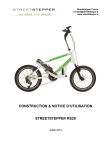
1
USER MANUAL
Please take the time to read and follow the instructions and information in
this manual, as well as the enclosed brake manufacturer´s instruction
manual, before using the “bodybuddy” Streetstepper for the first time!
Version 1.2
September 2007
USER MANUAL
For the „bodybuddy ® “ Streetstepper ®
Version 1.2.
© September 2007
According to EN 14764:2005
GRADITECH Entwicklungs GmbH
Grillhofweg 20b
A-6080 Innsbruck-Vill
AUSTRIA
Tel.: +43 (0)664 / 5115 878
Fax: +43 (0)512 / 56 44 42
Mail: [email protected]
www.streetstepper.com
Hot Chili & D.A.R.T GmbH
Carl-Zeiss-Straße 43-45
D-73614 Schorndorf-Weiler
GERMANY
Tel.: +49 (0)7181 / 97 8 42 - 44
Fax: +49 (0)7181 / 97 8 42 - 20
Mail: [email protected]
www.hot-chili.com
Bodybuddy®, Streetstepper ® as well as the logo (tire symbol &
drive element) are registered trade marks of GRADITECH
Development GmbH (Innsbruck/Austria)
This
innovative
product
is
protected
and
patented
by
GRADITECH Entwicklungs GmbH.
The product design is made by KISKA (Salzburg/Austria) and is
registered and protected through GRADITECH.
Dear Customer
Thank you for buying the “bodybuddy” Sreetstepper!
The “bodybuddy” is a world novelty, that’s been available in selected stores since autumn 2007. You
are now the proud owner of this innovative product, shortly after it has been released onto the market.
Marketing researchers respectfully call these people “innovators” and “early adopters”. We are glad to
welcome you in the circle of “bodybuddy” owners!
Your “bodybuddy” Streetstepper is a high-tech-vehicle driven by muscular power, which cleverly
combines fitness and transport. It is equipped with the latest technical devices, and whilst developing
it, we emphasized on quality, ease of use, low maintenance and safety.
The “bodybuddy” Streetstepper is easy to use, and most people will be able to ride it immediately.
Given that this vehicle is a brand new form of transport, a few special features need to be noted and
possible risks, which you may not be familiar with. This vehicle is different than any other product you
might know.
Please read and follow the instructions and information in this, as well as the enclosed brake
manufacturer´s instruction manual, before using the “bodybuddy” Streetstepper for the first
time!
We wrote this user manual with your safety and fun in mind. We can not predict every aspect of the
versatile use of this vehicle, but the owner manual includes important suggestions regarding your
safety when used properly, as well as some tips for the optimal riding experience and product
longevity.
The detailed list of safety instructions and recommendations should not make you think that your
“bodybuddy” Streetstepper is a particularly dangerous or complicated invention! If you follow the
suggestions, the “bodybuddy” Streetstepper is no more difficult or risky than riding a bike.
If any questions arise, or you are still uncertain about something after reading the user manual, please
contact the distributor - or us!
Have fun and safe travels with the “bodybuddy” Streetstepper!
FREE THE GYM! – TRAIN AND MOVE!
Your „bodybuddy“-Team
www.streetstepper.com
CONTENTS
1. Important Suggestions
5
2. Technical Specifications
7
3. Guidelines for riding in traffic
8
4. Definitions
9
5. Before your first ride
10
6. Before every ride: technical check
11
6.1 Technical check – overview
11
6.2 Detailed description of the technical check
12
7. Particular warnings
16
8. Riding techniques – how to “streetstep” perfectly!
18
9. The “bodybuddy” as a work out machine
21
10. Adjustment and Assembly
22
11. Cleaning and Care
25
12. Repair and Maintenance
26
13. Tightening torque for bolts
27
14. Warranty
27
Enclosures
• Brake manufacturers instruction manual
• Registration
• Warranty
4
1. Important Suggestions
1. Important Suggestions
The user manual is filled with suggestions and information for your own safety and fun as well as the
longevity of the product. Please follow the suggestions and information, otherwise you may harm
yourself and/or other people and cause liability claims!
Your “bodybuddy” Streetstepper is equipped with hydraulic brakes from the renowned, German
manufacturer MAGURA. The user manual for your “bodybuddy’s” brakes is enclosed and is an integral
part of this user manual. Read the brake user manual carefully and follow the instructions, suggestions
and information! In case the manual is missing, please contact the distributor or us! (You can find
more details and information about the brakes online at www.magura.com)
In the instruction manual we talk about a tightening torque for bolts [Nm]. Do not trust your feelings
when tightening the bolts. “Tight” does not mean “tight enough”! ONLY a bolt tightening torque will tell
you exactly when it is tight enough. Use a tightening torque for bolts, whenever the user manual
mentions the amount of torque. Incorrect tightening of the bolts may result in damage and
malfunctions, which can be harmful to your own and other people’s lives and health!
When we manufactured the “bodybuddy” Streetsteppers we focused on safety, ease of use and low
maintenance. It needs to be mentioned though, that this product is built with ground-breaking technical
equipment. In this respect, please leave any maintenance and repair work to the experts! If any
maintenance, assembly or repair work is not explained in this user manual, please contact an
authorized distributor!!
If the maintenance, assemble or repair work in the user manual is not clear and you are having
trouble, leave it to the distributor as well! Unfinished or improper work performed on the equipment
may leave the product permanently damaged, and could therefore harm your life and health!
!! ATTENTION!!
Important notice regarding lending your “bodybuddy” Streetstepper to someone else!
No liability claims will be acceptable when used by a non-owner!
Immediately you will draw attention, when riding your “bodybuddy”. Your friends, family and even
strangers will want to try your “bodybuddy. Especially kids and youngsters will be fascinated and
asking to take the “bodybuddy” for a spin. After reading the user manual and a test ride, you should
know how to use the vehicle correctly and avoid dangers. Please keep in mind that someone who
does not have that knowledge is not safe to ride it. We would like to inform you that neither the
manufacturer nor the distributors can be held responsible for any bodily injuries or material damages,
caused by third persons using the “bodybuddy”.
5
1. Important Suggestions
We know how tempting it is to loan a friend your “bodybuddy”, because it is fun to share an exciting
new toy, but sometimes it is better to just enjoy your friend’s admiration! Be aware of the risk of
loaning your “bodybuddy” to someone else even if it is just for a short test run. If you would like to
introduce someone to your “bodybuddy”, please consider the following:
•
Make the person aware of all the dangers and risks mentioned in the user manual, as well as
the liability claims.
•
Please explain the person the correct use of the “bodybuddy” and the particular dangers and
risks if it is used incorrectly!
•
Insist that they follow your instructions! Immediately stop the test drive if they behave in a
hazardous, careless or unsafe manner.
•
Insist that they listen to your instructions, especially the ones for the brakes, before they start
the test run!
•
Make sure the person is wearing appropriate clothes and a helmet!
•
Do the test drive away from traffic!
•
Do the technical check mentioned in this manual and make sure the brakes are working and
the handlebars are adjusted to the correct height and mounted properly.
•
Consider the body weight and height restrictions! (chapter 2 “technical specifications”)
•
Note that kids under 12 years, without a bike driver’s license are not allowed to ride in traffic!
(Not even when the legal guardian would permit it!)
We would like to point out that a verbal explanation of what is written in the user manual, does not
replace reading it and therefore we do not cover any claims, caused by a third party, even if they were
instructed by you.
We recommend you send the person interested in trying the “bodybuddy” to the nearest distributor!
Distributors are authorized to advice and supervise someone in their first test ride, which alleviates
you of any responsibilities!
Our product is an ever developing machine and some of the illustrations might not be up
to date with your new model of the “bodybuddy” Streetstepper, but this does not affect
the subject matter of this user manual.
6
2. Technical Specifications
2. Technical Specifications
1.
Product name
bodybuddy®
2.
Type of vehicle
Streetstepper® – single track vehicle for standing use,
and driven by muscle power
3.
Specified use
4.
Series
September 2007
5.
Power System
Step-system (pedals) with automatic gradient
transmission
6.
Length
183 cm
7.
Handlebar
adjustable from 104 cm to 119 cm
8.
Weight
1)
designated for driving on streets and fixed trails
1)
15,8 kg
2)
9.
Max. capacity weight
10.
Permitted user height
11.
Luggage Rack
95 kg (Including additional baggage)
145 cm – 195 cm
optional (any certified handlebar carriers are suitable)
2)
12.
Max. capacity for luggage
13.
Max. total weight (incl. operator
and luggage)
120 kg
14.
Front brake
Magura „Julie“ (hydraulic disk brake)
15.
Rear brake
Magura „HS 11“ (hydraulic rim brake)
16.
Positioning of brake handles
right = front brake
left = rear brake
17.
Wheels
20 inch, hollow section rims
18.
Tires
Vredestein „Perfect Moirée“, 20 x 1,75 inches
Manufacturer’s recommended tire pressure: 2,8 – 4,5
bars (40 - 65 psi).
We recommend 4 bar (60 psi)
19.
Axis
Front: quick release axis, rear: nuts
20.
Gears
none; automatic transmission
21.
Bearings
all bearings (except some friction bearings in the
brakes) are ball bearings, lubricated for life
10 kg
1)
Use your ‘bodybuddy” Streetstepper on streets and smooth trails only! The
“bodybuddy” is not to be used off-road. Do not jump with it! Do not drive over
curbs, edges, stairs or other obstacles! The vehicle could get damaged and you
could get hurt. Any incorrect use, racing, jumping or other similar activities will
result in the loss of any right to liability claims towards the manufacturer.
2)
Even top-quality equipment and components get damaged when overstrained.
Note the maximum allowed weight! (see top of page 9., 12. And 13)
7
3 Guidelines for riding in traffic
3. Guidelines for riding in traffic
The Streetstepper is a muscle powered, single track vehicle, equipped with top quality brakes. Its
performance (speed and climbing ability) is comparable to a modern City or Fitness bike and in some
cases even better (agility and mobility). Just like a bike, the Streetstepper is technically suitable for
riding in traffic.
The tires of the “bodybuddy” are equipped with reflectors, which are required by law in Austria,
Germany and Switzerland.
To ride your “bodybuddy” in traffic legally, further equipment is necessary, which is not mounted to the
standard Streetstepper, because of the differing standards throughout Europe regarding:
•
More reflectors
•
Lights
•
Bell
•
Switzerland: Insurance sticker
Before riding in traffic, please find out (for instance at the distributing store)
about the local restrictions and laws in your country!
The “bodybuddy” does not have a seat. It is ridden while standing and the experience might be a little
different than riding a regular bike. Giving hand signals might require a bit more balance and practice,
than on your bike.
Therefore you should get used to it on a less busy road without heavy traffic.
Practice giving hand signals to the right as well as to the left. Do not apply brakes
while giving the hand signal. If you need to, slow down, put your hand back on
the bar and then apply brake. Do not brake hard, while giving the signal! Riding
one handed while braking may cause a bad accident!
Do not ride the “bodybuddy” without holding on to the handlebar! Since the
Streetstepper does not have a seat, hands-free riding may result in a serious
accident!
8
4 Definitions
4. Definitions
Your “bodybuddy” Streetstepper is a technical novelty. Mechanical components are used, that you
might have never seen on any other product. Illustration 1 shows the different parts and new names
for them, which are important for understanding the user manual. Please make yourself familiar with
these terms before you read on!
Fig. 1:
brake lever
stem
bracket of the step pedal
steering rod
upper stop for step pedal
(Elastomer)
headset
carrying handle 1)
tread
head tube
pulley
chain
step pedal
bearing of the step pedal
lower stop for step pedal
(Elastomer)
rear brake
cam of the gear system
1)
reflecting strip
retaining spring
here you find the
chassis number for
registration!
The carrying handle is not to be used as a seat! Do not sit on the carrying
handle! It could break and cause serious injuries! Besides, riding while sitting will
affect the weight distribution and you could lose control and fall!
9
5. Before your first ride
5. Before your first ride
The distributor has assembled your “bodybuddy” so it is ready for use. A test run was made and the
mandatory checks were done to ensure flawless and optimum operation. Most likely the distributor has
run you through the initial instructions and you have had a test drive, but before you take it for a spin
on your own, please follow these instructions:
Is the handlebar adjusted to the right heights?
Take the Steetstepper with both hands and stand right next to the vehicle. Your upper
arms should be along the side of your body and the forearm should be at a 90 degree
angle to your upper arms. (Further information on adjusting the handlebar can be found
in chapter 10.)
Are you familiar with the brake system?
Check if your brakes are used the same way on the Streetstepper as on your bike.
If they are positioned differently it might take some getting used to. Practice on
low traffic roads, because wrong use of the front brake might result in an
accident.
The hydraulic brake system is a lot more powerful, than you might be used to!
Practice carefully and get used to the power of the brakes away from traffic.
New brakes need to be broken in, in order to run smoothly and at optimal
performance! This takes about 30 full brake applications at a speed of 30 km/h,
away from traffic. The same needs to be done when you get your brake pads
replaced!
The brake performance depends on the kind of pavement you ride on. Rain or wet
roads can dramatically influence the brake capability. So be extra careful when
riding on gravel and when roads are wet!
Further information on the brake system can be found in the enclosed user manual from
the manufacturer.
10
6. Before every ride: technical check
6. Before every ride: technical check
6.1. Techncal check - overview
The following checks should be performed before each ride:
1. Is the quick release axis of the front wheel mounted correctly?
2. Brake performance?
3. Are the nuts tight on the axis of the rear wheel?
4. Is there enough pressure in the tires?
5. Condition of the tires?
6. Is the steering mechanism/headset smooth and easy-going?
7. Is the steering mechanism working properly?
8. Is the handle bar installed securely to the stem?
9.
Is the handle bar installed securely to the front wheel?
10. Is the kick stand up?
If any of these points are faulty, please refrain from use of your “boddybuddy”,
and when in doubt call your distributor!
Ride with a suitable helmet!
With a bit of practice, you can get up to great speed as on your bike, thanks to the
patented power system used for the “bodybuddy”. More than 30 km/h on flat roads (and
significantly more when going downhill). Be aware that this kind of velocity involves
greater risk and danger! Always ride with a suitable helmet!
11
6. Before every ride: technical check
6.2. Detailed description of the technical check
1) Is the quick release axis of the front wheel mounted correctly?
1. Check if the lever of the quick release axis is mounted correctly, as you can see in the
illustration: The lever of the quick release axis needs to be parallel to the front tire. It should
not be sticking out to the side.
2. Push on the lever where it says CLOSE. There must be a significant resistance when pushing
this lever.
3. If the lever is still movable, it is too loose! You have to adjust the pre-tension of the
quick release axis by turning the nut on the opposite side of the lever!
The lever is closed correctly when
parallel to the front tire.
If the quick release axis of the front wheel is not mounted correctly this can result
in loss of your front wheel whilst riding, which can result in an accident and
injuries!
Remember that the lever of the quick release axis can be loosened quickly and easily
without tools (beware of malicious pedestrians or mischievous youngsters…), so please
check it before every ride. Check your vehicle before each ride, even if you just stopped
for a minute (for instance while stopping to get groceries) and have left it unattended!
12
6. Before every ride: technical check
2) Are the brakes functioning?
Perform a brake check while you are standing still, by pulling the brake lever to the handle bar. Both
brakes should build some resistance (pressure point). Neither one of the levers should reach the
handle bar without resistance.
You can find further information in the enclosed user manual from the brake manufacturer.
3) Are the axel nuts on the rear tire tight?
Incorrect tightening of the axle nuts might result in a loss of your vehicle’s parts and
accidents can occur!
4) Is there enough pressure in the tires?
•
Check the tire pressures at least manually with the “thumb test”, by applying the thumb on one
side of the tire and 2 – 3 fingers on the opposite side. Apply pressure. The tire should feel tight
and firm.
•
To get optimum pressure (see below) in your tire use a manometer (pressure measuring
device) from time to time.
Recommendation: The manufacturer of the standard tires recommends a
pressure of 2,8 – 4,5 bar (40 - 65 psi). We recommend a pressure of about 4 bar
(60 psi) for optimal driving performance and safety.
This recommendation applies to the standard tires! In case you use different tires,
follow the directions of the particular manufacturer.
5) Condition of the tires?
Visually inspect the tire. Any bulging or unusual wear and tear indicate damage.
A damaged tire might lose air and turn into a flat tire, which may cause severe
accidents! Damaged tires need to be replaced, ideally by the distributor.
13
6. Before every ride: technical check
6) Is the steering mechanism (headset) smooth and easy-going?
1. Lift the bike up at the frame where it says “bodybuddy”, so that the front tire is off the floor.
2. Turn the handle bar as far as possible to the right and left. This should be an easy movement,
silent and without any friction.
3. Turn the handle bar about 5 degrees to the right and then let it go. It should keep turning to
the right without any further input from you.
4. Repeat the same test on the left.
7) Is the steering mechanism (headset) free moving?
1. Stand next to your bike and apply the front brakes (standard brake lever on the left).
2. Shake the handle bar, with the brake lever applied, towards the driving direction and into the
opposite direction.
3. Make sure nothing is loose while you do this. If there is a clearance in the headset you will feel
it clearly.
If you ride with an incorrectly adjusted, loose or defect steering mechanism
(headset), several components of the vehicle (bearings, parts of the frame) are
exposed to excessive strain and pressure, resulting in the malfunctions and
damage of your vehicle.
Adjusting the headset requires expert knowledge. Leave it to the distributor!
8) Is the handle bar installed tightly to the stem?
Take the handle bar with both hands and try to twist it at the stem. The three screws attaching it to the
stem should be tightened enough to keep it from twisting!
If the screws are not tight enough, the handle bar may move whilst riding which
can result in an accident!
14
6. Before every ride: technical check
9) Is the handle bar installed tightly to the front wheel?
Stand in front of your vehicle and hold the tire tightly between your legs, and try to twist the handle
bar. The handlebar should not move unless a lot of force is needed. It should take some effort to twist
it or should even be impossible.
A sudden twist of the handle bar while riding might be the result of loose bolts
and can cause severe accidents!
10) Is the kick-stand up?
The “bodybuddy is equipped with a standard kick-stand. Riding with the kickstand down may result in severe accidents!
15
7. Specific Warnings
7. Specific Warnings
“bodybuddy” the Streetstepper is a fundamentally new innovation and it is important to know about
these particular warnings:
1) Watch out for obstacles at head height!
OBSTACLE
Because you are in an upright position while riding the “bodybuddy”, you are
significantly taller than on a bike.
Pay attention to head high obstacles like street signs, awnings, underpasses,
parking garages and similar objects! A collision with obstacles can cause severe
injuries!
Immediately avoid any head high obstacles like street
signs and awnings. If it is not possible to avoid obstacle
OBSTACLE
like underpasses, reduce the speed and bend down to
avoid a collision.
Always ride with a suitable helmet! A bike helmet can prevent you from getting
injured when colliding with obstacles!
16
7. Specific Warnings
2) Always ride with both hands on the handle bar. Do not ride hands-free!
Even though the “bodybuddy has an excellent straight-running stability, it lacks the stabilizing seat
found on a standard bike, and requires a different kind of stabilization! The “bodybuddy” is stabilized
by means of your handle bar, similar to a scooter. Riding single-handed can be particularly dangerous
when you gain a certain speed. The vehicle could rear up resulting in loss of control, which can result
in an accident. The same applies when operating the brakes while driving single-handed.
Never try to ride your “bodybuddy” hands-free. This could result in severe
accidents!
Ride with both hands on the handle bar - particularly when riding fast! Practice
giving hand signals at a safe and obstacle free area before riding in traffic! Use
your brakes only when both hands are on the handle bar!
3) Always wear shoes with anti-slip soles
The treads on the “bodybuddy” are covered with an excellent anti-slip surface. This anti-slip surface is
suitable most for sneakers or shoes with soft rubbery soles.
The anti-slip quality of the surface is significantly diminished with hard leather soles.
The anti-slip surface is also significantly diminished when the shoes are very dirty and if rain or slushy
snow is accumulated on shoes or treads.
Always wear anti-slip shoes. Make sure the treads are safe to step on. Adjust your
speed to the condition (reduced friction) of the treads and your shoes. Severe
accidents can occur when you slip off the tread while riding!
17
8.Riding techniques
8. Riding techniques – how to “streetstep” perfectly!
(A video at www.streetstepper.com shows practised drivers in all driving
situations)
Different to the crank drive of a bike, the uncoupled step pedals of the “bodybuddy” do not predefine
the work movement. You can step slow or fast, with the right leg, the left leg or alternately, and you
can quit stepping. The gear system automatically provides the right transmission ratio.
To tap the full potential of the Streetstepper, please follow the suggestions below:
1) Get on and go!
Different to a bike, the “bodybuddy’s” frame does not
get in the way when getting on and off the vehicle. If
you are standing to the left of the Streetstepper, put
your right foot on the right tread first and vice versa.
That might seem awkward at first, but makes getting on
and riding away much easier. Use the leg that is still on
the floor to push yourself and there you go! Do not
apply brakes when you start riding.
2) Comfortable riding on flat terrain
To get from point A to point B comfortably, or for a low
impact work out make small steps. The treads should
stay in the lower region of the vehicle. If you like, you
can step with just one leg or coast and enjoy the ride.
The treads will sink to the bottom for a comfortable
posture.
The “bodybuddy” is powered by your weight. Do not try
to apply power to the handle bar to get more power to
the treads. That is tiring and does not work, so ride with
a relaxed upright posture!
18
8.Riding techniques
3) Speeding up
To reach a higher speed, lift your legs up higher to use
the full range of the step pedals and increase your step
frequency. This motion is similar to jogging. When the
tread is close to the lower position your balls of the feet
should carry most of the weight. Work with your weight
only and do not yank on the handle bar. Ideally it
should feel like jogging while standing, with a
continuous up and down movement of the whole body.
If you would like to exceed 30 km/h, lower your upper
body to improve aerodynamics.
4) Riding up-hill and accelerating
Riding up-hill takes a bit of experience. Do not attempt
to ride any roads with more than a 10% gradient,
unless you are comfortable riding on flat roads using
the full range of the step pedals.
To ride up-hill you need to start out with the step pedals
at their highest position, because that is where the
transmission ratio is optimal.
ADVICE: over-exaggerate when you first start out, so
you can hear the step pedals hit the upper stop.
Then you need to continue doing this at a high step
frequency in order to keep going.
The key for going up-hill is to perform lots of small
steps in the tread’s upper range.
19
8.Riding techniques
Don’t try to force the treads to move by applying more
pressure. Your weight is the only thing necessary!
To succeed in ascending a road with 15% gradient,
move your feet to the very back of the treads. You can
apply more force to the rear wheel in this manner.
With a bit of practice you can accomplish riding roads
steeper than 15%.
For long up-hill rides – to improve your stamina for
instance – we recommend 10 – 13% gradient
5) Reversing
For technical reasons the “bodybuddy” cannot be used in reverse mode. To move it backwards you
must lift the rear wheel by the plastic carrying handle.
Do not sit on the plastic handle. It could break and cause severe injuries!
Ergonomically speaking, sitting while riding is not favorable for an ideal weight
distribution. When sitting you could lose control over your vehicle, which results
in severe accidents!
6) Do not ride over stairs or high kerbs!
The frame of the “bodybuddy” is low to the ground. The hydraulic line for the rear brake runs through
the beam of the lower stop for the step pedals. The connecting line for the rear brake is located below
the frame and is not totally protected.
Do not ride over thigh kerbs or stairs, because the hydraulic brake could be
damaged.
Even
if
you
push
it,
you
must
lift
it
over
high
kerbs.
In case the hydraulic brake gets damaged, your distributor will fix it professionally and
reasonably.
20
9. The „bodybuddy“ as a work out machine
9. The “bodybuddy” as a work out machine
The “bodybuddy is not just an ideal form of transport for the city and the countryside, it is also an
excellent work out machine!
It is particularly suitable for endurance training as well as high impact training.
The main health benefits of the streetstepper:
•
Homogenous, concentric muscle exertion
•
Ideal hip, knee and ankle joints
•
Upright body position and no spinal damaging forced posture caused otherwise by cycling
•
Gentle, low impact step movement
•
Works out all muscle groups which were created during evolution enabling us to walk upright
•
As there is no saddle, tummy, upper body and arms are also in motion (no movement
blockage from the hips upwards)
•
Due to the upright riding position and the uncoupled step pedals, coordination and balance
are improved automatically
Like with any other work out machine, your exercise program and heart frequency should match your
physical condition!
Training at a heart frequency that is too high for your personal health levels can
be health damaging!
Talk to a trainer about a suitable work out and intensity (heart frequency) for you,
before using the Streetstepper for work out purposes!
Just like with the use of any other work out machine, a heart frequency
measuring device is recommended!
21
10. Adjustment and assembly
10. Adjustment and assembly
The Streetstepper will be fully assembled and tested by the distributor. We recommend you have it
adjusted to your body height and personal requirements in relation to the height of your handle bar
and the location of the brake levers.
You can perform the following adjustments and assembly work yourself:
1) Installing and removing the front wheel
The front wheel is equipped with a quick-release axis, which permits you to quickly and easily remove
the front tire – for instance when transporting the vehicle in a car.
Make sure the quick release axis is locked down securely!
A faulty and incorrect tightening of the quick release axis may result in loss of the
tire while riding. Severe accidents and danger to your life and health may occur.
(see chapter 6.2.)
Read the brake user manual enclosed by the manufacturer, before you install or
remove the front wheel! If you are not used to hydraulic disc brakes, have the
distributor show you how to install and remove the front wheel.
Transporting the vehicle in a passenger vehicle does not require removing the front tire.
We recommend inserting the handle bar/steering rod and turning the handle bar 90
degrees. It fits easily in most cars where you can put the seats down, not necessitating
removal of the front tire.
22
10. Adjustment and assembly
2) Adjusting the handle bar height
Loosen the socket head screw at the frame (see
arrow), pull the handle bar to the desired height
and tighten the socket head screw again.
The right torque for the bolt is described in
chapter 13!
Loosen the screw until you can easily adjust the
handle bar. If you loosen it too much the lower
part of the handlebar could fall inside of the
frame. It takes a lot of effort to get the part back
into its original position. If it is difficult to move
the handle bar twist it back and forth while pulling
or pushing.
Pay attention to the marking on the steering rod,
which marks the maximum extension length.
Do not pull it out past this marker!
Do not pull the handle bar past the mark, which points out the max. extension
length! The stability of the handle bar will be diminished, parts could get
damaged and accidents may occur!
23
10. Adjustment and assembly
Rule of thumb for adjusting the handle bars to the correct height:
Stand next to your bike, with both hands on the handle bar. Your upper arms should be
along the side of your body and the forearm should be at a 90 degree angle to your
upper arms.
3) Adjusting the handle bar position
To adjust the handle bar position loosen the
three bolts on the stem (see arrow) until you can
easily twist and adjust it to the desired position.
Then tighten the three bolts again.
Make sure all three bolts are tightened equally
and that they are not crooked. The three bolts
need to be tightened to where the handle bar
does not move anymore!
The correct torque for these bolts can be found
on page 13!
If the bolts are not tight enough the handle bar could suddenly move and twist
while riding, which may result in severe accidents!
24
11. Cleaning and care
11. Cleaning and care
Dried dirt or salt (from winter use and/or sweat) may damage your Streetstepper. Cleaning with a
steam pressure cleaner is not recommended: the pressurized water coming out of the jets can
penetrate into the sealed area of the bike and dilute the lubricant, which decreases the lifespan of the
bearings.
Clean your Streetstepper by either gently hosing down or using a bucket of water and a sponge or
cloth. For heavy soiling use window cleaner.
While cleaning, check for chipped paint, loose bolts or spokes and check the pressure in the tires and
the brake pads.
Pay attention to tears, bent parts or discoloration. When in doubt contact your distributor. Damaged
parts need to be replaced immediately and paint chips need to be touched up!
Do not clean your Streetstepper with a pressurized water jet cleaner or steam
blaster at close proximity!
When your vehicle is clean, we recommend you wax all painted areas, spores, hub joints, bolts, nuts,
etc. and polish it with a soft cloth
After you have cleaned and polished the bike you should lubricate the chain. Use
any standard chain wax.
Make sure none of the cleaning products or lubricants touch the brake pads,
brake discs or rims.
It could diminish the brake performance drastically and result in severe
accidents!
25
12. Repair and Maintenance
12. Repair and Maintenance
Your “bodybuddy” Streetstepper is a technical innovation and is built with parts that you might not
recognise from any other vehicle.
Leave repair and maintenance work to your distributor!
If you would like to carry out repairs and maintenance yourself, make sure you
just do so on parts that you are familiar with from your bike, and only if you have
experience in fixing these parts!
The rear wheel construction including the axis, the hub, the two gear boxes with cams and the chain is
a patented invention that is not used on any other vehicle. Inserting and removing the rear tire takes
expertise and should be done by trained professionals only!
Do not attempt to remove the rear wheel (to replace the tube for instance)! Always
leave it to the qualified distributor.
INSERTING AND REMOVING OF THE REAR WHEEL BY A NON QUALIFIED
PERSON, CAN LEAD TO INJURIES, FOR WHICH THE COMPANY DOES NOT
ASSUME LIABILITY!
THE WARRANTY DOES NOT COVER DAMAGE CAUSED BY INCORRECT
MOUNTING OF THE REAR WHEEL BY NON-QUALIFIED PEOPLE!
26
13. Tightening torque for bolts
14. Warranty
13. Tightening torque for bolts
For information purposes only to be carried out by trained personnel (Service)
COMPONENT
SCREW CONNECTION
Stem
3 bolts to secure the handle bar
M6 / 10 Nm
Stem
1 bolt to adjust the height of the handle bar
M8 / 25 Nm
Retaining springs
1 bolt above and 1 bolt below
Step pedal, bearing
1 bolt in the lid
Footsteps
6 attachment bolts per foot step
M5 / 6 Nm
Step pedal, bracket
3 attachment bolts per pedal
M5 / 6 Nm
Step pedal, bracket
3 attachment bolts to secure the chain
M4 / 3 Nm
Pulley
1 attachment bolt
M10 / 49 Nm
Rear axle
2 axel nuts
M8 / 25 Nm
Front brake
2 attachment bolts
M6 / 10 Nm
Rear brake
2 x 2 attachment bolts
M5 / 6 Nm
*
TORQUE
BOLT
RETAINING
DEVICE
(Loctite 243)*
-
25 Nm
Disassembly of Loctite-secured bolts:
1)
Disassemble with regular tools
2)
If it is difficult to loosen the bolt, warm it up to about 150 °C. Loosen while the bolts are warm!
3)
After disassembling Loctite-secured bolts, Loctite needs to be reapplied before remounting.
14. Warranty
•
There is a 24 month warranty on the frame of your Streetstepper and all Streetstepper-specific
parts, starting on the day you bought it, with proof of purchase. Keep the invoice!
•
Parts made by other manufacturers are covered up to 24 months, starting on the day you
bought it, with proof of purchase.
•
The warranty covers faulty materials arising during fabrication at the manufacturers.
The warranty does not cover:
•
Anything related to improper use, inadequate care or lack of maintenance
•
Regular wear and tear (brakes, tires, tubes, surface of the tread pedals)
•
Damages caused by accidents or transportation
•
Force majeure, and acts of nature beyond control
•
Inappropriate use
27