1
Framework for management of VO breeding environments
45
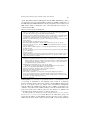
system. The VBE Competency Management System (CMS) shall include a catalog
of competencies and a set of functionalities to manage it. In VBE, potential users of
the CMS include the VBE Administrator, Broker, VO planner, VO Coordinator, and
VBE Adviser. Table 2 summarizes some of the important issues needed to be
considered in the CMS.
Table 2. Issues in Competencies Management
Competencies catalog:
- Ontology of competencies / skills – competencies need to be properly specified and organized in
some taxonomic structure, supported by suitable navigational interface
- Related competencies/ skills must be identified as means for replace-ability or equivalence of skills
- Some hierarchy of competencies must be defined and supported for search, for instance the more
generalized (e.g. welding) as well as some specializations (e.g. spot welding).
- Furthermore, the inter-relationships (e.g. the IS-A, the whole-part, etc.) among competencies / skills
must be defined.
- Properties aggregation to characterize each competency.
- Basic catalog entities manipulation – flexible search (multi-criteria), add, remove, edit, etc.
- Internal Core and some non-core – For each member we can distinguish between the core and the
non-core competencies.
- External valuation of VBE competency – Considering the global market level of the competency of
the VBE as a whole.
- From an “operational” point of view, how to determine / collect competencies? Automatic? Manual?
How to update them?
- Dynamic properties?
- It may be interesting to consider levels of competencies / skills. For a given competency C, does our
VBE master it to the level of setting strategic developments, or is it only able to “follow” what is
suggested by a customer, for instance.
Competencies Management functionalities:
- Competencies appraisal functionality - How “robust” or “sustainable” is the competencies base?
- Skills’ gap analysis. What if one member leaves? Specific indicators of skill robustness? Skill
robustness inside an organization – skill possessed by one employee or part of the “culture” of
the organization? How to rate the skills base?
- Marketing support functionality - How to “sell” it to the outside?
- Identification of strengths and weaknesses? (Dynamic) Identification of new potentials?
- Acquisition of complementary skills? Which support functionality?
- Internal competencies & external but “easily” accessible competencies
- What is the “unit”? Enterprise? Department? Group?
- Relationship to processes and roles
- Endorsement / “accreditation” of competencies. Or rating their quality/past performance?
- Notion of joint competency (when one specific competency results from the contribution of 2 or
more partners, and such competency cannot be provided by a single partner). Or is this represented
by the notion of complex competency (see above)?
- Others to be determined.
Value Systems. It is commonly accepted that the behavior of an individual, society,
or ecosystem is determined by the underlying value system. It is intuitively
understood that the values considered in a business-oriented VBE are different from
those in a non-profit context (e.g. disaster rescue and incidence management
network). Taking the simplified view that the goal of a VBE is to maximize some
“attribute” of its value system, within a business context the dominant value is the
profit (in economic sense), while in other cases the objectives are altruistic and
compensated by the amount of prestige or social recognition, etc.
A value system is in essence the ordering and prioritization of a set of values
that an actor or a society of actors holds. However, the values that a group or an
actor holds may fall into several different categories since the concept of value is
multifaceted. In order to define a value system for a VBE, we need to first define the