1
88—Chapter 26. Time Series Regression
series is stationary or not before using it in a regression. The formal method to test the stationarity of a series is the unit root test.
Unit Root Tests
EViews provides you with a variety of powerful tools for testing a series (or the first or second difference of the series) for the presence of a unit root. In addition to the existing Augmented Dickey-Fuller (1979) and Phillips-Perron (1988) tests, EViews now allows you to
compute the GLS-detrended Dickey-Fuller (Elliot, Rothenberg, and Stock, 1996), Kwiatkowski, Phillips, Schmidt, and Shin (KPSS, 1992), Elliott, Rothenberg, and Stock Point Optimal (ERS, 1996), and Ng and Perron (NP, 2001) unit root tests. All of these tests are available
as a view of a series.
Performing Unit Root Tests in EViews
The following discussion assumes that
you are familiar with the basic forms of
the unit root tests and the associated
options. We provide theoretical background for these tests in “Basic Unit Root
Theory,” beginning on page 92, and document the settings used when performing
these tests.
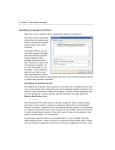
To begin, double click on the series name
to open the series window, and choose
View/Unit Root Test…
You must specify four sets of options to
carry out a unit root test. The first three settings (on the left-hand side of the dialog) determine the basic form of the unit root test. The fourth set of options (on the right-hand side of
the dialog) consist of test-specific advanced settings. You only need concern yourself with
these settings if you wish to customize the calculation of your unit root test.
First, you should use the topmost combo box to select the type of unit root test that you
wish to perform. You may choose one of six tests: ADF, DFGLS, PP, KPSS, ERS, and NP.
Next, specify whether you wish to test for a unit root in the level, first difference, or second
difference of the series.
Lastly, choose your exogenous regressors. You can choose to include a constant, a constant
and linear trend, or neither (there are limitations on these choices for some of the tests).
You can click on OK to compute the test using the specified settings, or you can customize
your test using the advanced settings portion of the dialog.