1
Pooled Estimation—491
Alternatively, we may produce estimates for the two
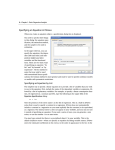
way random effects specification. First, in the Specification page, we set both the
cross-section and period
effects combo boxes to Random. Note that the dialog
changes to show that
weighted estimation is not
available with random effects
(nor is AR estimation).
Next, in the Options page we
change the Random effects
method to use the Wansbeek-Kapteyn method of
computing the estimates of the random component variances.
Lastly, we click on OK to estimate the model.
The top portion of the dialog displays basic information about the specification, including
the method used to compute the component variances, as well as the coefficient estimates
and associated statistics:
Dependent Variable: I?
Method: Pooled EGLS (Two-way random effects)
Date: 12/03/03 Time: 14:28
Sample: 1935 1954
Included observations: 20
Number of cross-sections used: 10
Total pool (balanced) observations: 200
Wansbeek and Kapteyn estimator of component variances
Variable
Coefficient
Std. Error
t-Statistic
Prob.
C
F?
K?
-63.89217
0.111447
0.323533
30.53284
0.010963
0.018767
-2.092573
10.16577
17.23947
0.0377
0.0000
0.0000
The middle portion of the output (not depicted) displays the best-linear unbiased predictor
estimates of the random effects themselves.
The next portion of the output describes the estimates of the component variances: