1
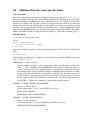
The activation of these distributions at surface events during the particle history generation
process is controlled by the surface species index flags ISRF$, ISRT$ read in the species
sub-blocks of section 2.4 and 2.5. By default the following conventions are used (and can be
overruled by calls to subroutines REFUSR, SPTUSR only, see section 3.3):
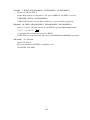
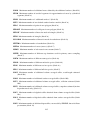
ISRF$ fast particle reflection species flag:
> 0 If ISRF$ ≤ NATMI, then ISRF$=IATM, the species labelling index for the reflected fast atom.
If ISRF$ > NATMI not in use, warning and error exit.
= 0 no fast particle reflection for this species: pf = 0
< 0 not in use, warning and error exit.
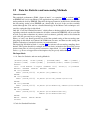
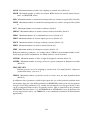
ISRT$ thermal particle re-emission species flag:
incident atoms, test ions and bulk ions:
> 0 If ISRT$ ≤ NATMI, then ISRT$ = IATM, the species labelling index for the reemitted thermal atom.
If ISRT$ > NATMI, then IATM is sampled from the distribution DATM(IATM).
= 0 no thermal particle re-emission for this species: pt = 0
< 0 molecule is re-emitted, and -ISRT$ is used to identify the species labelling index IMOL for the re-emitted molecule, exactly as described above for re-emitted
atoms. The relevant sampling distribution for species index IMOL in case -ISRT$
> NMOLI is DMOL(IMOL). This option can e.g. be used to specify the distribution of vibrationally excited molecules H2 (ν) emitted from a surface after
bombardment by incident H atoms, the so called Eley Rideal mechanism: Surface(with implanted H) + H → H2 (ν)
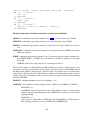
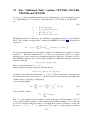
incident molecules:
> 0 If ISRT$ ≤ NMOLI, then ISRT$ = IMOL, the species labelling index for the
re-emitted thermal molecule.
If ISRT$ > NMOLI, then IMOL is sampled from the distribution DMOL(IMOL).
= 0 no thermal particle re-emission for this species: pt = 0
< 0 not in use, warning and error exit: “species index out of range”
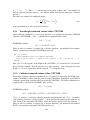
In code versions older than year 2000 this ISRT<0 options was also used to activate sampling the new species index IMOL from distribution DMOL. In order to
avoid un-intentional species sampling at surfaces this option was disabled from
year 2000 on.
These latter two surface-species index flags are considered to be particle properties, hence
they are read in the particle specification blocks 2.4 and 2.5. The flags in the next card can be
used to modify the pre-programmed fast particle reflection models, to some extend at least.
ERMIN For incident particle energies below ERMIN, the “fast” particle reflection model is
switched off. Only the “thermal” particle model is used.
140