1
Chapter 4
DWBA for multilayer systems
In Sect. 3.1, we have discussed wave propagation and scattering in 2+1 dimensional
systems that are translationally invariant in the horizontal 𝑥𝑦 plane, and have a vertical
refractive index profile 𝑛2 (𝑧). Here we specialize to layered systems where 𝑛2 (𝑧) is a
step function that is constant within one layer. First, only scalar interactions are
considered. Later, the theory is extended to account for polarization effects.
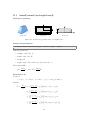
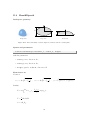
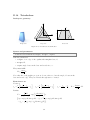
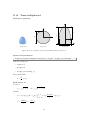
By convention, layers are numbered from top to bottom (see Fig. 4.1). The
top vacuum (or air) layer (which extends to 𝑧 → +∞) has number 0, the substrate
(extending to 𝑧 → −∞) is layer 𝑁 .
All layer interfaces are assumed to be perfectly smooth. Support for rough interfaces is already implemented in BornAgain, but documentation is adjourned to a later
edition of this manual.
4.1
Scalar case
4.1.1 Wave propagation and DWBA matrix element
To compute scattering cross sections in DWBA, we first need to determine the distorted
wavefunctions 𝜓𝑤 (𝒓) for 𝒓 inside the sample. The following derivation holds for the
incoming wave (𝑤 = i) as well as for the back-traced detected wave (𝑤 = f).
We consider wave propagation in one layer 𝑙 with constant average refractive
index 𝑛2 (𝑧) = 𝑛2𝑙 . A vacuum plane wave, impinging on a layered structure, is at each
interface partly reflected, partly refracted, so that the wavefunction inside a material
layer has an upward and a downward propagating component, as per (3.10). Each
component is a plane wave, with a wavevector
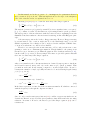
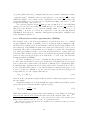
𝒌±
𝑤𝑙 = 𝒌∥𝑤 ± 𝑘⟂𝑤𝑙 𝒛.̂
(4.1)
As explained in connection with (3.4), the in-plane wavevector 𝒌∥𝑤 remains constant
across layer interfaces. The vertical wavenumber is obtained from (3.5),
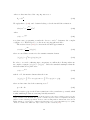
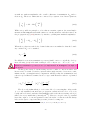
2 .
𝑘⟂𝑤𝑙 = √𝐾 2 𝑛2𝑙 − 𝑘∥𝑤
(4.2)
21