1
22
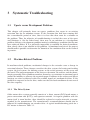
Systematic Troubleshooting
Table 3.1
Troubleshooting Guide for DC Motor
Problem
Possible cause
Action
Motor will not start
Low armature voltage
Make sure motor is connected
to proper voltage
Check for resistance in the
shunt field circuit
Check for open circuit
Weak field
Open circuit in armature or
field
Short circuit in armature or
field
Motor runs too
slow
Low armature voltage
Overload
Brushes ahead of neutral
Motor runs too
fast
High armature voltage
Weak field
Brushes behind neutral
Brushes sparking
Brushes worn
Brushes not seated properly
Incorrect brush pressure
Brushes stuck in holder
Commutator dirty
Commutator rough or eccentric
Brushes off neutral
Short circuit in commutator
Overload
Excessive vibration
Check for short circuit
Check for resistance in
armature circuit
Reduce load or use larger motor
Determine proper neutral
position for brush location
Reduce armature voltage
Check for resistance in shunt
field circuit
Determine proper neutral
position for brush location
Replace
Reseat brushes
Measure brush pressure and
correct
Free brushes, make sure brushes
are of proper size
Clear commutator
Resurface commutator
Determine proper neutral
position for brush location
Check for shorted commutator,
and check for metallic particles
between commutator segment
Reduce load or use larger motor
Check driven machine for
balance
Brush chatter
Incorrect brush pressure
High mica
Incorrect brush size
Measure and correct
Undercut mica
Replace with proper size
Bearings hot
Belt too tight
Misaligned
Bent shaft
Bearing damage
Reduce belt tension
Check alignment and correct
Straighten shaft
Inspect and replace