1
Assembly and operating instructions
AKOvisc 410-001
page1
1
General
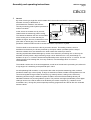
By virtue of having a single disc which rotates within the medium and which is used for measuring the
kinematic viscosity of Newtonian or
quasi-Newtonian mediums, the AKOvisc
viscosity measuring probe system represents a
market innoviation.
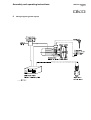
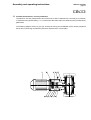
A disk, driven at constant revs by a motor,
rotates within the measuring probe housing.
The clearances between the disc and the sides
of the housing are so chosen that they lie
outside the region where a Couette flow occurs
(flow within a narrow gap). This also makes it
possible to measure mediums which contain solid matter, impurities or crystals.
The drive shaft is connected to the disc by a torsion element. The braking moment, which is
transferred to the disc by the friction produced by the liquid, makes it possible (with the help of
inductive emitters which are situated on the shaft outside the medium) to detect a
viscosity-proportionate differential angle by means of the electronic processing unit. In this way the
kinematic viscosity within a large measuring range can be determined to a very small margin of
deviation of up to <1 % with an almost total reproducibility within a pick-up-time of <1 second. The self
cleaning power of the rotating disk, for many mediums, is an advantage which is not to be
underestimated.
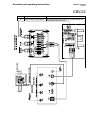
The modular construction of the entire apparatus, as well as of the electronic processing unit, allows for
a high degree of customising to the particular job in hand.
An self optimising PID controller, in conjunction with a fast and precise measuring probe, makes it
possible to obtain high control quality. A range of extension modules are able to be supplied which can
control and regulate a large number of devices (e.g. butterfly valves, heating units, valves etc.).
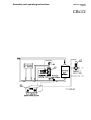
Measuring devices using the AKOvisc system are able to send their actual readings directly via
standard interfaces to a process guidance system. The precision and high reproducibility of the digital
readings can then be used for tasks to be decided by the master computer (e.g. variations to the
formulations etc.). During this process special processing programmes are able to filter out unwanted
extreme values.