1
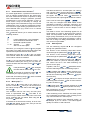
In Germany DIN EN, UVV apply, for industryspecific applications regulations of DVGW, Ex, GL,
as well as the rules of the local authorities (EVUs in
Germany).
1.4
3
Product description and functions
3.1
Functional scheme
3.2
Principles of operation
Forbidden modifications
Modification or other technical alteration of the device by the customer is not permissible. This also
applies for the use of spare parts. Any eventual
modifications/ variations will be carried out solely by
Fischer Mess- und Regeltechnik GmbH.
1.5
Impermissible operational modes
The operational dependability of the device is guaranteed only if it is used as intended. The device
version must be adapted to the medium used in the
system. The limiting values stated in the technical
data must not be exceeded.
1.6
Safety Considerations during Installation and Maintenance
The safety instructions stated in this manual, existing national regulations on accident prevention and
the internal rules and procedures on working, operation and safety of the operator are to be observed.
It is the responsibility of the operator to ensure that
only authorised and skilled technical personnel carry out any required maintenance, inspection and installation works.
1.7
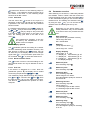
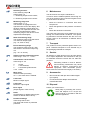
Explanation of symbols
WARNING!
...indicates a possible hazardous situation the non-observance of which
might result in hazards to humans, animals, environment and objects.
INFORMATION!
…points out important information for
efficient and trouble-free operation.
TIP!
…points out useful recommendations
that are not necessarily required for
operation that might however be of
use in certain situations.
2
Intended applications
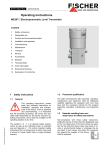
The product includes the functions of sensing, signal conversion, display, signal transmission, and
limit detection of differential pressure of gases and
liquids. The product must be used only for applications and under conditions specified by the manufacturer. In case of uncertainties, the user should
consult the manufacturer before installing and using
the product.
The instrument uses a tough, flexible sensing diaphragm embedded between stiffening plates and
balanced by springs on either side. The diaphragm
is at zero position when pressures on either side of
the diaphragm are equal. Inequality of pressures
results in deflecting the diaphragm towards the lower pressure side until a new equilibrium determined
by the changed balance of forces is reached. Fastened to the center of the diaphragm is an axial rod,
the other end of which forms the moving core of a
linear inductive displacement transducer. The linear
displacement is proportional to the pressure difference across the diaphragm. This displacement is
converted by the transmitter's electronic module to
a standard electrical signal output. An optional output signal can be slew rate limited, spreaded, inverted and piecewise transformed nonlinearly by
means of a table function.
4
Installation
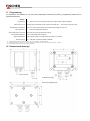
The device is equipped with a wall-mounting adaptor plate.
The pressure transmitters are calibrated at the factory while mounted vertically, pressure ports downward. However, they can be mounted in any orientation. If they are installed with any orientation other
than vertical (pressure ports downward) the zero
point must be reset.
IP65 protection for the housing is guaranteed only if
suitable connecting cable is used.
If the instrument is intended for outdoor application,
we highly recommend using an adequate protective
housing (or at least a big enough shelter) as permanent protection against UV-radiation on the
membrane keyboard and against exposure of the
instrument to rain or snow.