1
DELIVERY PRESSURE (PSI)
A tractor that is equipped with both a front and rear axle
brake proportioning valve with the trailer supply valve
activated (tractor/trailer mode) will experience 50% of service
brake application pressure on the front axle up to 40 psi.
With service applications above 40 psi the differential between
the supply and delivery diminishes until at 60 psi it is a
one-to-one ratio. The rear axles receive 100% of the service
application. With the trailer supply valve pulled out, (bobtail
mode) the front axle of the tractor will receive 100% of service
brake application and the rear axle(s) approximately 25%
during normal brake applications. As application pressure
increases, the differences between the front axle and rear
axle(s) pressures diminishes.
SUPPLY PRESSURE (PSI)
DELIVERY PRESSURE (PSI)
With the trailer supply valve released, air pressure in the
supply line to the trailer is exhausted to atmosphere. At the
same time the air pressure to the control port of the TR-3™
FULL DELIVERY MODE
(NO CONTROL PRESSURE)
DELIVERY PRESSURE (PSI)
SUPPLY PRESSURE (PSI)
LIMITING MODE
(WITH CONTROL PRESSURE)
BLEND BACK
POINT
LIMITING MODE
(WITH CONTROL PRESSURE)
BLEND BACK
POINT
SUPPLY PRESSURE (PSI)
FIGURE 3 PERFORMANCE CURVE FOR NOMINAL
BP-1™ BRAKE PROPORTIONING FRONT VALVE
inversion valve is also exhausted. This sequence causes
full reservoir pressure to be delivered to the control port of
the BP-1™ rear valve. This air is contained on the underside
of the upper piston and when a brake application is made
the air entering the supply port of the BP-1™ rear valve can
only affect the surface of the lower and inner pistons. Due to
the reduced area of the lower and inner pistons, the valve
delivers approximately 25% of the supply pressure to the
relay valve. See Figure 2, limiting mode. In addition, spring
#8, Figure 4 causes the lower piston to be initially held open
until initial delivery pressure closes the lower piston and the
valve will limit normally. The purpose of this initial delivery is
to offset the relay valve crack pressure when the vehicle is
operating bobtailed and enhance the performance of the
proportioning system.
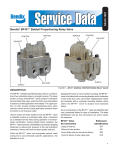
BP-1™ FRONT VALVE (REFER TO FIGURE 5)
SUPPLY PRESSURE (PSI)
FIGURE 2 PERFORMANCE CURVE FOR NOMINAL
BP-1™ BRAKE PROPORTIONING REAR VALVE
2
DELIVERY PRESSURE (PSI)
BP-1™ REAR VALVE (REFER TO FIGURE 4)
When the trailer supply valve is activated, air pressure is
delivered to the trailer via the supply line. At the same time
air is delivered to the TR-3™ inversion valve which exhausts
the air to the control port of the BP-1™ valve and a brake
application is made, air entering the supply port works upon
the total area of the upper and inner pistons and delivery
pressure equals supply pressure. See Figure 2, full delivery
mode.
FULL DELIVERY MODE
(NO CONTROL PRESSURE)
When the trailer supply valve is activated air is supplied to
the trailer via the supply line at the same time air is delivered
to the TR-3™ inversion valve which exhausts the air to the
control port of the BP-1™ front brake proportioning valve.
With air pressure removed from the control port of the BP-1™
valve and a brake application is made, air entering the supply
port works upon the total surface area of the upper and lower
piston. The upper piston is restricted by the piston spring
up to 40 psi; therefore, brake applications up to 40 psi can
only displace the lower piston, which due to its surface area