1
TELESCOPE BASICS
Although the power is variable, each instrument under average
skies has a limit to the highest useful magnification. The general
rule is that 60 power can be used for every inch of aperture.
For example, SkyProdigy 90 is 3.5” (90 mm) in diameter.
Multiplying 3.5 by 60 gives a maximum useful magnification of
210 power. Although this is the maximum useful magnification,
most observing is done in the range of 20 to 35 power for every
inch of aperture which is 70 to 122 times for SkyProdigy 90.
A telescope is an instrument that collects and focuses light. The
nature of the optical design determines how the light is focused.
Some telescopes, known as refractors, use lenses. Other telescopes,
known as reflectors, use mirrors. SkyProdigy 70 telescope is a
refractor telescope that uses an objective lens to collect its light.
SkyProdigy 90 and 130 are reflecting telescopes with a primary
and secondary mirror to gather and focus light.
Focusing
Determining Field of View
Once you have found an object in the telescope, turn the focusing
knob until the image is sharp. To focus on an object that is nearer
than your current target, turn the focusing knob toward the
eyepiece (i.e., so that the focusing tube moves away from the
front of the telescope). For more distant objects, turn the
focusing knob in the opposite direction. To achieve a truly sharp
focus, never look through glass windows or across objects that
produce heat waves, such as asphalt parking lots.
Determining the field of view is important if you want to get
an idea of the angular size of the object you are observing. To
calculate the actual field of view, divide the apparent field of
the eyepiece (supplied by the eyepiece manufacturer) by the
magnification. In equation format, the formula looks like this:
Apparent Field of Eyepiece
True Field = ________________________________________
Magnification
Image Orientation
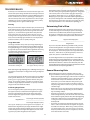
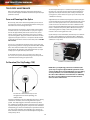
The image orientation of any telescope changes depending on
how the eyepiece is inserted into the telescope. When observing
through SkyProdigy 70 or 90 using the diagonal, the image will
be right side up, but reversed from left to right. When observing
straight through, with the eyepiece inserted directly into the
telescope, the image will be inverted.
Reversed
from left
to right,
Reversed from left tas
o viewed
with
a
Star
Diagonal
right, as viewed with a As you can see, before determining the field of view, you must
calculate the magnification. Using the example in the previous
section, we can determine the field of view using the same
25 mm eyepiece. The 25 mm eyepiece has an apparent field of
view of 50°. Divide the 50° by the magnification, which is 50
power. This yields an actual field of view of 1°.
To convert degrees to feet at 1,000 yards, which is more useful for
terrestrial observing, simply multiply by 52.5. Continuing with our
example, multiply the angular field 1° by 52.5. This produces a linear
field width of 52.5 feet at a distance of one thousand yards. The
apparent field of each eyepiece that Celestron manufactures is found
in the Celestron Accessory Catalog (#93685-11).
Inverted
image, as
viewed
Inverted image, as with
the eyepiece directly in telescope
viewed with the eyepiece Star Diagonal directly in telescope When observing through SkyProdigy 130, a reflecting telescope, the
image will be reversed (mirror image) when looking through the
eyepiece.
General Observing Hints
When working with any optical instrument, there are a few
things to remember to ensure you get the best possible image:
• Never look through window glass. Glass found in household
windows is optically imperfect, and as a result, may vary in
thickness from one part of a window to the next. This
inconsistency can and will affect the ability to focus your
telescope. In most cases you will not be able to achieve a
truly sharp image, while in some cases, you may actually see
a double image.
• Never look across or over objects that are producing heat
waves. This includes asphalt parking lots on hot summer
days or building rooftops.
• Hazy skies, fog and mist can also make it difficult to focus
when viewing terrestrially. The amount of detail seen under
these conditions is greatly reduced. Also, when photographing
under these conditions, the processed film may come out
a little grainier than normal with lower contrast and
underexposed.
• If you wear corrective lenses (specifically glasses), you may
want to remove them when observing with an eyepiece
attached to the telescope. When using a camera, however,
you should always wear corrective lenses to ensure the
sharpest possible focus. If you have astigmatism, corrective
lenses must be worn at all times.
For astronomical viewing, out of focus star images are very diffuse,
making them difficult to see. If you turn the focus knob too
quickly, you can go right through focus without seeing the
image. To avoid this problem, your first astronomical target
should be a bright object (like the Moon or a planet) so that the
image is visible even when out of focus.
Calculating Magnification
You can change the power of your telescope just by changing
the eyepiece (ocular). To determine the magnification of your
telescope, simply divide the focal length of the telescope by
the focal length of the eyepiece used. In equation format, the
formula looks like this:
Focal Length of Telescope (mm)
Magnification = ___________________________
Focal Length of Eyepiece (mm)
Let’s say, for example, you are using the 25 mm eyepiece. To
determine the magnification you simply divide the focal length
of your telescope (for example, SkyProdigy 90 has a focal length
of 1250 mm) by the focal length of the eyepiece, 25 mm. Dividing 1250 by 25 yields a magnification of 50 power.
21