1
INSTRUCTION MANUAL
APPENDIX B - GLOSSARY OF TERMS
A
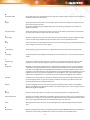
Absolute Magnitude The apparent magnitude that a star would have if it were observed from a standard distance of 10 parsecs,
or 32.6 light-years. The absolute magnitude of the Sun is 4.8. at a distance of 10 parsecs, it would just be
visible on Earth on a clear moonless night away from surface light.
Airy Disk
The apparent size of a star’s disk produced even by a perfect optical system. Since the star can never be
focused perfectly, 84 per cent of the light will concentrate into a single disk, and 16 per cent into a system
of surrounding rings.
Alt-Azimuth Mounting
A telescope mounting using two independent rotation axes allowing movement of the instrument in
Altitude and Azimuth.
Altitude
In astronomy, the altitude of a celestial object is its Angular Distance above or below the celestial horizon.
Aperture
The diameter of a telescope’s primary lens or mirror; the larger the aperture, the greater the telescope’s
light-gathering power.
Apparent Magnitude
A measure of the relative brightness of a star or other celestial object as perceived by an observer on Earth.
Arc Minute
A unit of angular size equal to 1/60 of a degree.
Arc Second
A unit of angular size equal to 1/3,600 of a degree (or 1/60 of an arc minute).
Asterism
A small unofficial grouping of stars in the night sky.
Asteroid
A small, rocky body that orbits a star.
Astrology
The pseudoscientific belief that the positions of stars and planets exert an influence on human affairs;
astrology has nothing in common with astronomy.
Astronomical Unit (AU)
The distance between the Earth and the Sun. It is equal to 149,597,900 km., usually rounded off to
150,000,000 km.
Aurora
The emission of light when charged particles from the solar wind slams into and excites atoms and molecules in a planet’s upper atmosphere.
Azimuth
The angular distance of an object eastwards along the horizon, measured from due north, between the astronomical meridian (the vertical line passing through the center of the sky and the north and south points
on the horizon) and the vertical line containing the celestial body whose position is to be measured.
B
Binary Stars
C
Celestial Equator
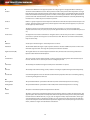
Binary (Double) stars are pairs of stars that, because of their mutual gravitational attraction, orbit around
a common center of mass. If a group of three or more stars revolve around one another, it is called a multiple
system. It is believed that approximately 50 percent of all stars belong to binary or multiple systems.
Systems with individual components that can be seen separately by a telescope are called visual binaries
or visual multiples. The nearest “star” to our solar system, Alpha Centauri, is actually our nearest example
of a multiple star system, it consists of three stars, two very similar to our Sun and one dim, small, red star
orbiting around one another.
The projection of the Earth’s equator onto the celestial sphere. It divides the sky into two equal hemispheres.
Celestial Pole
The imaginary projection of Earth’s rotational axis north or south pole onto the celestial sphere.
Celestial Sphere
An imaginary sphere surrounding the Earth, concentric with the Earth’s center.
Collimation
The act of putting a telescope’s optics into perfect alignment.
26