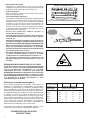
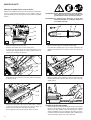
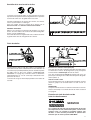
1
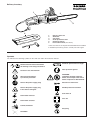
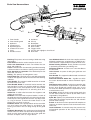
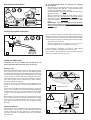
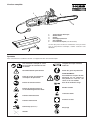
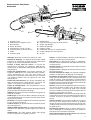
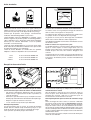
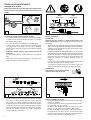
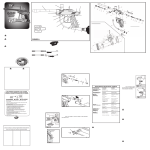
Chain Saw Nomenclature
1
2
3
4
5
6
9
10
11
7
Front handle
Front handle guard
Spike bar
Fastening nut
Sprocket guard
Carbon brush cover
Cord
Guide bar nose
13
8
16
1
2
3
4
5
6
7
8
12
9
10
11
12
13
14
15
16
15
Guide bar
Oil cap
Nameplate
Lock-off button
Rear handle
Trigger switch
Oil tank with sightglass for oil level
Saw chain
Bucking: The process of cross cutting a felled tree or log
into lengths.
Chain Brake: A device used to stop the chain saw.
Chain Saw Powerhead: A chain saw without the saw
chain and guide bar.
Clutch - A mechanism for connecting and disconnecting
a driven member to and from a rotating source of power.
Drive Sprocket or Sprocket: The toothead part that
drives the saw chain.
Felling - The process of cutting down a tree.
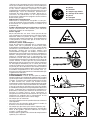
Felling Back Cut : The final cut in a tree felling operation
made on the opposite side of the tree from the notching
undercut.
Front Handle: The support handle located at or toward
the front of the chain saw.
Front Handle Guard: A structural barrier between the
front handle of a chain saw and the guide bar, typically
located close to the hand position on the front handle
and sometimes employed as an activating lever for a
chain brake.
Guide Bar: A solid railed structure that supports and
guides the saw chain.
Kickback: The backward or upward motion, or both of
the guide bar occurring when the saw chain near the nose
of the top area of the guide bar contacts any object such
as a log or branch, or when the wood closes in and
pinches the saw chain in the cut.
Kickback, Pinch: The rapid pushback of the saw which
can occur when the wood closes in and pinches the
moving saw chain in the cut along the top of the guide
bar.
Kickback, Rotational: The rapid upward and backward
motion of the saw which can occur when the moving saw
chain near the upper portion of the tip of the guide bar
contacts an object, such as a log or branch.
14
Low-Kickback Chain: A chain that complies with the
kickback performance requirements of ANSI B175.1
when tested on a representative sample of chain saws.
Normal Cutting Position: Those positions assumed
in performing the bucking and felling cuts.
Notching Undercut: A notch cut in a tree that directs
the tree’s fall.
Oiler Control: A system for oiling the guide bar and
saw chain.
Rear Handle: The support handle located at or toward
the rear of the saw.
Reduced Kickback Guide Bar: A guide bar which
has been demonstrated to reduce kickback significantIy.
Replacement Saw Chain: A chain that complies with
the kickback performance requirerments of ANSI
B175.1 when tested with specific chain saws. It may
not meet the ANSI performance requirements when
used with other saws.
Saw Chain: A loop of chain having cutting teeth, that
cut the wood, and that is driven by the motor and is
supported by the guide bar.
Spike Bar (Spike): The pointed tooth or teeth for use
when felling or bucking to pivot the saw and maintain
position while sawing.
Switch: A device that when operated will complete or
interrupt an electrical power circuit to the motor of the
chain saw.
Lock-Off Button: A movable stop that prevents the
unintentional operation of the switch until manually
actuated.
7