1
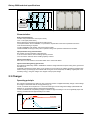
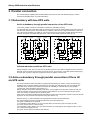
Galaxy 5000 technical specifications 3. Parallel connection The modular design of Galaxy 5000 enables parallel connection of units with identical ratings in order to increase the available power or provide redundancy. 3.1 Redundancy with two UPS units Active redundancy through parallel connection of two UPS units In this case, parallel connection is intended to increase the availability of energy. Two identical UPS units, each with its built-in manual bypass, supply the load in parallel. They both operate at the same time (hence the term active redundancy). However, each unit can supply the load alone if the other fails. This type of redundancy is called 1/2. The second unit can be connected in parallel without interrupting the load. Connection is possible with separate or common normal and bypass AC inputs (fig. 16). Normal AC input Module 1 (a) Bypass AC input Normal AC input Normal AC input Bypass AC input Module 1 Module 2 Load (b) Bypass AC input Normal AC input Bypass AC input Module 2 Load Fig. 16 a-b. Modular active redundancy with two units, with separate (a) or common (b) normal and bypass AC inputs. Isolated redundancy with two UPS units Strictly speaking, in this case, the units are not parallel connected. One UPS unit supplies the load. A second identical unit is connected to the bypass AC input of the first. The second is on standby (passive redundancy) and if the first unit fails, it steps in to supply the load via the bypass of the first unit. 3.2 Active redundancy through parallel connection of three till six UPS units The basic idea behind active redundancy is splitting the load between a number of units, but with enough available power to continue supplying the load if one unit fails (one redundant unit) or if two units fail (two redundant units). Studies show, however, that optimum availability is achieved with two units parallel connected for active redundancy (see section 3.1). Galaxy 5000 also offers active redundancy with three or four parallel-connected units of which at least one must be redundant. The UPS units share the entire load. Shutdown of one unit does not stop the system which can continue to operate with the remaining units. Units can be connected in parallel without interrupting the load. This configuration requires a common external bypass for all units, sized for the total power rating (see section 3.4). Example (see fig. 1), active redundancy through parallel connection of three UPS units. The external bypass is sized to handle the total power of the three UPS units. Two types of redundancy are possible: 1/3 redundancy (also called 2+1). If one unit shuts down, the remaining units can supply the load. (E.g. three 30 kVA units for a 50 kVA load.) 2/3 redundancy (also called 1+2). If two units shut down, the remaining unit can supply the load, i.e. each unit is sufficient to supply the load. (E.g. three 30 kVA units for a load less than 30 kVA.) MGE UPS SYSTEMS SPTC5 500 UK – 09/2005 page 20