1
Bri_;_s& Stratton Power Products Home Generator System
Owners Hanual
Co_,*Psby Eoro_'sC_erHem_,
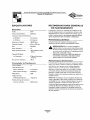
Essential
Circuits
i,
As a Home Generator System owner, it is important that
you clearly identify the circuits in your building that are
"essential" to you.Your Home Generator System is
equipped with a Semi-Automatic Transfer Switch.When
properly wired, your selection of essential circuits will be
transferred to the generator power within 10 seconds
(+/- 5 seconds) after the generator is connected and started.
Device
It is important that your installer understand which circuits
you want to include as "Essential Circuits". Depending on
the power consumed by these circuits, most or all of them
can be switched to the Home Generator System for the
duration of normal power interruption.
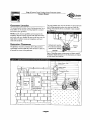
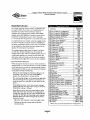
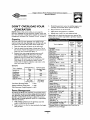
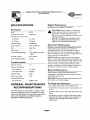
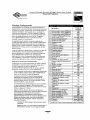
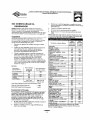
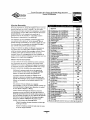
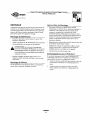
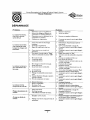
The wattage reference guide shown in Figure 3 will assist
you with your decision-making process. It provides the
wattage used by many ordinary household devices.Use it as
a guide when selecting your essential circuits. Review this
information with your installer and ask about any technical
considerations that might affect the cost of your installation.
Essential
Circuit
Selection
When selecting the essentialcircuits that will be switched to
"Backup Power" it is important that the sum of the combined
circuit loads does not exceed the wattage!amperage capacity
of the generato_To help you with your selection of essential
circuits, please consider the following:
Add up the total wattage of all electrical devices to be
connected at one time.This total should NOT be
greater than the generator's watXage capacity.
The rated wattage of lights can be taken from light bulbs.
The rated wattage of tools, appliances and motors can
usually be found on a data plate or decal affixed to the
device.
If the appliance,tool or motor does not give wattage,
multiply 120Volts times the ampere rating to determine
Watts (Volts x Amps = Watts).
Some electric motors (induction types) require about
three times more watts of power for starting than for
running.This surge lasts for only a few seconds. Be sure
you allow for this high starting wattage when selecting
electrical devices that will be energized by the Home
Generator System:
17
[]
71
O
[]
rq
I-1
[]
[]
Air Conditioner (12,000 Btu)*
Air Conditioner (24,000 Btu)*
Air Conditioner (40,000 Btu)*
Battery Charger (20 Amp)
Circular Saw (6-1/2")
Clothes Dryer (Electric)*
Clothes Dryer (Gas)*
Clothes Washer*
Coffee Maker
[]
17
[]
[]
[3
[]
Compressor (I HP)*
Compressor (I/2 HP)*
Compressor (3/4 HP)*
Curling Iron
Dehumidifier*
Electric Blanket
2000
t400
1800
700
650
400
[]
[]
[]
Electric Range (per element)
Electric Skillet
Freezer*
1500
1250
700
[]
[]
[]
[]
[]
Furnace Fan (3/5 HP)*
Garage Door Opener*
Hair Dryer
Hand Drill
Iron
875
500 to 750
1200
250 to 1100
1200
[]
[]
[]
[]
17
Jet Pump*
Light Bulb
Microwave Oven
Milk Cooler*
Oil Burner on Furnace
800
100
700 to 1000
1100
300
[]
[]
[]
[]
Oil Fired Space Heater (140,000 Btu)
Oil Fired Space Heater (30,000 Btu)
Oil Fired Space Heater (85,000 Btu)
Radio
[]
[]
Refrigerator
Slow Cooker
[] Submersible Pump (I HP)*
[] Submersible Pump (I/2 HP)*
[] Submersible Pump (I-I/2 HP)*
[] Sump Pump*
[] Table Saw (10")*
[] Television
Figure the watts required to start the largest motor.
Toaster
Add that to the total running watts of all other
connected loads.
Running
Watts
1700
3800
6000
500
800 to 1000
5750
700
I IS0
1750
400
150
225
50 to 200
700
200
2000
1500
2800
800 to 1050
1750 to 200C
200 to S00
1000 to 165C
*Allow three (3) times listed watts for starting device
/
6