1
Installation
Remote Alarm Sounder
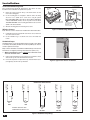
The Control Panel provides two terminals for an optional connection
to a remote electronic alarm sounder. DO NOT CONNECT AN
ELECTROMECHANICAL BELL TO THESE TERMINALS. The
bell terminals can be supervised. If bell trouble reporting is enabled
and the wire between the Control Panel and sounder is cut, the
Control Panel will report bell trouble.
1. Install the remote sounder in a secure location where it can easily be
heard.
2. Route wiring from the remote sounder location to the Control Panel’s wall
cutout.
THE BELL OUTPUT CAN BE PROGRAMMED
FOR SUPERVISION TO DETECT IF THE
WIRE TO THE BELL IS CUT
8 - HARDWIRE LOOP 2
7 - HARDWIRE LOOP 1
6 - BELL (-)
5 - BELL (+)
4 - OPEN COLLECTOR OUTPUT
3 - GROUND
2 - 14 VDC POWER INPUT (-)
SUPERVISED BELL OUTPUT
6-12 VDC @ 120 mA MAXIMUM
PIEZO
SIREN
1 - 14 VDC POWER INPUT (+)
USE SOLID STATE SOUNDERS ONLY
DO NOT CONNECT TO AN ELECTROMECHANICAL BELL !!!
Solid State Output
The Control Panel provides one solid state output that can be
programmed to activate during various conditions. The output can
switch up to 250 Ma @ 16 VDC to ground. Refer to Figure 11 for
examples of devices wired to the output.
Figure 10. Remote Sounder Wiring
This output will only function while the Control Panel is
receiving power from the wall power supply.
1. Install the device to be controlled by the solid state output.
2. Route wiring from the device location to the Control Panel’s wall cutout.
➜ WARNING: Do not connect an electromechanical bell to these
terminals. Damage to the output will occur.
OPEN COLLECTOR OUTPUT
250 mA @ 16 VDC MAXIMUM
OUTPUT SWITCHES TO
GROUND WHEN ACTIVATED
8 - HARDWIRE LOOP 2
7 - HARDWIRE LOOP 1
6 - BELL (-)
5 - BELL (+)
4 - OPEN COLLECTOR OUTPUT
3 - GROUND
2 - 14 VDC POWER INPUT (-)
NOTE: FOR ETL LISTING,
AN EXTERNAL DC BACKUP
POWER SUPPLY IS REQUIRED
FOR A LOAD CONNECTED
TO TERMINAL 4
Communicator Telephone Line
Both an incoming telephone line and an outgoing telephone line
will be connected to the Control Panel. When the communicator
activates, all local telephones will be disconnected to prevent
an off-hook telephone on the premises from blocking the
communicator’s call. See Figure 12 for RJ31X jack wiring details.
1. Run a 4-conductor telephone cable from the telephone company
demarcation box to the Control Panel mounting plate.
1 - 14 VDC POWER INPUT (+)
1K
LED
NOTE: TERMINAL 1 WILL ONLY
PROVIDE DC POWER WHEN
THE CONTROL PANEL'S
POWER SUPPLY IS CONNECTED
TO AN AC POWER SOURCE
EXAMPLE HOOKUP SHOWING AN ARMED LED,
THE OPEN COLLECTOR OUTPUT CAN BE PROGRAMMED
TO ACTIVATE DURING VARIOUS CONDITIONS
2. At the demarcation box, disconnect the house telephones that are
wired to the box output. DO NOT DISTURB THE TELCO INPUT
“DROP” SIDE OF THE BOX OR ANY EARTH GROUNDS.
Figure 11. Solid State Output Wiring
3. At the demarcation box, connect the RED cable wire to the
box RING, and the GREEN cable wire to the box TIP.
4. At the demarcation box, connect the BLACK cable wire
to the house telephone RING wire(s), and the YELLOW
cable wire to the house telephone TIP wire(s).
RED (RING IN)
GREEN (TIP IN)
IMPORTANT !
FOR PROPER LINE SEIZURE, ALL HOUSE
TELEPHONE CONNECTIONS MUST PASS
THROUGH THE RJ31X JACK
RJ31X
TELEPHONE
JACK
5. At the Control Panel, connect the cable’s RED wire to
the RJ31X jack’s RING IN terminal, and the GREEN
wire to the RJ31X jack’s TIP IN terminal.
BLACK (RING OUT)
YELLOW (TIP OUT)
6. At the Control Panel, connect the cable’s BLACK wire to
the RJ31X jack’s RING OUT terminal, and the YELLOW
wire to the RJ31X jack’s TIP OUT terminal.
7. Snap the cover on the jack. Plug one end of the modular cable into the
jack and slide it through the hole in the mounting plate into the wall.
INCOMING TELEPHONE LINE
FROM DEMARCATION BOX
OUTGOING TELEPHONE LINE
TO HOUSE TELEPHONES
CONTROL PANEL
TELEPHONE
JACK
PLUG CABLE
FROM CONTROL
PANEL INTO JACK
PLUG CABLE
FROM JACK
INTO CONTROL
PANEL
Figure 12. Telephone Jack Wiring
9