1
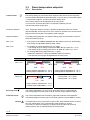
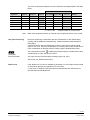
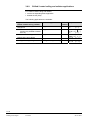
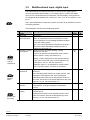
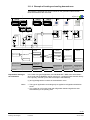
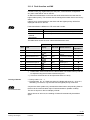
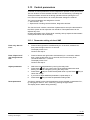
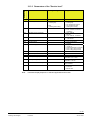
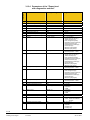
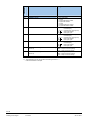
3.11.8 Fault function on KNX If a fault occurs (e.g. digital fault input, dew point, communication configuration, etc.) then a fault will be sent on the bus. An RDG thermostat listens on the bus and sends its fault when the fault has the highest alarm priority. This ensures that the management station does not miss any alarms. If alarms occur at the same time, the alarm with the highest priority will be first displayed and sent on the bus. K NX Fault transmission is different in LTE mode and S-mode: R S-mode Fault state Fault information (internal information) LTE mode Alarm info (error code + internal information) Alarm text (default text can be edited with ACS700 tool) The table below shows the error code and default alarm texts. Prio Fault 1 No fault Bus power supply**) Thermostat Fault information on bus Display Error code Default fault text 0 5000 No fault No bus power supply --- 6001 >1 id device address --- 4930 Condensation in the room --bus Text adjustable *) 2 Device address error 3 Condensation 4 External fault input X1 AL1 9001 Fault input 1 5 External fault input X2 AL2 9002 Fault input 2 6 External fault input D1 AL3 9003 Fault input 3 7 Clean filter reminder FIL 3911 Dirty filter Addr *) Default alarm texts are stored in the thermostat’s non-volatile memory and can be adjusted using the ACS700 commissioning tool **) This error will not be sent on bus (because there is no bus!) Priority of alarms Priority order is #1…7 External faults #4…6: If faults are active, the display will show AL1, AL2, AL3, alternating. On the bus, only the fault with the highest priority will be sent K NX A supervisor alarm system may command the thermostat to stop sending faults to the bus via the communication object “Fault transmission” (disable / enable). This has no impact on the local display of faults. R Fault transmission After a timeout of 48 hours, the sending of faults will automatically be enabled again. 57 / 86 Siemens Building Technologies RDG100KN Basic documentation Functions CE1P3191en 22 Jun 2010