1
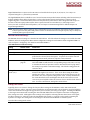
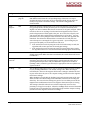
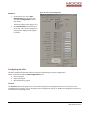
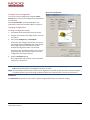
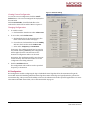
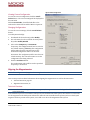
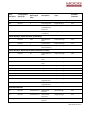
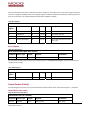
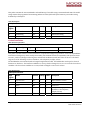
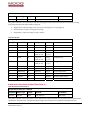
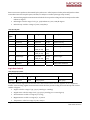
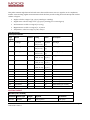
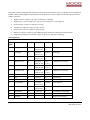
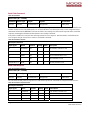
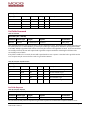
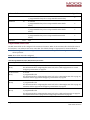
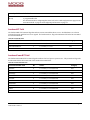
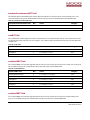
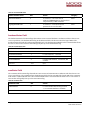
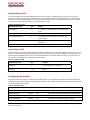
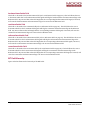
 Setting Default Value Comments Restart On Over Range OFF This setting forces an algorithm reset when a sensor over range occurs i.e., a rotational rate on any of the three axes exceeds the maximum range. The default setting is OFF. Algorithm reset returns the unit to a high gain state, where the unit rapidly estimates the gyroscope bias and uses the accelerometer feedback heavily. This setting is recommended when the source of over‐range is likely to be sustained and potentially much greater than the rate sensor operating limit. Large and sustained angular rate over‐ranges result in unrecoverable errors in roll and pitch outputs. An unrecoverable error is one where the EKF cannot stabilize the resulting roll and pitch reading. If the over‐ranges are expected to be of short duration (<1 sec) and a modest percentage over the maximum operating range, it is recommended that the restart on over range setting be turned off. Handling of an inertial rate sensor over‐range is controlled using the restartOnOverRange switch. If this switch is off, the system will flag the overRange status flag and continue to operate through it. If this switch is on, the system will flag a masterFail error during an over‐range condition and continue to operate with this flag until a quasi‐static condition is met to allow for an algorithm restart. The quasi‐static condition required is that the absolute value of each low‐pass rate sensor falls below 3 deg/sec to begin initialization. The system will then attempt a normal algorithm start. Dynamic Motion ON The default setting is ON. Turning off the dynamic motion setting results in a higher gain state that uses the accelerometer feedback heavily. During periods of time when there is known low dynamic acceleration, this switch can be turned off to allow the attitude estimate to quickly stabilize. Turn Switch threshold 0.5 deg/sec With respect to centripetal or false gravity forces from turning dynamics (or coordinated turn), the unit monitors the yaw‐rate. If the yaw rate exceeds a given TurnSwitch threshold, the feedback gains from the accelerometer signals for attitude correction are reduced because they are likely corrupted. NAV440Function The NAV Function supports all the features of the IMU440, VG440 and AHRS440 functions. In addition, the NAV function provides an internal GPS receiver, which includes software running on the DSP processor for computing navigation and orientation information. In this function, the unit outputs GPS information (Latitude, Longitude, and Altitude), inertial‐aided 3‐axis velocity information, as well as heading, roll, and pitch measurements, in addition to digital IMU440 data. At a fixed 100Hz rate, the unit continuously maintains the digital IMU440 data; the dynamic roll, pitch, and heading data; as well as the navigation data. As shown in Figure 2 on page 21, after the Sensor Calibration block, the IMU440 data is passed into an Integration to Orientation block. The Integration to Orientation block integrates body frame sensed angular rate to orientation at a fixed 100 times per second. For improved accuracy and to avoid singularities when dealing with the cosine rotation matrix, a quaternion formulation is used in the algorithm to provide attitude propagation. Following the integration to orientation block, the body frame accelerometer signals are rotated into the NED level frame and are integrated to velocity. At this point, the data is blended with GPS position data, and output as a complete navigation solution. Page 30 NAV440 User Manual
7430‐0131‐01 Rev. F