1
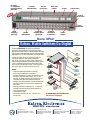
Extron’s Product
Line of Twisted Pair
Transmitters &
Receivers
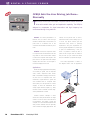
CAT 5 T AV
CAT 5 Video and Audio
Transmitter
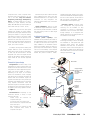
Extron’s CAT 5 T AV accepts NTSC/PAL composite
video with stereo audio.
CAT 5 T 15HD A
CAT 5 Interface
Transmitter
Transmitters
Extron’s CAT 5 T 15HD A accepts analog computer
video with PC audio.
CAT 5 T 15HD AV
CAT 5 Interface/
Composite Video and
Audio Transmitter
Extron’s CAT 5 T 15HD AV accepts analog computer
video with PC audio as well as NTSC/PAL composite
video with stereo audio.
CAT 5 T BNC
CAT 5 RGB Video
Transmitter
Extron’s CAT 5 T BNC accepts RGBHV, RGBS, RGsB,
component video, S-video, or composite video signals.
CAT 5 T BNC DA4
CAT 5 RGB Video
Distribution
Amplifier/Transmitter
Extron’s CAT 5 T BNC DA4 is a one input, four output
distribution amplifier that accepts RGBHV signals.
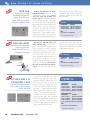
CAT 5 R AV
Cat 5 Video and Audio
Receiver
Receivers
Extron’s CAT 5 R AV receives long-distance transmission of NTSC/PAL composite video with stereo audio.
CAT 5 R BNC A
CAT 5 RGB Video and
Audio Receiver
Extron’s CAT 5 R BNC A receives long-distance transmissions of RGB video, component video, S-video, or
composite video with stereo audio.
Tw i s t e d P a i r Tr a n s m i t t e r s a n d R e c e i v e r s ( c o n t . )
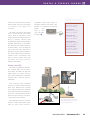
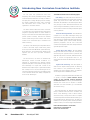
• At a large venue awards presentation,
audience members in the back of the
auditorium use monitors to get close-up
views of the onstage action. For long cable
runs from the A/V rack to the ceiling-mounted
monitors, UTP cable is more economical.
• For a staging event or tradeshow, the
A/V crew needs to quickly run temporary
cabling that can be taken down with no
hassle—or even discarded at little cost.
• A college wants to use the existing UTP
cable infrastructure, and there is plenty of UTP
wiring for A/V signals, separate from the phone
and computer network systems (A/V signals must
be run separately from the other types of signals).
For other scenarios, UTP is a less viable
choice. For short cable runs, UTP is a more
complicated and more costly cable to use than
coaxial cable because there is a high initial,
fixed cost. This expense is inevitable because of
the need for UTP transmitters and receivers.
Special transmitter and receivers sets are
required for two reasons:
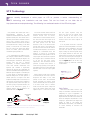
1) The main reason is signal transmission. A
special type of signal (differential analog) is
used to make the best use of UTP wire despite
its limitations. To transmit video over UTP, a
special transmitter is needed to convert the
video to a differential analog signal that is a
better match for UTP wire. At the receiving
end, a receiver is needed to convert the
differential analog signal back to a usable video
signal.
2) A less significant reason is connectorization.
A/V components typically don’t use the RJ-45
connectors that UTP cable uses.
Also, coaxial cable systems have better
quality and consistency, while being lower-cost,
than UTP cable systems when cable runs are
shorter than 200 ft. (61 m). Coaxial cable is also
more uniform at these shorter distances, since
lengths of wire pairs often vary within the same
UTP cable due to small differences in twist
tension and rates.
UTP Cabling
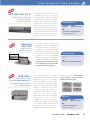
CAT 5 R BNC AV
CAT 5 RGB Video,
Composite Video and
Audio Receiver
Extron’s CAT 5 R BNC AV combines all of the
functionality and connections of the CAT 5 R BNC
and the CAT 5 R BNC AV into one enclosure.
2
ExtroNews 12.2
UTP cabling was originally developed by the
computer industry for transmitting digital data
over computer networks. Using UTP for video is
not simply a matter of soldering BNC
connectors to the wire and then connecting
equipment together. It’s vital to treat your UTP
system as an A/V system.
March/April 2001
In any A/V system, the displayed image
quality is only as good as the weakest link in
the video signal chain. In most cases, that
weakest link is the cable. This holds especially
true for UTP transmission systems. To achieve
the best possible image quality with a UTP
system, the highest quality UTP cable,
connectors, and patch cords available should
be used. At this time, Category 6 rated UTP
cable is manufactured to the most exacting
specifications. Designed for Gigabit Ethernet,
CAT 6 cable provides 250 to 350 MHz of
bandwidth as well as the best crosstalk and
attenuation specs available for UTP cable. To
run video over UTP and get professional
results, Extron has designed a transmission
system to compensate and correct for signal
losses that occur during a UTP cable run.
However, for best results, it is important to
know the kind of transmission cable that
connects the transmitter to the receiver.
Although UTP cable installed in a facility can
be used, it is important to note that this cable
may be of unknown quality and has been
designed for computer network use with
termination in an IP network patch bay, digital
switching system, or router. The balanced
analog video signals transmitted by Extron
transmitters are not compatible with digital
network equipment. Mixing signals can cause
damage to a router if a signal is mistakenly
connected to the wrong piece of equipment. If
possible, a UTP video system should be treated
as an A/V system with all signal cables and
connections kept separate from the computer
and data systems in a facility. When possible, a
direct cable run from transmitter to receiver
should be used. (For more information on UTP
Cabling, see the Tech Corner article in this
issue on page 22.)
Extron UTP Products
Extron’s family of Twisted Pair transmitters
and receivers are designed to integrate
Twisted Pair cabling into analog A/V systems.
Our Twisted Pair solutions are designed to be
used the way A/V system designers and
installers build systems—offering the
compact size, connectorization, remote
control
capability,
and
mounting
configurations needed for architectural
integration plus the level and peaking control
needed for high performance.
Extron offers a versatile class of
transmitters and receivers that enable longdistance transmission of RGB video,