1
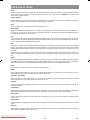
DEFINITION OF TERMS
Angle
Recorded onto some DVDs are scenes that have been simultaneously shot from a number of different angles (the same
scene is shot from the front, from the left side, from the right side, etc.). With such discs, ANGLE can be used to view
the scene from different angles.
Chapter Number
These numbers are recorded on DVDs. A title is subdivided into many sections, each of which is numbered, and specific
parts of video presentations can be searched quickly using these numbers.
DivX®
DivX® is a digital video compression format developed by DivX, Inc.
Dolby Digital
Many movie theatres are equipped with 5.1 channel surround systems. This same type of technology is available to you
in your home. To enjoy full 5.1 channel surround, the player must be connected to an external Dolby Digital decoder via
the digital outputs (either coaxial or optical).
DTS
This is a digital sound system developed by Digital Theater Systems for use in cinemas. This system uses 6 audio channels and provides accurate sound field positioning and realistic acoustics. (By connecting a DTS Digital Surround decoder,
you can also listen to DTS Digital Surround sound.)
DVD
This refers to a high-density optical disc on which high-quality pictures and sound have been recorded by means of digital
signals. Incorporating a video compression technology (MPEG II) and high-density recording technology, DVD enables
aesthetically pleasing full-motion video to be recorded over long periods of time (for instance, a whole movie can be
recorded).
DVD has a structure consisting of two 0.6 mm thin discs, which are adhered to each other. Since the thinner the disc, the
higher the density at which the information can be recorded, a DVD has a greater capacity than a single 1.2 mm thick
disc.
HDMI
The High-Definition Multi-media Interface (HDMI) is an industry-supported, uncompressed, all-digital audio/video interface.
The HDMI provides an interface between any compatible digital audio/video sources, such as a set-top box, a DVD player,
and an AV receiver and a compatible digital audio and/or video monitor, such as a digital television (DTV).
LPCM
LPCM stands for Linear Pulse Code Modulation and is digital audio.
MPEG
Short for Moving Picture Experts Group. This is an international standard for compression of moving images. On some
DVDs digital audio has been compressed and recorded in this format.
Playback Control (PBC)
This is recorded on a Video CD (Version 2.0). The scenes or information to be viewed (or listened to) can be selected
interactively with the TV by looking at the menu shown on the TV.
Subtitles
These are printed lines appearing at the bottom of the screen, which translate or transcribe the dialogue. They are recorded on the DVDs.
Time Number
This indicates the playtime that has elapsed from the start of a disc or a title. It can be used to find a specific scene quickly.
(Not all discs permit the use of a time search feature. Availability is determined by the disc’s manufacturer.)
Title Number
These numbers are recorded on DVDs. When a disc contains two or more movies, these movies are numbered as title
1, title 2, etc.
Track Number
These numbers are assigned to the tracks that are recorded on Audio CDs. They enable specific tracks to be located
quickly.
Video CD
This contains recordings of pictures and sound whose quality is on a par with that of video tape. The player also supports
Video CDs with playback control (Version 2.0).
Downloaded From Disc-Player.com Sharp Manuals
- 38 -
EN