1
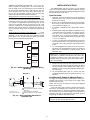
WIRING THE ROOM CONTROLLER — The room controller is capable of controlling from 1 to 6 fan coil units. The
total run length of the wire connecting the room controller to
the fan coil units should be kept to under 500 feet. Wire the
room controller to the unit using daisy chain wiring. See
Fig. 28. The room controller connects to the receiver board
connection on the electronic board inside the unit.
Wiring the Power Connection to the Room Controller — The
thermostat will be powered by unregulated nominal 12.5 volts
DC (10V min to 20V max) which is provided by the electronic
board inside the unit. The power consumption will be 50 mA
12.5 volts DC. For applications where more than one fan coil
unit is to be controlled, the fan coil unit closest to the room
controller will be the only one that supplies power to the room
controller. The control should be protected from damage in
case of accidental wiring of power, ground and signal wiring
occurs.
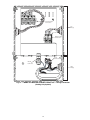
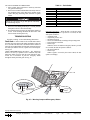
Wiring the Room Controller to the Indoor Unit — Loosen
the screws of terminals P (DC Power), G (GROUND) and C
(SIGNAL) on the indoor unit and room controller terminal
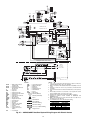
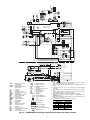
blocks. Refer to Fig. 29 and connect the indoor unit terminal
block to the room controller terminal block.
INSTALLATION OPTIONS
The 40KMC,KMQ units can be used to cool an adjacent
room or for fresh-air ventilation. Plan the installation carefully.
Measure carefully and follow acceptable building practices and
the National Electric Code (NEC).
Fresh Air Intake
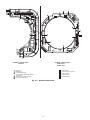
1. Using Fig. 30, locate and remove the factory-installed insulation from the side of the unit where the prepunched
knockouts are located.
2. Remove the pre-punched knockouts for fresh air intake.
Refer to Fig. 30. Be careful not to damage internal parts
such as the heat exchanger coil.
3. If installing a 40KMC018 unit, install baffle. Refer to
Fig. 30.
4. Install ductwork using field-supplied, insulated flex duct,
or insulated sheet metal suitable for working temperatures up to 140 F. Conduits can be of flexible polyester
(with spiral core) or corrugated aluminum, externally
covered with anti-condensate material (fiberglass from
1/ in. to 1 in. thickness).
4
5. Use Fig. 31 to determine the allowable static pressure loss
for the ductwork airflow. The ductwork design must not
exceed this value or the job airflow requirements will not
be met.
6. Use a field-supplied fan if airflow does not meet job requirements. The field-supplied fan motor for outside air
intake must be controlled by a bipolar ON/OFF switch
with safety fuses.
FCU 1
REMOTE
FCU 2
IMPORTANT: Ventilated air must not exceed 10% of the
total airflow or problems with operation will result. If the
ventilated air surpasses 10% of the total airflow, a fieldsupplied primary air treatment system with separate deflectors is recommended.
FCU 3
FCU 6
7. Install an air inlet grille with filter inspection port to prevent dust and dirt from entering and fouling the indoor
unit heat exchanger. Filter installation also makes the installation of a duct closing damper during shutdown periods unnecessary.
8. All non-insulated ducts must be covered with anticondensate insulation (such as expanded neoprene, 1/4 in.
thickness).
Fig. 28 — Room Controller Daisy Chain Wiring
(Multidrop)
Diagram 1
Conditioned Air Supply to Adjacent Room —
Air supply to an adjacent room requires that the outlet corresponding with the duct is closed, using the air supply outlet
obstruction accessory kit.
NOTE: The accessory kit cannot be used in units equipped
with an electric heater.
An air inlet grille must be fitted (if possible near the floor)
between the air conditioned room (where the unit is situated)
and the adjacent room or, alternatively, the door must be undercut, as shown in Fig. 30. The duct lengths can be calculated in
accordance with Fig. 30, also taking into account the pressure
drop through air diffusers and fresh air filters.
R ed
B lack
White
A
R emote connector
(J5) 5 pins
A Indoor unit
B R oom C ontroller
P
G
C
B
P
G
C
Main electronic card
4 pins terminal block placed on external
control box
Wires supplied by the installer
Terminal block in the R oom C ontroller
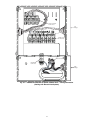
Fig. 29 — Wiring the Room Controller to
the Indoor Unit
IMPORTANT: DO NOT use active carbon or electrostatic
filter kits for ducts towards adjacent rooms.
19