1
OWNERS MANUAL
MANUAL NO. 01
REV. DATE: 7/2012
Rachael
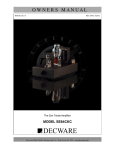
The Zen Triode Integrated Amplifier
MODEL SE34I.3
Decware High Fidelity Engineering Co., East Peoria IL, USA www.decware.com
OWNERS MANUAL
DESCRIPTION
The Zen Triode Integrated is a 5~6 watt per channel - single-ended-triode amplifier
using easy to find EL34/6CA7 output tubes. It has zero negative feedback for unlimited
sound-stage depth and superior imaging. It features tube rectification, proprietary
Decware transformers, a self-biasing circuit with a bias meter for each output tube.
Like the famous SE84C 2 watt Decware amplifier, this is a purist built product with the
absolute minimum number of parts and solder nodes. Between the input and output
jacks there is only 1 capacitor, 2 resistors and our premium output transformers made
from the finest US gain oriented silicon steel. (see section on transformers)
The amplifier is available in five configurations...
Configuration 1 - Straight Amplifier with one pair of inputs and
no volume or gain control(s).
Configuration 2 - “Integrated” amplifier featuring a volume
control so that it can be used without a preamplifier.
Configuration 3 - “Integrated” amplifier with dual volume
controls, one for each channel.
Configuration 4 - “Integrated” amplifier featuring multiple
inputs for 4 different sources.
Configuration 5 - “Integrated” amplifier just like configuration
4 but with dual volume controls.
Decware High Fidelity Engineering Co., East Peoria IL, USA www.decware.com
OWNERS MANUAL
DUAL VOLUME VS. SINGLE VOLUME CONTROLS
When you purchase the “Integrated” configuration of this amplifier you will have the
option of setting it up with ONE or TWO volume controls. Here are the pros and cons of
each:
Single volume control Dual volume controls -
Pros: Ease of Use, stereo image is always centered.
Cons: No way to adjust balance
Pros: Ability to adjust balance
Cons: slightly more difficult to use.
The main question one would have is why not simply have a volume control and a
balance control? Reason: That puts two controls in the signal path instead of one. In
an amplifier with only two resistors and one capacitor, adding additional parts, like
these controls, in the signal path is audible. Remember, less is more and the goal is to
preserve transparency - one of this amplifiers strongest traits.
Dual volume controls have another advantage besides half as many parts in the signal
path when compared to a volume and balance control. With dual volume controls you
can turn up one speaker by itself to a desired listening level and then turn up the other
channel to match. Meaning you can make the second channel higher or lower without
effecting the first channel. The advantage to doing this is that you can hear once you
get close to a match between the channels, the sound stage lock-in when you hit the
right spot. Since your room is non-symmetrical and your speakers are in reality not
matched to within 5% of each other, having the volume exactly perfectly centered
between the channels is never the perfect spot. You’ll hear it when you try it. And
you’ll notice a small window when you get close to matched where you can actually
adjust the sound stage to your room a bit better.
TUBES - output
The SE34I.3 uses a single EL34/6CA7 output tube per channel. These are the larger
ones on either side of the power transformer. They are run with lower voltages for
increased life and better tone. NOTE: The EL34 is a true pentode and has no internal
connections between the suppressor grid and cathode like the vast majority of audio
tubes (6550, KT88, KT77, 6L6, 6V6 to name a few). That means other than directly
heated triodes like 2A3’s, 300B’s for example, the EL34 is the only popular audio tube
that can be wired as a TRUE TRIODE. We find the EL34 wired this way in our circuits
to be more neutral than the darker sounding 300B’s and without the over-inflated price
for the tubes, a lot more practical.
Decware High Fidelity Engineering Co., East Peoria IL, USA www.decware.com
OWNERS MANUAL
We took this a step further with what we call the Hazen Grid Mod, aka Christmas
Comes Early Mod, where we couple the suppressor grid to the cathode through a
capacitor adding great clarity to the tube by reducing stray electrons that typically
bounce of the plate and reattach themselves in a different location due to the potential
on the suppressor grid. This pushes this popular tube up the fidelity later even higher
and as a result handles stray electron bounce better than expensive directly heated
triodes like the 300B. Another advantage to using this output tube configuration is that
it’s quiet.
Directly-heated triodes are generally noisy in that some hum is expected unless great
expense is taken in the power supply which is seldom done. The result is an amplifier
with less than black backgrounds when you listen to music.
TUBES - input
The smaller 9 pin input tubes in this amplifier are dual triodes configured as an SRPP
stage to give maximum voltage swing with the least number of parts. The only
alternative is to use two gain stages with an additional coupling capacitor. Since the
amplifier design only has one coupling capacitor, we certainly would hate to DOUBLE
the quantity in this otherwise extremely transparent amplifier. The tube used is our
favorite Russian NOS military grade 6N1P-EV. (In Russian that reads 6h1n-EB, which is
what is printed on the tube) Alternately you can use 6922’s which are a touch less
warm but slightly more dynamic. Using 6DJ8’s may or may not work depending on the
brand and condition of the tube. This is because the voltages used are on the max
end of what a 6DJ8 likes to see. Alternately, you can also use the Russian 6N2P-EV
for more gain, a more open and lively sound. There are two grades of this tube (as
there is for the 6N1P) and the easy way to tell the military grade from the consumer
grade is the pins. The better tubes have shiny plated pins, while the consumer grade
are un-plated and dull looking.
With the 6N2P the difference in sound between the two grades is pretty obvious. The
better grade has more definition and is tighter. These tubes are also quiet. The
consumer grade is more musical sounding, but typically noisier. The consumer grade
usually requires you to have two or three pairs on hand to find one pair that is quiet
enough to use and enjoy - but they are inexpensive.
TUBES - rectifier
The rectifier tube in this amplifier is located directly in front of the power transformer.
DO NOT TOUCH IT WHEN IT IS ON as it will be HOT and could burn your hand. The
amplifier typically ships with a 5U4G rectifier tube. There are many different brands of
5U4 type rectifiers both in New Old Stock (NOS) and in current production. Each will
have a subtle effect on the sound of your amplifier. Each will also sound different.
Decware High Fidelity Engineering Co., East Peoria IL, USA www.decware.com
OWNERS MANUAL
There are also some compatible substitutes that you can try which include 5Y3GT and
5AR4. The 5AR4 is an indirectly heated rectifier with a soft start up so it may be a bit
more expensive than the 5Y3GT and 5U4. A popular rectifier tube that many people try
to substitute is the 274B. There are different manufactures and different types of 274B
rectifier tubes. Of the ones we’ve examined, they all required no more than a 10uf
capacitor in the first section of the power supply. Very few tubes amps today use that
small of a value. The SE34I.3 uses a 47uf capacitor in this location which can cause
the 274B to arc on start-up and thus reduce it’s life.
BIASING and METERS
The SE34I.3 is a self biasing, self balancing design meaning there is never a need to
adjust the bias of the output tubes. The amp does it for you. It also insures that you
get matched output power from each channel even if the tubes are not matched. And
most importantly, when compared to the common “fixed bias” approach where you
adjust the bias with a bias control, this way sounds better. The reason everyone
doesn’t do it this way is because it sacrifices power. So it’s an issue of better sound or
more power. We choose better sound.
If you have perfectly matched tubes,
your bias meters of which there is
one for each of the two output tubes,
will read the same. This is typically
around 38 millivolts per side. Of
course different brands of tubes may
read as much as 10 millivolts higher
or lower than that figure.
These bias meters will tell you at a
glance if your output tubes are
healthy and if they’re matched. As a
completely analog device, they can
tell you other things as well. For
example, you can watch how long it
takes the tubes to warm up and come to full bias by watching the meters when you first
turn the amplifier on. If one tube takes a lot longer to arrive at it’s bias point than the
other tube it can be an early warning that there are differences developing between
either your two output tubes are the input tubes. Yes, the input tubes can effect the
bias reading on the meter as well since they are coupled to the output tubes.
Decware High Fidelity Engineering Co., East Peoria IL, USA www.decware.com
OWNERS MANUAL
The bias meters also show what happens when the amp is at full power by dropping to
a lower figure. For example, when the amplifier is at it’s maximum clean power (just
before clipping) you will see the meters move in response to the music. They will
dance between the bias point and 1/2 the bias point which is typically between 40 mills
and 20 mills. It’s a nice visual indicator that lets you know if your amp is clipping.
Decware amplifiers clip so gracefully it can be sometimes hard to notice when you
have it turned up too loud. Seeing the meters plunge down below 20 mills is a certain
indication that your amp is clipping or near clipping.
Bias meters set up like this can also tell you at a glance if a tube has shorted or failed
unexpectedly by suddenly reading abnormally high or low on one channel relative to
the other channel. They can also reveal faults in a tube that may not show up until
several minutes or hours after the amp has warmed up. In this case you would notice
one channel consistently clips sooner than the other. This condition can not be
discovered by the vast majority of tube testers, as the faulty tube will test perfectly fine,
so the meters are the only way to discover this problem - which of course you would
also hear - but if you ONLY heard it and did not have the meters, you would have no
idea what is causing the problem.
CLIPPING
With 6N1P input tubes and a standard 2 volt souce such as a CD player, the volume
control can typically reach 2/3rds before the amp runs out of steam (clips). With a
6N2P the volume control will typically reach 1/2 way up before clipping. Of course if
you have a source with higher than 2 volts of output, the SE34I.3 will clip sooner.
SPEAKER BINDING POSTS
The SE34I.3 features heavy duty (almost bomb-proof) connectors for the speaker
wires. They are the standard 5-way posts with standard spacing. They accept banana
jacks, large spades, or bare wire up to 10 AWG in thickness. The are color coded with
a RED and BLACK base. Black is the NEGATIVE speaker connection and RED is the
positive speaker connection. In this amplifier (like most) the two black speaker jacks
are connected together and tied to ground.
BRIDGING INTO MONO
You can bridge both channels into one by simply connecting the two positive speaker
binding posts together. The negative posts are already connected together internally.
Decware High Fidelity Engineering Co., East Peoria IL, USA www.decware.com
OWNERS MANUAL
RCA OUTPUT JACKS
You can have your amplifier configured with line level outputs that can be used to drive
a second amplifier or subwoofer. These RCA output jacks are located directly next to
the speaker binding posts. You will find that these are healthy outputs that will make
whatever is plugged into them sound more like the amplifier itself. This is possible by
taking the output jacks directly from the amplifiers output transformers. That makes the
signal coming out of the jacks rich with even order harmonics that can make even a
solid state amp plugged into them sound more like tubes. This of of critical importance
if you plan to use them in a bi-amp system or to drive a subwoofer amplifier(s) because
either one will sound and therefor blend much better with the SE34I.3’s sonic signature.
In fact, if you change tubes in your amp and consequently change the sound, the
sound from your second amplifier or subwoofer amplifier will also change to match,
automatically!
INPUT JACKS
The input jacks will be located in the second space away from the binding posts on
each side. The ones on the Right side serve the right channel and are color coded
RED. The left channel jack(s) are color coded WHITE. If you have all four input jacks
on your amplifier the selector switch will start with the farthest pair to the outside (near
the binding posts) and finish with the nearest pair to the inside of the amp (near the
power cord). Remember, the amplifier chassis has been laid out in a MIRROR IMAGE.
POWER UP
The power switch is located in the front center of the amp. It will take approximately 30
seconds for the tubes to warm up after you turn on the switch. You can watch this
happen by looking at the meters because they will be at ZERO when the amp is off,
and slowly climb to around 40 once the amp is beginning to conduct (work). As a
general rule is it always best to have speakers hooked up to the amp whenever it is on.
If you have a volume control and IF you have it turned all the way down, it is OK to
have the amplifier on without speakers connected for brief periods of time. Having NO
speakers connected and the volume control all the way up with music playing can
damage the output transformers. This is common for all tube amps except that MOST
will absolutely fail if this is done and so far no Decware amp ever has, but just because
you would have to try repeatably to damage your amp does not mean your output
tubes will car for it.
Decware High Fidelity Engineering Co., East Peoria IL, USA www.decware.com
OWNERS MANUAL
SHORTING SPEAKER WIRES
When your tube amp is on and you want to unhook your speaker wires without turning
the amplifier off, it is an acceptable practice to SHORT the speaker wires TOGETHER.
Yes, it’s true, this protects the output transformers from operating without a load. They
can handle a dead short ALL DAY LONG without issue. This is JUST THE OPPOSITE
of most solid state amplifiers, which as you may know, will blow up instantly if you short
the speaker wires together, even for just a split second.
DECWARE TRANSFORMERS
Since the output transformer is the only component your hearing other than the two
resistors and one capacitor inside the SE34I.3 it should become obvious that this is a
critical component relative to the overall fidelity of the amplifier. And given that, the
quality of the power transformer and power supply in general is at the heart of the
amplifiers performance.
Our transformers cores (shown left) are made with M-6 29
Gauge - 0.014" (0.355 mm) Grain Orientated Electrical
Transformer Steel Lamination with steam blue oxide on the
surfaces and edges to minimize stray losses between
laminations.
This squared hysteresis loop iron-silicon alloy was expressly
developed to provide lower core loss with higher permeability
in the rolling direction. Grain oriented laminations are supplied in the stress relief
annealed condition. The elementary patterns of the crystals in the material are
"oriented", or arranged so that the axis of easiest magnetization is nearly parallel and
aligned in the direction of rolling. The alignment is accomplished by a special coldrolling and annealing processes. This allows the product to withstand more severe
vibration and shock and enables the following:
1.
Lower core losses as a consequence of design.
2.
Higher initial permeability.
3.
Higher permeability at higher inductions.
4.
More stable VA/Temperature relationship over a wide range of ambient
temperatures.
Most importantly, Superior Bandwidth and The Coherency Decware amplifiers
are famous for.
5.
Decware High Fidelity Engineering Co., East Peoria IL, USA www.decware.com
OWNERS MANUAL
The stacking of these cores, the wire and interleaving are trade secrets, and you can
certain that Chinese built transformers which are so inefficient they have to be twice the
physical size to do half as much, can’t compete. You can relax in knowing you have
the best.
LOUDSPEAKERS / EARSPEAKERS
The SE34I.3 is designed to have it’s maximum power into 8 ohm speakers. That does
not rule out all 4 or 6 ohm speakers, or 12, and 16 ohm speakers. It simply means that
statistically it will work best with around 8 ohms. Since the only thing that happens
when you get a lot higher or lower than 8 ohms is the power output goes down, having
efficient speakers may make this completely a non-issue. You can not hurt the
amplifier by hooking up speakers that are more or less than 8 ohms. This includes
planar magnetic ear-speakers (headphones) which are too hard to drive with
conventional headphone amplifiers but may be as high as 30 or even 70 ohms. Most
of the time these work just fine and sound great with this amp.
We find that some speakers rated as low as 90dB 1w/1m get loud enough on this amp
to fill an average size room with a nice full sound. However, statistically 94dB or higher
is ideal.
POWER CORD / FUSE
Your amplifier has the highest quality fused IEC connector available. It is SUPERIOR to
the Gold Plated Chinese units that are rebranded and passed of as expensive
audiophile gear -at a ridiculous price. This is important because if you choose to use a
high grade audiophile power cord it makes no sense to plug it into a 50 cent IEC
connector, which btw is what is on MOST amplifiers today - even expensive ones.
The fuse is a 3 amp, 20mm glass fuse. You can use fast or slow blow type
replacements in the amp. It is located INSIDE the IEC connector. To access it, remove
the power cord and take a small screwdriver to pry the little door open. It will come
Decware High Fidelity Engineering Co., East Peoria IL, USA www.decware.com
OWNERS MANUAL
completely out of the IEC connector and not only holds the fuse, but has a spare fuse
in it as well.
GROUND LOOPS, POWER STRIPS, HUM
Whenever we connect more than one audio component together we run the risk of
creating a ground-loop which causes hum.
A ground loop happens when the path to ground in one component finds an easier
(less resistive) path through another component via the ground or shield wire in your
interconnects. This is a common problem when components are plugged into different
outlets or a power strip is used, as the resistance varies at the ground point of each
receptacle.
Ways to combat the problem are - try to plug everything into the same outlet when
possible, do not use power strips, try to keep the length of the power cords the same.
If all else fails, you can try lifting the ground on one or more component until the hum
goes away.
How to tell if you have a ground loop causing hum - simply remove all your
interconnects from the input jacks of your amplifier so that the only thing hooked to it is
your loudspeakers. You should hear no hum on all but the most efficient speakers and
even those would sound quiet from the listening chair some 6 or 8 feet back. If you do
hear hum, then it’s likely the amplifier assuming your speaker wires are not wrapped
around a power cord somewhere. The most likely cause if it is the amplifier itself would
of course be tubes. Start by installing a new rectifier tube and see if that corrects it. If
not you can systematically try the remaining tubes in the amplifier.
If the amp is acceptably quiet just hooked to your loudspeakers with no inputs
connected, then hook your inputs up one component at a time and listen for hum. If
you get hum, then you either have a ground loop between that component and the
amplifier, or that component is bad.
Decware High Fidelity Engineering Co., East Peoria IL, USA www.decware.com
OWNERS MANUAL
BREAK-IN also known as BURN-IN
When your amplifier is new, it will not sound as good as it does when it’s several
months old. The reason for this is the internal parts breaking in. The process typically
involves the amp sounding a little harsh, or a little muddy, or having premature
distortions when run at higher volumes. It can change from one to the other in as little
as 15 minutes time. This process usually completes in less than 100 hours of use, so
just a few days really. Of course after the initial burn-in process, the amp will continue
to season and refine over several months.
SOUND QUALITY
The fidelity of the amplifier, it’s frequency balance, pace, transparency, imaging and
sound stage are extraordinary due to the small number of parts to get in the way of the
music. That said, you will only ever hear it sound as good as the weakest link in your
system, which could be cables, a preamp, your source component. The only way to
hear how good the amplifier CAN sound would be to hook an analogue master tape
machine with a live two track master tape where the recording was done with top notch
microphones and engineering. Even the worlds most expensive DAC and
TRANSPORT will not sound as good, so obviously a 2500.00 DAC and transport is
going to be a step down, and a 500.00 CD player is going to be another rather large
step down. That means you WILL be handi-capping your amplifier, the variable being
HOW MUCH. Moral of the story is that given the choice to replace this less than two
thousand dollar amp (wholesale price) with one 10 times as expensive will sound NO
WHERE NEAR as good as keeping this amp and spending 10 times as much on a new
source.
SOUND STAGE
Decware amplifiers are a benchmark for holographic sound where the music is
completely 3D. In fact many people who watched movies using a two channel
Decware amplifier thought there were 5 speakers playing. That said, give yourself a
chance to experience it by occasionally pulling your speakers out into the room,
several feet away from the walls. Tow them in to create an X just in front of your face
and sit anywhere from 4 to 6 feet back. Close your eyes and we’ll see ya when you
return to Earth.
Decware High Fidelity Engineering Co., East Peoria IL, USA www.decware.com
OWNERS MANUAL
WARRANTY
Your amplifier comes with a lifetime warranty to the original buyer. It covers defects in
parts or labor. If you sell your amp for some reason, the buyer can return the amplifier
to us for inspection and any updates at which point we can offer to transfer the lifetime
warranty to him or her for a reasonable fee.
If your amp needs to return to the mothership, please call us first or at least e-mail with
a description of the problem. Statistically 50% of all amps sent here for repair have
nothing wrong with them. We can often head this off at the pass by consulting you by
phone and helping you troubleshoot the problem. Decware amps are built to outlast
you, and are frankly damn hard to break.
Returns should be sent to our main office. Please use the Return Form on our web site
for the correct address and required information.
FINAL NOTE
We want this to be the best sounding amplifier you’ve owned and since these
amps area like our children we have a vested interest in their continued
success. Please call us any time you have questions or need advise on how
to improve your sound, or room acoustics. We want you to love this thing
as much as we do, and will bend over backwards to make sure you do.
-Steve Deckert,
-owner of Decware and designer of all Decware amplifiers.
Decware High Fidelity Engineering Co., East Peoria IL, USA www.decware.com