1
Maintenance / Shipping and Travel
Avalanche Rescue
4
1
1
This is a basic introduction to avalanche rescue techniques. On our website, you will also find a list of
avalanche instructors. We strongly suggest taking an avalanche course in your area before venturing
into the backcountry. Each person needs a working beacon, probe and shovel—and must know how
to use them. Before leaving, call your local avalanche forecast center and determine the danger level
in the area you intend to visit:
US: www.avalanche.org
Canada: www.avalanche.ca
Europe: www.lawinen.org
Searching for victims
Shipping a Compressed Air Cylinder
If a member of your group is buried, you must perform a beacon
search. The objective is to find the strongest signal (lowest
distance reading) and immediately begin probing the area. In the
event of a burial, switch all avalanche beacons to search mode.
The guidelines below assume the use of a digital beacon.
20m
40m
40m
path
Signal search: If there is a “last seen point,” start your signal
search there. Otherwise, start your signal search at the top,
bottom or side of the slide path. See diagram on right to establish
a search pattern.
20m
avalanche
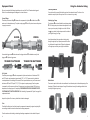
3. Connect the quick connect fitting u by pulling the large ring toward the air cylinder. It should click
back into place when air hose nipple is properly connected. Coupler gauge x is not essential, but
should fit in place to ensure air hose is connected properly.
4. Position air cylinder v next to the ejector assembly 14 as shown on page 5. Secure air cylinder
into place with the elastic and Velcro straps.
5. If you’re replacing a discharged cylinder, return empty cylinder to retailer or refill center to refill
or exchange it for a recharged one. See “Shipping a Compressed Air Cylinder” below for shipping
instructions, if shipping is required.
6. To disconnect an empty cylinder, follow these steps in reverse.
DISCHARGE CYLINDER BEFORE SHIPPING.
Compressed air cylinders may not be shipped pressurized without proper (Hazmat) certification.
Compressed air cylinders must be shipped in original packaging to prevent damage. Please return
protective covers. When shipping unpressurized cylinders in their original packaging, please make
sure you remove any Hazmat labels or markings that were used when they were shipped pressurized.
Coarse search: Once a signal is engaged, align your beacon so
that any of the center three lights are flashing and move quickly in
the direction it is pointing. Make sure the number in the distance
display is decreasing. If it is increasing, turn 180 degrees. Inside
ten meters, move slowly and try to keep the center search light engaged.
Transportation Guidelines
Fine search: Within three meters, use your beacon close to the snow surface and look for the
smallest distance reading. Confirm by “bracketing” in the perpendicular direction.
While the Federal Aviation Administration (FAA) has specifically approved avalanche airbags with
pressurized cylinders for airline travel, many individual airlines have not. Airport security personnel
have no way of knowing what your pressurized cylinder contains or its purpose.
The best way to travel by airline with an airbag is to discharge the compressed air cylinder before you
are anywhere near the airport (discharging the cylinder will create a loud noise, not unlike a gunshot),
unscrew the cylinder head and carry the pack through security so you can explain what it is. When
you get to your destination, locate a retailer or refill center and exchange or refill your empty cylinder.
The cylinder head can be screwed back on the cylinder by hand.
Do not attempt to bring a pressurized system through security or check one in your luggage.
Transportation Security Administration (TSA) personnel will ask you to remove the cylinder head so
they can see that the cylinder is empty. If you discharge the cylinder at the airport, you are not likely to
reach your destination.
10
single searcher
search path
multiple searchers
search paths
Probing/Pinpointing: At the point where the distance has reached a
minimum, probe the area in concentric circles, with each probe hole about
10 inches (25cm) apart. Your probe should enter the snow perpendicular to
the slope. Once you have confirmed the victim’s location, leave the probe
in the snow.
Shoveling: While shoveling might seem elementary, it usually
consumes the majority of time during an avalanche beacon rescue.
For best results, start shoveling just downhill of the probe. Make your
hole one “wingspan” wide. In burials deeper than one meter, excavate
downhill about 1.5 times the burial depth. For more advanced
shoveling techniques, see our website:
www.backcountryaccess.com/education.
90˚
10˝ 10˝
25CM 25CM
1.5 x
burial depth
11