1
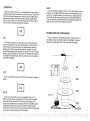
Eagle offers a choice of transducers with either an 8 or 20 degree
cone angle that will Interchangewith any of the 192 kHz sonar
In otherwords, any Eagle sonar instrument can be used with producth.
any Eagle
transducer of the same frequencywith no loss of performance.Howevet
the use of any olher manufacturers'transducer will result in a loss of
performance.
Generally,wide cone angle transducers (20 degrees) are
suited
for operating in shallow to medium water depths.The 20 ideafly
degree cone
angle allows you to see more of the underwater world. In 15 feet of water
the 20 degree cone covers an areaabout six feet across. The8
degree
transducer covers only about a two foot circle.
The 20 degree transducer is almost always the bestto use in fresh
wate while the 8 degreetransducer is used mostlyin salt water. In a
deep waterenvironment, (300 feet—fresh water, 100 feet—salt water)the
narrow cone angie is more desireable because it can
penetrateto much
deeper depths since the sound energy is concentrated in a smaller area.
Both 8 degree and 20 degree transducers give accuratebottom
readings,even though the bottom signal is much wider on the 20 degree
model becauseyou are seeing more of the bottom. Remembetthe
shallow edge of the signal showa youthe true depth. The rest of the
signal tells youwhether you are over rocks, mud, etc.
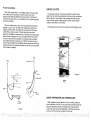
Transducerson saltwaterboats need to be painted with a thin coat of
anti-foulant paint to prevent organismsfrom growing. If unchecked,
barnacles and othermarine growth will cause a decrease in the
transducer's sensitivity. Do not usea metal based antifoulantpaint as it
will decrease the transducer'ssenstivity. There are special anti-foulant
paints specifically designedfor transducers.They're readily availableat
most marine dealers.
=
*______V
SENSITIVITy
LIGHT
__________ __________
+
SHALLOW SET
+
DEEP SET
________
+
LOOM
[OFF
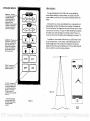
,__._—RANGE Therengb keys allow
..'.
.
you to selectdifferent depth
ranges bypressing the upor
down arrow.The available
ranges ere: 10,20,40,60,103,
200. 400, and 600.
+
JRJ
if
AUTO TheAUTO key
switches theZ-6100 in oroutof
theautomatic mode, when the
Z-6100 is first turned on, it
automaticallyadjusts the
sensitivityand rangeselection,
and the word "AUTO" will be
displayed near the lop of the
screen, By pressing theAUTO
key,you can take control of the
Z-6100, making manuel
adjuslmenls as desired, When
theZ-B100isIn the automatic
mode, the word "AUTO" will be
displayed near thelop of the
ON.1
MADE IN U.S.A.
SIGNAL INTERPRETATION
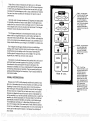
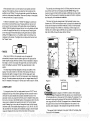
Because your Z-6100 is both extremelysensitive and powerful, it can
give you an accurate picture of the kind of bottom over which your boat
is passing. A bottom offirm sand, gravel, shell, or hard clay returns a
fairly wide signal. If the automaticsensitivity is turned off, and the signal
narrows down, then it means that you have moved over a mud bottom
because mud absorbs the sound wave and returns a weak signal.Turn
up the sensitivity. Ifyou have the automatic senstivity turned on, watch the
sensitivitybar. As the boat passes over the mud bottom, the Z-6100 will
automaticallyincreasethe sensitivityto maintain a good bottom signal.
The sensitivitybar will helpyou in determining if the bottom is soft
or
hard. If it increaseswhile in the same depth of wat&, then the boat has
moved over a soft bottom, if it decreases,then it is over a hard bottom. Of
course,as the water depth increases or decreases,the sensitivitywill
also change.
,v
CHART The chartspeed is
controlled bythe CHARTgroup
of keys.TheZ-6100 has32
chartspeeds, ranging fromVery
slowto FAST.Pressing the
FASTkey speeds up the chart
speed.The slowkey reduces it.
Thechart display can be
stopped andstarted again by
pressing both arrow keys at the
same lime.
disploy.
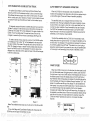
Figure 3
PDF compression, OCR, web-optimization with CVISION's PdfCompressor
17
6