1
CS616 and CS625 Water Content Reflectometers
The typically used method for packing a container of soil to uniform bulk
density is to roughly separate the soil into three or more equal portions and add
one portion to the container with compaction. Evenly place the first loose soil
layer in the bottom of the container. Compact by tamping the surface to a level
in the container that is correct for the target bulk density. Repeat for the
remaining layers. Prior to placing successive layers, scarify the top of the
existing compacted layer.
The container to hold the soil during calibration should be large enough that
the rods of the probe are no closer than about 4 in. from any container surface.
Pack the container as uniformly as possible in bulk density with relatively dry
soil (volumetric water content <10%).
Probe rods can be buried in a tray or inserted into a column. When using a
column, insert the rods carefully through surface until rods are completely
surrounded by soil. Movement of rods from side-to-side during insertion can
form air voids around rod surface and lead to measurement error.
Collect the probe output period. Repeat previous step and this step 3 or 4
times.
Determine volumetric water content by subsampling soil column after
removing probe or using weight of column. If subsampling is used, remove
soil from column and remix with samples used for water content measurement.
Repack column.
Water can then be added to the top of the container. It must be allowed to
equilibrate. Cover the container during equilibration to prevent evaporation.
The time required for equilibration depends on the amount of water added and
the hydraulic properties of the soil. Equilibration can be verified by frequently
observing the CS616/CS625 period output. When period is constant,
equilibration is achieved. Collect a set of calibration data values and repeat
the water addition procedure again if needed.
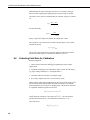
With soil at equilibrium, record the CS616/CS625 period value.
Take subsamples of the soil using containers of known volume. This is
necessary for measurement of bulk density. Copper tubing of diameter ≥ 1 in.
and length about 2 in. works well. The tubes can be pressed into the soil
surface.
It is good to take replicate samples. Three carefully handled samples will
provide good results.
The sample tubes should be pushed evenly into the soil. Remove the tube and
sample and gently trim the ends of excess soil. Remove excess soil from
outside of tube.
Remove all the soil from tube to a tray or container of known weight that can
be put in oven or microwave. Weigh and record the wet soil weight.
Water is removed from the sample by heating with oven or microwave. Oven
drying requires 24 hours at 105°C. Microwave drying typically takes 20
minutes depending on microwave power and sample water content. ASTM
35




















![Expanding Grain Model [EGM v1.0] - Illinois Institute of Technology](http://vs1.manualzilla.com/store/data/005895685_1-bff858b86f7bc344864531d7e5f7cd87-150x150.png)