1
BrightSign HD2000
Theory of operation
Power Supply
The HD2000 has a five voltages present. These are 5V, 3.3V, 2.5V, 1.8Vand 1.2V. 5V comes in from the
power connector and is used directly for USB, the video filter chip, the optical SPDIF chip, and the audio
dacs. 3.3V is created from 5V by a AMC2596 switching regulator. Similar regulators are used to create
2.5V for the DDR SDRAM, 1.8V for the HDMI chip, and 1.2V for the PNX8950 core voltage.
Reset
The HD2000 has a Low Voltage Reset circuit made up of a ADM809SAKS. This circuit will hold the
RESET_L signal low until a valid 3.3V power is present.
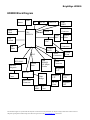
PNX8950 CPU
The HD2000 has a Philips PNX8950 Multimedia CPU in it. This CPU runs on 3.3V, 2.5V, and 1.2V.
The PNX8950 runs from a 27MHz oscillator. The PNX8950 is reset by the signal RESET_L from the
low voltage reset circuit going into the RESET_IN pin on the PNX8950. When the RESET_IN pin goes
from low to high, then the PNX8950 will look at the bootstrap pins GPIO0-2, which are pulled low on the
PNX8950. This forces the PNX8950 to boot from IIC serial boot flash.
Built in Flash
The HD2000 contains four flash devices. One of the devices is denoted to be the IIC BOOT flash. This
flash is write protected from the factory and it contains the MAC address for the 10/100 Ethernet chip, as
well as the boot code and the SRB bytes. The boot code in the IIC serial flash instructs the PNX8950 to
continue the boot process by reading additional code from the on board NAND flash. This flash can be
updated in the field, either from on the flash slots or 10/100 Ethernet. Part of the NAND flash is also used
to hold non-volatile parameters. The contents of the boot flash is copied into the SDRAM, then the
PNX8950 jumps to the boot code. There is also a serial settings flash that can be used to contain nonvolatile settings. The last flash is the Ethernet flash that is used to configure the Ethernet PHY chip.
SDRAM
The HD2000 contains four DDR SDRAM devices. When the PNX8950 boots, it will copy the code from
the NAND flash device into SDRAM, and then execute the code from SDRAM. The SDRAM runs at
clock rate 200MHz, with data rate 400MHz.
Serial Port
The HD2000 has a built in UART that that communicates with the RS232 level shifter. The MAX232
creates valid RS232 voltage levels for the transmit pin by using a capacitive voltage switcher.
This information applies to a product under development. Its characteristics and specifications are subject to change without notice. Roku assumes no
obligation regarding future manufacturing unless otherwise agreed to in writing. www.rokulabs.com © Roku 2006