1
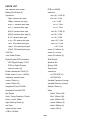
AND Gate:
29, 36, 39, 40
Data:
47
DTL:
29, 30, 31, 33, 35
Exclusive OR:
33, 44
Flip-flop:
27, 28, 38, 43, 58, 59
Inverting:
70, 72, 73, 74, 85, 95,
109
Line:
46
NAND Gate:
31, 41
NOR Gate:
42
OR Gate:
37, 42, 44, 45
Power Supply:
29, 72, 73, 74, 75
TTL:
34, 35, 36, 37, 38, 39,
40, 41, 42, 43, 44, 45,
46, 47, 48, 50, 51, 54,
55, 60, 78, 90, 112, 123
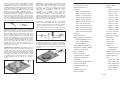
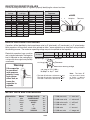
The “8” LED display is mounted on a board and to
prevent burning out the display with excess current,
permanent resistors have been wired in.
Diodes: Are like one-way streets. They allow the
current to flow in only one direction. There are three
of these in your kit. Your kit contains one silicon diode
(marked Si) as well as two germanium diodes (marked
Ge).
LOGIC AND COMPUTER CIRCUITS
Integrated Circuit: The transistor was invented in
the 1940’s and after that the next big break through
in electronics was in the 1960’s with the invention
integrated circuit or the ICs. The advantage of this that
the equivalent of hundreds or even thousands of
transistors, diodes and even resistors can be placed
into one small package.
Transistors: Three transistors can be found in your
kit. The part that makes each transistor work is a tiny
chip, which is made of either germanium or silicon.
There are a total of three connections points on each
transistor. They are B, which stands for base, C, which
stands for collector, and E, which stands for emitter.
Mainly transistors are used to amplify weak signals.
Transistors can also be used as switches to connect
or disconnect other components as well as oscillators
to permit signals to flow in pulses.
Two types of ICs are used in this kit. They are the
quad two-input NAND and the dual-operational
amplifier, and you will have the chance to learn more
about these in a bit.
Simple ICs will help you to understand enough to
grasp the basic theories of more advanced ICs.
NATURAL SCIENCE PROJECTS
Electrical Energy:
52
Fish:
11
PNP
OSCILLATORS
Blocking:
21
Oscillators:
8, 51
Sine wave:
128, 129, 130
Square wave:
67, 86, 96, 118
NPN
LEDs (Light Emitting Diodes): These are special
diodes because they give off light whenever electricity
passes through them. (The current can only pass
through in one direction—similar to “regular” diodes).
Cadmium Sulfide (CdS) Cell: This is what is known
as a semiconductor, which practically resists
electricity while it conducts. The resistance changes
by the amount of light that is shined upon it.
SWITCHING AND CONTROL CIRCUITS
Relay:
26
Transistor:
27, 28, 61, 67, 95, 101,
113, 127
LED Digital Display: Seven Light Emitting Diodes
are arranged to create an outline that can show most
letters of the English alphabet and all the numbers.
An additional LED is added to represent a decimal
point.
TEST EQUIPMENT
Transistor Checker:
127
Voltmeters:
25, 68
Water Level:
115
Note: Provided is a light shield to use with the CdS
cells, to use just simply place the shield over the cell,
this helps to prevent light from leaving the cell.
TRANSMITTERS
Code:
110, 114
Tone:
2, 5, 14, 19, 51, 60, 64,
65, 66, 94, 110, 111,
114, 128, 125
Voice:
4, 52, 85, 97, 105, 111
-154-
-7-