1
DRV Final Evaluation Report
operator constrained in a standard vehicle cab and presents ergonomic design issues.
Important areas to investigate are the interface of the operator with the controls and the
interface of the operator with the task.
The relation of a joystick axis to its associated joint and joystick motion to joint
directional motion is very intuitive. An equipment operator can accomplish the joystick
operation quickly from either side of the vehicle. In addition, the automated motion
commands are easy to remember and execute. The programmed automated motion
sequences were precise and efficient while still allowing the operator to take control by
simply moving the joystick off center and then directly controlling the arm. Due to the
versatility of the joystick, the machine can nearly be operated entirely from the joystick
using one hand. All operators using the machine were able to adapt to the control
interface without significant effort. Some of the features, such as the changing of preset
positions, required more training, however, they are not used often and therefore, they are
not always committed to memory.
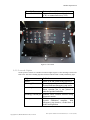
One area that required additional operator training was the interpretation of the indicator
lights. In order to limit the number of indicator lights, their functionality was overloaded.
The overloaded functionality of the lights means that a constant ‘on’ light indicates
something entirely different than a blinking light. Adding to the complexity was the
labeling of the light. For example, the light labeled Restraint Pin indicates one of the
restraint pins on the arm is still engaged; however, if the Restraint Pin light is blinking it
indicates that when trying to perform an automated motion the controller detects a
possible collision with the truck, such as the side gate not being in the down position. An
operator might execute an automated motion command and then when the arm does not
respond notice the Restraint Pin light blinking. Rather than looking to correct the
possible collision, perhaps lowering a side gate, a repair order might be made indicating
the machine was not responding to the command even though the restraint pins were
disengaged. The solution is either additional indicator lights or clearer labeling
distinguishing the significance of the constant on light and the blinking light. Alternative
solutions could incorporate either a text based display such as a LCD or voice recorded
message to describe the current state of the machine.
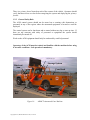
One of the most important concerns is how comfortable the operator is running the
machine and how much effort they have to put forth. The universal complaint by the
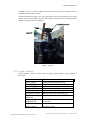
operators involved was the uncomfortable orientation of the operator to the task. The
seats in the vehicle are in a fixed position facing forward; however, the task is on the side
of the vehicle and often requires the operator to turn their head greater than ninety
degrees. This requires that the operator work while looking over their shoulder.
Working in this configuration promotes neck and back pain. One solution would be to
utilize a cab that would accommodate seats that rotate and lock in place at ninety degrees.
This would allow the operator to drive the vehicle then adjust the seat in order to face
their task, similar to the operation of a backhoe. Another solution would be to have a
vehicle that utilizes a driver and an operator. The operator seat could be left in the
direction facing the task while a dedicated driver managed traffic. In addition to the
orientation of the driver, the type of control interface is important. There were no
Copyright 2011, AHMCT Research Center, UC Davis
6