1
Setup
Connections
Correctly connecting audio and power to any signal processor is the
most important step towards successful audio processing. Please follow
these steps carefully for best results:
1. Turn off all equipment before making any connections
2. Mount the 290 in a rack (optional)
The 290 requires only one standard rack space. It can be mounted
above or below anything that doesn't generate excessive heat, since it
requires no special ventilation. Ambient temperatures should not
exceed 113˚F (45˚C) when equipment is powered.
3. Make audio connections via 1/4" phone jacks according to your
requirements.
Although the 290 is a true stereo reverb processor, it can also be used
in a mono in/stereo out or mono in/mono out configuration. The
290 configures itself by sensing whether or not plugs are inserted into
the Right Input and Right Output jacks.
For mono input applications, use the Left Input jack only. For stereo
input applications, use both Left and Right Input jacks.
Likewise, for mono output applications, use the Left Output jack only.
For stereo output applications, use both Left and Right Output jacks.
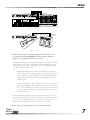
Typically, the 290's inputs are connected to the auxiliary sends (sometimes called effect sends) of a mixing console. The 290's outputs are
then connected to the effect returns on the console. For best results,
a stereo effect return should be used. See figure 1-1.
L/R Outputs
ROOM
HALL
CHAMBER
PLATE
CATHEDRAL
GATED
SMALL
MEDIUM
LARGE
DARK
MED
L/R Inputs
Aux Sends 1/2
Stereo
FX Return
BRIGHT
0
Stereo
Reverb
-6
290
-12
-18
short
SIZE / GATE SHAPE
dry
long
DECAY
TYPE
LEFT RIGHT
wet
MIX
INPUT
OUTPUT
COLOR
Figure 1-1
The 290 can also be used in a keyboard setup as in figure 1-2 or in a
guitar rig as in figure 1-3.
6