1
On The Road
Cargo Carrying Capacity
and Load Distribution
.(1
NOTE
I
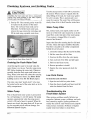
Cargo Carrying Capacities (CCC) of your motor
home are specified on a label affixed to the inside of
the motor home. The label includes all factory
installed options. If other equipment such as leveling
jacks, awnings, roof pods, etc., are installed after the
motor home leaves the factory the weight of these
items must be subtracted from the total of the passenger and cargo carrying capacities.
The amount of cargo weight you can place in
your motor home is the motor home's GVWR
minlls its UVW, or maximum capacity minlls the
weight of your motor home as assembled by
Fleetwood, i.e., without dealer installed
accessories, water, LP gas, cargo or occupants.
When the motor home is being designed, the
number and size of storage compartments, the
liquid tank capacities and number of belted seating positions are determined for value and
convenience. If you fill all liquid tanks to capacity, fill all storage compartments and cupboards
to maximum volume and fill all available seating
positions with passengers, the motor home could
be overloaded. (See Loading Tips). Be aware of
the weight of the items you store, where you
store the items in your motor home, and weigh
your motor home after it is fully loaded.
In addition to knowing the overall weight that
can be safely loaded in or attached to the motor
home, you must know how to distribute the
weight so that correct amounts of weight are distributed between the axles or front-to-rear and
also between the wheels or side-to-side. It is also
important to place heavier items in under-thefloor storage or low in the motor home. If you
make the motor home top heavy or much too
heavy on one side, the motor home can be overturned and crash in a curve, turn or in an emergency steering maneuver. When the load is properly distributed, your motor home will handle
and respond safely, and you as the driver can be
more confident and will be more comfortable.
If your motor home is improperly loaded, it may
be unsafe to drive, uncomfortable to drive, or
both. Axle load is important and it is recommended that you should load your motor home
so that the front axle is loaded to at least 80% of
the front GAWR.
How to Weigh Your Loaded
Motor Home
Refer to your local telephone directOlY to find a
public weigh station. The following procedures
wiII help you determine whether your loaded
motor home (complete with cargo, fluids, passengers, and driver) is within GAWR, GVWR, and
GCWR limits. When you arrive at a weigh station, the attendant will guide you through the correct positioning of the motor home on the scales.
Your RV must be weighed fully loaded, that is,
with passengers, food, clothing, fuel, water,
propane, supplies, etc. Any towed vehicle
(car/pickup, boat or trailer) or item loaded on
brackets on the back of the RV, such as bikes or
motorcycles, should also be included in the
weighing.
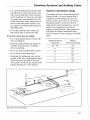
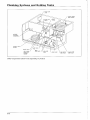
The following steps are suggested and are illustrated on the following pages:
I. Pull onto the scale so that only the front
axle is on the platform (with the end of the
scale midway between the front and rear
axles), and record the scaled weight.
2. Pull forward until the full unit is on the
scale, and record the scaled weight.
3. Pull forward so that only the rear axle is on
the scale (again with the edge of the scale
midway between the front and rear axles),
and record the scaled weight.
If the RV has a rear tag axle, pull forward
so that only the tag axle remains on the
scale, and record the scaled weight.
To determine individual wheel position weights,
it is necessary to repeat the first three steps, but
this time, use only one side of the scale, as
shown on the following pages.
05-5