1
8
Introduction to programming in POP-C++
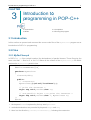
4. the presence of the directive classuid(1001). (see section 3.3.2 of the user manual)
Parallel class
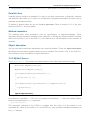
A parallel class is similar to a standard C++ class. It can have constructors, a destructor, methods
and attributes. But unlike a C++ class, it is compiled as a separated executable file which can be
executed and invoked remotely.
To declare a parallel class we use the keyword parclass. Refer to section 3.2.1 of the user
manual of POP-C++ for more details.
Method semantics
The methods have extra descriptors, such as sync/async or seq/conc/mutex. These
descriptors allow to define the semantic of the methods i.e. the way the remote method is invoked.
Refer to the section 3.2.3 of the POP-C++ user manual for a full description of the semantic of
methods.
Object descriptor
You can note that constructors declaration have extra information. These are object descriptors
specifying how and where parallel objects must be created. See section 3.2.4 of the POP-C++
user manual for more information on object descriptors.
3.2.2 MyParClass.cc
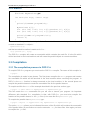
The MyParClass.cc file contains the implementation of the class (also called: the body).
#include <stdio.h>
#include "MyParClass.ph"
MyParClass::MyParClass(){}
void MyParClass::putchar(char c)
{
printf("%c ", c);
}
void MyParClass::putchar(char c, MyParClass& o)
{
o.putchar(c);
}
@pack(MyParClass);
The MyParClass.cc file contains the implementation of the class (also called: the body). It is
very similar to a standard .cc file of a C++ program. Nevertheless, .cc files of a parallel classes
must be terminated by the pack instruction.
@pack(POPCobject);
This instruction indicates to the POP-C++ compiler that this class is to be packed in one
executable file. Refer to the section 3.3.1 of the POP-C++ user manual for detailed information on
the pack directive.