1
US 6,442,686 B1
1
2
SYSTEM AND METHODOLOGY FOR
MESSAGING SERVER-BASED
MANAGEMENT AND ENFORCEMENT OF
CRYPTO POLICIES
any Way compromising the integrity of the private key.
Anyone can use a recipient’s public key to encrypt a
message to that person, With the recipient, in turn, using his
or her oWn corresponding private key to decrypt the mes
sage. One’s private key, on the other hand, is kept secret,
RELATED APPLICATIONS
knoWn only to the user.
Keys are typically stored on “keyrings.” Public keys,
The present application claims the bene?t of priority from
and is related to the following commonly-oWned U.S. pro
visional application: application Ser. No. 60/095,722, ?led
Aug. 7, 1998, and entitled SYSTEM AND METHODOLOGY FOR
including a user’s oWn as Well as those of colleagues’, are
stored in a “public keyring” ?le. Auser’s private key is, in
10
a similar fashion, stored in a “private keyring” ?le. Each key
pair has a User ID (such as the oWner’s name and e-mail
address) so that the user and the user’s colleagues can
MESSAGING SERVER-BASED MANAGEMENT AND ENFORCE
MENT OF CRYPTO POLIcIES; and Ser. No. 60/091,649, ?led
identify the oWners of keys. Each private key also has a
Jul. 2, 1998, and entitled CRYPTOGRAPHIc SYSTEM AND
METHODOLOGY FOR CREATING AND MANAGING CRYPTO 15 passphrase, or verbose passWord, that protects it. No one but
a message’s intended recipient can decrypt the message, not
POLICY ON CERTIFICATE SERVERS. The disclosures of the
even the person Who originally encrypted the message,
foregoing applications are hereby incorporated by reference
because no one else has access to the private key necessary
in their entirety, including any appendices or attachments
thereof, for all purposes.
COPYRIGHT NOTICE
for decrypting the encrypted message.
Since public key cryptography provides privacy Without
20
tional secret key encryption requires, it is commonly
A portion of the disclosure of this patent document
contains material Which is subject to copyright protection.
employed to send secured messages and other documents
from one individual to another across a netWork or other
The copyright oWner has no objection to the facsimile
reproduction by anyone of the patent document or the patent
25
disclosure as it appears in the Patent and Trademark Of?ce
patent ?le or records, but otherWise reserves all copyright
rights Whatsoever.
BACKGROUND OF THE INVENTION
the need for the same kind of secure channels that conven
30
communication channel, including the Internet. An eXample
of its use in a commercial product today includes PGPTM,
available from Pretty Good Privacy, Inc. of Santa Clara.
Calif.
Keys are also used to digitally sign a message or ?le and,
in a complementary manner, to verify a digital signature.
These “digital signatures” alloW authentication of messages.
The present application relates generally to cryptographic
When a user signs a message, a cryptographic program uses
systems and, more particularly, to methods for messaging
server-based management and enforcement of crypto poli
that user’s oWn private key to create a digital signature that
is unique to both the contents of the message and the user’s
cies.
With each passing day, more and more computers are
35
connected together through pervasive open netWorks, such
40
ments in a secured fashion over an open communication
netWork. To this end, some sort of cryptographic system is
Which public and private keys are used When sending and
receiving messages. When keys are used to secure ?les
45 stored on a user’s oWn computer or local netWork server, the
user is both the “sender” (the person Who saves the ?le) and
encryption, a single key is used for both encryption and
decryption. Consider, for eXample, a user (sender) Who
the “recipient” (the person Who opens the ?le).
Cryptographic systems, including ones implementing
public key cryptography, are described in the technical,
Wants to send an electronic mail or “e-mail” message to a
colleague (recipient) in a secured manner, such that no one
Who intercepts the message Will be able to read it. If the
sender employs a cryptographic “secret key” to encrypt the
message, the recipient, in turn, must also use the same key
to decipher or decrypt the message. As a result, the same key
must be initially transmitted via secure channels so that both
parties can knoW it before encrypted messages can be sent
50
55
The deployment of strong cryptography Within an orga
niZation forces some important business policy issues to be
60
or “private key.” Operating in a complementary fashion,
each key in the pair unlocks the code that the other key
makes. Knowing the public key does not help deduce the
corresponding private key, hoWever. Accordingly, the public
Edition, John Wiley & Sons, Inc., 1996. For a description
focusing on the PGPTM implementation of public key
cryptography, see e.g., Gar?nkel, Simon, PGP: Pretty Good
Privacy, O’Reilly & Associates, Inc., 1995. The disclosures
of each of the foregoing are hereby incorporated by refer
ence.
tWo mathematically-related keys, a “public key” and a secret
key can be published and Widely disseminated across a
communications netWork, such as the Internet, Without in
trade, and patent literature. For a general description, see
e.g., Schneier, Bruce, Applied Cryptography, Second
over insecure channels. This is typically inconvenient, hoW
ever. A better approach is, therefore, sought.
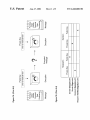
Public key cryptography overcomes the problem by elimi
nating the need for a single “secret” key. As illustrated in
FIG. 1A, each user of a public key cryptographic system has
subsequently altered by anyone else. Forgery of a signed
message is computationally infeasible.
By Way of summary, FIG. 1B illustrates the functions for
usually employed.
Generally, cryptographic systems use either “secret-key”
encryption or “public key” encryption. In “secret-key”
to authenticate the signature. Since the signer, alone, pos
sesses the private key that created that signature, authenti
cation of a signature con?rms that the message Was actually
sent by the signer, and that the message has not been
as the Internet, Wide Area NetWorks (WANs), and the like.
With the ever-increasing popularity of such environments
comes the need for exchanging messages and other docu
private key. Any recipient can employ the user’s public key
65
managed. As With all strong crypto, the key(s) to Which the
data is encrypted must be available or else the data is totally
unrecoverable. Most organiZations ?nd this risk unaccept
able. For instance, a company might be (legally) required to
be able to provide copies of e-mail that originated Within its
netWork. Accordingly, most organiZations take steps to
ensure that any corporate information is alWays recoverable
by the company.