1
Duplex - Dual. A fiber-optic cable that contains two optical
fibers.
Ferrule - A component of a fiber-optic connection that holds a
fiber in place and aids in its alignment.
Fiber - The optical wave guide, or light-carrying core or
conductor. Generally refers to the combination of optical core
and cladding.
Fiber amplifier - A special length of fiber that will amplify
optical signals entering its active area. Very similar in operation
to a laser amplifier.
E
Fiber bandwidth - The frequency at which the magnitude of
the fiber transfer function decreases to a specified fraction of the
zero frequency (DC) value. Often, the specified value is one-half
the optical power at zero frequency.
Electron - A particle which orbits the atomic nucleus. It
possesses a unit negative electrical charge of 1.6 x 10 -19
coulombs.
Fiber buffer - A material protecting optical fibers from physical
damage by providing mechanical isolation between them and
external influences.
Electro-optic effect - The change of a material's refractive
index or the change of its birefringence under the influence of an
electric field. One material that exhibits this effect is lithiumniobate.
Fiber bundle - An assembly of unbuffered fibers. These are
usually used as a single transmission channel to transmit light or
images which may be either coherent or incoherent.
End finish - Quality of the surface at an optical-fiber's end,
commonly described as mirror, mist, hackle, chipped, cracked,
or specified by final grit size of the polishing medium (1 µm, 0.3
µm, etc.).
Fiber-optic link - Any optical transmission channel designed to
connect two end terminals.
Endoscope - A medical-optical fiber bundle used to examine the
inside of the human body.
Fiber optics - A branch of optical technology that deals with the
transmission of radiant energy through optical wave guides
generally made of glass or plastic.
End separation loss - The optical power loss caused by
increasing the longitudinal distance between the end of an
optical fiber and a source, detector, or fiber. See also: Extrinsic
joint loss.
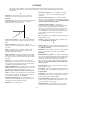
Fresnel reflection - Reflection losses that occur at the input and
output faces of any optical material due to the differences in
refractive indexes between them. Similar to "standing wave
ratio" in electronics.
Equilibrium length - For a specific excitation condition, the
length of a multimode optical wave guide necessary to attain
stable distribution of optical power among the propagating
modes.
G
Graded-index fiber - An optical fiber which has a gradual
refractive index change from the center to the edge. This type of
fiber has much less dispersion than step-index fiber.
Equilibrium mode distribution (EMD) - The condition in a
multimode optical fiber in which the relative power distribution
among the propagating modes is independent of length.
Synonym: Steady-state condition. See also: Equilibrium length;
Mode; Mode coupling.
H
Hertz (Hz) - A unit of frequency equivalent to one cycle per
second.
Extraordinary ray - A ray that has a non-isotropic speed in a
doubly refracting crystal. It does not necessarily obey Snell's law
upon refraction at the crystal interface. See also: Birefringence;
Ordinary ray.
I
Inclusion - The presence of an impurity within a body of glass.
Incoherent light - Light that is made up of rays which lack a
fixed phase relationship. Most light is incoherent. LEDs produce
this type of radiation. See Also: Coherent.
Extrinsic joint loss - Light loss caused by imperfect alignment
of fibers in a connector or splice. Contributors include angular
misalignment, lateral offset, end separation and end finish.
Generally synonymous with Insertion loss. See also: Angular
misalignment loss; End separation loss; Intrinsic joint loss;
Lateral offset loss.
Index-matching material - A liquid or cement whose refractive
index is nearly equal to that of a fiber's core index; used to
reduce Fresnel reflections from an optical fiber's end face. See
Also: Fresnel reflection; Refractive index.
F
Index of refraction - See: Refractive index.
Fall time - Typically specified as the time required for a signal to
fall from 90 percent to 10 percent of its original negative or
positive amplitude. See also: Rise time
Infrared - Wavelengths longer than 700 nm and shorter than l
mm. Infrared radiation cannot be seen, but it can be felt as heat.
Infrared light-emitting diode (ILED) - A semiconductor diode
very similar to LEDs, but which emits infrared radiation rather
- 56 -