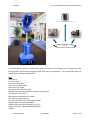
1
Project Acronym: GiraffPlus Project Title: Combining social interaction and long term monitoring for promoting independent living Grant agreement no.: 288173 Starting date: 1st January 2012 Ending date: 31st December 2014 D1.2 Technological Component Specifications WP related to the Deliverable: WP1 Nature: R Dissemination Level : P Version: Final Author(s): Maria Lindén (MDH), Javier Gonzalez (UMA), Francisco Melendez (UMA), Andrea Orlandini (CNR-ISTC), Francesco Furfari (CNR-ISTI), Michele Girolami (CNRISTI), Filippo Palumbo (CNR-ISTI), Stephen von Rump (Giraff AB), Soraia Rocha (Intellicare), John Barry (Tunstall), Lars Karlsson (ORU), Reviewer: Fransesco Furfari (CNT-ISTI), Silvia Coradeschi (ORU) Project Participant(s) Contributing: MdH UMA ORU CNR-ISTC CNR-ISTI GRF Intellicare TUN Contractual Date of Delivery: 1/04/2012 Actual Date of Delivery: 24/05/2012 GiraffPlus D1.2 Technological Component Specifications Document History Version V2 V3 V4 V5 V6 Date 03/04 26/04 08/05 18/05 27/05 Type of editing revision revision revision revision final Editorial Deliverable Summary This deliverable reports the work performed in Task 1.3, Technical Component Assessment and Selection. Within this task, an assessment of suitable technological components to be integrated with the GiraffPlus project has been performed, based on the result from Tasks 1.1 and 1.2. Further, the need of increased autonomous mobility and increased interaction capabilities of the system have been considered. The technical requirements for the personalized interface, configuration planning and context recognition have also been outlined. In particular a summary of sensors that can be used in the project have been presented and a technical specification of the Giraff robot has been outlined. A key section of the deliverable is section 2.4 where the matching of the user requirements with the sensors needed to fulfil them is presented. Version 0.6 Final 27/05/2012 Page 2 of 46 GiraffPlus D1.2 Technological Component Specifications Table of Contents List of Figures .................................................................................................................................... 4 List of Table ...................................................................................................................................... 4 1 Introduction ................................................................................................................................. 5 1.1 Scope of the document ...................................................................................................................5 1.2 Deliverable structure ......................................................................................................................5 2 Part I – Sensors............................................................................................................................. 8 2.1 Environmental Sensors from Tunstall .............................................................................................9 2.2 Physiological Sensors from Intellicare ......................................................................................... 11 2.2.1 Sensors Description................................................................................................................ 12 2.2.2 General description of the functioning of the kit .................................................................. 13 2.3 Complementary sensors/systems ................................................................................................ 16 2.4 Matching of user requirements with available sensors............................................................... 19 2.5 Integrating ZigBee Sensor Networks............................................................................................ 25 3 Part II – The Robotic Platform Giraff ........................................................................................... 30 3.1 Giraff platform ............................................................................................................................. 30 3.1.1 Giraff Motor Controller Board Serial Interface ...................................................................... 32 3.2 Increasing autonomous mobility of the Giraff platform .............................................................. 33 3.3 Increasing interaction capabilities ............................................................................................... 36 4 Part III – Software Services ......................................................................................................... 38 4.1 Services specifications ................................................................................................................. 38 4.1.1 Intelligent monitoring and adaptation................................................................................... 38 4.1.2 Services for personalization and users Interaction ................................................................ 39 4.1.3 Interaction and personalization ............................................................................................. 39 5 Part IV - Overall Conclusions ....................................................................................................... 40 Appendix A: References .................................................................................................................. 42 Appendic B: Equipment specification of IntelliCare's sensors ............................................................ 44 Version 0.6 Final 27/05/2012 Page 3 of 46 GiraffPlus D1.2 Technological Component Specifications List of Figures Figure 1 Overview of the ADLife system ......................................................................................................... 11 Figure 2 Overview of the system provided by IntelliCare. .............................................................................. 14 Figure 3 Overview of data transmission. ......................................................................................................... 15 Figure 4 The ZB4OSGi software architecture .................................................................................................. 26 Figure 5 Integrating different sensor networks............................................................................................... 29 Figure 6 The ZigBee Gateway Layers ............................................................................................................... 29 Figure 7 The GIraff platform ............................................................................................................................ 31 Figure 8 Motion profile of the motor control.................................................................................................. 33 Figure 9 Kinect sensor ..................................................................................................................................... 34 Figure 10 Sharp sensor .................................................................................................................................... 35 Figure 11 Interaction with the Giraff platform ............................................................................................... 36 Figure 12 Specification of the weight scale. ................................................................................................... 45 List of Table Table 1 Physiological parameters that the users wish to monitor .................................................................... 6 Table 2 Social communication functionalities that the users wish from the system ........................................ 7 Table 3 activities and situations the users wish are monitored by the system ................................................ 7 Table 4 Environmental parameters that the users wish the system to detect ................................................. 7 Table 5 User requirements with respect to teleoperated robot ....................................................................... 8 Table 6 User requirements with respect to sensors ......................................................................................... 8 Table 7 User requirements for the overall system ............................................................................................ 8 Table 8 Overview of Intellicare's Sensors ........................................................................................................ 12 Table 9 Complementary sensors/systems for monitoring physiological parameters. .................................... 19 Table 10 Matching key services/parameters and sensors .............................................................................. 23 Table 11 Matching desirable services/parameters and sensors ..................................................................... 23 Table 12 Matching optional services/parameters and sensors ...................................................................... 24 Table 13 Main characteristics of the GP2D12 sensor ...................................................................................... 35 Table 14 Sensors Specification blood pressure sensor................................................................................... 44 Table 15 Equipment Features blood glucose sensor. ...................................................................................... 45 Table 16 Equipment specification weight scale. ............................................................................................. 45 Table 17 Equipment Specification thermometer. ........................................................................................... 46 Version 0.6 Final 27/05/2012 Page 4 of 46 GiraffPlus D1.2 Technological Component Specifications 1 Introduction 1.1 Scope of the document The aim of this deliverable is to assess and select a set of technological components suitable for both collecting the relevant information and implementing the GiraffPlus services according to the Task 1.1 and Task 1.2 results. The result of this work is a selection and specification of the sensors, which will be used in Task 2.4 and fully integrated in the GiraffPlus system. Further, an assessment of the current status of the Giraff robot is performed. An initial work on the definition of new functionalities to support limited autonomous mobility, and the interaction capabilities that pave the way to actuate the personalization capabilities subject of WP4 in the GiraffPlus Intelligent Environment is performed. 1.2 Deliverable structure The deliverable is structured as follows: after an introduction, which describes the scope of this document and its structures, follows a summary of the user requirements based on the result from Deliverable 1.1 "User Requirements and Design Principles Report". Part I specifies the sensors that are considered for integration in the GiraffPlus system. The matching of the user requirements in terms of activities and parameters to be monitor with the respective sensors needed is presented in section 2.4. Thereafter follows Part II, describing the present Robotic Platform Giraff and an initial work on the definition of new functionalities including increased autonomous mobility and increased interaction capabilities. Part III describes software services available and an initial assessment on how to integrate intelligent monitoring and adaptation and personalization and interaction of the system. Part III stresses that a User Centered Design approach will be used throughout the development process. In Part IV the overall conclusions are drawn. Version 0.6 Final 27/05/2012 Page 5 of 46 GiraffPlus D1.2 Technological Component Specifications 1.3 Summary of user requirements from D1.1 The GiraffPlus project aims at developing a system that addresses the challenge of early detection and adaptive support to changing individual needs related to aging. In order to select the most important physiological and environmental parameters to incorporate for monitoring in the GiraffPlus project, a thorough investigation has been performed in Task 1.1, and described in Deliverable 1.1, User requirement and Design Principles Report. This investigation comprises: a literature study on indicators for independent living a qualitative study to identify user requirements on the GiraffPlus system with the use of focus groups a quantitative study to validate and prioritize the user requirements by questionnaires. Primary and secondary end users from three countries have been involved in the focus groups and have answered the questionnaires. Primary end-users are the persons who will be actually using the GiraffPlus system/services (i.e., the elder), while secondary end-users are persons directly in contact with a primary end-user (see Section 4 of D1.1 User Requirements Analysis and Design Principles Report for a presentation of GiraffPlus key aspects). In Deliverable 1.1, user requirements are used to prioritize the physiological and environmental parameters of interest to monitor within the GiraffPlus project ranking them as Key, Desirable or Optional. (For definition of the level of priority for each parameter to monitor, see section 6.2.6 in D1.1.) In the following a list of aspect that the users wish the system to be able to monitor are outlined. In particular four tables are presented: physiological parameters, social communication, activities and situations, and environmental parameters. A letter indicates if the requirement is considered a Key requirement (K), Desirable (D) or Optional (O). 1.a.3 Monitoring blood pressure K 1.a.4 Monitoring blood glucose levels K 1.a.2 Detecting the presence of body fluids D 1.a.6 Monitoring body temperature O 1.a.8 Monitoring body weight O 1.a.1 Monitoring of vital signs K 1.a.5 Monitoring blood oxygen levels K 1.a.9 Monitoring Heart function K 1.a.7 Determining whether the person suffers from incontinence D 1.a.10 Monitoring sleep activity O Table 1 Physiological parameters that the users wish to monitor 1.b.1 Facilitating contact between the person and healthcare professionals K 1.b.3 Facilitating contact between the person and home care assistant K 1.b.2 Periodic reporting to secondary users K 1.b.4 Reminding medications K 1.b.8 Warning notice to secondary users K 1.b.5 Notifying the house presents an unusual setting to caregivers 0 1.b.7 Allowing forced entry in case of emergency K 1.b.1 Facilitating contact between the person and healthcare professionals/home care Version 0.6 Final 27/05/2012 Page 6 of 46 GiraffPlus D1.2 Technological Component Specifications assistant /family D Table 2 Social communication functionalities that the users wish from the system 1.c.1 Detecting the position in the home K 1.c.2 Monitoring the movement K 1.c.12 Detecting decline in mobility K 1.c.13 Detecting absence of the elderly person K 1.c.3 Detecting the absence of movement K 1.c.15 Detecting Falls K 1.c.6 Monitoring of night activities D 1.c.16 Monitoring the time spent in bed K 1.c.14 Monitoring the use of home appliances D 1.c.17 Monitoring person balance K 1.c.4 Temporal monitoring of the position O 1.c.5 Detecting changes of habit O 1.c.8 Monitoring the time spent for preparing 1.c.7 Monitoring cooking ability O lunch O 1.c.9 Monitoring the time spent in different 1.c.11 Monitoring the social interactions activity home places O O 1.c.10 Monitoring the use of refrigerator at home O Table 3 activities and situations the users wish are monitored by the system 2.a.1 Detecting dangerous situations K 2.a.3 Detecting open doors K 2.a.8 Detecting water leaks K environmental 2.a.7 Detecting risky situations K 2.a.9 Detecting taps status K 2.a.2 Detecting misplaced objects inside the house K 2.a.4 Detecting lights status O 2.a.5 Detecting gas leaks 2.a.6 Monitoring temperature D Table 4 Environmental parameters that the users wish the system to detect A number of additional aspects have also emerged with respect to the design on the system. In particular in the following tables expectation with respect to the telepresence robot, the sensors and the overall system are presented. A letter indicates again if the requirement is considered a Key requirement (K), Desirable (D) or Optional (O). Appearance Sounds and Voice 3.a.1 nice-to-see aspect D 3.b.1 no noisy engine and/or unpleasant sounds K 3.a.2,3 suitable size and material K 3.b.2 sounds setting can be easily adjusted O 3.c.1 Adjustable dimensions K 3.a.4 customizable colors D 3.b.3 reaching the charging station or to 3.c.5 robot open to object allocation D Version 0.6 Final Hardware Configuration 3.c.2 operated also with reduced light conditions K 27/05/2012 Position in the home environment 3.d.1 placed in different rooms according to the elderly person preferences K 3.d.2 allowed to access the rooms according to the elderly person preferences K 3.d.3 charging station placed according to Page 7 of 46 GiraffPlus D1.2 Technological Component Specifications move to some positions after voice commands O 3.a.5, 3.c.3 with adjustable screen position K the elderly person preferences K 3.c.4, 4.b.5 robot open to sensors installation O Table 5 User requirements with respect to teleoperated robot Appearance 4.a.1 graceful aspect D 4.a.2 reduced dimensions D 4.a.3 suitable materials D 4.a.4 different colors D Integration in the home environment 4.b.1 gracefully integrated within the home environment K 4.b.2 suitable for installation in different home environment positions according to the elderly person preferences D 4.b.3 limited number of sensors to be installed in the home environment according to the elderly person preferences K 4.b.4 camouflage sensors according to the elderly person preferences K Table 6 User requirements with respect to sensors 5.a.1 reminders to the elderly person K 5.a.2 alarms to the elderly person in case of emergency K 5.a.3 memorandum repository access through the tele-presence robot O 5.a.4 record and store audio/video/picture memorandum through the tele-presence robot O 5.a.5 internet access through the tele-presence robot D 5.a.6 book reader service through the tele-presence robot D 5.a.7 customize its interface according to the nationality of the elderly person D 5.a.8 support rehabilitation activities K 5.a.9 capable of detecting obstacle K 5.b.1 a low-cost system K 5.b.1 paid by public healthcare service K Table 7 User requirements for the overall system The user requirements described above have been used as a guideline to identify which components need to be examined in this deliverable. In particular they have influenced the selection of sensors to be considered for detecting physiological parameters, activities and situations and environmental parameters. 2 Part I – Sensors In this section we examine the sensors that can be needed in the GiraffPlus system to satisfy the user requirements. Among the user requirements, the ones that are most significant for this section are the ones in tables 1, 3 and 4. The requirements in tables 2 and 5 are mostly related to the Giraff robotic platform and the personalized interface and will be considered in Deliverable Version 0.6 Final 27/05/2012 Page 8 of 46 GiraffPlus D1.2 Technological Component Specifications 1.3. The requirements in tables 6 and 7 are more of general character and will also be considered in Deliverable 1.3. Two of the industrial partners in the GiraffPlus project, i.e. Intellicare and Tunstall, will provide their sensors to the project. These sensors and systems are described in detail in the sections below (Sec. 2.1 Environmental Sensors from Tunstall and Sec. 2.2 Physiological Sensors from Intellicare). The measured parameters include physiological sensors for measurements of heart rate, blood pressure, temperature, oxygen saturation and glucose level and environmental sensors monitoring activity pattern and alerts in case of deviations from normal as well as social alarm with a radio trigger button and Electrical Usage Sensor, warning if an electrical device as a toaster is forgotten, passive infrared sensors for monitoring of movement, bed and chair sensors for monitoring location and activity and door opening and closing sensors. Further, a fall detection sensor, detection of body fluids and medication dispensers are available. There are also environmental sensors for fire detection, flood sensor and gas detection sensors. In section 2.3 complementary sensors to the ones already available via Tunstall and Intellicare are presented. Section 2.4 considers a possible solution to create a sensor network among the sensors, that is, using ZigBee technology. The project is open also to other solutions like Bluetooth. However we describe in details in this document just the ZigBee solution as it is less commonly used and less know in the consortium. 2.1 Environmental Sensors from Tunstall Tunstall sensors can be described as binary sensors, that is, the alarms they send are only to alert that a threshold has been crossed. These are the typical telecare sensors. Tunstall has created a second product line called AD Life that is a more advanced deployment of telecare designed to monitor the residence’s activity during the day and not just when an alarm is to be raised. To achieve this, the sensor reports are aggregated and plotted over time to give graphical views to the data to see how change happens over time. All in home local radios transmit on the 869 MHz social alarm frequency. The transmission is a proprietary radio system that Tunstall has invented that meets the European requirements for social alarms. Most specifications refer to 50m in-building range. Generally Tunstall radios work in at least 200m free space and with the 869 frequency propagation 50 meters is the most likely short distance that can be achieved under the most restrictive home environment. The most basic deployment is a social alarm with a radio trigger button. Most social alarms are analogue in that they communicate over analogue telephone lines (Public Switched Telephone Network or Plain Old Telephone Service). This has worked using in-band signalling with Dual Tones Multiple Frequency signalling or Touch tones for several decades. With more and more IP being used in telephone networks (both as a customer service and as a back haul technology), Tunstall has invented a modification of DTMF that allows for the coding and decoding of analogue signals over digital networks. In addition Tunstall has a native IP solution that uses IP for the signalling between the carephone and the monitoring system and then opens an analogue voice channel for voice communications between the carephone and the monitoring center. This requires that the house has either a digital subscriber line with an Analogue Terminal Adaptor voice gateway or a digital subscriber line with an analogue voice connection. In the following the sensors used in the ADLife system are described. Version 0.6 Final 27/05/2012 Page 9 of 46 GiraffPlus D1.2 Technological Component Specifications ADLIFE SENSORS: FAST Passive InfraRed motion detector – Generally in social alarms the PIRs are specified to be slow triggers, resetting only after 3 minutes (to preserve battery power), the fast PIR resets more regularly to be able to give a time sensitive view of the local activity. The typical deployment of ADLife will have 3 FAST PIRs located to monitor the bedroom, bathroom and one additional location (typically the entry way or kitchen). These are the key locations to monitor time in bed, trips to the bathroom, length of time in bathroom, trips to kitchen, time in kitchen and entry/exit information. The local area connection is 869MHz Tunstall protocol. The battery life expectancy is one year and the battery is user changeable. Electrical Usage Sensor – A box that plugs in a serial connection between the mains socket and the device plug. It detects when significant current is being drawn and reports the start event to the social alarm. When the current is no longer being drawn it reports the end event to the social alarm. This is quite useful for appliances like a toaster, coffee maker or kettle where the standby current is minimal or there is no draw and not useful for appliances like refrigerators where there is a consistently high draw. For the larger appliances a door usage sensor can be used. The local area connection is an 869MHz Tunstall protocol. The electrical usage sensor is mains powered. Universal Sensor – This name Universal comes from the devices flexibility. By itself the Universal Sensor can be uses as a door usage (open or close) sensor. In combination with other sensors it enables wired devices to transmit a signal to a social alarm. The Universal sensor has many different configurations that customise how the alerts are transmitted. The Universal Sensor has a five-year battery in order to support being deployed in different situations. Bed/Chair Occupancy Sensor (requires Universal Sensor) – is a pressure sensitive mat that is used with the Universal Sensor in ADLife deployments. The bed sensor alerts when pressure is sensed. The reported state is pressure sensed (on) and pressure not sensed (off). This combined with a PIR can create more complicated reporting like ”bed sensor turns off, room PIR turns on, bathroom PIR turns on, (delay of 60 seconds), bathroom PIR turns on, room PIR turns on, bed sensor turns on” for a bathroom visit at night. Only the change of state is reported in the apartment, it is up to the server or the reviewer to interpret the data. The radio used is the Universal Sensor, so battery is not an issue. Because they are pressure activated the bed sensor is expected to last 12 months of regular use and the chair is expected to last 12 months. Door usage (Universal Sensor) – is a ”universal receiver” that can be used to perform several tasks. As described above it is used as the controller for radio communications between less advanced sensors and the social alarm. The Universal sensor can also be used with other passive sensors to monitor door in cases where the door is normally open as well as normally closed. For example it can monitor a refrigerator, where the door is typically closed or an internal door like a bedroom door where it is typically open. The Universal sensor uses 869MHz with the Tunstall proprietary protocol. The battery life is 2 years. Version 0.6 Final 27/05/2012 Page 10 of 46 GiraffPlus D1.2 Technological Component Specifications Figure 1 Overview of the ADLife system Tunstall does have several other sensors like enuresis sensors, but they are not part of ADLife. One of these is the fall detection sensor, which is worn around the wrist and gives an alarm in case of a fall. There are also medication dispensers, sensors for detection of body fluids and environmental sensors for fire detection, flood sensor, temperature extremes sensor and gas detection sensors. If there are other sensors that are applicable for the GiraffPlus project, Tunstall will investigate if and how they can be included in the project. A full list of peripherals can be found on the webpage [24]. 2.2 Physiological Sensors from Intellicare Intellicare has developed telemonitoring solution of several biomedical parameters (blood pressure, blood glucose, weight, oxygen saturation, temperature, among others), well-being monitoring (daily routine, aid requests, and fall detection, among others) and people and goods tracking. In particular Intellicare has developed the Look4my Health kit. Look4MyHealth is a system for remote monitoring of health and wellbeing parameters (blood pressure, heart rate, blood glucose, weight, oximetry, body temperature, among others) in the home environment. The patient can be monitored by his doctor, nurse, pharmacist or relative. In the following table the sensors available in the kit are presented. A detailed description of the sensors and of the overall kit follows. Version 0.6 Final 27/05/2012 Page 11 of 46 GiraffPlus D1.2 Technological Component Specifications Table 8 Overview of Intellicare's Sensors 2.2.1 Sensors Description In the following sections we describe the sensors available from Intellicare. 2.2.1.1 Blood pressure and glucose meter Key Features This is a 2 in 1 sensor equipment. It has the Blood Pressure (BP) measurement functionality and the Blood Glucose (BG) measurement functionality as well. Blood Pressure (BP) Sensor Automated Averaging 3 Measurements (AVG Technology) conducts 3 measurements within 2 minutes to provide the most accurate and reliable final average test result. RB (Irregular Rapid Beat) Technology: a technology with high precision to detect pulse irregularities during the measurement. It alerts the user of any unusual spike, patterns and trends for further check-ups with the doctor, but it does not substitute for a cardiac examination. Detailed specification of the blood pressure sensor is found in Appendix D. Blood Glucose (BG) Sensor No Coding Required: to reduce errors and enhance the accuracy while performing the blood glucose test Safe Strip Ejection: to protect from infection and also eliminate any hand contact with the test strip Pre & Post-Meal Recording: to distinguish the blood glucose test data between pre and post meal in order to improve blood glucose level with a better control Version 0.6 Final 27/05/2012 Page 12 of 46 GiraffPlus D1.2 Technological Component Specifications Clear & Wide Screen View: to provide comfortable result reading for people of all ages and eyesight quality Accuracy by International Protocol: clinical accuracy of the device is further guaranteed by the ESH validation Memory up to 864 Tests with Date & Time 7,14, 21, 28, 60, 90 Days Average Tiny Blood Sample: 0.5 uL Quick Result within 5 seconds Less Pain by AST (Alternative Site Testing) Support OneCare System Detailed specification of the blood glucose sensor is found in Appendix D. 2.2.1.2 Thermometer Features of the thermometer Accurate result in 1 second. 3 color LCD backlight provides a color coded result reading. Probe cover detection and ejection. Supported by OneCare System Fever indicator / over range warning. Large memory capacity up to 10 results. Battery life: more than 1000 measurements. Detailed specification and user manual of the thermometer is found in Appendix D. 2.2.1.3 Weight Scale The scale has a built-in 10-user memory and can store up to 135 measurements. It provides data transmission via RS232/Bluetooth/USB. In the GiraffPlus project, the version with Bluetooth transmission will be used. Detailed specification of the weight scale is found in Appendix D. 2.2.2 General description of the functioning of the kit The measurements are done at home, with a frequency appropriate to each situation, depending on the condition of the user and as prescribed by the care giver. They are done through several wireless devices, such as blood pressure monitor, weight scale or other devices for measuring biosignals with Bluetooth communication capability. A remote control is used by the user to register himself in all evaluations, it transmits via Bluetooth and identifies of the user which is about to use the device. Its function is to authenticate the user which will be evaluated and inform him that the measurement was entered correctly in the system. Version 0.6 Final 27/05/2012 Page 13 of 46 GiraffPlus D1.2 Technological Component Specifications It has four buttons, which allows the use of the system by up to four different users. Each patient/person has its own color-coded button. After each assessment, data is sent to the gateway, via Bluetooth. The data is then encrypted, transmitted to a server and stored in a database. The server which receives the data keeps it available for consultation via web page, by the care giver responsible for monitoring and evaluating the user. All the data sent and stored in the server is encrypted with secure and reliable encryption codes. A web Portal is used by the healthcare givers to remotely monitor their patients. It shows to the doctor all his patients measurements via graphs, tables and using a calendar. This remote monitoring can be also made by the person himself or close family. The software is a web application that can be accessed at any place where there is an Internet connection. There are different permission levels for the users taking in consideration if the data is seen by system administrators, doctors or simply the user itself. Both can coexist and see the data. This means that the patient can monitor himself, see the data, set alarms and also can be followed by his doctor. The alarms are simple maximum and minimum thresholds for measurement controls. The system sends alarms in risky situations, and deviations from patterns are notified to healthcare provider. Alarms, in addition to being displayed in the Web portal, can be sent by SMS or email to the healthcare provider. Alarm settings, which may include various levels, are defined by the caregiver for each user individually. Figure 2 Overview of the system provided by Intellicare. 2.2.2.1 Communication and data storage The remote communications used in the Look4MyHealth system are known technologies very well integrated in daily life. The Gateway can use GPRS, 3G and Ethernet to send the data to the server. GPRS and 3G are achieved by using a SIM card in the Gateway simulating mobile phone communication. This adds a cost to the solution but it is very well accepted by the elderly and Version 0.6 Final 27/05/2012 Page 14 of 46 GiraffPlus D1.2 Technological Component Specifications remote community where many families do not have Internet at home. If there is an Internet provider already, the Ethernet solution is a simpler and less expensive choice. It works by connecting an Ethernet wire to the gateway or simply by configuring the Wi-Fi option in the gateway. The wireless communication used between sensors and gateway in the look4MyHealth kit is a Bluetooth protocol. The kit can also use Wi-Fi. However Wi-Fi is not a power saving technology and the tendency is to consider low power Wi-Fi equipment or even Zig-bee. Technologies like Zigbee are very interesting because of their characteristics (low power, mash, etc). However there are still some certification issues ongoing. To summarize the following remote communication is used in the kit (default communications in bold): Remote communications used in the Gateway: GPRS, 3G, Ethernet; Wireless Technologies that the Gateway supports: Wi-Fi, Bluetooth; It is possible to use USB to access the Gateway configurations. Intellicare aims to be compliant with HL7 (standard in the software communications) and Continua Alliance. The Continua Alliance strives to allow several sensor manufacturers integrate the same communication protocol for several sensor manufacturers and service providers. Figure 6 offer an overview of the proposed data transmission solution for GiraffPlus. Figure 3 Overview of data transmission. The sensors proposed are compliant with Continua Alliance and can be from different manufacturers. They can also use different wireless technologies as ZigBee, Wi-Fi and Bluetooth. The data sent by those sensors are acknowledged by the gateway that also supports Wi-Fi, Bluetooth or ZigBee, and uses the Internet to send the data to be stored in the server via Ethernet cable or 3G communications. The server then stores all the data and uses HL7 with propose of integrating different software interfaces. Look4MyHealth offers also a warehousing, certified healthcare data storage. This means all the data from sensors or patients are secured with respect to legal and ethical requirements. All the collection and data transmission are certified and guaranteed by Intellicare Communication Support. Intellicare offers also Data Management and Processing Algorithms tested and approved in real and clinic sceneries. Version 0.6 Final 27/05/2012 Page 15 of 46 GiraffPlus D1.2 Technological Component Specifications Login Validations and different User Profiles implemented as part of a secure network (different degrees in login process – admin, doctor, pharmacies, informal care giver, user himself). The solution also offers Network Traffic Management with partnerships in strategic positioned companies in the market for 3G communications. A direct line for customer support is available for technical and end user support. 2.3 Complementary sensors/systems In addition to the sensors that can be provided by Tunstall and Intellicare there are also complementary sensors/systems available as products on the market and/or as research prototypes. Since the GiraffPlus project will include an evaluation in the homes of elderly at an early stage of the project, we have focused on sensor solutions that already have reached the market. Complementary/alternative sensors can be considered in the project due to specific needs from the users or lack of user acceptance of the initial provided sensors. It has, for example, been shown that people with chronic heart failure found it difficult and painful to use an upper arm cuff blood pressure monitor [1], whereas a wrist mounted system showed a higher user acceptance [2]. Below is a first description over possible complementary/alternative sensors, systems and solutions that could be useful to the project. The sensors should be wearable, comfortable, and also provide the data to the GiraffPlus system in an automatic way, to avoid human input errors. Wireless technologies are used when appropriate. Pulse and oxygen saturation Pulse and oxygen saturation can be measured by a pulse oximeter. There are several mobile systems available on the market, but if the intention is to manage monitoring of mobile users in their home, the flexibility and comfortability is important. Such a system is available from Nonin [3]. Heart monitoring In certain situations, there could be a need to record ECG data. One solution is the use of the Zenicor system, allowing dry electrode recordings by using contact with the thumbs [4]. Using this sensor arrhythmia investigations and screening for atrial fibrillation among risk groups can be performed. When used in research projects, the cost for one system is 10 000 SEK per year. Blood pressure monitor A clinical evaluated wrist mounted blood pressure monitor is available from Omron. The cost is 1 433 SEK for the blood pressure monitor and an additional cost of 547 SEK for an usb computer connection [5]. Applications for self-reported health related data Self-report of health related data has shown to increase patients’ compliance and both objective and subjective (symptoms) data are important to follow [2]. This can be performed by web based questionnaires in combination with objective sensor data capture. In the case of persons with limited or no user experience of computers, a digital pen can be used on a special paper for the computer input. This has for example been used in palliative care [6] and in the care of severe heart failure patients [7]. A license and digital pen costs about 3900 SEK and is available from Anoto [8]. Version 0.6 Final 27/05/2012 Page 16 of 46 GiraffPlus D1.2 Technological Component Specifications Continuous monitoring of glucose level Some patients have difficulties in controlling their glucose levels. For those, continuous monitoring of glucose level might help in finding a balance in food intake, medication and exercise. Such systems are provided by e.g. Medtronics [9]. Sleep pattern monitor There are several systems available to monitor sleep pattern. One system is the wellness watch that is worn around the wrist [10]. Another is the Zeo sleep manager, a system composed of a wireless headband, a bedside display, a set of online analytical tool (cost 149 USD) [11]. Activity monitoring There are several commercial available systems for activity monitoring. A system called IDEEA has been used to analyse movements of various body parts [12]. The physical activity together with the energy consumption during daily activities is measured. The Fitbit system [13] measures physical activity; calculates the energy consumption and presents the sleeping pattern. The product GeneActiv is worn as a bracelet and measures daily physical activity, body position and sleeping pattern [14]. The ActivePal from PAL technologies provides a similar system with an inclinometer and tri-axis accelerometers. It is attached to the user's leg and calculates step, energy consumption and how long time the user has been moving [15]. The product Trigno Mobile combines EMG measurements with acceleration in a wireless sensor [16]. Balance and movement assessment Inertia sensors, available as research prototypes within the GiraffPlus project, have been assessed in a pilot investigation for rehabilitation of patients with Whiplash associated disorders [17]. This sensor system could be modified to be used in the assessment of balance. There are also available products initially developed for the gaming market, as Nintendo Wii, with a Balance Board, which can be used for balance assessment and home rehabilitation. Several studies have been performed with promising results [18-23]. Microsoft also provides a system for movement detection by Xbox Kinect, using infrared cameras for motion detection. Additional environmental sensors Detecting lights status can be performed by the use of photo detectors commonly available on the market. Also thermometers common available on the market can be used in order to monitor the in-door temperature, raising an alert in case of extreme temperature conditions. In general it can be noted that although there is a large interest to participate in initiatives as the Continua Alliance, most companies tend still to keep their communication protocols protected, which hampers the development. Measured parameter Pulse and oxygen saturation Heart monitoring, ECG arrhythmia investigations and screening for atrial fibrillation Blood pressure Version 0.6 Final Product /Company Price name WristOx2™, Model 3150 Wrist-worn Pulse Oximeter, Nonin Zenicor system 10 000 SEK/year Comment Omron USB-interface 433 SEK for the blood 27/05/2012 Compliant to the Continua Version One Design Guidelines Web-interface (not open for integration) Page 17 of 46 GiraffPlus D1.2 Technological Component Specifications monitor pressure monitor, 547 SEK for an usb computer connection License and digital pen Transmits data to costs about 3900 SEK computer or server System for selfreported health related data Digital pen, Anoto Continuous monitoring of glucose level Sleep pattern monitor Medtronics - Transmits data to wearable transceiver 4400 SEK Continuous measurement Sleep pattern monitor Vivago Active Wellness Clock, Wrist worn system Zeo sleep manager 149 USD Activity monitoring IDEEA - Activity monitoring Fitbit system measures physical activity, calculates the energy consumption and presents the sleeping pattern GeneActiv - Activity monitoring ActivePal / PAL technologies - Activity monitoring Trigno Mobile - Inertia sensors Research prototypes available within the Wireless headband, a bedside display, a set of online analytical tools Analyse movements of various body parts, the physical activity together with the energy consumption during daily activities are measured Attached to the user's leg and calculates step, energy consumption and how long time the user has been moving Measures daily physical activity, body position and sleeping pattern Inclinometer and triaxis accelerometers. It is attached to the user's leg and calculates step, energy consumption and how long time the user has been moving Combines EMG measurements with acceleration, wireless 3-axis accelerometers and gyroscopes could Activity monitoring Version 0.6 Final - 27/05/2012 Page 18 of 46 GiraffPlus D1.2 Technological Component Specifications project Wii Fit Plus (with Balance Board Available from Nintendo 1000 SEK Kinect Available from Microsoft 150 € Temperature Commonly available Photo detectors Commonly available Video camera Commonly available be used to assess the balance. Balance board connected to the Wiigame system, making balance assessment available. Sensor system based on IR sensor for motion detection. Thermometer measures the temperature in the house and can alert at extreme temperatures. Can be used to monitor light status in the house. Can be used to monitor who is entering and leaving the house. Possible solution if privacy is not considered a concern Table 9 Complementary sensors/systems for monitoring physiological parameters. Detecting dangerous environmental situations Detection of dangerous environmental situations, such as gas leakage, water leakage and risk of fire is prioritized in the User requirement and Design Principles Report. Systems for environmental monitoring for detection danger are, however, common available consumer products on the market. These systems will not be assessed in detail in this report. 2.4 Matching of user requirements with available sensors In the following tables a summary of a matching of user requirements and possible sensors that can be used is presented. The user requirements considered are the ones most relevant with respect to sensor selection. They are listed in tables 1, 3 and 4 and are the ones related to detection of physiological parameters, activities and situations and environmental parameters. The first table considers all the identified key requirements in tables 1, 3, and 4 and the following tables the desirable ones and a selection of optional ones1 in the same tables. 1 The optional requirements not considered are: 1.b.5 Notifying the house presents an unusual setting to caregivers, 1.c.8 Monitoring the time spent for preparing lunch, 1.c.7 Monitoring cooking ability, 1.c.11 Monitoring the social interactions activity. These requirements need to be further specified to allow a clear matching to sensor requirements. They will be considered further in D1.3. Version 0.6 Final 27/05/2012 Page 19 of 46 GiraffPlus D1.2 Technological Component Specifications Services/parameters identified as KEY: Services/Parameter to monitor 1.a.1, 1.a.9 Monitoring of vital signs, Monitoring heart function Sensors provided by Intellicare Pulse oximeter Weight scale 1.a.3 Monitoring blood pressure Blood pressure monitor 1.a.4 Monitoring blood glucose levels Glucose meter 1.a.5 Monitoring oxygen saturation levels Pulse oximeter 1.c.1, 1.c.2, 1.c.3, 1.c.12, 1.c.4, 1.c.9 Detecting the position, Monitoring the movement Detecting the absence of movement Detecting decline in mobility Version 0.6 Final Sensors provided by Tunstall Complementary sensors/systems Comments -WristOx2™, Model 3150 Wrist-worn Pulse Oximeter available from Nonin Zenicor system ECG registrations, 1 channel, dry electrodes suitable for arrhythmia investigations and screening for atrial fibrillation -Pulse oximeter can monitor pulse and oxygen saturation -1 channel ECG registrations, using dry electrodes can be suitable for arrhythmia investigations and screening for atrial fibrillation -Weight scale can be useful to monitor the weight of people with heart failure. -Blood pressure monitor, wrist measurements, available from Omron, clinically evaluated -Continuous monitoring of glucose level, system available from Medtronic FAST Passive InfraRed motion detector Door usage 27/05/2012 -WristOx2™, Model 3150 Wrist-worn Pulse Oximeter available from Nonin -IDEEA, analyses movements of various body parts -Fitbit system measures physical activity, calculates the energy consumption and presents the sleeping -Continuous monitoring of glucose could be useful if a person has difficulties in regulating his/her glucose level by intermittent measurements -Can also detect vital signs. Page 20 of 46 GiraffPlus D1.2 Technological Component Specifications Temporal monitoring of the position Monitoring the time spent in different home places 1.c.15 Detecting falls Fall sensor worn around the wrist 1.c.17 Monitoring person balance 1.c.13 Detecting absence of the older person 1.c.16 Monitoring the Version 0.6 Final FAST Passive InfraRed motion detector Door usage Bed/Chair Occupancy Sensor Electrical Usage Sensor Bed/Chair 27/05/2012 pattern -GeneActiv measures daily physical activity, body position and sleeping pattern -ActivePal from PAL technologies includes inclinometer and triaxis accelerometers attached to the user's leg and calculates step, energy consumption and how long time the user has been moving -Trigno Mobile Combines EMG measurements with acceleration, wireless -Body worn inertia sensors available as research prototypes within the GiraffPlus project -Body worn inertia sensors available as research prototypes within the GiraffPlus project -Wii balance plate -Kinect sensor system -Body worn inertia sensors available as research prototypes within the GiraffPlus project -Video camera detecting who is entering and leaving the house placed outside the entrance door. Possible solution if privacy is not considered a concern Page 21 of 46 GiraffPlus time spent in bed 2.a.1, 2.a.5, 2.a.7 Detecting dangerous environmental situations (gas leakage, water leakage, risk of fire) D1.2 Technological Component Specifications Occupancy Sensor Carbon Monoxide Detector (wireless) Telecare Flood detector Gas shut off valve Natural gas detector Smoke detector (wireless) Heat Detector Temperature extremes sensor 2.a.2 Detecting misplaced objects inside the house 2.a.3 1.c.10 Detecting open doors, Monitoring the use of refrigerator at home 2.a.9 Detecting taps status 5.a.1 Reminding medication Version 0.6 Final -Systems for environmental monitoring for detecting hazardous events are, in addition to Tunstall’s sensors, also commonly available consumer products on the market. -Gas shut off valve: when combined with the natural gas detector, this solution automatically cuts off the gas supply to an appliance when a leak is detected. -Heat Detector provides additional protection against the risk of fires in rooms where smoke detectors are unsuitable e.g. kitchen. -Temperature extremes sensor Helps minimise the risks associated with changes in temperature including the build up of heat in a kitchen and the risk of sustained periods of cold weather. -Could be detected by video cameras; Possible solution if privacy is not considered a concern Door usage used in combination with the Universal Sensor to detect open or closed doors Telecare Flood detector Medication dispenser 27/05/2012 -Automatically dispensing medication and Page 22 of 46 GiraffPlus D1.2 Technological Component Specifications providing audible and visual alerts to the user each time medication should be taken. Table 10 Matching key services/parameters and sensors Services/parameters identified as DESIRABLE but feasible to consider: Services/Parameter to monitor Sensors provided by Intellicare Sensors provided by Tunstall Complementary sensors/systems 1.c.6 Monitoring of night activities Bed/Chair Occupancy Sensor FAST Passive InfraRed motion detector Door usage Electrical Usage Sensor -Vivago Active Wellness Clock, Wrist worn system that monitors sleep pattern -Zeo sleep manager, Wireless headband, a bedside display, a set of online analytical tool -Fitbit system measures physical activity, calculates the energy consumption and presents the sleeping pattern -GeneActiv measures daily physical activity, body position and sleeping pattern 1.a.2, 1.a.7 Determining whether the person suffers from incontinence, Detection of body fluids 1.c.14 Monitoring the use of home appliances 2.a.6 Monitoring the temperature inside the house Sensors available from Tunstall Comments Electrical Usage Sensor Temperature extremes sensor -Thermometers common available Table 11 Matching desirable services/parameters and sensors Version 0.6 Final 27/05/2012 Page 23 of 46 GiraffPlus D1.2 Technological Component Specifications Services/parameters identified as OPTIONAL but feasible to consider: Services/Parameter to monitor Sensors provided by Intellicare 1.a.8 Monitoring body temperature 1.a.6 Monitoring body weight Thermometer Sensors provided by Tunstall Weight scale Comments -Also estimates the body water and fat percentage. -Can be useful in monitoring patient's nutrition, status and heart failure. 1.a.10 Monitoring sleep activity 1.c.5 Detecting changes of habit Complementary sensors/systems -Vivago Active Wellness Clock, Wrist worn system that monitors sleep pattern -Zeo sleep manager, Wireless headband, a bedside display, a set of online analytical tool -Fitbit system measures physical activity, calculates the energy consumption and presents the sleeping pattern -GeneActiv measures daily physical activity, body position and sleeping pattern FAST Passive InfraRed motion detector Door usage Bed/Chair Occupancy Sensor Electrical Usage Sensor 2.a.4 Detecting lights status -Photo detectors common available Table 12 Matching optional services/parameters and sensors Version 0.6 Final 27/05/2012 Page 24 of 46 GiraffPlus D1.2 Technological Component Specifications 2.5 Integrating ZigBee Sensor Networks In this section we consider a possible solution to create a sensor network, that is, using ZigBee technology. The project is open also to other solutions like Bluetooth. However we describe in details in this document just the ZigBee solution as it is less commonly used and less know in the consortium. In the recent past a consortium of major industries, interested in Wireless Sensor Networks [30] (WSNs), delivered a new industrial standard called ZigBee (http://www.zigBee.org). Its main application fields are home and factory automation, consumer electronic and healthcare. The ZigBee specification defines the network and the application layer of low-power wireless networks, based on the IEEE 802.15.4 [30] standard (which specifies physical and MAC layer of low-power WSN). The network layer provides support to star, tree, and peer-to-peer multi-hop network topologies. The application layer provides a framework to support, configure and manage distributed applications running on the sensor nodes. To enable interoperability of nodes from different manufacturers, the ZigBee alliance defines the concepts of application profiles and clusters. The application profile is a collection of device descriptions that form a cooperative application. A device is described as a set of clusters, a sort of standardized network messages exchanged among the cooperating devices. In turn, a cluster is a collection of commands and attributes: data entities which represent a physical quantity or state. Interacting with a ZigBee network requires prior knowledge about the ZigBee protocol, in particular the messages (frames) format, the interaction paradigm, and the ZigBee clusters and profiles. The possibility of accessing to the ZigBee network without such prior-knowledge and from heterogeneous networks requires to design and to implement ZigBee gateways able to ease the access to the ZigBee nodes and, simultaneously, able to export the ZigBee services to different target networks. More generally, the design of a ZigBee gateway gives rise to two main aspects that should be taken into account: 1. Seamless integration: ZigBee nodes become accessible from outside, without any prior knowledge about the specific technology (message format, hardware features, interaction paradigm, network topology etc.); 2. Interoperability: services exposed by the ZigBee nodes cooperate by adopting a serviceoriented model. The services can be integrated within existing architectures, drawing the socalled mash-up services. These aspects are taken into account by ZB4OSGi software developed by CNR-ISTI [31]. ZB4OSGi is an OSGi-based software gateway that exports the ZigBee network services via different channels by exploiting a 3-layered architecture. The gateway exports an abstract view of the ZigBee network, in which only the services provided by the ZigBee nodes are mapped into some OSGi services. The OSGi specification [32] defines a service oriented, component based platform for Java developers, and it offers a standardized way to manage the software life cycle. The OSGi implementations are containers running on top of a Java virtual machine, in which components can be installed, removed, started, and stopped at run time. An OSGi component (called bundle) is a JAR file that contains Java classes, resources and metadata describing the dependencies with other bundles. The main features that OSGi offers are: a service model where every application component can be registered as service into a service registry; Version 0.6 Final 27/05/2012 Page 25 of 46 GiraffPlus D1.2 Technological Component Specifications an execution environment where multiple applications can run on the same virtual machine; a set of API for the control of the bundles life cycle; The software components (bundles) wishing to detect the presence of a particular service, configure a service listener (with appropriate filters) and, as soon as the specified service becomes available, the OSGi framework notifies all the listeners with a service handler instance. ZB4OSGi exploits the OSGi execution environment exporting the ZigBee network services dynamically by means of different application-level technologies, for instance UPnP protocol [33], SOAP/REST-based services and others. The following figure depicts the service-oriented model defined by the ZB4OSGi architecture. All of the 3 layers are here represented: Access, Abstraction and Integration layer together with the underlying OSGi platform. Figure 4 The ZB4OSGi software architecture The Access Layer directly communicates with the ZigBee network by means of a network adapter (called USB dongle), or by RS232 dongles or other kind of adapters. According to the OSGi Device Access Specification, the component implementing the Access Layer is called Base Driver, while the components of the upper layers are called Refinement Drivers. The main role of the Base Driver is the discovery of all the ZigBee devices available in the network and the registration of service proxies representing the remote devices. The proxy services registered by the Access Layer are gradually refined and further abstracted by means of the upper layers. In particular, the Access Layer registers a ZigBee service proxy that is cluster neutral: it provides semantic-free methods that accept a ZigBee frame as formal parameter (represented as a sequence of byte) and injects the frame into the ZigBee network. The Abstraction Layer introduces more semantic to the registered proxy services, by refining them with new ones. These new OSGi services are dynamically registered according to the ZigBee profile implemented by the remote ZigBee devices. For this reason the Abstraction Layer registers ZigBee Version 0.6 Final 27/05/2012 Page 26 of 46 GiraffPlus D1.2 Technological Component Specifications services that are profile based (i.e. Light devices, thermostat devices). Note that, although the Abstraction Layer is designed as a generic layer, it should include a specific refinement driver for each ZigBee profile in use. The Integration Layer, finally, maps the profile-based ZigBee services to an application-level protocol. Figure 4 show, as example, a ZigBee light Device exported as UPnP Light. The way the Integration Layer reacts to the services registered by the Abstraction Layer, follows the standard OSGi event mechanism. ZB4OSGi fully integrates ZigBee nodes adhering to the standard ZigBee Home Automation Profile, but further profiles can be easily included. Currently, the ZigBee Alliance defines profiles for 8 different application domains: Building Automation, Remote Control, Smart Energy, Health Care, Home Automation, Input Device, Retail Services, and Telecom Services. Recently, a first set of ZigBee Health Care devices has been certified and released by the Brunel University of London (http://www.zigbee.org/Products/CertifiedProducts/ZigBeeHealthCare.aspx): Blood Pressure Monitor Weighing Scale Pulse Oximeter Blood Glucose Reader Pill Dispenser The devices will be launched on the market the next year. In order to integrate health care devices with the ZB4OSGi software a new refinement drivers has to be developed which implements ISO/IEEE 11073 protocol. Possible Scenarios In order to execute ZB4OSGi software the hardware and software requirements are: PC with a compatible ZigBee Network Interface Java 5 OSGi compliant framework Operating System supporting the RXTX library (this library enables the Java interaction with serial port) These requirements can be easily satisfied by any desktop PC or laptop with a compatible ZigBee dongle plugged, but in a smart environment where a lot of devices are deployed as edge node and where the collection of the data and the interaction with the system must be as transparent as possible to the end user, the presence of a small, powerful and low power gateway become Version 0.6 Final 27/05/2012 Page 27 of 46 GiraffPlus D1.2 Technological Component Specifications crucial. In this scenario, two example configurations are detailed that reflect this non-functional requirement: a Plug Computer with a compatible ZigBee dongle plugged and a M2M (Machine to Machine) device with a built in ZigBee SOC. GuruPlug Server Standard + CC2531 Marvell Kirkwood 6281, 1.2GHz 512MB 16bit DDR2 RAM, 800MHz 512MB NAND Flash Wi-Fi 802.11 b/g Bluetooth 1 Gigabit Ethernet Port 2 USB 2.0 ports U-SNAP I/O Texas Instruments CC2531 USB Dongle 2.6.32 Linux Kernel Indicative costs 100€ + 50/80 € for the dongle http://www.globalscaletechnologies.com/ Kontron M2M Smart Services Developer Kit Intel® Atom™ processor E640T 1 GHz/Intel® Platform Controller Hub EG20T 1 GB DDR2 Internal Data Storage capacity 4 GB via internal MicroSD card Wi-Fi WLAN (802.11b/g/n) Intel® Centrino® Advanced N 6205 Wi-Fi module installed 1 RJ-45 Ethernet Port 3 USB 2.0 ports Microphone, Headphone/Line Out, 2x MicroHDMI, MicroSD slot WPAN (802.15.4) TI CC2531 SOC; ready for ZigBee® certification or for 6LoPAN or Wireless HART WPAN use 3G/4G WWAN Ericsson 5521gw 3G module Ultra low-power high performance three axis linear accelerometer OS Wind River Linux 4.1 Indicative costs 500/800 € depending on the configuration http://us.kontron.com/simplify-and-speed-your-entry-into-the-m2m-marketplace/ The following figures describe a possible configuration of the sensors network, which is composed of a certain number of hardware gateways, each providing access to different sensor technologies. Software modules of the GiraffPlus system communicate with such gateways to access sensor data by means of software middleware which enables protocol interoperability. Version 0.6 Final 27/05/2012 Page 28 of 46 GiraffPlus D1.2 Technological Component Specifications Figure 5 Integrating different sensor networks The following figure describes the stack of layers used to integrate ZigBee technology and for each one report the main functional purpose: Java is used to guarantee portability with different Operating System, OSGi enables the remote management of the gateway, and therefore it might be useful to provide remote assistance during the pilot site configuration. ZigBee4OSGi abstracts from the details of the network protocol by exposing each device as a service, and finally the middleware enables each module and component of the Giraff+ system to communicate and access the sensor data. Figure 6 The ZigBee Gateway Layers Version 0.6 Final 27/05/2012 Page 29 of 46 GiraffPlus D1.2 Technological Component Specifications 3 Part II – The Robotic Platform Giraff In this section we first describe the Giraff platform and then the technical requirements related to improvements in terms of autonomy and interaction that can be implemented during the GiraffPlus project. 3.1 Giraff platform The Giraff platform has 3 main architectural components: 1. The “Giraff” is a remotely controlled mobile, human-height physical avatar integrated with a videoconferencing system (including a camera, display, speaker and microphone). It is powered by motors that can propel and turn the device in any direction, even backwards. The Giraff is placed in a home or care facility and allows a caregiver (formal or informal) to virtually visit the residents there, move about and freely interact with them (talk and listen, see and be seen) just as if that caregiver were physically present. 2. The Giraff is accessed and controlled over a standard Internet connection via the “Pilot” computer/laptop client. From a remote location a person with no prior computer training can “visit” a home and intuitively navigate the Giraff down hallways, through doorways and around tables and chairs. Visitors can also look around via a pan/tilt/zoom camera, and be seen and heard in real time via a life-size portrait image from their webcam. 3. Care organizations manage Giraffs and users via “Sentry,” a user management policy and supporting administration database that ensures only caregivers authorized by the resident can connect to the home, and only under the circumstances (day, time, etc.) dictated by the resident. Some trusted caregivers may be allowed in certain situations to connect without the call being answered by the resident. Version 0.6 Final 27/05/2012 Page 30 of 46 GiraffPlus D1.2 Technological Component Specifications ”Sentry” (management system) “Pilot” (caregivers) “Giraff” (residents) Internet Figure 7 The Giraff platform The Giraff device itself has 5 components that are relevant to development and integration work for the project, particularly integrating work from other organizations. This section describes the specifications for these components. CPU # of Cores 2 # of Threads 4 Clock Speed 2.1 GHz Intel® Smart Cache 3 MB Instruction Set 64-bit Instruction Set Extensions AVX Max Memory Size (dependent on memory type) 16 GB # of Memory Channels 2 Max Memory Bandwidth 21.3 GB/s ECC Memory Supported No Processor Graphics Intel® HD Graphics 3000 Graphics Base Frequency 650 MHz Graphics Max Dynamic Frequency 1.1 GHz Graphics Output eDP/DP/HDMI/SDVO/CRT Details: Version 0.6 Final 27/05/2012 Page 31 of 46 GiraffPlus D1.2 Technological Component Specifications http://ark.intel.com/products/52220/Intel-Core-i3-2310M-Processor-(3M-Cache-2_10-GHz) Motherboard Intel® HM67 Express Chipset 2nd-Generation Intel Core i3, i5, i7 Mobile Processors Embedded Windows 7 SO-DIMM Dual Channel DDR3-1066/1333 up to 16GB Intel 82577LM PCI-E Gigabit LAN 2 * SATA2 6Gb/s & 3 * SATA2 3Gb/s with RAID 24-bit Dual Channel LVDS & Inverter PCI Express 2.0 x16, PCI Express Mini Card slots 2 * USB 3.0 & 8 * USB 2.0 ports VGA/DVI/HDMI Video Outputs Watchdog Timer, HD Audio, AMI EFI BIOS Details: http://www.jetwaycomputer.com/spec/NC9B-HM67.pdf Memory ValueRAM 512M x 64-bit (4GB) DDR3-1333 CL9 SDRAM (Synchronous DRAM) 2Rx8 memory module, based on sixteen 256M x 8-bit DDR3-1333 FBGA components. CL(IDD) 9 cycles Row Cycle Time (tRCmin) 49.5ns Refresh to Active/Refresh 160ns Command Time (tRFCmin) Row Active Time (tRASmin) 36ns Details: http://www.kingston.com/dataSheets/KVR1333D3S9_4G.pdf Hard drive Interface: SATA III 6Gb/s high-speed interface Capacity: 60GB Data transfer rate: Read-550MB/ S *max Write-480MB/ S *max Dura Write technology RAISE technology (data protection, debug and wear balance for single-driver RAID) Supports SMART hard drive detection Support for Windows 7 Trim commands Details: http://www.teamgroup.com.tw/filterable_product/tabs_detail/data/en/12/576/zfKsFi.html 3.1.1 Giraff Motor Controller Board Serial Interface The Giraff software consists of a high-level GUI and state management system written in Java and running on the Embedded Windows 7 board described above. Low level motion control and sensor feedback is accomplished using a separate AVR micro-controller running a single- threaded C application. Communication between the Java software and the AVR micro-controller occurs over a RS-232 serial interface, using a library of text-based commands. Version 0.6 Final 27/05/2012 Page 32 of 46 GiraffPlus D1.2 Technological Component Specifications The AVR micro-controller sequences all real-time motion control on the Giraff system. It is one of numerous components that together form the Motor Controller Board, which includes the electronics to control the position and velocity of three brushed motors under PID control using encoder feedback. The Motor Controller Board controls motors using a trapezoidal motion profile: Figure 8 Motion profile of the motor control As can be seen from the above diagram, the “trapezoid” is a plot of speed over time. In general, a motion command consists of a request to move a specific distance, with a specific acceleration, and a specific peak velocity. This distance can be considered the area under the trapezoid, or the integral of speed over time. The software calculates the required movement time given the desired acceleration, peak velocity, and distance. Short distance moves may never reach the peak. The AVR micro-controller software uses 'get' and 'set' commands to modify and query state information regarding the Motor Controller Board; 'set' commands are also used to initiate movement commands. These commands can be sent to the Motor Controller Board using a textbased serial interface program, which is described in detail in a separate Application Program Interface (API) document. 3.2 Increasing autonomous mobility of the Giraff platform The GiraffPlus project envisages significant improvements in the autonomous mobility of the Giraff platform. Concretely, we consider: 1.- Robust and reliable obstacle detection. The robot is aimed to deal with cluttered and dynamic environments. A variety of objects placed at different, unknown positions, with different characteristics, i.e. shape, dimensions, materials, etc., are supposed to be present in the environment. In order to reliably perceive the environment for obstacle detection, threedimensional sensors, are needed. 2.- Safe navigation to a user-specified place. The robot is intended to automatically move in a secure way to particular places pointed out by the user, negotiating any possible obstacle that Version 0.6 Final 27/05/2012 Page 33 of 46 GiraffPlus D1.2 Technological Component Specifications may appear along the way. Smooth paths and quick response to properly react against obstacles are desirable features will require a significant computational burden in the system. 3.- Robust manoeuvring to approach distinctive locations, e.g. the recharging station or the ”idle-point”. Apart from safely navigating to a destination, the platform should also be able to perform sophisticated and accurate manoeuvrings in particular for performing the auto-docking operation. Some simplifications of these feature were already addressed with success by the UMA group under the EXCITE project. Concretely simple algorithms for obstacle detection were integrated utilizing 2D laser rangefinder sensors. This functionality was combined with autonomous navigational algorithms that permitted the Giraff platform to approach to the recharging station from a limited distance and orientation, and to autonomously moving between short distances stopping when a close obstacle was detected. In such cases the secondary user had to take the control of the robot and command it to avoid the obstacle in order to arrive to the destination. According to the experience gained by the UMA group in the field of mobile robotics and particularly with the Giraff platform, and the inputs collected by the users, the results obtained in the EXCITE project are going to be extended in the aforementioned directions. In order to achieve these improvements in the mobility of the Giraff platform, the recommended specifications from the technical point of view includes i) improving the sensorial system, and ii) improving the computational performance: i. The requirements for the sensorial system embrace the inclusion of new sensors able to scan the surroundings of the platform in 3D, being the novel Kinect sensor an attractive option. Among others, the main characteristics that make Kinect an interesting solution for improving the perceptual abilities of Giraff are: It is compact and lightweight. It provides both RGB and range images. It is fast, range information is generated at a frequency of 30 Hz. The operation range is acceptable for house-like environments: from 1.2 to 3.5m. It is cheap, around 150 € nowadays. Figure 9 Kinect sensor Range information provided by Kinect will largely enhance the perception of the Giraff platform enabling the detection of obstacles located in a field of view of 58º in the horizontal plane and 45º in the vertical one. Version 0.6 Final 27/05/2012 Page 34 of 46 GiraffPlus D1.2 Technological Component Specifications Additionally, short-range sensors can be considered for covering areas out of the field of view of this sensor, such as blind angles, stairs, etc. For this, standard optoelectronic devices installed at particular points around Giraff are the most convenient solution. For example, the SHARP family of proximity sensors are adequate for these purposes, like the GP2D12 sensor which is small (4x1.3x1.3 cm. approx.) cheap (less than 15$) and exhibits a detection range from 10 to 80 cm. Figure 10 Sharp sensor Range 10 to 80cm Response Time 39 ms Frequency 25Hz Power supply voltage: 4.5 to 5.5V Mean consumption: 35mA Peak consumption: ~ 200mA Table 13 Main characteristics of the GP2D12 sensor ii. Requirements regarding the computational performance of the Giraff Robot platform come from the inclusion of the Kinect sensor and the algorithms to be integrated into the platform for managing 3D data in the navigation, localization and obstacle negotiation tasks. Memory and storage capacities of the current version of the platform have to be increased. The current version of the Giraff platform is based on a computer with a 2GHz Intel Core Duo processor, 1 Gb of RAM memory and 4 Gb of hard drive capacity. Considering the preliminary tests performed in this period we estimate that the following configuration can fulfil the computational requirements for mobility: Processor 2.4GHz Intel Core 2 Duo (or equivalent) L2 cache 4 MB Memory 4 GB Storage 64 GB Conclusions Work packages WP2, WP4 and WP5 are closely related to the Giraff Robot Platform and therefore, the specification of the sensorial system and the computational requirements described above are important inputs for them. Concretely, the work packages that will be influenced by the considered specifications are: WP2. - Task 2.6: Increase the Giraff robot mobility WP5. - Task 5.6: Integrate the Giraff robot platform with the GiraffPlus system Version 0.6 Final 27/05/2012 Page 35 of 46 GiraffPlus D1.2 Technological Component Specifications WP5. - Task 5.7: Integrate the data related to the Giraff robot provided by the GiraffPlus system with a working prototype. WP4. - Tasks 4.1, and 4.3: Design of the Interaction and Visualization Service that will be in charge of designing and implementing the user interface with the Giraff robot platform. 3.3 Increasing interaction capabilities An aspect that can be of interest in the project is enhancing the interaction capabilities of the Giraff robot to allow an increased engagement for remote operators (i.e., secondary users) during the interactions through the robot. The use of computers and mouse devices for controlling the robot may result as a sort of “barrier” in having a thorough immersion in the remote environment. Therefore, the use of alternative tangible interfaces to control the robotic platform has been investigated. A wide numbers of work presented the assessment and exploitation of such tools [25, 26], sharing the objective of minimizing the cognitive load required by the user during the tele-presence experience. In fact, lowering such burden enhance the quality of the interaction. Then, a set of suitable devices for implementing alternative tangible interfaces has been identified. Namely, the Nintendo Wii remote controller, the Microsoft Kinect and smartphones equipped with accelerometers. Potentially, such devices allow to implement tangible interfaces that may allow the user to control the robot performing some gestures instead of using a mouse and a keyboards, and, then, having a more natural and immersive interaction. Figure 11 Interaction with the Giraff platform Each device introduces both positive and negative aspects that can be quickly stated as follows: Version 0.6 Final 27/05/2012 Page 36 of 46 GiraffPlus D1.2 Technological Component Specifications Wii Remote Controller The use of this controller allows the user to perform simple arm gestures in order to control the robot. Basically, given a mapping between gestures and robot movements, a client software is needed in order to track and detect the gestures and, then, to translate the gestures in robot movements. A suitable set of gestures is to be identified in order to implement a natural control. The use of such kind of device still requires the presence of a computer on the remote user side and performing some gestures can be tracked only when the user holds the remote controller. In addition, the user has to stand in front of the computer moving his/her arms but maintaining a frontal position with respect to the computer. Microsoft Kinect The main advantage in using the Microsoft Kinect is that the user is not requested to hold any device. Then, the above cited barriers disappear and the control from the user may result as more natural. In fact, even though a set of suitable gestures still has to be defined, the user may use his/her body in order to control the robot. Nevertheless, again, the user has to stand in front of the computer moving his/her arms maintaining a frontal position with respect to the computer. So the physical relation between the user and his/her computer still is there. Smartphones with accelerometers Nowadays, people are used to have smartphones and use them in multiple ways. Then, such devices result as the use of well-known tools for a wide number of potential users. Moreover, holding the smartphone with the both hands and moving it in several directions can constitute a sort of virtual window that provides an access to the remote environment. In addition, smartphones are endowed with videoconference capabilities and, thus, they allow having all the functionalities required to perform a call through the Giraff robot in a pretty small object. As such devices rely on mobile Internet connection, the available bandwidth may represent a critical issue. In fact, controlling the Giraff requires a real time control of the robot as well as a high quality video call service. Conclusions If the development of alternative interfaces is prioritized in the project, then an investigation need to be made if the Giraff robot can support such development. If this is the case in Work package 4, a dedicated activity can be dedicated to further investigate the above mentioned possibilities in order to (i) assess the technical issues related in using such devices, (ii) implement a prototype service that can be provided to secondary users in a real test site and (iii) evaluate the associated engagement and the usefulness perceived by the users. The latter aspect can be considered also in Work package 6 activities. In this regard, in [27, 28], authors discuss tele-presence as a multi-dimensional concept constituted by several dimensions, and we find as essential 4 of them in order to assess a tele-presence tool like the Giraff robot: Spatial Presence, the spatial perception of a remote environment as the actual environment in which the user feels his/her presence; Social Presence, the “illusion of non-mediation” against the awareness of the user of communicating through a tool during the tele-presence experience; Engagement, the cognitive involvement degree of the user during the tele-presence experience; Version 0.6 Final 27/05/2012 Page 37 of 46 GiraffPlus D1.2 Technological Component Specifications Social Richness, a measure of how much the tele-presence tool enhances sociality. Then, the concepts mentioned above should be carefully assessed while evaluating the possible prototype of alternative tangible interfaces implemented to control the Giraff robot. According to the results of that activity, also the impact on both the business model and the standardization task should be carefully evaluated in Work package 8. 4 Part III – Software Services This section shortly introduces the software services that will be produced within work packages 3 and 4. They will play a role of added value services that act on top of the basic services for sensing and actuating in the home environment. 4.1 Services specifications These services are developed on top of the basic data gathering of the home sensors and relay on high level reasoning to improve understanding of the activities performed in the home and configure the sensor network. In addition they also provide visualization of the information and personalization of the interface. In the following we briefly consider the technical requirements for these components of the system. 4.1.1 Intelligent monitoring and adaptation The software for intelligent monitoring and adaptation will be written in Java, which implies great flexibility regarding on what platform it is being run. It will essentially consist of three processes, one for configuration planning, one for context recognition, and one for the context database. It should be possible to run these processes either locally (i.e. on a computer in the apartment) or centrally (at some server). The configuration planning process shall be able to interact with the sensor network by activating and deactivating various sensors, and by directing the various sensor network data to different processes (“functionalities”) for further processing. The configuration planning process shall also be able to start, terminate and connect different processes (“functionalities”) for process sensor data at different levels of abstraction, and to direct data flows to the context recognition process. These functionalities should mainly be execute locally (i.e. on a computer in the primary user’s apartment), and communicate with sockets or some other means. The functionalities may be coded (and compiled) in Java, C, C++ or other languages. Finally, the configuration planning process shall be able to start processes that control any available actuators in the sensor network. The context recognition process and the configuration planning process shall be able to exchange information, e.g. about what state variables to track. The context database allows the context recognition system to store data permanently. This database can either be stored locally or centrally. The intelligent monitoring and adaptation services will be developed and deployed in WP 3. An important issue is the transfer and storage of physiological data, which may constitute a large volume if recorded over an extended amount of time, and which needs to be transferred and stored in a secure manner. This issue should be resolved in Task 1.4. Version 0.6 Final 27/05/2012 Page 38 of 46 GiraffPlus D1.2 Technological Component Specifications 4.1.2 Services for personalization and users Interaction The User Centered Design approach pursued within the GiraffPlus development aims at promoting optimal human-computer interactions both for primary and secondary users. Primary end-users are the persons who will be actually using the GiraffPlus system/services (i.e., the elder) while secondary end-users are persons directly being in contact with a primary end-user (see Section 4.1 of D1.1 User Requirements Analysis and Design Principles Report for a further presentation). The former should be considered the “driving element” for the technology and services development while the latter should be enabled to perform complex tasks more quickly and accurately, thus improving their analysis, satisfaction, communication capability and support efficacy. Broadly speaking, elderly people show low acceptance for new technology, mainly due to the fear of too high complexity in its use. At the same time, secondary users should be facilitated in operating with the GiraffPlus system, allowing them to mainly focus their attention on their particular assistive tasks. 4.1.3 Interaction and personalization Regarding the interaction, interpreted in a broad sense, two main services will be designed: the Interaction and Visualization Service (IVS); the Personalization Service (PerS). The IVS activity will produce a well-organized set of functionalities for allowing secondary users to connect with the GiraffPlus environment during its continuous use by means of interaction modalities both easy to use and adequate for different classes of people. The PerS contributes a new functionality that continuously guarantees fine-grained personalization to the specific elderly at home. The PerS can be seen as a continuous loop around two data structure: (a) a User Knowledge Base that initially contains data about classes of potential users (a-la User Stereotypes) and during use will contain an increasingly accurate model of the target old user at home; (b) a Person Dynamic Model which uses a representation based on temporal constraint network (also called timelines) for modeling and updating key features that should be maintained over time to enable more complex personalized services. The use of the timeline representation will be exploited as reference model for the interaction visualizations toward the secondary users. Then, advanced visualization capabilities should be built allowing to effectively visualizing trends of data over long period of time. Given the above specifications, both IVS and PerS will be provided to secondary users, and will access the context database remotely. This implies that the software should be running on secondary users computers. Therefore, the software should be platform independent as well as endowed with a suitable security protocol for data transfer and storage communications. In order to implement the IVS and PerS system modules, a timeline-based reasoning environment will be exploited. Namely, the J-TRE (Java Timeline Representation Environment) [29] will constitute the core software module of the interaction and personalization services. The J-TRE is implemented in Java, a programming language that ensures cross-platform feature and strong software portability. This results from the use of the Java Runtime Environment. The JRE allows Version 0.6 Final 27/05/2012 Page 39 of 46 GiraffPlus D1.2 Technological Component Specifications running software on quite different computer configurations and supports 32 bits and 64 bits processors architectures. The J-TRE software platform has its own graphical interface that requires the JavaFX libraries (http://www.javafx.com/ later than version 2). The presence of graphical hardware endowed with the new Prism pipeline (a wide range of Graphic Processing Units (GPUs) currently available on the market) allows the use of an accelerated Graphical interface. If not supported, standard graphical modalities can be also exploited. An additional key aspect to facilitate interaction between services in WP3 and WP4 is that the Person Dynamic Model uses an internal representation compatible with the one used for the context model (the SAM module - WP3). As a consequence it is relatively easy to exchange data to create different services synchronized at knowledge level. The dynamic context module is also responsible for accepting new information and new constraints from the secondary users that contribute additional information and set constraints to be monitored on the Person Dynamic Model representation. 5 Part IV - Overall Conclusions Within this deliverable, an assessment of suitable technological components to be integrated with the GiraffPlus project has been performed, based on the results from Tasks 1.1 and 1.2 and reported in Deliverable 1.1 the User Requirements and Design Principles Report. Further, the needs of increased autonomous mobility, increased interaction capabilities and high level reasoning of the system have been considered. To fulfil the overall goal of the GiraffPlus project, to develop a system that addresses the challenge of early detection and adaptive support to changing individual needs related to aging, a set of sensors that can be used in the project have been outlined and matched with the user requirements (section 2.4). Most of these parameters can be monitored by technology supplied by partner companies within the GiraffPlus project. This includes environmental data, including activity pattern and alerts in case of deviations from normal as well as social alarm, which can be monitored by the Tunstall system. Tunstall also provides a system for fall detection, which would be of interest to include in the system. Intellicare provides technology to follow oxygen saturation, blood pressure measurements, weight and glucose level, which also are of primary interest to monitor. Complementary sensors/systems enabling monitoring of identified key parameters have also been reviewed. The requirements will be further analysed, and an initial set of sensors will be selected within WP 2, Task 2.4 at month 6. Increasing the autonomous capabilities of the Giraff platform includes both improving the sensorial system and the computational performance. The Kinect sensor is considered an attractive solution. In order to perform the computational tasks required if the Kinect sensor is used, the current version of the Giraff has to be improved. Alternative interaction capabilities of the Giraff platform have been presented. There are alternatives, as Nintendo Wii remote control, Kinect and smartphones with accelerometers, which would allow control by gestures. An important issue for the next step is how to integrate services/sensors with the configuration planning and context recognizer. As concluded in section 4.1.1 in this document, the configuration Version 0.6 Final 27/05/2012 Page 40 of 46 GiraffPlus D1.2 Technological Component Specifications planning process shall be able to start, terminate and connect different processes (“functionalities”) for process sensor data at different levels of abstraction, and to direct data flows to the context recognition process. These functionalities should mainly execute locally (i.e. on a computer in the primary user’s apartment). Version 0.6 Final 27/05/2012 Page 41 of 46 GiraffPlus D1.2 Technological Component Specifications Appendix A: References 1. Design Evaluation of a Home-Based Telecare System for Chronic Heart Failure Patients, A. Gund, I. Ekman, K. Lindecrantz, B. A. Sjöqvist, E. L. Staaf and N. Thornesk¨old, Engineering in Medicine and Biology Society, 30th Annual International Conference of the IEEE (EMBC), August 20-24, 2008, Vancouver, Canada. 2. On the Design and Evaluation of an eHealth System for Management of Patients in Out-ofHospital Care, Doctoral thesis, Anna Gund, Chalmers Uiversity of Technology, Gothenburg, Sweden, 2011 3. http://nonin.com/PulseOximetry/Wrist-Worn/WristOx2-Model-3150, Visited 2012-03-05 4. http://www.zenicor.se/, Visited 2012-03-05 5. http://www.medistore.se/blodtrycksmatare-omron-r7-med-tillval-pcanslutning-p-2229.aspx 6. Evaluation of the use of digital pens for pain assessment in palliative home healthcare, Lind L, Stud Health Technol Inform. 2008;136:101-6. 7. http://www.liu.se/forskning/forskningsnyheter/1.325498/?l=en&sc=true, Visited 2012-03-15 8. http://www.jsk.nu/order/orderanoto.html, Visited 2012-03-15 9. http://www.medtronicdiabetes.net/products/guardiancgm, Visited 2012-03-15 10.http://www.medistore.se/somnregistrering--vivago-active-wellness-klocka-ultra-sleep-p2132.aspx?externalsearch=1?, Visited 2012-03-15 11. http://www.myzeo.com/sleep/shop/featured-products/zeo-sleep-manager-bedside.html 12. Zhang K, Werner P, Sun M, Pi-Sunyer FX, Boozer CN. Measurement of human daily physical activity. Obesity research. 2003;11(1):33-40. 13. Fitbit. Available at: http://www.fitbit.com/product (Accessed Jan 14: 2012). 14. genactiv. Available at: http://www.geneactiv.co.uk/ (Accessed Jan 14:2012). 15. Paltechnologies. Available at: http://www.paltechnologies.com/ (Accessed Jan 14: 2012). 16. delsys. Available at: http://www.delsys.com/Products/TrignoWireless.html (Accessed Jan. 14: 2012). 17. Portable sensor system for rehabilitation of WAD patients, C. Gerdtman, M. Folke, C. Bexander, A. Brodd and M. Lindén, IEEE Xplore proceedings of the 6th international workshop on Wearable Micro and Nanosystems for Personalised Health (pHealth 2009), 24-26 June 2009, Oslo, Norway 18. Interactive Games to Improve Quality of Life for the Elderly: Towards Integration into a WSN Monitoring System. Elaine Lawrence CS, Karla Felix Navarro, Mu Qiao. International Conference on eHealth, Telemedicine, and Social Medicine; St. Maarten, Netherland2010. p. 106-12. 19. Use of the Nintendo Wii Fit for the Treatment of Balance Problems in an Elderly Patient with Stroke: A Case Report. Riki Brown HS, Arie Burstin. International Journal of Rehabilitation Research. 2009;32:109-10. 20. Enhanced Feedback in Balance Rehabilitation using the Nintendo Wii Balance Board. Kennedy M W JPS, Crowell C R, Villano M, Striegel A D, Kuitse J, editor. 2011 IEEE 13th International Conference on e-Health Networking, Applications and Services; 2011. 21. The effects of Nintendo Wii fit training on gait speed, balance, function mobility and depression in one persons with Parkinson's disease. Zettergren K, Antunes M, Lavallee C. Medical and Health Science Journal. 2011;9:18-24. 22. Is the Nintendo Wii Fit really acceptable to older people? A discrete choice experiment. Laver K, Ratcliffe J, George S, Burgess L, Crotty M. BMC geriatrics. 2011;11:64. Version 0.6 Final 27/05/2012 Page 42 of 46 GiraffPlus D1.2 Technological Component Specifications 23. Stroke Therapy through Motion-Based Games: A Case Study. Alankus G RP, Kelleher C, Engsberg J. ACM Transactions on Accessible Computing. 2011;4(1):3:1-3:35. 24.http://www.tunstall.co.uk/Products-and-services/Telecare-solutions/Individualhomes/Telecare-sensors Accessed March. 19: 2012). 25. Duran L., Fernandez Carmona M., Urdiales C., Peula J.M., Sandoval F. (2009), "Conventional Joystick vs. Wiimote for Holonomic Wheelchair Control", Lecture Notes in Computer Science, Volume 5517, pp. 1153-1160 26. M. Marge, Powers A., Brookshire J., Jay T., Jenkins O. C., Geyer C. (2011) "Comparing Headsup, Hands-free Operation of Ground Robots to Teleoperation", In proceedings of “Robotics: Science and Systems”. 2011. 27. Lombard M., Ditton T. (2004), "A literature-based presence measurement instrument: The Temple Presence Inventory", The seventh annual international workshop on presence (PRESENCE 2004). 28. M. Lombard and T. Weinstein. Measuring Presence: The Temple Presence Inventory. In Proc. of Intl. Wksp. On Presence, 2009 29. R. De Benedictis and A. Cesta. New Reasoning for Timeline Based Planning. An Introduction to J-TRE and its Features. ICAART 2012. Proceedings of the 4th Int. Conf. on Agents and Artificial Intelligence, Volume 1, pp. 144-153, 2012 30. P. Baronti, P. Pillai, V. Chook, S. Chessa, A. Gotta, and Y.F. Hu: Wireless Sensor Networks: a Survey on the State of the Art and the 802.15.4 and ZigBee Standards. In: Computer Communications, 30 (7): 1655-1695 (2007). [31]Fides-Valero A., Freddi M., Furfari F., Tazari M. The PERSONA framework for supporting context-awareness in open distributed systems. In Lecture Notes in Computer Science, vol. 5355, Springer (2008) pp. 91 - 108 [32] OSGi Service Platform Release 4, Version 4.1, May 2007 [33] Universal Plug and Play (UPnP) Device Architecture Reference Specification Version 1.0. Microsoft Corporation, June 2000 Version 0.6 Final 27/05/2012 Page 43 of 46 GiraffPlus D1.2 Technological Component Specifications Appendix B: Equipment specification of Intellicare's sensors Table 14 Sensors Specification blood pressure sensor. Version 0.6 Final 27/05/2012 Page 44 of 46 GiraffPlus D1.2 Technological Component Specifications Table 15 Equipment Features blood glucose sensor. Table 16 Equipment specification weight scale. Figure 12 Specification of the weight scale. Version 0.6 Final 27/05/2012 Page 45 of 46 GiraffPlus D1.2 Technological Component Specifications Table 17 Equipment Specification thermometer. Version 0.6 Final 27/05/2012 Page 46 of 46