1
Chapter 1 Overview
Tempco’s TEC-x100 Series Fuzzy Logic plus PID microprocessor-based controllers incorporate two bright easy to read 4-digit
LED displays, indicating process value and set point value. The
process value (PV) display is always the top digital display. The
setpoint (SV) display is always the bottom display. Fuzzy Logic
technology enables a process to reach a predetermined set point
in the shortest time with a minimum of overshoot during powerup or external load disturbance.
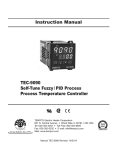
TEC-9100 is a 1/16 DIN size panel mount controller. TEC-7100
is a 72×72 DIN size panel mount controller. TEC-8100 is a 1/8
DIN size panel mount controller and TEC-4100 is a 1/4 DIN size
panel mount controller. These units are powered by 11–26 or 90–
250 VDC/VAC 50/60 Hz supply, incorporating a 2 amp control
relay output as standard. The second output can be used as a cooling control or an alarm. Both outputs can select triac, 5V logic
output, linear current, or linear voltage to drive an external device.
There are six types of alarm plus a dwell timer that can be configured for the third output. The units are fully programmable for
PT100 RTD and thermocouple types J, K, T, E, B, R, S, N, and L
with no need to modify the unit. The input signal is digitized by
using an 18-bit A to D converter. Its fast sampling rate allows the
1–1 General
unit to control fast processes.
Digital communications RS-485 or RS-232 (excluding TEC7100) are available as an additional option. These options allow
the units to be integrated with supervisory control systems and
software.
A programming port is available for automatic configuration, calibration, and testing without the need to access the keys on the
front panel.
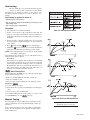
By using proprietary Fuzzy modified PID technology, the control
loop will minimize overshoot and undershoot in a short time. The
following diagram is a comparison of results with and without
Fuzzy technology.
Figure 1.1 Fuzzy Control Advantage
This series is manufactured with custom
designed ASIC (Application Specific Integrated Circuit) technology which contains an 18-bit A to D converter for high
resolution measurement (true 0.1°F resolution for thermocouple and PT100) and a
15-bit D to A converter for linear current
or voltage control output. The ASIC technology provides improved operating performance, low cost, enhanced reliability
and higher density.
High accuracy
The sampling rate of the input A to D converter is 5 times/second. The fast sampling
rate allows this series to control fast
processes.
Fast sampling rate
The function of Fuzzy control is to adjust
PID parameters from time to time in order
to make manipulation of the output value
more flexible and adaptive to various
processes. The result is to enable a process
to reach a predetermined set point in the
shortest time, with the minimum of overshoot and undershoot during power-up or
external load disturbance.
Fuzzy control
The units are equipped with an optional
RS-485 or RS-232 interface cards to provide digital communication. By using
twisted pair wires, up to 247 units can be
connected together via RS-485 interface
to a host computer.
Digital communication
A programming port can be used to connect the unit to a PC for quick configuration. It also can be connected to an ATE
system for automatic testing and calibration.
Programming port
The auto-tune function allows the user to
simplify initial setup for a new system. An
advanced algorithm is used to obtain an
optimal set of control parameters for the
process, and it can be applied either as the
process is warming up (cold start) or when
the process is in a steady state (warm
start).
Auto-tune
Depending on security requirements, one
of four lockout levels can be selected to
prevent the unit from being changed without permission.
Lockout protection
Bumpless transfer allows the controller to
continue to control if the sensor breaks by
using its previous value. Hence, the
process can be controlled temporarily as
if the sensor is normal.
Bumpless transfer
The ramping function is performed during
power up as well as any time the set point
is changed. It can be ramping up or ramping down. The process value will reach the
set point at a predetermined constant rate.
Soft-start ramp
A first order low pass filter with a programmable time constant is used to improve the stability of the process value.
This is particularly useful in certain applications where the process value is too unstable to be read.
Digital filter
The units have the flexibility to allow the
user to select those parameters which are
most significant to him and put these parameters in the front of the display sequence. Up to eight parameters can be
selected to allow the user to build his own
display sequence.
SEL function
Page 3 of 12