1
MCNPX User’s Manual
Version 2.4.0, September, 2002
LA-CP-02-408
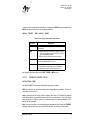
5.7.22.1 Setting up the Mesh in the INP File
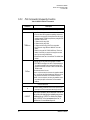
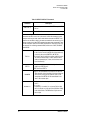
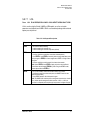
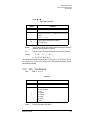
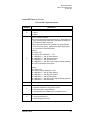
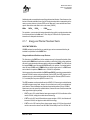
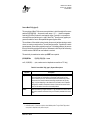
A mesh tally is defined by several cards which are described below. All of the control cards
for mesh tallies must be in a block preceded by a card containing the word tmesh in the
first five columns, and terminated by a card containing the word endmd in the first five columns. For each mesh tally card, the following set of cards must be present which give
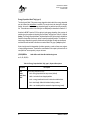
details on the mesh characteristics:
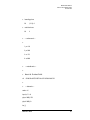
CORAn
CORBn
CORCn
corra(n,1), corra(n,2), ... corra(n,N)
corrb(n,1), corrb(n,2), ... corrb(n,N)
corrc(n,1), corrc(n,2), ... corrc(n,N)
where the CORAn, CORBn, and CORCn, cards are used to describe the three coordinates as defined by the mesh type (rectangular, cylindrical or spherical), prior to any trans
transformation.
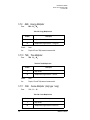
In the case of rectangular meshes, CORAn represent planes perpendicular to the x-axis,
CORBn are planes perpendicular to the y-axis, and CORCn are planes perpendicular to
the z-axis. Bins do not have to be equally spaced.
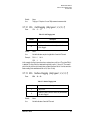
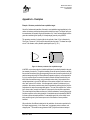
In the case of the cylindrical mesh, the middle coordinate, CORBn, is the untransformed
z-axis, which is the symmetry axis of the cylinder, with radial meshes defined in the
CORAn input line. The first smallest radius may be equal to zero. The values following
CORBn define planes perpendicular to the untransformed z-axis. The values following
CORCn are positive angles relative to a counter-clockwise rotation about the untransformed z-axis. These angles, in degrees, are measured from the positive x-axis and must
have at least one entry of 360, which is also required to be the last entry. The lower limit
of zero degrees is implicit and never appears on the CORCn card.
In the case of spherical meshes, scoring will happen within a spherical volume, and can
also be further defined to fall within a conical section defined by a polar angle (relative to
the +z axis) and azimuthal angle. CORAn is the radius of the sphere, CORBn is the polar
angle and CORCn is the same as in the cylindrical case. It is helpful in setting up spherical
problems to think of the longitude-latitude coordinates on a globe.
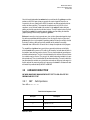
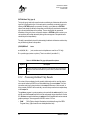
The original capability of MCNP involving the “i” option is retained, allowing a large number
of regularly spaced mesh points to be defined with a minimum of entries on the coordinate
lines. All of the coordinate entries must be monotonically increasing for the tally mesh features to work properly, but do not need to be equally spaced. It should be noted that the
size of these meshes scales with the product of the number of entries for the three coordinates. Machine memory could become a problem for very large meshes with fine
spacing.
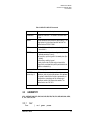
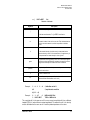
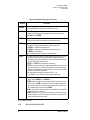
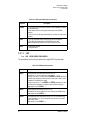
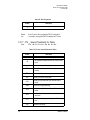
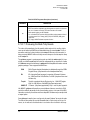
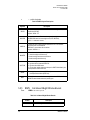
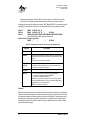
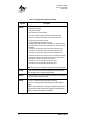
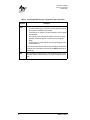
Additional cards which can be used with Mesh Tallies are:
ERGSHn
144
E1 E2
MCNPX User’s Manual