1
•
•
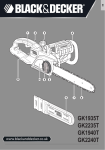
Bumper guard to protect the motor housing
Tool kit for corrective and preventative
maintenance.
OPERATOR SAFETY
Using a chainsaw is physically demanding and
requires concentration and attention to your
surroundings. Learning how to start, transport, cut,
and maintain a chainsaw is essential for personal
safety. Wear the right personal protection
equipment, check your surroundings, and anticipate
what will happen when trees and limbs are cut
down. Establish an escape route from falling
timber. Maintain a sharp chain and kickback guard.
Personal Protective Equipment
More than 80 percent of all chainsaw accidents
injure the hands, legs, knees and feet. Dress with
the appropriate protection to significantly reduce the
risk of injury. For maximum protection, wear cuffless pants and long-sleeve shirts, steel-toe boots
with non-slip soles, fitted gloves, a hardhat, eye
protection, and hearing protection. Safety chaps
made of ballistic nylon or Kevlar are designed to
slow or stop the chain if it strikes your leg.
Starting a Chainsaw
Many accidents occur from unsafe starting
practices. To start a chainsaw safely, place the
chainsaw on a level surface. Make sure the chain
is clear of debris. Apply the chain brake. Hold the
rear handle down with the right foot and secure the
front handle with the left hand. Pull the starter core
with the right hand.
Never “drop-start” a chainsaw (i.e., hold onto the
starter cord with the right hand while forcing the
chainsaw towards the ground). This is extremely
dangerous to you and to others in the vicinity.
Maintenance
One aspect of chainsaw safety is to check that it is
in good condition. Before and after using the
chainsaw, check the saw for loose, damaged, or
broken parts. Check the chain bar for dents, warps,
and other damage. Make sure the chain is sharp
and set at the proper tension, and check the
condition of guards and shields. Test the chain
brake periodically, and make sure the chain does
not move at idle speed.
Preparation for Work
Before starting work, remove any broken or dead
limbs that could fall from the tree. Watch for trees
with tension that could spring when cut. Clear any
underbrush from around the tree that might be
struck by the chainsaw and cause it to kick back.
Make sure there are no bystanders, animals, cars,
buildings, or power lines that may be struck by the
falling tree. Clear an escape path 45 degrees to the
rear of the tree fall line. Locate the best direction
for the tree to fall, and plan your cut accordingly.
Rain, snow, or high wind conditions increase the
risk of accidents. Rain results in poor footing.
Snow may accumulate in the trees and make it
difficult to locate the tree’s center of gravity. Trees
with thick canopies can be redirected by high winds.
Felling, Limbing and Bucking
Many chainsaw accidents
can be avoided using safe
felling, limbing, and bucking
techniques. Felling is the act
of cutting down trees.
Limbing is the act of
removing limbs from the main
trunk. Bucking is the act of
cutting felled trees into
smaller pieces for removal
and transport.
Small trees less than six
inches caliper (diameter) may
be cut all the way through
with one cut. However, larger
trees should be cut using a
front-cut and back-cut to
establish a notch and hinge
to control the tree’s line of
fall.
Three common cutting
patterns, Conventional,
Humboldt, and open face, are
shown here. These
techniques will greatly reduce
the need to stay near the tree
to physically guide the
direction of the fall. Do not
try to cut down a tree with
caliper greater than the
length of the chainsaw guide
bar. This will increase the
risk of kickback injury.