1
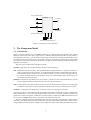
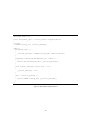
Facets (provided Interfaces)
Component
Event Sinks
Event Sources
Receptacles (used Interfaces)
Attributes and supported Interfaces
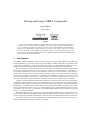
Figure 1: External view of a Component
2 The Component Model
2.1 Introduction
Figure 1 shows the external view of a CORBA Component. A component may have attributes, may support
interfaces, and may have any of five types of ports. Attributes and supported interfaces can be used by a
client application as before - you can think of “supporting” an interface as inheriting of that interface. Ports
are used to express the connectivity of a component. Lateron, an Assembly tool may be used to interconnect
ports between components, resulting in the assembly of applications from existing components rather than
application development.
The port types are reflected by their IDL keywords:
provides Components can provide interfaces, which are also called facets.
uses Components can use interfaces. This documents that a component wants, or requires, a reference to
another component in order to operate. An example might be an Editor component that uses a Printer.
Used interfaces are also called receptacles. There are simplex receptacles, where the component can
use at most one object reference, and multiplex receptacles, where multiple object references can be
connected to the same receptacle.
publishes Components can publish events (event source). Clients (or other components that act as client
to this component) can then subscribe to the event as in the Event Service.
emits Components can also emit events (also an event source). While publishes implies a 1:n relationship
in which the event is sent to many subscribers, emitted events can only be received by one listener.
consumes A component can declare that it consumes events of a certain type (event sink).
Note that ports do not really offer features that wouldn’t have been possible with “classic” CORBA operations and attributes – you could easily design interfaces that have e.g. readonly attributes for facets and
operations to connect receptacles. Technically, in terms of object orientation, CORBA Components are not
an extension of CORBA objects but they are rather a specialization of objects.
However, components embrace a different point of view by explicitly expressing the connections that
they offer to the outside world, and what connections they expect the outside world to offer to them. This is
a huge difference to the concept of CORBA servers, which was mostly concerned with standalone services.
2